~oOo~

2014-01-31

cfp: religion and fat

This call for papers came across my desk this morning and sounds fascinating! Please, someone who reads my blog be doing research in this area (or know someone who is!). Because SO VERY COOL.

~Anna

CFP—Special Issue of Fat Studies: An Interdisciplinary Journal of Body Weight and Society on Religion and Fat, guest edited by Lynne Gerber, Susan Hill and LeRhonda Manigault-Bryant. 

This special issue of Fat Studies: An Interdisciplinary Journal of Body Weight and Society explores the relationship between religion and fat. The editors invite papers on a variety of topics that address, for example, how particular religious traditions engage the fat body, or how religions define, circumscribe and/or understand fatness. We seek to answer questions such as: How is the fat body read in religious ways? What kinds of socio-cultural spaces do religions offer fat people? 

Potential topics might include, but are not limited to:

  • Fat bodies as religious bodies
  • The use of fat or fatness in religious texts
  • Use of fat in theological discourse
  • Fat in world religions
  • Religious and/or moral dimensions of fat or fatness in popular culture
  • Fat bodies and lived religion
  • Religion and weight loss/weight gain
  • The fat body as moral or immoral body in religious texts or objects
To be considered for inclusion in this special issue, please send a 200-250 word abstract and a current c.v. to Susan Hill (susan.hill@uni.edu) by March 31, 2014. 

Any questions about the topic can be directed to this e-mail, as well. Final submissions should be between 3000-6000 words, including all notes and references. If you wish to include reproductions of visual images with your essay, you will need to receive permission to do so from the artists/copyright holders of the image(s). All authors will need to sign a form that transfers copyright of their article to the publisher, Taylor & Francis/Routledge. 

Fat Studies is the first academic journal in the field of scholarship that critically examines theory, research, practices, and programs related to body weight and appearance. Content includes original research and overviews exploring the intersection of gender, race/ethnicity, sexuality, age, ability, and socioeconomic status. Articles critically examine representations of fat in health and medical sciences, the Health at Every Size model, the pharmaceutical industry, psychology, sociology, cultural studies, legal issues, literature, pedagogy, art, theater, popular culture, media studies, and activism. 

Fat Studies is an interdisciplinary, international field of scholarship that critically examines societal attitudes and practices about body weight and appearance. Fat Studies advocates equality for all people regardless of body size. It explores the way fat people are oppressed, the reasons why, who benefits from that oppression and how to liberate fat people from oppression. Fat Studies seeks to challenge and remove the negative associations that society has about fat and the fat body. It regards weight, like height, as a human characteristic that varies widely across any population. Fat Studies is similar to academic disciplines that focus on race, ethnicity, gender, or age.

2014-01-28

'abiyoyo': in memory of pete seeger

I woke up this morning to the news that Pete Seeger had passed away at the age of 94. As a child of the 1980s, Pete Seeger was one of the musicians of my childhood. In his memory, here is a performance of the story-song Abiyoyo from another cultural artifact of my childhood, "Reading Rainbow".


I hope generations upon generations of children to come grow up enjoying Seeger's music ... and learning the often-radical messages within the stories he tells.

2014-01-27

subject/verdict: stuff I've been reading in two-sentence reviews [no. 5]


Here's a peek at the books I read between mid-November and the end of the year. Exceeding my own expectations of finishing 2013 roughly 10% short of my goal of reading 104 books (two books per week), I actually came in at 102 by midnight on December 31st. Thanks to the polar vortex, I've started this year's challenge at a good clip -- more on the ones I haven't yet reviewed in March.

In the meantime, to wrap the previous year's reads, here are a handful of noteworthy titles (in alphabetical order by author).

Bronski, Michael. A Queer History of the United States (Beacon Press, 2011). Drawing upon several generations of historical scholarship on LGBT and queer history, Bronski traces the lives and experiences of queer Americans from early Euro-colonial history to the present. One of the things I particularly appreciated about his narrative is that it is not solely focused on sexual experiences or on the lives of high-profile non-straight and non-gender-conforming people -- rather, it seeks to approach a broader view of American experience through a queer lens.

Cain, Susan. Quiet: The Power of Introverts in a World That Can't Stop Talking (Crown, 2012). Cain's work is a strong analysis of modern American culture as one which favors the strengths of a certain type of personality (here labeled "extroverted) and denigrates many of the strengths of another ("introverts"). Quiet is a good reminder to those of us who favor the quiet life to feel no guilt about working to organize our lives and spaces to play to our strengths.

DiCamillo, Kate and K.G. Campbell. Flora and Ulysses (Candlewick Press, 2013). I don't read as many middle grade & young adult novels as I used to when I was working in a trade bookstore (for shame), but happily a friend of mine has a seven-year-old son who is a voracious reader, and buying this novel for him prompted Hanna and I to read it -- and purchase a copy of our own! A delightful, if somewhat surreal, tale of a comic-loving girl, a poetry-writing squirrel, an errant vacuum cleaner, and a cast of family and friends.

Didion, Joan. The Year of Magical Thinking (Vintage, 2007). Didion's memoir about the sudden death of her husband received much well-deserved press for its finely-tuned analysis of the process of trauma and grief. What struck me most about Magical Thinking was Didion's internal conviction that death was something to be prevented and thus possibly, if the right combination of actions were performed, reversible.

Fadiman, Anne. At Large and At Small: Familiar Essays (Fararr, Straus, and Giroux, 2007). A dear friend of mine gave me this collection of essays as a present about five years ago, and I confess I only just this December got around to the act of reading them: they did not suffer for the wait! Fadiman is a master of creative nonfiction and her essays on everything from insect collecting to polar exploration, Charles Lamb to 9/11 to the joys of ice cream gave me pleasure to read and a yen to write deliberately once more.

Glaesser, Edward. Triumph of the City: How Our Greatest Invention Makes Us Richer, Smarter, Greener, Healthier, and Happier (Penguin, 2011). Glaesser makes a compelling, if slightly glossy argument in favor of dense urban centers as catalysts for creativity and an energy-efficient way to house the world's population. While I agree with much of his argument, I do wish he had been more thoughtful in addressing how the needs of those for whom human density is a struggle will be met in a pro-urban future.

Hodges, Jane. Rent vs. Own: A Real Estate Reality Check for Navigating Booms, Busts, and Bad Advice (Chronicle Books, 2012). As Hanna and I dive into apartment-hunting this year, I borrowed this slim-yet-packed little volume from our local library. Hodges provides an excellent overview of the pros and cons of both renting and buying one's place of residency and when the time came to return this one to the library shelves I felt a lot more equipped to think about options than I had before I borrowed it! (P.S. She also has an excellent "further reading" list.)

Kimmel, Michael. Angry White Men: American Masculinity at the End of an Era (Nation Books, 2013). I'll admit that I read this book mostly because if you're in any field that touches on masculinity studies, Kimmel is someone whose work you need to be familiar with (full disclosure: I had a lovely lunch with him once, as an undergrad, when he was a speaker at our campus). AWM explores the perspective of the titular angry white dude whose sense of aggrieved entitlement is familiar to all who spend time on the internet; it provides little fresh insight to those familiar with the issues at hand, but does bring good research to the table for us to mull over in the years to come.

Liptak, Adam. To Have and Uphold: The Supreme Court and the Battle for Same-Sex Marriage (New York Times, 2013). This brief e-publication is an excellent summary, with some analysis, of last year's two same-sex marriage cases argued and decided before the Supreme Court. As someone who followed the cases fairly closely at the time, I can't say I learned a whole lot that was new -- but am still glad to know this source is out there in the event I need to refer back for details.

Mitchell, John Hanson. The Paradise of All These Parts: A Natural History of Boston (Beacon Press, 2008). A dollar-cart find, Mitchell's "natural history of Boston" is more familiar essay than scholarly history, with few source notes and a conversational style. Nonetheless, I found it a pleasure to read -- perhaps only in the way one can when a book charts the landscape which one navigates on a daily basis.

Morris, Theresa. Cut It Out: The C-Section Epidemic in America (New York University Press, 2013). The latest in a growing list of texts critiquing the American way of birth, Morris' insightful analysis of the c-section epidemic in the United States draws on qualitative interviews with parents who had just given birth, nurses, midwives, and doctors to argue that neither pregnant women nor medical staff are to blame for the trend. Rather, she convincingly asserts, institutional cultures and the insurance industry push hospitals to define risk in terms of risk-of-lawsuit rather than risk-to-patients, leading to a deeply concerning trend away from centering best practices on the health and wellbeing of the pregnant parent and infant themselves.

Walker, Lisa. Looking Like What You Are: Sexual Style, Race, and Lesbian Identity (New York University Press, 2001). Recommended by a friend, I found this a useful exploration of what it has meant in the late twentieth, early twenty-first century to perform lesbian identity visually and bodily -- Walker asks us to think about who is recognized (and trusted) as a lesbian, and why. As someone who has walked both sides of the queer-coded line (people have been both surprised I'm queer and told my parents they'd known all along [how could they when I didn't myself, right??]) I found this a thoughtful reflection on the boxes we attempt to put people into, and how human diversity defies such categorization.

And for a sneak peek at what I've been reading this year, you can always find my current bookshelf in "real time" and my complete year-to-date list at the GoodReads 2014 reading challenge.

What's on your (reading) plate this year?

2014-01-20

booknotes: 'bi' and 'a woman like that'

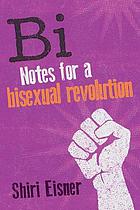
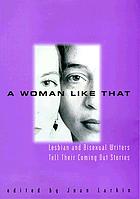
While we were snowbound in Michigan, I had time to do quite a bit of reading. Two of the titles I read were A Woman Like That: Lesbian and Bisexual Women Tell Their Coming Out Stories edited by Joan Larkin (Avon Books, 1999) and Bi: Notes for a Bisexual Revolution by Shiri Eisner (Seal Press, 2013). Separated by nearly fifteen years, and written for very different purposes, yet grappling with similar subject matter, it was interesting to read them back to back.

A Woman Like That is -- at the subtitle implies -- an anthology of personal essays by queer women describing their experiences of coming-to-awareness of their sexual selves. "Coming out" is a term we typically use for the process by which we (non-straight) people make public the shape of our sexual desires. While mainstream narratives generally pin-point a singular event ("When did you come out?") what most of the essays in A Woman Like That make clear -- and what most in the queer community already know -- is that to come out is a verb, a process, and myriad. Reading these pieces challenged me to consider my own narrative of sexual awakening, and asked me to consider how I would organize it biographically. Does one begin with romantic/passionate friendships in childhood? With the acquired vocabulary that allows you to name yourself, or proscribes that ability (more on this below)? With a sexual debut? The first time you employed the word (bisexual lesbian dyke queer) to describe yourself to a (parent friend lover colleague medical professional) or on (on a form the internet) or in (an academic essay a job interview a survey response)?

The women in A Woman Like That, whose essays are arranged roughly chronologically featuring stories from the 1950s to the 1990s, use a variety of these definitions of "coming out," often in combination. They describe childhood passions, first crushes, sexual initiations (good, not-so-good, violently non-consensual). They describe always knowing and coming to their realization later in life. They write a lot about the pain of living queer in an anti-gay world: of "reparative" therapies, of drugs, of physical abuse, of children taken away, of ruptured relationships, of fear and self-loathing. One of the things that startled me, in fact, and bogged me down in the reading, is how grim so many of these women's narratives were. Hanna and I joked, as I kept reading her excerpts, that it should have been titled "The Unhappy Dyke Book."

Still, as I said, the book made me think about the shape of my own story: the intense romantic friendships (same- and other-sexed); the inability to discern erotic from platonic attractions by gender in adolescence (I was told by multiple people "you'll know" ... what it turned out "I knew" was that gender was not a salient factor for me!); the internalized biphobia that caused me to de-legitimize my same-sex longings as invalid data; the sexual debut(s); the transition into a relationship, the describing of that relationship; the (mostly unruffled) reactions of people who found out I was dating a woman; the experience of getting married in a state where same-sex marriage is legally recognized.

Shiri Eisner, author of Bi would probably frown upon my brand of bisexuality. For one thing, I'm an "assimilationist" bisexual, perpetuating my own erasure by playing nice with the mainstream LGBT (or "GGGG") movement, by often using language like "lesbian" to describe myself (even though I am, in fact, bi), and by marrying Hanna ("even if one particular marital arrangement doesn't include any form of direct violence, marriage still constitutes symbolic violence against women in and of itself"). Bi: Notes for a Bisexual Revolution challenges those of us with bisexual desires and identities to push for an end to bisexual invisibility, and to recognize the radical challenge the organization of our sexual desires pose for the sex, gender, and sexual hierarchy of what Eisner refers to as minority-world culture (more commonly known as Western culture).

In eight chapters, Eisner explores what bisexuality is, how monosexism and biphobia work, bisexuality and the concept of "passing" and social privilege, and the intersection of bisexuality and feminism, trans* activism, racialization, and the mainstream gay movement. Overall, despite the fact that I suspect Eisner would take away my bisexuality card if she could, I thoroughly enjoyed this book. It's accessibly written, deeply researched (I'm already mining its bibliography for further reading), and thoughtfully inclusive of many different peoples and communities.

At times I felt like the apparatus of inclusivity was top-heavy and slightly arbitrary. For example, Eisner had a habit of identifying authors' nationalities which didn't always seem any more relevant to the meaning of their work than, say, their marital status, or whether they were parents. Still, I think probably over-articulating subjectivity is probably better than assuming objectivity or universal applicability. The other stylistic challenge of the "big tent" work Eisner is attempting to write is the way the text sometimes got bogged down in enumerations of what could not be discussed, whom the next statements would not be relevant for, and whose voices might be in danger of erasure. As with the identity-markers, these provisos sometimes felt like they were undercutting the relevance of the forthcoming passages and/or assuming a readership that would be unable to discern for itself about whom the text was speaking. While I fully appreciate what Eisner was trying to do, I found myself as a reader getting impatient with too much telling and not enough showing ("I know that already! Get to the damn point!"). This is perhaps a personal limitation rather than an authorial flaw.

At the end of the day, I appreciate Bi as a call to stand up for bisexuality as an actual-factual way of being sexual in the world, and one which is not an attempt to cover one's homosexuality or seek to gain heterosexual privilege. As an adolescent and young twentysomething, I needed someone like Eisner to come along and point out to me that my erotic interest in people with male parts and identities did not trump my erotic interest in people with other parts and identities. For too long, I assumed that as a woman who was capable of sexual attraction to men, my only social recourse was a heterosexual relationship.

(Because statistically speaking, in my hometown, what were the odds of finding a woman interested in me. Because lesbians would all hate and be suspicious of me. Because I was sexually inexperienced and too stupid to tell the difference between platonic and erotic interest; once I had sex with a man I'd suddenly realize what made that different from my same-sex romantic friendships. Because "everyone knows" that bisexuality is just a phase and that bisexual women are flakey, indecisive, and deceptive. Because no one believed me when I said I didn't know what orientation I was. Because the default sexual orientation is always straight and monosexual.)

While A Woman Like That would likely only be of interest to people who like to think about the structure of coming-out narratives and about how the material experience of coming out has (and hasn't) changed since the mid-20th century, I'd argue that Bi is absolutely essential reading for anyone who cares about keeping their fingers on the pulse of queer activism. As we look beyond, around, and through the mainstream gay rights issues that have preoccupied the most visible activists and activist organizations in recent years (i.e. as "gay" people become more accepted to the extent that they look and act like hetero, gender-normative folks), we need to remain committed to gender, sex, and sexual diversity beyond the hetero/mono and male/female binaries that obsess Westerners and others across the globe. Bi offers up a robust toolbox of concepts for doing so.

2014-01-15

oh yes, we're home! [a no-photo post]

Hanna and I finally made it back to Boston on an uneventful Saturday-afternoon flight through Cleveland. We sort of didn't believe it was happening until we actually hit the runway at Logan, but yay! We're home.

We think it's probably a good measure of the good fit of our lives currently that even though we both really enjoyed the extended stay with my folks in Holland, we had good feelings about being back in Boston, in our apartment, and back at our respective jobs.

We're playing catch-up this week, for obvious reasons, but my hope for the winter/spring is to have at least one book review-type post up per week, likely on Mondays. For next week, I plan to write a joint review of Shiri Eisner's Bi and the anthology A Woman Like That both of which I read while snowbound in Michigan.

More soon. Meanwhile, enjoy this videosoothing of our new humidifier, which changes colors and baffles the cats!
>

2014-01-10

blizzard of '14: black river books [photo post]

Yesterday, in an attempt to re-boot the vacation we're inadvertently having, Hanna and I took a small road-trip to South Haven, Michigan, to visit a bookshop Hanna found via the Internets.


Black River Books was well-worth the thirty-minute drive down I-196. Our outbound trip was punctuated by a stop at Uncommon Grounds, where we refueled with two French Giana lattes. 

We paused at the cafe's community bulletin board to wistfully gaze at the "for rent" advertisement featuring a three-bedroom house on offer for less than what we pay per month for our one-bedroom in Allston.


South Haven was quiet, still digging out from the beginning of the week.


Sidewalks clearly weren't a top priority.


Hanna and I were the only two customers at the bookstore, which made for leisurely browsing. The shop was clearly set up as a sit-and-read business, complete with coffee urns and comfy chairs.


Like all used bookshops worth their salt, Black River Books had stacks of overflow (neatly labeled!) on the floor and steps-stools for easy book access.


They also had two shop dogs, who snuffled us out upon entry and then curled up in their appointed locations by the shop counter, waiting for snack time.


I have to say that only in West Michigan are you likely to find a religion section subdivided by Christian theologian (and "Jesus" shelves alongside [Philip] Yancey and Matthew Fox).


Though to their credit they also had extensive LGBT and Sexuality sections, as well as separately-shelved erotica, clearly labelled and tucked away above the paperback mysteries.

In the Sexuality section, I was delighted to find a 1972, hardcover and full-color edition of Alex Comfort's The Joy of Sex for which a review post will simply have to be forthcoming. Its loving sketchy drawings of the heterosexual couple enjoying intimacies of various configurations are as delightful as Dr. Comfort's opinions about things such as bisexuality are antiquated.


In any event, if you ever find yourself stuck in West Michigan for ten days longer than you anticipated in the middle of a snow storm, Black River Books is definitely a place we would recommend for a field trip!

2014-01-08

blizzard of '14, day six [an update, with photos]

Today, our flights were re-scheduled for the fifth time in a week -- pushing us out to ten additional days in Michigan! It's wicked wild (as a Bostonian might say) how far the ripple-effect of cancelled flights and serial bad weather can reach.

So it's time for more self-soothing photography!


Playing with reflections on the dining room windows a couple of nights ago brought out some interesting visuals.


The family Christmas tree, mirrored in the glass against the falling snow.


A neighbor's out-door lights as seen across the church parking lot, drifted with snow.


The "brisk" temperatures of the Polar Votex brought in some gorgeous frost on my parents' windowpanes. This was yesterday's patterning on our bedroom window.


This morning, a strange globe of light appeared in the sky for a short portion of the morning. We took the opportunity to go out on a few needed errands: emergency prescription refills at Model Drug pharmacy, emergency coffee at lemonjello's, emergency trip to Herrick District Library for books.


Shoveling has become a bit daunting.


We've been so grateful for lemonjello's caffeination and gluten-free muffins!


The fierce wind and cold temperatures have conspired to create some fascinating snow sculptures along the eves of many buildings.


When I got off the phone with United this afternoon, first I spent a few moments pounding my fists on the floor in frustration. Then Hanna and I decided an emergency trip to the library was in order.


Because where do two snowbound librarians find peace, except in the stacks?


I like the way the children's room decorates ...


... and, perhaps more importantly, attends to the nutritional needs of its young readers!


On our walk home, Hanna snapped a few wintery pictures as the snow, once again, began to fall.


This has been another update from the Clutterbuck-Cook family adventure of January 2014! We hope all of you continue to be well.