~oOo~
Showing posts with label memoir. Show all posts

2013-09-25

booknotes: my brother, my sister

Molly Haskell at a book signing for
My Brother, My Sister (via)
Just before leaving on vacation, I was asked to review the new memoir My Brother, My Sister: A Story of Transformation by Molly Haskell (Houghton Mifflin, 2013). I spent the flight from Boston to PDX reading ... and taking increasingly irritated notes. While I didn't actively seek out this book to review, I had slightly higher hopes for a memoir that promised in its ad copy to be a "candid" and self-critical memoir by a "feminist academic" who not only seeks to describe her own journey to understanding but also to "chart the cultural map ... of gender roles and transsexualism." I had hopes for a memoir that evidenced both better understanding of the trans issues its author attempts to outline for readers -- one that hadn't fallen into some of the most basic traps of our problematic cultural narratives about trans lives.

Part of my disappointment comes from the fact that cis* family members and friends of trans individuals often struggle to get up to speed on trans issues after a loved one opens up about their experience -- and there is a need for personal narratives by individuals who have struggled through ignorance and misconception into better understanding. Such stories don't need to paper over the messy reality of feeling that often accompanies such a journey. I have a friend whose spouse came to the realization of their transness within the last two years, and as a partner my friend struggled with many of the same feelings a major life change will bring: grief over the loss of "before," fear about what the future will bring, uncertainty about what this change meant for their relationship and family life, sometimes anger at their spouse for being at the epicenter of this upheaval -- and for mostly not sharing in the grieving process. Like many trans individuals, the partner was mostly elated and relieved to be finally bringing their self-presentation into alignment with their interior self: to no longer be living a dissonant life. To my friend, whose emotions were much more ambivalent, it often felt like there was no safe or sanctioned place to process their complexity of feeling. With economic barriers to therapy and other social supports often prohibitively high, books like Transitions of the Heart (written by parents of trans and gender-nonconforming children) can help mitigate what could otherwise be intense isolation.

My Brother, My Sister could have been an addition to this small but growing literary offerings. In my estimation, it was not.

Let's begin with the most basic trap of all, the way the memoir's narrative is structured around and saturated in the physical aspects of transition, most particularly fixated on gender confirmation surgery and Haskell's assessment of how well or appropriately she believes her sister is presenting as a woman. While acknowledging that authors sometimes have little control over book jacket design, the plain red cover with a youthful photograph of Ellen "before" and a current "after" photograph invites the reader to center Ellen's appearance and physical transition rather than Haskell's experience as the cisgendered sister having to assimilate her sibling's late-in-life changes. A set of photographs at the center of the volume likewise foreground the "before" and "after" images.

As authors like Julia Serano and S. Bear Bergman have pointed out, the narrative of "passing" places the onus on a trans person to conform to the world's high expectations of gendered behavior rather than demanding that the world accept a person's self identification regardless of presentation. A trans person -- just like any of us -- may be a butch or lipstick lesbian, a twink or a jock, a sorority girl or tomboy. Bodies come in all shapes and sizes, and sartorial taste ranges across a field of more-gendered and less-gendered style choices. Historically, we (the public) have required a high level of stereotypical gender performance from trans women -- at the same time as we (feminists) blame trans people for perpetuating sexism through that same exploration of femininity.**  Haskell perpetuates this scrutiny by making physical transformation the benchmark of transition, and by dwelling on the surgeries, the clothing choices, the gender-coded vocal and physical mannerisms, and other aspects of her sister's self-presentation.

While her sister's pleasures and anxieties around offering up her newly-visible self to the world are understandably preoccupying, Haskell's perspective is more often one of harsh judgment than it is attempt to follow where her sister leads. She frets that her sister will be unattractive, considers her clothing choices to slutty, and considers anyone who can't or is unwilling to fit into her neat categories of gender to be somehow at fault. For example, she writes of a trans woman her sister knows, "One man, though convinced he's a she, refuses to do anything to alter his rough male appearance" (158). As if this "refusal" to care about her appearance somehow invalidates the woman's self-articulated gender identity. She also offers unsolicited opinions on the femininity of other high-profile trans women:
From photographs, Jennifer [Finney Boylan], being younger and more typically feminine, seems to have made an attractive looking female, while [Jan] Morris by most accounts, before settling into dignified-dowdy, went through a grotesquely awkward wannabe-girl period (122). 
I scribbled in the margins “seriously. out. of. line. judgy.”

When Ellen visits Haskell after a period of cloistered transformation, Haskell nervously invites friends over and then grills them afterward on Ellen's ability to perform femininity: "The verdict ... she's very convincing. I said the hair's too blond, and Lily and Patty agree, the hair is too blond, but they're surprised at how good she looks" (146).

I think possibly a large part of my irritation is that I couldn't find Molly Haskell very likable, as a sister or as a feminist. She's critical of other women's appearances, ageist towards both the old (women who might be unable to catch a man) and the young (who are too slutty in appearance and too casual about identity), and hews close to gender expectations. One of her first reactions to her sister's coming out as trans is to fear that the tech- and number-savvy brother she relied on will no longer be good at computer repair or math. While she sidles up to the notion that this first reaction was unfounded, she never demonstrates for her readers that she has since come to revise her binary thinking when it comes to girl brains and boy brains.

At what might be a low point of the book, she even suggests that Brandon Teena, the trans man who was the subject of the biopic Boys Don’t Cry somehow “asked for it” by dressing in clothing appropriate to his gender and not disclosing his trans status:
Yes, the yahoos were uptight and murderous, but she in some sense invited the violence by taunting their manhood, pulling the wool over their eyes, and acting in bad faith (106). 
Yes, she willfully mis-genders him. To fall back on the trope of the deceptive transsexual (who supposedly invites violence through the act of passing) in a throwaway comment, in a book pitching itself as one about understanding trans lives, seems to me a fairly basic mis-step that, again, both Ms. Haskell and her editor should have caught before the manuscript went to press. That they did not suggests neither understood how problematic it was.

Which in turn calls the entire project into question, at least as far as its worth as a positive contribution to trans literature goes.

At the end of the day, I am glad that Molly and her sister have remained in good relationship, and I am glad that Molly gained more understanding of trans experience and trans history than she had when her sister first came out to Molly and her husband. I imagine that, at the end of the day, there are far worse reactions to have had from one’s family upon coming out trans (see: transgender remembrance day). Yet I also wish that Haskell had let her own learning process cook a bit longer before publishing a book on the subject. As it stands, My Brother, My Sister is a tepid-at-best, damaging-at-worst popular memoir that does little to invite a more complex understanding of trans people or sex and gender identity more broadly. I expected better from a self-identified feminist author, although I’m sure trans feminists would laugh at my (cis-privileged) wishful thinking.
For those interested in learning more about trans lives, I would recommend The Lives of Transgender People by Genny Beemyn and Susan Rankin, Whipping Girl by Julia Serano -- who has also just published a book on trans-inclusive feminism that I can't wait to get my hands on -- and also Anne Fausto-Sterling's excellent Sexing the Body.

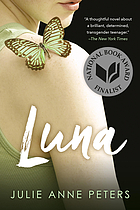
Luna, a young adult novel by Julie Ann Peters, is also an intimate fictional portrait of a sister coming to terms with her siblings trans identity.


*Cis or cissexual refers to individuals whose gender assigned at birth (usually based on external sex characteristics) matches their internal sense of their own physiological sex and gender identity.

 **Trans men have, historically, had a very different socio-political experience within both mainstream culture (where they are often rendered invisible) and mainstream feminism (where they are more often embraced while trans women are actively marginalized).

2012-11-17

booknotes: book of mormon girl

I rarely have the time these days to invest in comment threads on blogs, though I skim hundreds of RSS-scraped posts every day via Google Reader. Yet over the past few months, I've spent quite a bit of time over at the Family Scholars blog, engaging with socially conservative bloggers and commenters about issues such marriage equality and queer family formation.

I actually find the practice almost ... soothing.

Hanna, meanwhile, is mystified about my motivations, since just having me describe some of the interactions I have there ramps up her anxiety and stress levels to uncomfortable proportions. And I find I don't have very articulate reasons for why I find arguing with the opposition -- bearing witness, speaking up for my point of view -- to be an almost meditative practice.

Except that, growing up and going to college where I did, it's what I've had to do by default most of my life. So it's what feels comfortable, feels familiar: standing on the edges knocking politely on the door to remind those on the inside (of the mainstream culture, church, school, whatever) that I'm still here.

I don't necessarily want to be let in? It's a nice world, in many ways, where I am out here. I've always been a fan of fresh air and expansive horizons.

But I don't want them to forget that I'm out here.

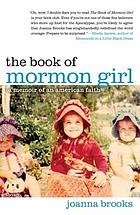
Another aspect of my insistence on being a complicating presence came home to me while I was reading Joanna Brooks' Book of Mormon Girl (Free Press, 2012) this past week. It had been on my radar for awhile, but what prompted me to read it was an email from a friend of mine, a former member of the LDS church, who has walked away from the faith in his adulthood for a variety of reasons not the least of which is the fact that he's gay and the Mormon church is not all that cool -- at least at an institutional level -- with queerness. He'd found the book a disorienting read, he reported to me, because while he's quit the church entirely Brooks continues to struggle mightily with her inherited faith and childhood experience, and the betrayal of the community she once felt safe within when she stepped outside the bounds of orthodoxy (as an outspoken Mormon feminist, queer ally married to a Jewish man). Why did she continue to fight to belong in a church that clearly pushed her away, hard, with both hands?

It's a stubbornness I recognize, though I wasn't actually raised in the church (Mormon or otherwise). The faith of my heritage was loosely Protestant, my father the son of a New Testament theologian, my mother the mostly unchurched daughter of a Christian Scientist and disbelieving Scotch Presbyterian. In my adolescence, we attended a liberal Dutch protestant church (a denomination in the Reformed Church in America) for a handful of years where I argued passionately with Conservative youth leaders from my position as a nascent feminist and tried to envision the Church as a pathway to effectively channel my welling passion for social justice.

Then I went to college and discovered feminist theology which offered (though I didn't have these words at the time) a way of thought and action that was both intersectional and spiritual: a faith of uncompromising social justice, nonviolent action, solidarity, and equality: each and every one of us is a child of God. Full worthy to be loved and capable of loving.

It's a theology that I, unchurched though I am, continue to strive for in the spiritual practice of daily living.

And it felt like a theology that many religious folk around me were uninterested in pursuing.

I've said before, and I'll repeat it here, that I found my Christianity and left the church in more or less the same breath.

I saw what Christianity could be and is, at its best and brightest, and in my adolescent impatience had no time for those preoccupied with orthodoxy at the expense of lovingkindness. Lacking the deep roots of religious history, community, family, and faith that ties women like Joanna Brooks to the church -- and I know many of them, ardent feminist thinkers, queers, social justice workers, all fighting past the burnout to build a Church I would be proud to call mine -- I up and quit and walked away.

But in part because of the women (and I know there are men, too, but it's the women I think of in these moments, the ones who stand up and refuse not to be counted) I keep circling back. I keep tapping on the door, poking my head in, and reminding folks that my life, too, is relevant to the conversation: You're talking about the welfare state? I might be financially secure right now, but I've had state-subsidized healthcare. You're talking about male headship? Let me talk to you about sex, gender, and humanity. You're talking about same-sex marriage? Let me introduce you to my wife, our two cats, and quotidian details of our lives.You're talking about war? Let's talk about the history of religious nonviolence.

My mother has always said that she won't join any church that constructs an "us" from which a "them" is excluded, kept at arms length, on the outside. Which is why, to this day, she remains unbaptized (and why none of us children were baptized), and certainly informs my own decision not to seek church membership.

But I keep tapping at the door. I keep having the conversations. I want to bear witness (imperfect, broken, human, though I am) to the fact that we could do better and that I know there are those working mightily within the Church, as well as without, to make it so.

Hmm. The plan was to write a book review, but clearly I had other things to say. Still: Book of Mormon Girl is sweet, funny, heartbreaking, thoughtful, and passionate. As a queer American I found the chapter on Proposition 8 particularly painful to read; as a woman who came of age about 5-10 years after Brooks, I found her chapter on feminism and faith, and the trauma of the LDS purges in the 90s (when the hierarchy excommunicated a number of liberal intellectuals and activists, and declared feminists, gays, and lesbians the "enemy") to be particularly resonant. As an historian with an interest in the personal journeys of those who grow up in fundamentalist, evangelical circles, Brooks' narrative was of scholarly interest to me as well. I highly recommend it to anyone who wants to think more deeply about what it means to be a politically and socially progressive person in the context of a reactionary religion.

2012-11-01

booknotes: ethics, politics, sex, and death

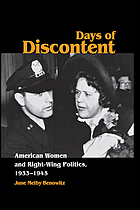
Benowitz, June Melby. Days of Discontent: American Women and Right-Wing Politics, 1933-1945 (Northern Illinois University Press, 2012). Days is positioned at the intersection of two growing fields: the history of conservative and right-wing grassroots political activism and the political activities of women between the passage of the 19th amendment in 1920 and the return to domesticity in the postwar Fifties (followed by the well known "second wave" of feminist activism in the Sixties). Benowitz surveys the activities of right-wing organizers Elizabeth Dilling, Grace Wick, Catherine Curtis and Agnes Waters among others. At times the narrative falls into repetitive sequence-of-events recounting. I found myself wishing to slow down certain chapters and delve deeper into, for example, the class dynamics and race fears of individual women who were profiled. Hopefully, such further exploration will be taken up by future scholars who build on the foundation laid by Days of Discontent.

Buechner, Frederic. Now & Then: A Memoir of Vocation (HarperCollins, 1983). My late paternal grandfather, who passed away in 2007, was a one-time graduate student in English literature who turned to the seminary after a year at University of Michigan and eventually became a professor of New Testament theology. His favorite course to teach, however, was a seminary elective titled "Christianity and Literature," which examined the power of literature (and later, film) to grapple with matters of faith. When I was nineteen, I audited the course and spent the semester reading, and arguing about, Billy Budd, Lord of the Flies, the work of Flannary O'Connor, and Frederick Buechner's Godric, the fictionalized account of the life of an English hermit. Buechner was one of my grandfather's favorite writers, and when Hanna and I married this fall my grandmother sent us an essay by Buechner on the sacrament of marriage. It was this collection of personal memories and relationships I brought to my reading of Buechner's slim memoir. In Now & Then Buechner reflects on his time at Union Seminary, his teaching at Exeter Academy, and his years of writing, lecturing, and preaching in rural Vermont. While I appreciated his reminiscences about his time at Union and his own personal faith journey, he occasionally veers into the preachy -- particularly, for some inexplicable reason, his insistence that Buddhism is a religion that fails to appreciate the power of love. I may not be a scholar of Buddhism, but say what? All-in-all, recommended for those interested in mid-twentieth-century American protestantism and personal reflections on the writing life.

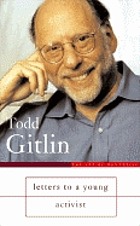
Gitlin, Todd. Letters to a Young Activist (Basic Books, 2012; 2003). Having read Gitlin's seminal history of mid-century movement politics, The Sixties, for my thesis research a few years ago, I picked up this slim volume at the Brattle book carts on the "it's only $1" theory. I don't generally like the "letters to a..." premise, which has become overplayed in recent years, and I can't say that format did a lot for this particular piece. But Gitlin manages (I think, though I'm now in the "over thirty" set myself) to skirt condescension and offer some useful reflections on the organizing, activist, or "movement" life. I particularly appreciated the way he wrestled with the complicated legacy of Sixties leftist movements and reactionary backlash, as well as the importance of practical (and often boring) action to balance out idealism. I think I will leave it to young activists themselves to weigh in on whether Gitlin succeeds in offering the wisdom of a mentor without the know-better attitude with which elder generations so often look upon the work of brash youth (so often judged and found wanting). Either way, his work is valuable as the thoughtful reflections of a once-young activist turned historian attempting to articulate his own lessons learned.

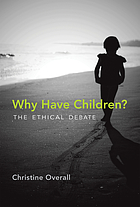
Overall, Christine. Why Have Children? The Ethical Debate (MIT Press, 2012). In our society, it is generally the non-parents among us who bear the brunt of curiosity and often censure. We scrutinize the motivations of the non-parents by choice and invest the resources of entire industries to enable those who have difficulty procreating to become parents. Yet philosopher of ethics Christine Overall -- herself a mother of two children -- argues that the burden of moral justification should fall not on those who do not procreate, but rather on those who do. Systematically, she explores the commonplace justifications for procreation -- continuing the family line, parental happiness, elder care, providing siblings for existing children, etc. -- and finds them insufficient to morally support the creation of new life. In the end, she makes the case that the only ethically justified reason for freely-chosen procreation is the desire to enter into a relationship with the future child. A committed feminist, Overall also spends a great deal of time exploring issues of bodily autonomy and reproductive justice -- careful to weigh the work of pregnancy as a female-bodied burden, as well as acknowledging the many situations in which procreation takes place under various levels of coercion -- for which I am grateful. Her arguments are logical, progressive, dense, and the boundaries of her consideration carefully delineated (she sets aside, for example, the ethics per se of assisted reproductive technologies, while acknowledging they deserve serious ethical consideration on their own), so readers looking for concise soundbite arguments will not find them here: her work requires careful attention and some measure of reflection to digest. My one serious point of divergence with Overall is in her discussion of unconditional love as both unsustainable and misleading. She argues that parental love is always conditional in that it is necessarily directed toward a particular child who is loved as an individual, not in a more universal sense. She and I differ in our understanding of unconditional love, which I have always understood to be both universal and particular. However, this is a small quibble with what at the end of the day is an extremely compelling and valuable addition to feminist ethics.

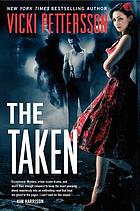
Pattersson, Vicki. The Taken (Harper Voyager, 2012). Last weekend I picked up Vicki Pattersson's Taken, a supernatural noir involving an intrepid lady journalist, Kit Craig, and a former P.I., Griffin Shaw, who for the past fifty years has been working as a Centurian ushing murder victims' souls to the afterlife. I had hopes Pattersson might be another Cherie Priest or Seanan McGuire, but this first installment, at least, of what promises to be a series, wasn't Bloodshot or Rosemary and Rue. For one, the supernatural aspect of the story (Griffin's post-mortal state) doesn't really factor into the story in a major way. It's what he is, and sets the plot in motion, but isn't really developed as part of the cosmology. The Taken is a fairly straightforward investigative drama. Likewise, the character of Kit Craig feels like a sketched-out caricature: a newspaper heiress deeply involved in rockabilly culture, she has a fascination for the Fifties that is introduced but has no material bearing on the plot. The crime upon which the novel hinges (predictably, these days) on sex work and secret religious societies that rather embarrassingly harkens back to Arthur Conan Doyle's A Study in Scarlet.