~oOo~

2013-01-22

movienotes: les miserables

I have some book reviews I need to write for books I've read this month, and a third "why I write fic" post in the queue, but I just got back from a weekend with my sister in the beautiful Austin, Texas, and my brain can't seem to form coherent-yet-complex thoughts. So instead, I'm going to offer up a few observations about the film version of Les Miserables that I saw in the theater the weekend before last.

Javert (Crowe) and Valjean (Jackman)
I saw the musical once before, live, when I was in London in January of 2004. My principle memories at the time involve enjoying the music (I'm a life-long musical theatre fan, so a good musical will always win me over in the end), being distracted by the book I'd picked up that day and brought with me to read during intermission (The Time-Traveler's Wife), and my surprise at the fact that the emotional-relational through-line for the story is not the second act marriage-plot between Marius and Cosette but the connection forged between Jean Valjean and Inspector Javert. It is their dance of power, desperation, obsession, compassion, forgiveness, and despair that drive the plot from start to finish. Hugo's novel is that 19th century classic the Social Problems Novel and, and is -- I'm sure I am far from the first to remark upon this! -- a queer choice for musical theatre.

Fantine (Hathaway) selling her hair.
A few thoughts in no particular order:
  • Women, work and society. The film version of Les Mis had some really interesting (largely visual) observations to make about women and work. There's Fantine, Anne Hathaway's character, who is working in a factory to pay for her daughter's care. Rumored to be a slut, and punished by the foreman for being a single mother, she's cast onto the streets and sells her hair, teeth, and sex before succumbing to consumption. Her daughter, Cosette, has been boarded out as a laborer herself, working for a couple running an inn (the buffoonish and cruel Thenardiers). While Cosette is rescued by Valjean and ascends to the middle class through marriage (one could argue a certain kind of "wage work" in its own right, certainly an economic decision), her age-mate Eponine Thenardier -- abused by her parents and pining after Cosette's lover -- cross-dresses as a boy to join the revolution and ultimately dies on the barricade. On the periphery of the story drift prostitutes, beggars, and female religious who serve as nurses and also offer refuge for Jean Valjean at various points throughout the story. When the student revolutionaries are shot by French soldiers, the uprising put down, it is women who are left to scrub down the blood-filled streets. Overall, Les Mis hammers home in multiple ways the limited options for the vast majority of women in 19th century France. True, there were limited options for most people living in France at that time -- but this film adaptation does a good job of highlighting the way women's sex/gender limited them in particular ways.
  • Futility of revolutionary action? Throughout, the film/musical has a deeply ambivalent relationship to the politics of its student revolutionaries. Marius's boyfriend Enjolras is a charismatic and idealistic young Parisian student who, with a group of peers, orchestrates a violent rebellion (based on a real historical incident) that ultimately fails and leaves everyone -- save Marius, rescued by Jean Valjean for his adopted daughter's sake -- dead. In Hugo's world, the violence of the state (personified by Javert; more below) is responsible for the wretchedness of virtually every character in the story, but political action is depicted as ultimately futile and deadly. Yet the film ends with a triumphant reprise of the rebels call to arms, with Fantine, Valjean, and all of the dead students waving tricolor flags high above the Parisian skyline. Have they ... won? And if so, how? Is the film meant to suggest revolutionary action is ever-needed? If the next generation (Marius and Cosette) have retreated into bourgeois respectability -- Marius' father welcomes them in with open arms and throws a lavish party for their wedding -- should this be considered a win? For whom? I have read some reviews that suggest Hugo's narrative points toward interpersonal love triumphing over political action (again, more below) but if that is the thrust of the plot it is an unsatisfying one: many people, even many "deserving" poor, die or are left in desperate poverty despite benevolence (and occasionally actual care) extended to them by others. If I had to guess, I'd hazard that Hugo might imagine that all attempts to improve the human condition on a large scale are doomed to failure, and that one-to-one interactions are our only -- and ultimately futile -- recourse.
  • Letting go of the next generation. As I wrote above, my first impressions of Les Mis is that it is a story about parents and letting go. Fantine, first, must let go of Cosette in order to provide for her (by going to work and leaving her with the innkeepers), and then ultimately must let her go when she dies and entrusts her to Valjean, a man she barely knows. She cannot know what her daughter's future holds -- for good or ill -- and yet must depart. And then in the second act Valjean must let go of Cosette when she falls in love with Marius. While at first this loss is painful to him, and he tries to leave  the country with Cosette in tow, when he intercepts a letter from Marius to Cosette he regrets his actions and rescues Marius from the barricades. After the two children are engaged to be married, Valjean -- his duty to his daughter complete, now she is in another man's care -- he departs to a monastery to die. We also have, of course, all of the children who die: Eponine and the students, including a young street urchin named Gavroche who is the first casualty of the day. The adults may believe these young peoples' actions are foolish and futile, dangerous even, but the young people ultimately must forge their own paths.
  • The central romance in the story is between Valjean and Javert. So, okay, you don't have to read their relationship as one long exercise in Unresolved Sexual Tension - but I certainly found it much more satisfying than the Marius/Cosette situation, let me tell you. Inspector Javert spends decades in pursuit of Valjean, obsessed with the man and fascinated/repulsed by the notion that the "criminal" Valjean (imprisoned for stealing a loaf of bread) could ever be anything other than a criminal. Valjean, whose religious conversion shortly after he is paroled helps him rebuild his life, tries to model a more nuanced morality for Javert (while, you know, evading re-arrest!) -- and in the penultimate scene he succeeds. Given the opportunity to kill or capture Valjean, whom he has tracked into the Parisian sewers, Javert lets Valjean go. And is so shattered by his decision to let the rule of law go in the interest of human compassion that he commits suicide.
  • Oh, and the acting. I was really impressed with everyone in this cast, all of whom seemed to really be throwing themselves into their work both musically and acting-wise. At times, Hugh Jackman and Russell Crowe really seemed to be struggling with the score which surprised me -- since I know Jackman, at least, is a strong singer. But I think that might have been a function of recording the songs live on-set rather than in a recording studio before or after the shoot. And Helena Bonham Carter and Sacha Baron Cohen as the odious Thenardiers were delightfully campy, offering some of the only comic relief around -- and even then, theirs is a story that has a pretty tragic side if you linger more than a moment or two). 
And that's all I got, folks. If you're musical theater fans or fans of the Victorian "social problem" novel, I'd highly recommend seeing the film -- preferably in the theatre since it truly is a spectacle of a movie musical. I know some people were really frustrated by the filming -- the tendency to frame actors in the corner of the screen, or incompletely, but I actually like that technique for the way it makes you notice the composition of the shot, makes you realize a visual image is being constructed for you, rather than allowing you to feel you're simply immersed in the action. Artifice, in this instance I would argue, works well with the musical genre.

2013-01-17

why do I write (and read) fan fiction? [part two]

(via)
See part one for the background to this post.

I've been letting this sit in my drafts folder for a couple of days and I'm starting to feel the weight of perfection closing in ... so quickly, quickly! I'm going to try and get these ideas out there before I'm crushed by the tyranny of Unfinished Thoughts.

Why write erotic fan fiction?

Why erotic fan fiction indeed.

So a couple of things.

Building on what I wrote in response to the question "why fan fiction," thinking about the lives of characters "off screen" (or after the novel or series is done) can often translate into imagining the playing-out of relationships that were established in canon. Not only do many mainstream novels (not just the ones for children and young adults) fade to black around sexual encounters, they often skirt the whole question entirely by ending the story arc with the get-together moment, or at least the early days of the relationship. Inquiring minds want to know what happens after -- and once you get to beyond a certain age, it seems pretty clear that sexual intimacy is often (though obviously not always) a part of the "after." It's long been a habit of the heart, for me, to extend the existence of fictional characters to give them the relationships and experiences the main narrative only gestures toward.

Too, when I was re-introduced to the concept of fan-created fiction and other fan works, it was as a genre that focused heavily on "slash," or fan work where characters' sexual relationships (whether canon or not) were the central theme. If your only encounter with fan works is through reading about 50 Shades of Gray or the resulting mainstream news coverage of fan fiction as a phenomenon, you can be forgiven in assuming that all fan fiction is erotic. It's not. I'm not sufficiently expert in the field to say what percentage of fan work is, in part or primarily, erotic (I'd guess a substantial proportion, but that's also what I tend to go looking for so my sample is extremely biased), but erotica is not the only direction fan work can take. Yet it was a key factor in what drew me, as an adult, back into the practice of fan writing.

I read it exclusively, for awhile, but eventually I started looking for pairings and stories that I couldn't find anywhere (more on that in part three) ... in other words, I found a gap in the literature! And like any nerdy academic, once I'd found the gap(s) people weren't exploring I determined to explore them. So pretty soon, I started writing, and people started reading, and people by their own account enjoyed what they read, and who doesn't like positive reinforcement?!

You could also ask the question this way: Why write erotic fan fiction?

I find erotica in general a compelling genre, and one -- as I've written before -- that has a great deal of (often underestimated) potential to help us explore meaningful aspects of the human condition. But I often find erotic fiction of the non-fannish variety incredibly hit-or-miss. As a member of my writing group and I were bemoaning the other day, it's often the case that you pick up an anthology of Best Lesbian Erotica or Best Erotic Romance or even the more theme-driven works (steampunk, quickies, food porn, BDSM, etc.) and at the most you find two or three stories out of twenty that dampen the knickers.

I always thought, you know, "different strokes for different folks" (in this case, ahem, quite literally), but then I discovered erotic fan fiction? Maybe it was just that I happened to re-acquaint myself with the genre at a time when I was ready to start thinking about sexual narratives in a more sustained way. Maybe it was because I was exploring my own sexual potential in concrete ways, and thus sexual knowledge, both fictive and non, were suddenly ever more compelling. This is part of the equation, surely. Fan fiction -- the writing and the reading, the community sharing -- has become entangled in my learnings and conversations about sexuality more generally and how we human beings narrate desire.

But as I've been turning this question over in my head the last couple of days, I think there's actually another more ... technical? ... reason why fan fiction erotica has a higher success rate for me (in terms of capturing my interest as a creator and consumer) than erotica in general. And the reason goes something like this: sex gains meaning through context. There are different schools of thought about what makes for effective porn, and some people will argue -- or even just take as read -- that effective porn is effective precisely because it's non-contextual and non-specific. That the characters are effective primarily because they are utterly interchangeable. One of the arguments for why so few male performers emerge as stars in the mainstream porn business is precisely this: that the ideal (male) porn actor fades into the background, is unremarkable enough that the (presumed hetero male) viewer can effectively erase the actor from the scene and insert himself into the action.

But for me, the exact opposite is true: the more particular and real the characters in a given story are, the more heartbreaking and hot the sex. Because I've been convinced I should care. Sex acts are weird and messy and frankly ridiculous ... it's we (participants and witnesses) who imbue the acts with meaning. (You'll say there's a physical component as well, and I'm not disputing that, but consider the difference between someone biting your neck out of the blue and sucking a hickey into your shoulder in the midst of lovemaking ... it's context that makes the physical activity feel good, not the actions in and of themselves.)

Intimacy can be the work of a fleeting moment or happen in the context of a life-long relationship, but without context sex acts themselves are, well, boring (to me, at least).

Fan fiction evokes context. True, the best fan fiction can stand on its own and be enjoyed by readers who know virtually nothing about the canon narratives to which the fic refers. Case in point, when Hanna first started sharing fic with me she was largely sending me stories written for anime and gaming 'verses I had no context for. And they were still compelling and hot. But I think there's a way that even just knowing these stories tie into a larger narrative encourage us to build context and imbue a scene with meaning. We don't have to know every detail of that context, just that there is one. We're encouraged to see the characters not just as conduits for sexual satisfaction, but individuals with full lives and the weight of personal history which they bring to their (fictional) sexual encounters.

As someone who counted fictional characters as intimate friends from a very early age, I guess it's not a big surprise to me that the act of participating (as a voyeur-reader, or as an author-creator) in the intimacy of fictional characters feels real and satisfying in a way that more conventional types of erotic creation/consumption have not, for me.

I also think the energy of the fan community feeds into this: virtually all of the fan writers creating smut in this context are also readers -- we swap work, we are one anothers' editors, we cheer on stories, we're invested in the (fictional) relationships working, so perhaps there's something in the very activity of co-creation that's ... erotic? It's similar to the really good energy you get in a class where everything gels and a critical mass of professor and students are pushing one another toward mutual heightened understanding? The relationship isn't just between the reader and the characters, but also the writer-reader and the reader-writer; even if fan fiction is penned (or typed) by a single author, there's usually a whole network of fellow fans around that author who create context for the work itself. And I think somehow that gives the relationship(s) and sexual intimacies within the work a unique intensity of meaning.

Stay tuned for part three, where I muse more specifically about why I write the particular types of erotic fan-fiction I write...

2013-01-15

'after pornified' book giveaway! [free stuff]

My friend Anne Sabo has given me three signed copies of her recent book, After Pornified: How Women are Transforming Pornography and Why it Really Matters (see my review here). And I would love to pass them along to you!

The only requirement is that you read and review the book by March 1st, post the review to Amazon.com and whatever other blogging or book-themed social networking site (GoodReads, LibraryThing, etc.) you choose and send the link to me.

Psyched to start reading? Leave a comment by midnight this coming Friday (so 12:00am 1/19/2013) on this post including an email where I can reach you and sharing, via link or description, one of your favorite pieces of erotica (can be any medium). I'll be taking all eligible entrants and randomly selecting three via the slip-of-paper-in-a-bowl method.

On Tuesday, January 22nd, I'll contact the three winners by email for a mailing address and send out the books via first class mail.

Let the commenting begin!

2013-01-10

why do I write (and read) fan fiction? [part one]

(via)
This topic has been kicking around in the back of my mind for awhile, in nebulous form, and then in the past couple of weeks I've (coincidentally?) found myself engaged in discussing theories of fan fiction and erotica writing with several friends via email, as well as the wonderful women of my #firstthedraft writing group. With encouragement from #ftd, here are my thoughts in blog post form.

I actually think the question why I write erotic fan fiction has several layers, and I'm going to unpack them successively: why fan fiction, why erotic fan fiction, and why the specific fandoms and pairings that I've chosen write. I also want to emphasize, because this is the sort of thing -- both in terms of fandom and in terms of porn/erotica -- about which people have Big and Important Feelings, that I am speaking very much for myself here. This is a post (or, rather, a series of posts) about why I write the erotic fan fiction I write. I am not attempting to synthesize the phenomenon writ large or pass judgement about what are the Correct and Right ways to approach the activity. I'm only trying to respond to the question people have asked me in various ways: Why do you do this thing you do? What do you find enjoyable about it? Is there anything you find troubling about the practice?

For all of you who have asked those questions, I'd love to continue the conversation in comments -- so please do participate if you feel so moved!

Note: It will be unsurprising to most of you that my thoughts are lengthy. So I'm breaking this post into three sections, the first of which is below. Parts two and three will be forthcoming and will be linked from this post as they go live.

Why write fan fiction?

So I've only been consciously participating in online fan spaces and reading/writing fan fiction identified as such for about five years. However, retroactively I would argue that my present practice of fan fictionalizing is only the most recent manifestation of the way I have always, since early childhood, interacted with fictional narratives. Some of my earliest memories are from around the age of five or six spinning out stories about my favorite fictional characters -- at that time stories like Little House in the Big Woods and The Lion, the Witch, and the Wardrobe. My childhood psycho-temporal spaces felt ... porous. My parents never judged us in our childhood practices blurring that line in our imaginative play. (This seems important, because I did know families where the children were schooled early and often on what was and was not "real" and judged harshly for flights of fancy.)

So I had an active imaginative (and often, with friends and siblings, collaboratively imaginative) inner life growing up. I put myself to sleep telling stories about "what happened after..." the end of my favorite books or series; my favorite characters became imaginary playmates; and in adolescence the nearest and dearest of those characters were part of my coming-of-age in intimate ways. They became active participants (as much as fictional characters can be) in my exploration of sexuality and relationships. I not only rehearsed the good and the bad (and the smutty) that actually appeared in the books that I read ... but I spun out elaborate stories incorporating my nearest and dearest (fictional) friends, and myself, building relational networks, families, and developing (hypothetical) sexual intimacies in various ways. In retrospect, I think this alternate universe I inhabited in my head helped me process a lot of the new information I was taking in -- physical changes, emotional upheavals, learnings about what it meant to be an adult in a variety of ways -- without feeling overwhelmed.

Without boring you to tears giving the world-building details, the space I created was one where I could literally move back and forth from childhood and adulthood, exploring the confines and capabilities of each mode of being. Imaginatively living an adult life elsewhere helped me approach my teenage years as if I had the confidence and experience of an adult.

In addition to being useful psychically and emotionally for me, I think the spinning out of private fan-fiction-like scenarios fed my insatiable desire to know more: to know about character motivation, to know what happened next, to know what the characters were thinking and feeling about events that took place, to know what might happen if event X or conversation Y took place. There's a great passage in one of E. Nesbit's Treasure Seekers books where the narrator informs the reader that lots of everyday things have happened (like eating and sleeping and going to the toilet) that he hasn't bothered to write down because those are all the boring bits that everyone does but no one wants to read about. Fiction necessarily revises for a tighter narrative, and things get left out. As a reader, I wanted them back in -- so I put them there, and molded them to my own particular specifications.

In those years, I encountered both professional and amateur fan works (from my mother's little stories about the Pevensie children that she penned for us at Christmastime to fan art to the Star Wars sequel novels to Neil Gaiman's "The Problem of Susan") but I wasn't actively participating in fan communities. I had friends who did (for example, a friend who was active in an online forum for writing stories inspired by Anne McCaffrey's Pern novels) but didn't hear a lot that drew me into active involvement. There was lots of interpersonal drama and litigation fears and, hey, I was already writing/imagining on my own so why bother with the added complication of other fans with their own vision and agenda?

But I got my fan community "reboot" (so to speak) when I met Hanna and she re-introduced me to the activities and pleasures of being a fan -- and this time, being a fan as part of a wider network of fans enjoying the same work(s) of whatever medium. Obviously the Internet had come along in the meantime, and as I was already involved in the feminist blogosphere I had some sense of how online communities work and what their pleasures and pitfalls are. Over time, the language of fandom bled into the language of feminism and became part of my social experience, as feminism had, both on- and offline.

These days, I really enjoy the positive energy of the fan circles in which I run. I enjoy that fans feel license to take joyful pleasure in things and create works inspired by those things. I enjoy the way those creations are shared freely and embraced by the fellow creator-consumer audience. I enjoy the practices of "gifting" works and creating "inspired by" pieces which complement one another or build off another fan's work. I like how the currency of fandom is mutual appreciation and celebration of amateur creation. (And simultaneously I'm much better able than I was as a teenager to ignore or minimize the drama and intensity which can overtake online communities of any kind. I've learned, in other words, when to close the internet browser and walk away!)

So I write fan fiction because I always have, and now know that this practice has a name! I write fan fiction because I'm always hungry to know more, and to make the fictional characters I love known to me in ways that go beyond the bounds of a single novel or series or television show or film. And I enjoy participating in such a positive, creative space that is outside of the economies of wage-work. I purposefully decided not to pursue a career as a writer in part because I wanted writing to be something that I could always come to voluntarily, without worrying whether or not I could pay rent. (I don't think this is a better or purer way to approach writing than writing as a job -- more power to those who do! It just wasn't for me, and I appreciate that I can continue to write and find readers in this playful alternative space.)

Click here for part two: "Why write erotic fan fiction?"

2013-01-08

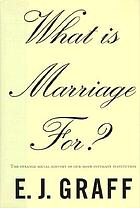
booknotes: what is marriage for?

Last week, I reviewed Public Vows which explored the history of American custom and law surrounding marriage. This week, I have some reflections on journalist E. J. Graff's book on roughly the same subject: What is Marriage For?: The Strange Social History of Our Most Intimate Institution (Beacon Press, 1999).

While Cott is an academic historian, Graff is a journalist -- and the differences in these two books reflects that to a great extent. This is not to say one is better than the other: Nancy Cott's work is a carefully-delineated study of American marriage from the Revolution to the late twentieth century while Graff's is a more wide-ranging exploration of what marriage has been and meant in the West over the past two millennia. Both work in their own ways to point out that the present-day arguments about the demise of "marriage culture" and/or the end of civilization as we know it because of [insert marriage change of your choice] is actually nothing new. Reactionaries have been raising a hue and cry in every era about the passing of one concept of marriage in favor of another, and our current notion of what "traditional" marriage looks like (what Cott referred to as Christian monogamy grounded in affection and entered by mutual consent) is actually a fairly new -- Graff would even say radical -- departure from the marriage norms of our forebears.

While for Cott the question of same-sex marriage is almost a coda to the main body of her argument -- which centers around non-white peoples' and women's citizenship rights and how they interact with marriage law -- same-sex relationships are the raison d'etre of Graff's work. After marrying her partner, Madeline, in 1992, Graff began to explore the slippery history of "marriage" and its meaning, with the goal of answering the question of whether same-sex couples can or do reasonably occupy the same space as other-sex couples in the present-day landscape of marriage beliefs, law, and practice. It will perhaps come as no surprise that Graff's answer is, again and again, that yes same-sex couples fit quite abley into our current notion of what a marriage is and does:
There remains an uneasy tension between, on the one hand, marriage as a way to resist consumer capitalism's pressure on the individual soul -- and, on the other, to fulfill consumer capitalism's ideology of individual love and commitment. But [today's reactionaries] wrongly choose those who love among the same sex as their scapegoats. The move toward same-sex marriage is the consequence, not the cause, of many other changes in Western life -- changes like legalized contraception, already inscribed in Western laws. A pluralistic democracy cannot fairly bar as pariahs people who fully fit its ideology of the meaning of sex within marriage (87). 
There were a few details in analysis upon which Graff and I disagree, such as her argument that the logic that allows for same-sex relationships (modern notions of love and personal choice) does not allow for polygyny, since the reasons for polygyny have traditionally been about political alliances and patriarchal kinship consolidation. While true insofar as it goes, her conclusion that therefore same-sex relationship recognition is in NO WAY related to recognition of more-than-two marriage models seems to ignore the way in which modern polyamory also draws on notions of love and personal choice. But that's overall a small quibble with what is an entertaining and well-researched exploration into the slippery meaning of something we think we all "know" when we see (or enter into) it.

2013-01-04

booknotes: public vows

I thought I'd kick off my 2013 book reviews with a few thoughts about the last book I read in 2012. That would be Nancy F. Cott's Public Vows: A History of Marriage and the Nation (Harvard U.P., 2000), which I picked up at the Montague Book Mill last week. A slim volume, Public Vows explores the ways in which local, state, and national culture and regulation have shaped the meaning and utility of marriage in the U.S. from the Revolution to the dawn of the 21st century.

Cott's overall point is that while marriage in the United States has been considered a private zone -- affectually and contractually -- it is also constrained by public custom and legal regulation. As she writes in the introduction:
In the marriage ceremony the public recognizes and supports the couple's reciprocal bond, and guarantees that this commitment (made in accord with the public's requirements) will be honored as something valuable not only to the pair but to the community at large. Their bond will be honored even by public force ... the public sets the terms of marriage (2).
Those terms have been paradoxically remarkably tenacious and constantly in flux. As Cott demonstrates, Americans have generally privileged the monogamous Christian marriage as the "common sense" of marriage relationships, despite the fact that at the time of the United States' founding "the predominance of monogamy was by no means a foregone conclusion" (9).

In the years of the Early Republic, this relationship was one of coverture, in which the wife's political identity was subsumed by that of her husband upon marriage; the husband was charged with representing his wife in the public realm much as a member of Congress (the founding generation of American political theorists drew this analogy) represented his constituents. As women and free blacks struggled for citizenship status throughout the 19th century, the terms of marriage (who could marry and the rights and duties marriage entailed) shifted to meet -- or at times to combat -- these new demands. Waves of immigration and anti-immigrant sentiment shaped laws around marriage as politicians determined what foreign marriage practices would be recognized as valid, and the changing economic landscape shaped and re-shaped understandings of how work and marriage inter-related.

Much of what Cott has to say will come as no surprise to historians of women's and gender history, or even social and labor history: notions of citizenship and personhood are uniquely tied up, in United States law and social custom, with one's status not only as an individual but also as the member of an acceptable family unit. Conformity to marriage norms can have real impact on one's status as a citizen (as any first-generation immigrant can tell you), and while women's political lives are no longer subsumed under their husband's at the altar, the assumption that women will be (hetero)wives continues to endure in tax codes and other legacies of coverture in the legal-political realm.

Cott touches only lightly on same-sex marriage in the final chapter of Public Vows, underscoring how little "gay marriage" actually has to do with the revolution(s) in modern family organization that the last two centuries of American history have seen. Feminist agitation has, indeed, played a much bigger role in shifting marriage onto new ground. As Cott observes, "So far as it is a public institution, [marriage] is a vehicle through which the apparatus of the state can shape the gender order.... Turning men and women into husbands and wives, marriage has designated the ways both sexes act in the world and the reciprocal relationship between them" (3). These designations often reach beyond the actually married, constraining the lives of the non-married as well. As women gained more equal footing as citizens, the shape of marriage as an economic, political, and personal relationship was fundamentally changed. In the context of this long sweep of change, the extension of civil marriage rights to same-sex couples is but a small step in the direction of equal citizenship status for all, regardless of gender or affectional ties.

Conversely, the fact that same-sex marriage evokes such strong reactionary feelings points toward the centrality of the Christian monogamous marriage plot to the organization of American civic life: as a key aspect of our project to differentiate ourselves from European and other world governments. By governing who is let in (and who kept out) of marriage we -- as a nation-state -- are often simultaneously identifying who -- both symbolically and literally -- is allowed to be a citizen.

I'm following my reading of Public Vows with E.J. Graff's contemporaneous What Is Marriage For? (Beacon Press, 1999). Like Cott, Graff explores the historical shape of marriage and discovers heterogeneity rather than some ur- form of "traditional" marriage ... I'm looking forward to limning the similarities and differences between their arguments, so look for a review here soon!

2013-01-01

looking back on the (previous) year in books

My reading goal in 2012, courtesy of Goodreads' reading challenge, was to finish 104 books (an average of two books per week). It was a goal I fell short of by six books, wrapping up the year in reading with #97 yesterday afternoon: Public Vows: A History of Marriage and the Nation by Nancy F. Cott (Harvard U.P., 2000).

(If only they allowed us to count fan fiction -- Hanna and I would have shot passed our goals and then some this year!)

But never mind -- I'm trying not to feel a failure for having fallen short: it was an ambitious goal, outstripping my previous record of the past five years (89 books in 2009) by fifteen titles. And there were some really great and interesting reads to be had in those ninety-seven titles. Below I've picked out my top fifteen titles. You can definitely see the way I trend: keywords include "sexuality," "politics," "history," "gender," and "feminism."

(Within the list order is strictly alpha by author; links are all to my blog reviews of said titles)

Memorable Reads of 2012:

Pray the Gay Away by Bernadette Barton

The Book of Mormon Girl by Joanna Brooks

The Straight State by Margot Canaday

Love the Sin by Janet Jacobsen and Anne Pellegrini

Bodies of Knowledge by Wendy Kline

The Mansion of Happiness by Jill Lepore

Discount Armageddon by Seanan McGuire

Why Have Children? The Ethical Debate by Christine Overall (MIT Press, 2012).

Well Met by Rachel Lee Rubin

After Pornified by Anne Sabo

Passing Strange by Martha Sandweiss

Not Under My Roof by Amy Schalet

Tiny Beautiful Things by Cheryl Strayed

Mrs. Robinson's Disgrace by Kate Summerscale

So, what were your memorable reads in 2012? Got anything you're excitedly looking forward to checking out in 2013? Share in comments! Inquiring minds want to know :)