With four weeks to go in the year, I've got fourteen books to read in order to make my 2012 goal of one hundred and four titles (two books per week). I don't think I'll make it. If there were a way to count reading of a non-book sort (journals, blogs, fan fiction) I'd be golden, but while I'll about match my 2011 level of book consumption, I probably won't read fourteen volumes by midnight on December 31st. Particularly since I'd like to put in some quality time on my epic, currently 30k and climbing, Carter/Stark fic, have a book review due for the
NEHA News, and Hanna and I hope to get out for some good long walks.
BUT. The fear of "failure" has not deterred me from reading, as always (I'm really not sure what
could actually. It's sort of what I
do, the way some people can't think without music on in the background). So here are some brief reviews of books I read during the month of November.
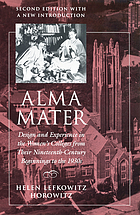
Horowitz, Helen Lefkowitz. Alma Mater: Design and Experience in the Women's Colleges from Their Nineteenth-Century Beginnings to the 1930s (University of Massachusetts Press, 1984; 1993). For a book originally researched in the 70s and published nearly thirty years ago,
Alma Mater feels refreshingly current -- not that I doubted Helen Horowitz's skill in research and writing (I've long been a fan), but historiography just as much as any other field has its tells for certain eras. Perhaps Horowitz lucked out by coming of academic age after the reign of Freud (see my review of
The Other Victorians below) and before the ascendancy of Foucault in the 1980s. This history of the Seven Sisters is an exploration of the culture of education through the lens of architecture: how the spatial organization of seminaries like Mount Holyoke and Vassar, colleges like Smith and Wellesley, Bryn Mawr, and the university affiliates Radcliffe and Barnard, reflect the assumptions, expectations, and fears about women and higher education across roughly a century of change. I was particularly fascinated by the way in which each institution's administrators sought to both foster and manage female intimacy: the single-sex environment was both encouraged (for its protective and training purposes) and feared (for its potential for same-sex romantic and sexual intimacy, and the way it led to "unfeminine" roles). In other words, the tension between the value of an all-female environment and its perceived downsides -- whether because it turns young women into lesbians (!) or because it perpetuates a separate-yet-equal passivity concerning gender equality -- have changed only in variation and not in substance since the 1830s. It will be interesting to see what the state of single-sex education is by the time we begin to reach the two-hundredth anniversary of women's higher education in this country. I really can't recommend Horowitz enough; as an historian of higher education in America I know of few more thoughtful or articulate.

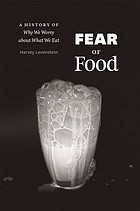
Levenstein, Harvey A. Fear of Food: A History of Why We Worry About What We Eat (University of Chicago Press, 2012). This slim, engaging volume is less a history of "why" twentieth-century Americans fear food than
how we choose to do so: each chapter presents a case of food fear, beginning with Progressive Era fears about food contamination spread by flies and infected milk for infants and ending with the present-day lipid-phobia (fear of dietary fat). An historian of food culture, Levenstein is on solid footing here in terms of research and a lively storyteller. My one complaint is that at times it is difficult to distinguish between food claims made in the context of a particular food scare and the more recent, evidence-based knowledge that Levenstein sometimes draws upon to refute or revise the basis of historical food scares. For example, in the chapter on "vitamania," it can be difficult to parse out what benefits of vitamains are still supported by the evidence, and what claims by vitamin manufactures have no solid backing in research and outcomes. In the end, though, I really appreciated that this narrative was not triumphalist the way so many health and science histories are: Levenstein's argument is not that American science has triumphed over superstision -- quite the contrary, he argues that we persist in demonizing (and celebrating) certain foods beyond all evidential backing. He also makes the key point that time and again throughout the twentieth century, the food industry and medical industry (including the public health sector) have powerful lobbies with their own profit-driven agendas, successfully exploiting food fears to their own gain (and American citizens' loss). I'd be making this essential reading in all public health programs around the country, and required reading by anyone who uncritically parrots the phrase "obesity epidemic."

MacDougall, Bruce. Queer Judgements: Homosexuality, Expression, and the Courts in Canada (University of Toronto Press, 1999). I picked this volume up while we were honeymooning on the Cape, but it took a while to wade through -- while thoroughly interesting, the textual analysis was dense and the Canadian legal framework just different enough that I needed to do some on-the-fly cultural translation to make sense of the arguments. MacDougall's central argument is that judicial
opinions concerning homosexuality matter as much as, if not more than, the material effects of their rulings. Combing through written decisions involving homosexual identity or expression from the 1960s to 1997, MacDougall finds that the Canadian courts have consistently framed homosexuality as disordered and marginal, a sexuality that is of potential threat to children, something that (because of its shameful nature) needs particular policing. For example, he points to the ways in which divorce court judges often express concern about a gay or lesbian parent's sexuality being evident to the children of the family in a way that they would not likely fret about straight parents bringing an opposite-sex partner home. Likewise, a whole chapter is devoted to the erasure of speech about homosexuality from institutions of education (primary, secondary, and higher education alike). While works such as
The Right to Be Out and
Queer (In)Justice have -- at least for a U.S. context -- superseded this volume, I did find it a worthwhile addition to my queer studies/queer history collection.
Marcus, Stephen. The Other Victorians: A Study of Sexuality and Pornography in Mid-Nineteenth-Century England (xxx, 1966; 2009). In the early 1960s, scholar of Victorian literature Stephen Marcus was approached by the Kinsey Institute to write a study of Victorian erotic literature.
The Other Victorians is what emerged: an oddly episodic work that has aged well in some aspects more than others. He begins with a study of doctor William Acton's works on sexual function and advice on sexual well-being, moves into an examination of Henry Spencer Ashbee's extensive bibliography of known pornographic literature, published in the 1870s-1880s, and then spends two lengthy chapters on a delightful, anonymous eleven-volume erotic autobiography
My Secret Life, published in the 1880s-1890s. These chapters are for the most part grounded in specific texts and hold up fairly well. Marcus's own sexual tastes and knowledge gaps seep through every now and then -- such as when he is baffled by the autobiographer's interest in BDSM, and when he insists that the autobiographer is exaggerating because women don't ejaculate -- but overall he was more aware of gender and class and the nuances of authorial voice than I might have expected. It's the chapter on the literature of flagellation and his concluding remarks that really let him down. I'm not exactly sure
why he chose to take up flagellation narratives other than that they were apparently prevalent in the pornography of the period. His descriptions of the literature's conventions is quite fascinating, but then he gets all sorts of judgy and Freudian about how flogging fantasies are sad and infantile and coded homosexuality. He also claims, in passing, that the Victorians produced no homosexual pornography -- an assertion that runs directly counter to the many passages depicting same-sex sexual encounters he has detailed in previous chapters, so I was baffled by the sudden reversal. And his final conclusions about pornography are, it seemed to me anyway, clearly written by a person who ultimately has no innate passion for or interest in the genre which he is studying. He argues that pornography lags behind fiction in its development, that it lacks in emotion and relational development, that the point of pornography is to depict acts outside of time and space, rather than human sexuality in the context of a deeper lived experience. Again, these assertions seem to run counter to the examples he himself has selected for review in the preceding chapters.*

Vaid, Urvashi. Irresistible Revolution: Confronting Race, Class and the Assumptions of Lesbian, Gay, Bisexual, and Transgender Politics (Magnus Books, 2012). This collection of essays by movement organizer Urvashi Vaid is a quick read -- I finished it in an afternoon -- and a bracing one. A national figure in LGBT politics, Vaid calls the mainstream queer movement to task on its unwillingness to engage in social justice activism that is not explicitly "gay." That is, activism around issues of racism, class disparity and poverty, misogyny, gender policing (particularly trans* issues), the prison-industrial complex, labor organizing, immigration, and freedom of family formation and sexual expression not necessarily grounded in heternormative marriage rights. My own feelings reading
Irresistible Revolution were complicated. On the one hand, I am basically on the same page with Vaid in terms of wanting a broad-based social justice movement that centers the most vulnerable among us and doesn't rest until
all are treated with respect and have the basic provisions necessary for well-being (healthcare, housing, food security, access to education, workplace safety, a healthy environment, etc.). And I feel comfortable with her lesbian-feminist roots and her critique of mainstream organizations (the Human Rights Campaign, National Gay and Lesbian Task Force, etc.) which may pay lip service to caring for all -- but in reality speak only to middle- and upper-middle-class priorities and aspirations. However, as a radical voice working from
within these organizations, she fails to draw upon and engage with the scrappy, marginalized groups and individuals who are doing the work she longs to see done. At least as much as she could have. The result is a book that feels like a lot of finger-wagging at the self-satisfaction of the elder generations of activists (and those with the most material resources) and the complacency of the younger generations -- without enough acknowledgement of the people who do not fit into either of those categories, and who are doing transformative and back-breaking labor being the change they wish to see.** Vaid is a high-profile voice whose commitments are key to a more just future, so I hope she is listened to by the "insider" audience she wishes to reach.
And that's all for now, folks! Off to see what else I can read before to clock for 2012 runs out.
*I couldn't help wondering if such judgmental attitudes came out of an extreme desire to be "objective" about the subject matter -- to the extent that he was unable to examine the material with an eye toward what an eager reader might get out of the experience. For example, he excerpts a lengthy and charming passage from
My Secret Life in which the autobiographer and a friend arrange a visit to a flogging parlor to watch a gentleman be spanked by the "abbess" in charge. Also present is a prostitute. All five people are participants in the action on some level, and although the autobiographer evinces no interest in being beaten himself, he is clearly curiously engaged and pleased (and aroused on some level) to be participating in someone else's erotic scene. Marcus, however, dismisses the scene as one "we" modern-day folk would obviously find sad and grim. Whoops!
**And to be clear, I don't include myself in this category. People who have the stamina and vision for professional movement work are brave and better souls than I; I'm glad they do what they do and I will support them as I am able ... but I have never been, and likely will never be, a queer organizer.