~oOo~

2011-12-20

new fic + nano recap

via
I've put off writing a recap of National Novel-Writing Month because, sadly, a brutal migraine caught up with me over the Thanksgiving weekend and put the kibosh on meeting my (until then quite reasonable) personal goal of 25,000 words for the month. Still, I clocked in at just over 20K.

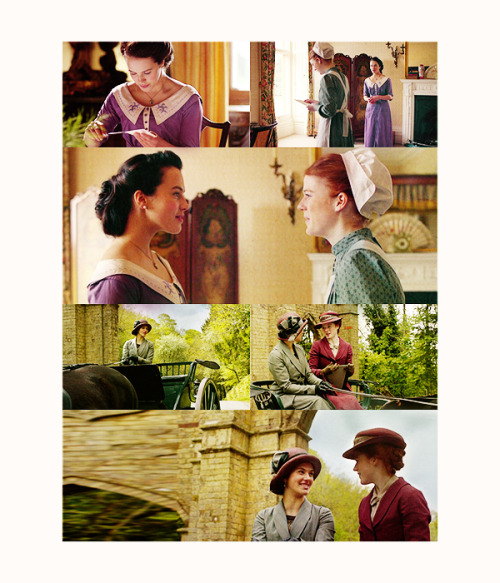
But meanwhile, thanks to participation in NaNo, I made writing erotica a top priority in November and completed a ~13,000 installment of my ongoing How She Loved You series featuring Sybil and Gwen from Downton Abbey. I finally had a chance to take Hanna's beta suggestions into account and code the piece for AO3 this past weekend.

So if fic be your thing, head on over and check it out:
Like Sorrow Or a Tune
by ElizaJane
Fandom: Downton Abbey
Pairing: Sybil/Gwen
Summary: Six scenes that trace the contours of Sybil and Gwen’s relationship from the first morning after to the night of their reunion in London, in the flat where they will make their home. This is the inevitable “five times” fic. Five times Sybil and Gwen parted before dawn and one time they didn't have to.
Now I should head back to reading Gayle S. Rubin's 1980s essays on the porn wars, which I have to say are an incentive like few other things to get into the business of writing and reading smut. Because really, people, really. Politics of disgust like crazy and that's just not cool. Life is short. Write good porn.

2011-12-18

in which we write letters: stop SOPA

via
Depending on your level of involvement in things internet-political and techy, you may or may not be aware of the Stop Online Privacy Act (SOPA) now making its way through congress. Introduced by representative Lamar Smith (R-TX), this bill mandates widespread monitoring of internet activity and has the potential to cause the internets as we know them to be fundamentally altered as blogs and other social networking sites are shut down for supposed acts "piracy." You can read more about the act at the Organization for Transformative Works, TechCrunch, and the American Library Association. The letter Hanna and I sent to our representatives is heavily cribbed from the ALA talking points.

Find your U.S. Representative here. 

Find your U.S. Senators here.


18 December 2011

Dear Representative Capuano,

As librarians, bloggers, and registered voters in Allston, Massachusetts, we are writing to ask you to vote against the proposed Stop Online Privacy Act (SOPA), H.R. 3261.

This bill, if it becomes law, will cause a widespread “chilling effect” on use of the Internet for commerce, communication, and participation in democratic society. The bill strikes at copyright protections currently granted to libraries and educational institutions by creating the possibility of criminal persecution of institutions and institutional representatives. for online streaming and other use of online resources in library and classroom space. SOPA's requirements to monitor internet traffic violate free speech and privacy protections and may create new forms of government surveillance of private activities within and outside the United States. The predicted consequences of SOPA are far-reaching. If passed, the potential for new jobs, innovative new ventures, and economic growth will be stifled.

Citizen engagement in online spaces depends on the ability to share and discuss a wide variety of media content across multiple social networking and other Internet platforms. SOPA will effectively shut down the vibrant creativity and vital political discourse that has been made possible by the World Wide Web. On behalf of ourselves, our online community of bloggers, and our library patrons, we ask you to vote against H.R. 3261, and support alternative ways for protecting legitimate copyright interests online.

Sincerely,

Anna J. Cook & Hanna E. Clutterbuck

2011-12-15

booknotes: one and only

Cleis Press recently sent me a review copy of One and Only: The Untold Story of On the Road and Lu Anne Henderson, The Woman Who Started Jack Kerouac and Neal Cassady on Their Journey by Gerald Nicosia and Anne Marie Santos (Berkeley, CA: Viva Editions, 2011). Here are a few thoughts.

In 1978, Beat biographer Gerald Nicosia had the opportunity to interview Lu Anne Henderson twice – once her a hospital in San Francisco, when she was recovering from surgery, and shortly after her release when she invited him to the house where she was recovering for a lengthy recording session. Over thirty years later, One and Only brings us these oral historical narratives in the form of heavily edited autobiographical vignettes. The sections of One and Only drawn directly from the interviews are framed by Nicosia's contextual commentary and supplemented by other historical material about the Beats and their milieu – including a number of photographs and an essay by Henderson's daughter, Anne Marie Santos.

I have, I will admit upfront, never been drawn to the Beat movement either in terms of its literary output or its place in American twentieth-century history. I have had passing acquaintance with its main personalities and the echoes of their work in 1960s and 70s cultural critiques. But I come to this work largely without preconceptions about the personalities of the individuals or the nature of the relationships between the main players. Therefore I'm not the best person to comment on the contribution this autobiographical narrative adds to the field of Beat studies. What I would like to talk about is the way in which Nicosia frames the oral history, and how one might approach reading the text with a skeptical eye -- yet still gain a valuable personal perspective on some fairly iconic historical people and events.

Nicosia's introduction does not inspire confidence in One and Only either as a work of oral historical scholarship or as a meaningful portrait of Lu Anne Henderson and her experience of mid-century American bohemia. Nicosia leans heavily on qualitative descriptions of his subject that came across  in my reading as tasteless objectification – he introduces her as “beautiful fortyish woman” who has a certain “homespun charm” and retains “touches of … charming innocence” (24; 33). Given his position as a younger (at the time) man requesting an interview about Henderson's life and sexual relationships, I find the focus on her simultaneous sensuality and almost childishness to be a little creepy.

Nicosia walks a fine line between asking his readers to recognize Henderson's agency – even as a fifteen-year-old teenage girl, she situates herself as a person who made choices about how to live her own life – and eliding the power dynamics borne of age and gender. While still a young man when he married Lu Anne, Cassady was in his early twenties, with more travel experience and a stint in the military under his belt. While not all such relationships need be inherently exploitative, this dynamic is never unpacked either by interviewer or interviewee. While Lu Anne's interview emphasizes their shared youthfulness and complicity in continuing to live in or on the edge of poverty, readers can't help but observe how Henderson is often forced into the position of providing for her husband and his friends, by hook or by crook, as in 1946 when Neal and Lu Anne, newly wed, arrive in New York City:
It was up to me to support us, so I found a job at a bakery. I had just gotten the job that morning, it was my first day, and Neal told me to steal some money! We didn't have a penny, and Neal told me, like, 'Bring some money home!' Well, the woman who ran the bakery caught me [and] dismissed me. It really put me through a traumatic experience (67).
Henderson passes over these incidents with a light touch, often turning them into amusing anecdotes. Similarly, she glosses over the emotional and physical abuse threading through her relationship with Cassady and, later, Kerouac, and subsequent husbands. “Neal was not a violent person,” she observes at point point, and then immediately qualifies this by saying, “except with me. And when Neal would hit me, that was simply emotion” (87).

Nicosia acknowledges that Henderson herself had an agenda in granting him an interview, as did he in seeking her out. She was unhappy with contemporary accounts of her place in the constellation of Beat relationships, approached the interview as an opportunity to correct historical memory. He was collecting material for a biography of Kerouac eventually published in 1983 under the title Memory Babe. To a great extent, Nicosia's focus on the high-profile male personalities in Henderson's circle persists in One and Only. He observes with unselfconscious approval that “Unlike so many of the other women who have written about Kerouac, [Lu Anne] resists the temptation to shift the focus of the story from Jack (or in this case, Jack and Neal) to herself” (27). In the context of a biography of Kerouac or Cassady, such an on-task informant might be an asset to the researcher – in the context of a book that places Lu Anne Henderson front and center, the observation tastes a bit sour on the tongue. Really, Nicosia? You make it sounds like Henderson's life story is only valuable to the degree she keeps herself in the background and focuses on the menfolk in her life? I really hope you didn't mean that the way it came out.

Despite my (many!) frustrations with the framing of Lu Anne's narrative by Nicosia, there will likely be value to Beat scholars in the publication of Henderson's perspective on the oft-chronicled historical events that inspired On the Road and other Beat works. Until now, the interview was unavailable to the public, for reasons Nicosia doesn't elaborate on – only hinting that he was “forced” to bring a lawsuit in order to open the archive. I certainly found Henderson's narrative compelling, and while her portrait of life on the economic and cultural edge was at times heartbreaking, I think it's an important antidote to those who might romanticize the outsider while forgetting the real material and social costs of socioeconomic and philosophical marginalization ... even if some aspects of that marginalization are, at least partially, by choice.

I look forward to seeing what future scholars do with the published work as well as the raw interviews, which I hope will be made available to scholars and the general public for research purposes.

2011-12-14

from the neighborhood: christmas tonttus

This past weekend, Hanna and I were up in Maine celebrating an early Christmas with the folks. This involved a lot of good food, a Christmas carols service at nearby Colby College, and the creation of our very own tonttu for the apartment. Tonttu are Finnish house spirits that Hanna's mother learned about from her Finnish parents and grandparents. Here are some photographs that we took of the process of making two tonttus. It took the better part of Sunday morning.

these fellows were our model tonttus
here are some of the supplies Linda provided
We started with a base of cardboard, Styrofoam, and felt
all self-respecting tonttus need hats
Mine is on the left, Hanna's is on the right.
Hanna named hers Ibrahim; mine is named Helga
We brought them back to Boston on Monday to grace our Christmas shelf
While tonttu is the Finnish term for house spirits, some of you may be familiar with the Astrid Lindgren picturebooks which tell the story about a gentle tomten who cares for a family farm in Sweden. This is essentially the same folk character, though seen through the lens of a slightly different Scandinavian tradition.

I hope all of you are finding small and pleasurable ways of preparing for the holiday season ...

2011-12-12

multimedia monday: purity myth trailer

Via @courtwrites (and lots of others by now, but that's where I first saw the link!):


I read and reviewed Jessica Valenti's Purity Myth when it first came out back in 2009 and in my opinion it's the best of her published works to-date. I'm definitely going to check out the documentary version.

See also: my review of Hanne Blank's Virgin: The Untouched History.

2011-12-11

four years ago today: "personal canon"

It's been awhile since we did one of the four years ago today flashback posts. So here's a fun one I pulled from the Gmail archive. My friend Joseph and his brother had generated lists of the top ten novels in their "personal canon" and Joseph emailed to ask what mine would be. After some thought, this is what I came up with. Looking it over today, I can't say there are any huge revisions to this list. 


From: Anna
To: Joseph
Date: Tue, Dec 11, 2007 at 10:22 PM
Subject: Re: Personal canon of books

Hiya,

My canon is decidedly more "lowbrow" and than yours, but I am squelching my impulse to apologise for it on Nick Hornby's firm orders (even though he loves Dickens' and writes tedious novels about men who refuse to grow up, so I am not sure how much I trust him . . .)

I have artificially controlled against all non-fiction and children's literature (well, below the teen level).  Not sure if that's quite what you had in mind, but there we are.  I discover my criteria are a) enduring "good read"--something I will go back to over and over again, as well as b) things that have had deep impact on how I answer the question, "how to live?" . . . these categories don't always overlap.  There are books that have had great impact on how I think about the world, but which I've only read once . . . and books that I read habitually, but that I don't really think of as life-shaping in any explicit way.  Maybe they're just sneaker at it? And of course these change over time . . . I was just thinking today how His Dark Materials has really grown on me over the years.  And even though I have issues with some of his didacticism, his theological imagery really speaks to me.  And, I mean, who could resist the idea of a reversal of the whole Genesis/Fall/Eve story? (Um . . . wait . . . that's right . . . a LOT of people ;) ).

via
That long introduction completed, here are my nominations. The top ten in a strictly alphabetical order. I figure once you make top-ten I'm not going to be judgmental. ALTHOUGH I do sometimes find myself paralyzed by the question of which book I would become if I were a character in Fahrenheit 451 . . . possibly a clear indication of how troubled I actually am :).

Top Ten:

1. E.M. Forester. A Room With a View.
2. Shirley Hazzard. The Great Fire.
3. Haven Kimmel. The Solace of Leaving Early.
4. Robin Lippincott. Our Arcadia.
5. Michelle Magorian. Not a Swan.
6. Robin McKinley. The Blue Sword, et al.
7. Audrey Niffinegger. The Time-Traveler's Wife.
8. Dorothy Sayers. Gaudy Night.
9. Martin Cruz Smith. Rose.
10. Tom Stoppard. Arcadia.

Some possible future candidates/honorable mentions:

Isabel Allende. Daughter of Fortune & Portrait in Sepia.
Jane Austen. Persuasion.
A.S. Byatt. Possession.
Sheryl Jordan. The Raging Quiet.
Laurie R. King. The Beekeeper's Apprentice, et al.
Barbara Kingsolver. Bean Trees.
David Levithan. The Realm of Possibility.
Gregory Maguire. Wicked, Son of a Witch
Philip Pullman. His Dark Materials.
Margaret Whelan Turner. The Thief, Queen of Attolia, King of Attolia.

Anna

2011-12-08

booknotes: when we were outlaws

In many ways, Jeanne Córdova's memoir, When We Were Outlaws: A Memoir of Love and Revolution (Midway, Fla.: Spinster's Ink, 2011), couldn't be more different than the last memoir of the 70s I reviewed here at the feminist librarian: Patricia Harmon's Arms Wide Open. Harmon's memoir told the tale of a self-trained hippie midwife who moved with sons and male lovers through several different rural communes before entering medical school for formal nurse-midwifery training. Jeanne Córdova, by contrast, spent the 1970s in the Los Angeles area free-lancing as a journalist and activist in what were then referred to as the women's and gay liberation movements. A self-identified butch, she came of age as part of the lesbian bar culture of the 50s and 60s, then discovered gay liberation and feminism in 70s. Córdova was the founding editor of The Lesbian Tide newsmagazine and the human rights editor of the L.A. Free Press, interviewing radicals on both the left and the right on the run from the law. As she observes in her introduction, "this memoir visits many outlaws, some freedom fighters, and a few who would be called terrorists ... I needed to know and sort out these outlaws in my mind in order to discover the perimeters of my own moral compass ... Outlaws takes place at the intersection of shadow and shade that differentiate between persona and principle" (vii).

Yet I found myself, while reading Outlaws, thinking often of Harmon's memoir and the parallels between both works in scope and tone. And in the relationship (in text, at least) between the authors and their own personal and political pasts. Like Arms Wide Open, When We Were Outlaws seeks to tell a specific slice of the authors life, rather than starting with childhood and moving through the years in an orderly progression. Both authors chose, as their time-frame, the turbulent years of the 1970s when the heady, optimistic social change movements of the late 1960s led to more complicated lived realities for those who championed leftist causes and a counterculture way of life. Córdova focuses on her life and work between 1974-1975, with some flashbacks and flash forwards to help us make sense of the dense web of associations -- political and personal -- that characterized that time, both for Córdova specifically and her fellow activists in what was then called "the Movement" more broadly. Like Arms, Outlaws gives us an in-the-moment perspective on the life of someone struggling to live out her political convictions in her personal life. For Jeanne Córdova this means an up-close, and in many ways unshrinking, view of her involvement with lesbian separatist politics in relation to the gay liberation movement more broadly. It also means intimate portraits of her trial-and-error practice of open relationships, as she paints a portrait of her involvement with two women -- the long-term relationship in which she and her partner have negotiated non-monogamy, and the quickening of an intense love affair with a fellow activist that threatens the stability of her more permanent ties.

It has become a commonplace, since almost before they began, to identify the leftist social movements of the 60s and 70s as enthusiasms of youth, as romantic idealism (or destructive self-absorption, depending on your political persuasion) that necessarily gave way to realistic politicking and material concerns. In some ways this is true. Many of the individuals who populate When We Were Outlaws are young adults in or just out of undergraduate or graduate school programs, young professionals or struggling under-employed twentysomethings. They don't (yet) have dependents to care for, and are geographically mobile, often living on the economic edge. They're at the point in their lives where they're developing a sense of what kind of life they want for themselves and those they care about -- what kind of work they find meaningful, what values they hold dear, what kind of relationships they want to build and maintain. Often, their answers (however tentative) to these questions are at odds with the answers their parents or the activists of the previous generations gave.

Yet despite the youth (and youthful perspective) of its protagonist, I would argue that Outlaws pushes us to re-examine our assumptions that the moral dilemmas and vision for a better future that Córdova and her cohort were immersed in are solely the province of the young -- impetuosity that will necessarily give way as one grows into more seasoned adulthood. One of the most interesting narrative threads in Outlaws traces the relationship between Córdova and her political mentor/substitute parental figure Morris Kight. Kight was a mover and shaker in L.A. gay political activism, someone with whom Córdova worked closely and fell out publicly over the place of women in the gay liberation movement. Their differences aren't so much conservative elders vs. radical youth but something more complicated -- a difference in experience, of power, of privilege. In the very personal (yet also political) struggle between Kight and Córdova we can see all the complications inherent in working for social justice, complications that don't get, well, less complicated -- or less relevant -- as we grow older.

Córdova reflects back on her younger self with a sometimes-critical, yet always compassionate eye. While the narrative style is "novelized memoir" (to use the author's own choice of phrase), one nevertheless gets the sense that the author both knows well her protagonist's faults and cares very deeply for her younger self, no matter how flawed her present self may find that person of the past. "I was not born knowing how to love," is how she open's her introduction. "It came to me late in life" (vii). In the pages of Outlaws we see her be cruel to lovers, ideologically ruthless, politically short-sighted, and cripplingly addicted to booze and prescription drugs. At the same time, we see a heart-breakingly young woman who's been physically evicted from her childhood home (for bringing home a lover), is living with serious and intermittently-treated depression, experiences chronic under-employment, and who nonetheless is working hard to build a meaningful life for herself and a better future for us all. Whether you agree with the young Córdova's means and visionary ends doesn't necessarily detract from the import of such a closely-rendered self-portrait.

I suspect we're only in the early years of a richly textured new wave of 70s-era autobiography which will shed new light on the particularity of growing into adulthood during a period when even the most fundamental of questions concerning how we organize our personal and political lives seemed to be in real, material flux. I am also happy (quite selfishly, I admit!) about the way these personal perspectives will provide unique, and accessible, primary source material for historians of the period, even while many historical sources remain in private hands (and therefore often invisible-to-researchers). Córdova's memoir would provide a rich jumping-off point in a course that sought to explore this era in all its rich historical realities -- and I hope it prompts many readers to re-examine what they think they know about the political contours of the decade.


This review was made possible by the generousity of Lynn Ballen at Spinster's Ink who provided me with an advance review copy of the book. The book is available now for purchase online or at your brick-and-mortar bookstore of choice. You can read more about the memoir and its author at www.jeannecordova.com.