~oOo~
Showing posts with label librarians. Show all posts

2014-07-18

"which materials in [your] collections support gendered stereotypes?" [comment post]

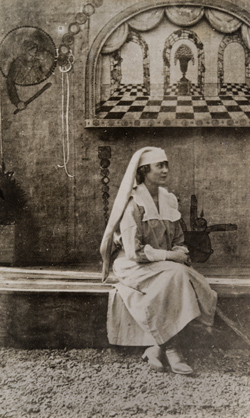
Mildred Mitchell
sitting under a frescoed wall (1918).
Massachusetts Historical Society
This week, I was contacted by a PhD candidate doing research on "archives and the construction of female identity." I had much to say about a couple of the questions, which I thought might be of more general interest to readers of this blog. So here is what I wrote!

4. Which materials in [your] collections support gendered stereotypes? Are there any examples materials which subvert these stereotypes? 

I find the framing of this question strange and confusing, perhaps because I am trained first and foremost as a historian. As a historian, I approach all collection materials as sources which can be understood in many ways. Most cultural artifacts do not in and of themselves support or subvert limited or fixed stereotypes or agendas; these artifacts are what we (the researchers) and any other individuals who interact with them (from creation to destruction) make of them. Rather than asking whether any particular item in our collections supports or subverts a particular understanding of gender (or sexuality or race or etc. etc. etc.), I would ask what the item might be able to tell us about how its creators and contemporaries understood gender (or etc.) in a multivalent sense. How did human beings make meaning using this item? What can this item tell us about the time and place in which it was created and used?

To use an example from the MHS collections which I, personally, have incorporated into my work as a historian, there is a deposition in the Godfrey Cabot Lowell Papers taken in 1914. It is the deposition, by a male member of the legal-judicial system, of a female office/retail worker about her experience of sexual-medical impropriety at the hands of a male doctor treating her for gynecological ailments. The deposition, as far as I have been able to piece together, is part of a larger case being assembled against the doctor for his activities, medical and personal. You can read the conference paper I wrote about the document here.

If we were to ask your question(s) of this item: does it support or subvert gender stereotypes, what would a meaningful answer be? One could argue the deposition was constructed in a context over-determined by a number of gender-based narratives: the female office worker, the sexually-naive spinster, the predatory male gynecologist, the hard-boiled private detective, the patriarchal morality police, the sexually immoral widow/madame with whom the doctor is living and working. The deposition and associated detective’s reports draw on all of these. Yet the deposition also offers up gender surprises, given its historical context. How did Nellie Keefe, the deposed woman, decide to speak out against the treatment that made her feel uncomfortable? How should we think about the persecution of a doctor for living with a woman (and perhaps enjoying a consensual sexual relationship with her) while unmarried? What bearing does that have on his medical practice? How are the women patients understood within the context of the case as gendered subjects? How does their agency in speaking out against the treatment they were uncomfortable with play into the “long game” persecution of the doctor for his domestic arrangements? Was the doctor acting inappropriately, based on the standard medical training of the day, in giving the treatment he did? To what extent are both women and men in this narrative leveraging and falling victim to narratives of gender salient in their specific time and place. Most historical texts (like our lived experiences!) are complex, multi-layered things which work within and against dominant narratives simultaneously.

As a reference librarian who works with researchers doing scholarship in the areas of women, gender, and sexuality -- along with other intersecting aspects of subjectivity and identity -- I see my job as helping a researcher to ask new questions of materials; to complicate our reading of what might at first glance seem self-evident as a source. I spend time brainstorming with researchers about where they might find documents or artifacts that speak in some way to their questions about gender and sexuality -- and the work they do with those items is quite often fresh and unique, challenging us to see particular moments in history and culture in new ways.

5. Should women’s collections, both those created by women and those about women’s activities, be kept in separate repositories or locations? Why? 

I believe in the organizational power (in a positive sense) of designated spaces and groups whose mandate is specifically to collect, preserve, and make accessible the documentary record of historically marginalized populations. The genesis of many special collections repositories for under-represented groups (people of color, religious minorities, women, LGBTQ folks, etc.) has often been within those communities themselves through grassroots organizing -- e.g. the Lesbian Herstory Archive. I believe those community-based archives have done (and continue to do) important work. I am also glad to see more conventional archives beginning to collect materials that more fully document all aspects of our culture and society. It is my hope that we will continue to have both types of archival repositories into the future, since I believe the “activist archive” and the institutional archive both serve important purposes within the ecosystem of the library/information professions.

Historically, the physical location of an archive or a collection has had significant bearing on who is able to access the materials the archive holds. Hence, it has often made sense for similar / like materials to be gathered in a specific location so that researchers can access them for a topical research project: e.g. lesbian pulp novels. Collecting policies often reflect this -- we don’t just take every collection we are offered, but rather consider whether it complements the other collections we have, or the goals of our repository in documenting certain aspects of history and culture: here at the MHS environmental history, for example, and Massachusetts family papers of the 18th and 19th centuries. My wife works at a repository that collects materials related to the history of medicine, so they collect physicians’ and medical researchers’ papers as well as print materials. As we are able to make collections more accessible through digitization, such geographical proximity can matter less (but still matter today, and will continue to matter for decades to come).

As an “activist archivist,” what I care about is that someone, somewhere, is collecting the materials related to histories of a wide range of people and groups. I want the employees at the institutions that care for these collections to believe in their worth and the necessity of their preservation. I’m pretty impartial as to whether those materials are held in an identity-based archive (e.g. a “women’s collection”) or whether they are held at a more eclectic institution. What I care about is that they are findable and accessible to whomever wishes to use them to further our knowledge of peoples and pasts. I would further complicate the issue of “women’s collections, both those created by women and those about women’s activities” by pointing out that each of us exists in the world with multiple facets of identity, and that making a present-day argument for the creation of women-focused collections (as opposed to historically women-centered collections) raises questions about how we would formulate a collecting policy for such an institution, and what such a policy implies or outright states about the notion of “women” as a discrete category of being.

Say you have a collection of personal and professional papers of a woman with both African (recent immigrant) and Euro-American ethnic and racialized heritage; she attended a historically-black college as an undergraduate, and then went on to seminary for an M.Div. Following several years as minister in the Reformed Church of America she left the ministry in order to openly marry her partner. She decides to pursue midwifery training so that she and her wife (a primary care physician) can set up a practice working with bisexual, lesbian, and trans* female couples around pregnancy, childbirth, and post-partum care. They become central movers and shakers in the women of color-led reproductive justice grassroots movement. The woman grew up in Georgia, attended graduate school in Michigan, then settled in Chicago with her wife whose family has roots in upstate New York and Western Massachusetts. After a long career in urban community-based women’s health activism, they retire to the Minneapolis/St. Paul (to be near the wife’s brother and his family). So, what’s the best place for these personal-professional records? In an archive that specializes in records of African-Americans? Women? Queer folks? People in the health sciences? Ordained individuals? Social justice activism? Should the records stay local to the Chicago area? Should they go to the HBCU institutional repository as an alumna collection?

I’m a cisgendered woman, but my womanhood is only SOMETIMES the most salient aspect of my identity (like when the Supreme Court decides because I’m a person with a uterus my workplace could pass judgement on my healthcare decisions). I’m also a librarian, a historian, a writer, a Euro-American with strong Scottish heritage, a bisexual lesbian -- where do my papers “best” belong, thirty years from now? It’s an imperfect science at best.

Any additional comments? 

In reflecting on your questions, I will say that it seems important to note that as a graduate student in library science / archives, with a background in women’s studies and history, I would have said my “ideal” job would be to work at a place like the Lesbian Herstory Archives, the Schlesinger Library, the Sophia Smith Collection -- somewhere that specializes in the historical subjects I find most interesting as a scholar. However, the job I found was here at the MHS, a repository that does not focus intentionally on any of my subjects of interest (history of sexuality, history of women and gender, history of social justice activism, history of religion, history of education, all emphasizing twentieth century American contexts…). Over time, I have grown to appreciate the important role I can play as a reference librarian in a more “generalist” research library in suggesting entry points into our collections that get at some of these subcultural and/or marginalized histories. Because of course even when we aren’t visible in the mainstream narratives, we have always been there -- to take queer sexuality as an example, it’s not like women sexually desiring women, and building relationships with them, is an invention of the twentieth century (though “Lesbian” as an identity construct, like “Straight” or “Cis” or “Trans*,” arguably is). So it’s important to remind researchers that they don’t have to go to “women’s collections” or “lesbian archives” to find stories that include queer folk. Which is not to say that finding us (people similar to us) isn’t harder in mainstream repositories, where finding guides and catalog records don’t necessarily indicate those aspects of an individual’s identity … to the extent that those aspects of identity are knowable.

2014-06-18

once again upon a listserv: some follow-up thoughts about #thatdarnlist

Note to non-archivist/librarian readers: this blog post is largely professional insider discussion and, while it may be interesting to some of you it will likely be tl;dr for many others. You have been warned!
a radical feminist cabal (via)
In the three weeks since I published my post about professionalism, privilege, and power, discussing the Archives & Archivists listserv, I’ve had further interesting adventures -- both inspiring and dispiriting -- around what I wrote, how I wrote it, and the manner in which it was shared. Having (mostly) weathered that storm, I offer a few further thoughts about what went down, and how, and the manner in which I’ve chosen to participate in this conversation moving forward.

My last substantive listserv email on this subject went out to the listserv on June 5th and can be read here. The two listserv threads to which that message refer can be read in their entirety here and here. What I would like to share in this post are two items of gratitude, four items of critical reflection, and finally an invitation.

For those wishing to skip straight to the invitation, please see my sounding of interest.


1) I am grateful to connect with so many likewise-minded and open-minded librarians and archivists since writing my initial post.

A huge big thank you to every individual who linked to, retweeted, liked, commented, emailed, and otherwise showed support and understanding for my arguments around these issues. I tried to thank as many of you as I could directly and personally. As I remarked to one man who spoke up in support, I may not “need” defenders but it is awfully nice not to feel alone in my perceptions or isolated in speaking up. Those who could not speak in public spaces, but did so in private, also counted in this way.

The outpouring of thanks I received from people (a majority women, but also men) who have experienced or witnessed professional bullying and marginalization in our field confirms my own perceptions that this is not an isolated “bad apple” situation. Instead, it is a community-wide, cultural problem that requires a collective response. I have been thinking about ways to continue the conversation with all of you (more below), hopefully calibrated to give particular support to those with the fewest emotional or professional “spoons” to give.

2) I am grateful for my co-workers and supervisors who value my attitude, approach, and contributions.

I want to particularly thank the individuals at my workplace, including people to whom I report as an employee, who have supported me and affirmed my right to speak up. It was a sweet victory, I’ll admit, to be explicitly thanked for the professional manner in which I conducted myself. Some of my detractors have suggested my employer should be ashamed of my behavior; instead, I am proud to work at an institution where challenging my profession to do a better job at being inclusive and social justice oriented is valued. As a supervisor, I have tried to foster a workplace culture of engaged professionalism and passionate advocacy. I also demand that all of my staff, regardless of their age or professional status, be treated with respect as human beings and archivists/librarians. I thank my mentors for modeling and making this possible.

3) “Benign neglect” is not benign. It’s just neglect.

Moving on to more critical points, I’m going to begin by reiterating that abdication of responsibility for a situation is, in fact, an active decision for which a person or group bears responsibility. When individuals are being bullied, harassed, condescended to, discounted, or otherwise marginalized, “benign neglect” is not benign. It’s just neglect.

In this situation, we had a group of people, the Dissenter(s) and Supporters, explaining that situation Q wasn’t working for them -- for a variety of intertwined reasons. Then we had a group of people whose response could be summed up as “I like things the way they are,” or “The way things are works for me.” There is nothing wrong with that experience; it is yours. Yet it does nothing to address the issue, which is that the status quo isn’t working for other people. Yes, your experience is part of the picture. But it’s not the only, most important, or truest perspective on the situation. Even if situation Q is the most ideal world you can imagine for yourself, I believe the fact that it is not working for someone, perhaps actively injuring them, should be of concern. To you.

But it became clear over the course of the situation that the majority of those speaking up within the listserv forum do not feel that way. I hope (suspect) this is not true of the over six thousand subscribers, the majority of whom are lurkers.
IMPORTANT: If you’re one of those concerned individuals, please take the time to comment on the SAA draft Code of Conduct before comments close on June 22nd. This Code of Conduct is a formal statement that SAA does not condone, among other things, “abusive verbal comments,” “deliberate intimidation,” and “sustained disruption of talks or other events.” While not sufficient on its own, a Code of Conduct gives Dissenters and Supporters a framework for seeking redress. Even if you are not a dues-paying SAA member, you can email your comments and support for the CoC to saahq@archivists.org.
4) As I predicted in my original post, the dynamic of bullying and exclusion did repeat itself again … the following week, and again … the following week.

Following my post, which was eventually circulated to the listserv by X himself, we had an “on list” discussion that basically replicated the original discussion. Only with a few extra juicy contributions from “professionals” accusing me of gross impropriety and paranoid delusion. This time, I was cast in the role of Dissenter (with some excellent Supporters). Once again we had Fixers, Defenders, Concern Trolls, Drama Queens, and Shamers all piping up in the more or less predictable pattern.

As I prep this post to go live, I'm watching the cycle unfold all over again.

My central takeaway from the experience is therefore that I learned nothing new that I hadn’t learned from last time; the “discussion” only served to further reinforce my judgments regarding the collective will to change that I had made earlier. As I wrote on Twitter:
This dynamic also reinforces my point (perhaps not as clear as it should have been in the original post) that the individual I called X is not personally the core problem here. I have some issues with his attitude and actions, but his behavior causes problems not primarily because of how he behaves but because of how the community incorporates -- dare I say centers -- him and others with a similar M.O. Again, this is not a "bad apple" situation, but a community culture issue.

5) It is not my job to educate the (obviously reluctant) list community on the dynamics of social inequality. 

I've had some people encourage me to approach SAA about collaborating on a fix to this situation. I gotta say, my feels at this point are that I'm not feelin' it.

(via)
On the one hand, I’m an inveterate Meddler. As my wife can tell you, someone punches down and she glances at her watch to start counting down the seconds until I can no longer help myself. That’s how this whole kerfluffle started, after all. Last year, I subscribed to A&A after years of just skimming the archive because someone was being a bully and I couldn’t let that sort of nonsense stand. I waded in this time around because of more or less the same dynamic. And I know I’ll be wading in again (and again, and again) in future.

But ultimately, the suggestions that I “reach out” to SAA or otherwise labor in a more formal capacity to change the situation leave me pretty skeptical. There are people who do this sort of training for a living; I am not one of them. And, as the Code of Conduct demonstrates, we’re not reinventing the wheel here. I refuse to fall into the trap of what might be called “teaching up,” or buying into a framework that requires the oppressed to educate the oppressor before those in power consider the need for change. I shouldn’t have to “ask” or offer my labor in order for education and change to happen. It should be (and hopefully is) happening from within.

6) Which brings me to the point that all of this is, in fact, emotional/mental/physical labor. Professional labor.

I’m aware that throughout this debate I’ve chosen (and it’s been a conscious choice) to play according to the rules of a politics of respectability. There’s a reason my boss got praise for my professionalism from others in the field, and that’s because I exerted a powerful lot of will over my desire to compose emails that were more along the lines of “I can’t even with this effing entitlement,” or “You, sir, are a paranoid dipshit.” This was exhausting. It cost me several sleepless nights (and the subsequent price of excessive coffee). I sat at my computer shaking with adrenaline, poured over every obsessively-crafted email and comment before hitting “post” or “send,” and had to keep going back after my words went live to re-read them and reassure myself I had said what I meant to say, the way I meant to say it.

Taking a page from Melissa McEwan’s recent playbook, I’m acknowledging (and will continue to acknowledge) this labor, and its unequal distribution along a number of vectors including gender. I’m going to go out on a limb here and speculate that I spent more time considering how to discuss my detractors' (and in some cases accusers') arguments than at least two of the more vocal individuals spent thinking about me as a human being and as a colleague. I am extremely lucky (see #1-2 above) to have allies, among them supervisors, whose trust in my professionalism I have earned. If I were someone more vulnerable, the accusations that were leveled against me within this professional community could have had real consequences for my career.

I don’t get the sense the individuals who clicked “send” on those emails or “post” on those comments actually thought about that -- except perhaps in the hopeful "she ought to be put in her place!" sense.

This highlights the dynamics (gendered and otherwise) at play here that I outlined in my original post. I -- the younger, early-career librarian, queer female blogger -- understand that my (professional) reputation is contingent on those with more power in (my professional) world “allowing” me to speak. I write, I revise, I document, I supply evidence, I qualify. While at least one of the men who disliked what I had to say wrote emails calling me a “radical feminist” (intended to be insulting but, um, it’s kinda right there in the name?), demonstrating poor reading comprehension and research skills, and suggested to a forum of six thousand individuals in my field that I had leveled baseless accusations of “moral impropriety” against X -- a (deliberate?) distortion of my argument.

Emails to which he signed his own name, job title, and place of work.

My point is that while I was up sleepless at 2am wondering if my carefully worded emails or carefully personal blog posts were going to upset someone, somewhere, whose opinion I care about -- or whose opinion may have professional consequences for me -- or who might decide to take out his anger against me in more personal ways -- this individual felt comfortable writing a troll-worthy rant about my “Soviet” politics and sending it tied to his real-world identity to a listserv at least nominally administered by his national professional organization. With (apparently) little or no fear of the consequences.

If that isn’t evidence of structural, socialized entitlement I’m frankly not sure what is.

7) The Amiable Archivists' Salon

Which brings me to the seventh and final thought I would like to share with you. And that is something most of you reading this post already know. Working for a more just, kind, inclusive, world (or profession) is work. It’s emotional work, it’s political work, it’s physical work.It takes spoons. Sometimes we have ‘em, sometimes we don’t. And it’s important to know how and when to use the spoons you have to give. So I've been thinking about how I want to use the spoons I have for this particular situation.

After reflection and discussion, I’ve decided I would like to establish an Amiable Archivists’ Salon*, a discussion and support group for those experiencing marginalization within the profession. The listserv lurkers who’ve contacted me more often than not express feelings of intimidation and isolation -- not just on the list, but in their chosen feel more broadly. I would like to do what I can to address that, building ties among us that can hopefully lead to more effective profession-wide intervention and cultural change. I'm a meddler (see #5) and I know I'll keep wading into this situation and trying to make it better, but I'd really rather not do it alone -- or fearful of being "the only one."

If you are interested in participating in these discussions, please fill out this brief ten-question survey to let me know who you are, what issues you want to see addressed, and what your goals for the group would be. If I receive six or more responses by July 1st I will contact the potential participants by email and together we can decide next steps.

*h/t to my wife, Hanna, for what I feel is a suitably "tea time & teach-ins" nom de groupe.

2014-05-29

once upon a listserv: thoughts on professionalism, privilege, and power [#thatdarnlist]

Thank you to all whose thoughts helped form this post. 

Coincidentally, this is the 1200th post to go live at the feminist librarian. I've learned a lot from this idiosyncratic labor of love. It's been great to have y'all along for the ride.


(via)
So a thing happened last week on one of the professional listservs I subscribe to. While I’m relatively new to this listserv, having been subscribed for roughly a year, I’ve been around long enough to know this is not an isolated happening in this particular online community. Similar incidents, involving many of the same players, have happened before. More importantly for this blog post, this thing that happened follows a wider pattern, one that will be familiar to most folks guilty of “blogging while female” or “blogging while queer” or “blogging while [insert marginalized identity group here].” As a veteran of the feminist blogosphere (at seven years and counting the feminist librarian is firmly middle-aged in Internet time) I’ve seen it happen before in other forums, and will no doubt see it again. It’s a worrying pattern, a pattern of unethically leveraged power and privilege, and I believe strongly that it needs to be named as such.


Thus, this post.
I’m going to tell the story of what happened without naming names or linking to specific emails in the listserv archive. Those of you interested in reading all 91 emails in the thread can find the archive here. Scattered additional responses can also be found seeded through the listserv archive from May 19 through May 23. Many of you will have already followed the exchanges in real time. Even so, I have chosen to describe what happened in archetypal terms because my goal here is not to reopen/rehash the details of specific exchanges. Rather, I hope to point out how the dynamic at play is a familiar one to many of us, particularly those of us on the receiving end of its toxic effect, and to bear witness to the way its poisonous effect ripples out under the guise of “professional” interactions.

Simply put, regardless of specific individuals’ intent, the net effect of the interactions that took place has been to reinforce the status quo of social privilege for some and marginalization of others. Because that’s how structural prejudice works. The net effect of this particular incident (as in previous iterations of the same) has been to reinforce the status quo through a discouraging pattern of behavior, one that is identifiable to us in the “blogging while…” crowd. 

And it’s a pattern that, in this community, has been repeatedly denied, ignored, minimized, and obfuscated throughout the interaction, by multiple people who should know better (or should know enough to listen to those who do know better).

I write this post from my own relative position of privilege in the world of librarians and archivists. Although I am an early career professional I have a secure, full-time position. Many of the individuals I’ve interacted with via email in the past week have expressed legitimate fear of going “on record” about the situation due to the fact that they’re currently job seeking or otherwise job-insecure. I write this post on behalf of all of them (and with their anonymous editorial guidance) because I am in a position to do so while they are not.

That acknowledged, back to our story.

There’s a professional listserv. It’s a profession in which women are the majority, yet in this online forum, an “unmoderated” email list sponsored by the national professional organization, a single mid-career, male contributor -- we’ll call him X -- dominates. In a recent quantitative analysis of the top fifty contributors by volume to the listserv, over 45% of the emails are generated by X. The majority of his contributions are what’s known colloquially as “linkspam” -- links to online content relevant to the field, offered up with little or no contextual explanation. 

(As someone who habitually tags, and religiously reads, “linkspam” lists made by my favorite bloggers, I recognize the value of curated links lists. However, there are legitimate views across the spectrum from “always love ‘em” to “always hate ‘em.” And content value can, and should, be separated here from the size and shape of one’s digital footprint.)

In addition, X also has a history of responding authoritatively and dismissively to the concerns of younger, primarily female, professionals who bring issues to the listserv for discussion. Time and time again, he positions himself as the arbiter of what is and is not accepted professional practice. So, as is often the case in online forums, this individual has become, over time, a sort of shorthand for those frustrated by both his specific behaviors and also what his continued presence exemplifies about the community in which he thrives.

Last week, as happens occasionally, a person spoke up, on the list, questioning this dynamic. 

Does anyone else find the dominance of this one individual annoying? the Dissenter asks (the Dissenter happens to have male name, though his student status marks him as an individual in the early stages of his career). Perhaps we could manage this individual’s participation such that he did not dominate the list, leaving space for others to meaningfully participate?

This opening salvo prompts three groups of listserv participants to respond:

1. The Fixers. These individuals offer individualistic solutions to the Dissenter’s problem: “If you don’t like X’s contributions, the delete button is always an option!” Regardless of tone -- condescending or supportive -- the problem with this type of response is that it places the burden of managing what is a community-wide issue on the person who has identified it, not the community as a whole. Too often, the “fix” serves to further isolate the Dissenter, and others like them, from the community rather than providing a way to increase participation.

2. The Defenders. These individuals categorically deny that the Dissenter has a point, asserting that X’s contributions bring much value to the list; over time, these assertions grow ever more fulsome. X labors tirelessly on behalf of the profession yet gets only criticism in return! X is generous with his wisdom and you ungrateful children fail to recognize its worth! 

This type of response works to turn a discussion that should be about how to share community space (recall our original request: “could we manage this person’s participation … leaving space for others to meaningfully participate?”) into a discussion about the value of X’s contributions (and, implicitly, X as an individual). This is a common dynamic in social justice circles, where raising questions about structural discrimination all too often results in defensive reactions by individuals and their protectors who make it personal (“But she doesn’t have a racist bone in her body!” “But he grew up poor!” “I couldn't possibly be anti-gay, some of my best friends are lesbians!”).

This defense of the status quo, in turn, prompts...

3. ...The Supporters of our original Dissenter to speak up, adding their voices and perspectives to the discussion. Yet they’ve already learned, by watching how the Fixers and Defenders responded, to speak up in careful and conciliatory terms: “Oh, no, we aren’t questioning the value of X’s participation -- indeed, we find much of value in his perspective! We are only asking for a little more room at the table.” This apologetic approach, while (sometimes) effective in protecting the Supporter from accusations of unprofessionalism, of personal attacks, of mean-spirited snark, unfortunately also undermines the Dissenter/Supporter position by turning what should be non-negotiable expectation of respectful, welcoming behavior that is the responsibility of all community members into an “ask” which the powerful within the group can grant or deny.

Eventually, after a period of silence, X himself steps into the fray. Notably, he chooses to do so not in response to the (male) Dissenter but in specific response to a female Supporter, a young professional. This is a woman who has articulated clearly how his dominance on the list has the effect of silencing others, and who has offered several community solutions which could potentially meet the needs of both Defenders and Supporters. In mansplainy tones, X ignores her community-based solutions and goes full-on Fixer, suggesting the issue is her (and others’) ineptness with technology rather than his manner of participation in the shared space of the online forum.

If only these children would shut up and sit down until they learned the proper skills to participate on my terms. It’s simple, really.

Another key feature of these interactions is that X has a habit of responding to criticism “off list,” via direct email. Giving him the benefit of the doubt, he may be unaware of how this action comes across to the (often young, female) recipients of his unsolicited emails. Rather than being some sort of polite follow-up, it’s a bright red flag for any woman with experience “blogging while female.”

Rule number one for many female bloggers is to never, ever let conversations move out of the public realm. For most of us, uninvited contact by men attempting to continue public debates (particularly disagreements) privately is a power play. In our experience, men who angle for private discussion are angling for the upper hand, in a space where we a) won’t be able to draw on others’ support for our position, and b) where the evidence of whatever harassment, manipulation, or abuse they engage in will be out of sight. For an older male colleague to take a disagreement with a young woman in the same field “off list” is an isolating maneuver, whether or not it’s intended as such. Most of us have learned the hard way not to engage, or to take our responses back to the public realm, rather than let backchannel condescension escalate into harassment, stalking, or worse.

(I drafted this post before the #YesAllWomen hashtag went viral on Twitter in response to the misogynist motivations of the Isla Vista shooter, but this safety-first approach to online communication with men we don’t know fits into the category of experience #YesAllWomen seeks to highlight: the ways in which we perceived-female persons negotiate the world ever-mindful of the potential of gender-motivated violence.)

Meanwhile, of course, the discussion around X and his place on the list continues. Even as the Fixer, Defender, and Supporter emails continue at a steady clip, The Feels reach new levels of intensity and spawn a second layer of response:

4. The Disaffected. The Disaffected contributors position themselves above The Feels, intermittently pointing out to the group as a whole how petty their concerns about community behavior are, suggesting that the dissenters/supporters are simply making a mountain out of a molehill.

Since some people on Twitter raised this concern, I want to explicitly acknowledge here  that walking away from a community debate/discussion/argument you are not able to participate in (for whatever reason) is a form of self care and never needs justification. You get to set boundaries for yourself, full stop.

The Disaffected, however, are not engaging in self care (or not only that). Instead, they are Making A Point by walking out in a huff. This trivializes the concerns of the Dissenter and Supporters by sending the message that their concerns are unworthy of serious consideration, or the labor (emotional or otherwise) that it will take to address them.

5. The Concern Trolls, meanwhile, similarly position themselves as the group with a more mature perspective, over and against those who are absorbed in petty or narcissistic concerns. “Why are you all wasting time on issue Y when WORLD HUNGER” goes the concern troll’s argument. “Why are you arguing amongst yourselves when federal funding for our profession is on the chopping block?!”

Such arguments will be familiar to anyone who has ever discussed modern American feminist politics, where this gambit typically takes the form of “Why are American women complaining about [equal pay, sexualization, street harassment, reproductive rights] when women in [Sudan, Iraq, China, Ukraine, Indonesia, Cuba] don’t even have [clean water, voting rights, contraceptives, are dying of AIDS].” This is a false dichotomy in which situation B is thrown up as if in competition with situation A for attention. Both A and B can be (and usually are) important. In fact, they are often interconnected. Discussing or addressing one does not equate to ignoring the other.

In this instance, how we behave toward one another as colleagues within a given professional community is intimately entangled with how we engage in growing and advocating for the profession as a whole, how effectively we are able to do our jobs, and how we mentor those who will be future leaders in the field. How we treat one another speaks volumes about how we treat those we serve professionally (or, you know, ask for funding from). It’s not a distraction from substance; it’s substantially about who and what we are as practitioners of our craft.

6. The Drama Queen. You know that guy (and yes, it’s pretty much always a guy) who stands ready to cry “censorship!” or “It’s a free country!” in any Internet context in which requests for comment moderation or policies regarding participation are under discussion? Yeah. We had that guy.

7. The Equal Opportunity Shamers. Late in the game come the Shamers, who take it upon themselves to blame and shame all participants in the debate for behaving badly. As is typical, the Shamers wait until enough mud has been slung and hurtful words exchanged that they can point to “bad” behavior on both sides and ignore the substantive issues even as they ask (or require, if they have the power) that everyone be civil.  In this instance, they invoked “professionalism” and the listserv Terms of Participation to issue general slaps on the wrist for those who, in their estimation, were contravening both.

This post facto moderation tactic does a couple of tricksy things in aid of perpetuating the status quo.

First, Shaming blurs the distinction between the Dissenter and their Supporters and the individual(s) whose behavior was initially being questioned. The Shamer slaps them collectively on the wrist for uncivil behavior, acts as the tone police, or uses a variety of other tactics to imply or even outright assert that naming the offense is as bad as -- if not worse than! -- the offense itself.

Such an approach is one I’m very familiar with engaging with anti-marriage-equality folks in the blogosphere, where identifying anti-gay speech or actions as, well, anti-gay will bring out cries of intolerance when comments calling queer folk child abusers are overlooked as normal or negligible (#YesAllQueers).

Second, this false equivalence of behavior has the effect of ensuring that the individual(s) whose actions have been questioned continue to believe in their rightness, while the individual(s) who have raised the questions are quashed. This is because, in the type of scenario I’m talking about here, X  began the day in a position of social privilege, and X’s challengers began the day in a position of relative vulnerability. Professionally vulnerable people who find their professional behavior under question will, quite sensibly, withdraw from the discussion. Professionally secure people will shrug because, I was only defending myself from my accusers, after all, and everyone knows how much value I bring to the table.

While seemingly neutral, treating all people the “same” with their admonishments, the Shamers’  tone policing that fails to engage with the dynamics of privilege and power is anything but neutral. Instead, it ends up serving the already powerful and doing nothing to protect the already vulnerable.

To put it another way, what we saw last week was a highly influential man who had his position at the center of a specific social group challenged by younger, less-influential (and mostly female) individuals who are also part of the same group. He, and perhaps more importantly his supporters, dismissed their concerns. They used the discourse of professionalism and the rules for participation in the forum to enforce the status quo rather than to address structural inequality.

An opportunity was lost, and we are all the poorer for it.

I’m telling this story because this pattern will be repeated, but it doesn’t have to be. Instead, as a professional community, we could decide that it matters to us that all of our colleagues -- no matter how young, structurally powerless, or socially vulnerable they are -- feel welcomed to participate in the listserv of our profession.

We could decide it matters to us that a single individual, no matter how well-respected and valued by members of the community, takes up as much (virtual) space as he does, and we could ask him to take a step back and listen for awhile, instead of perpetually dominating the conversation. (I offer this as a voluble talker and writer who is no stranger to being asked to step back and let others’ speak.)

We could decide to value, encourage, even demand, broad-based participation and open-ended conversation rather than instructional, condescending responses. 

We could decide to cultivate playfulness, humor, nerdiness, cooperation, encouragement, and speaking truth to power in ways that "punch up" rather than "punch down." And we could decide that these things were not incompatible with being professionals.

Yet for now, we appear to have decided that not hurting a single, powerful professional’s feelings and/or not asking him to modify his participation within the community is a more valuable goal than the goals above. 

We’ve decided that giving one person a national, sponsored platform on which to disseminate his opinions in an endless stream, and in a manner that drives some of our fellow practitioners away, is more important than fostering meaningful conversation and networking for all who serve our professional goals.

On the afternoon of the day I began drafting this post, X made a contribution to the ongoing debate that I believe brings the arc of this particular story to an all-too-familiar close. Following the intervention of the Shamers, which effectively shut down the possibility of challenges by the less powerful, X saw fit to suggest that more profoundly alienating, more profoundly “abusive,” than his own behavior, is the behavior of those who post to the listserv with too little or too much of the previous messages in the thread left at the end of their emails.


Because at the end of the day, who’s the real victim here? One way or another, apparently, it’s got to be him. 

Lesson learned, I guess.

I hope, in future, we revise the curriculum.

2013-10-26

writer, respect thyself [rambling thoughts on undervaluing scholarly labor]

To interrupt the recent run of photo and video and cat related posts with something a bit more library-professional about the place, I've been thinking a lot this week about the tendency of many historians, both amateur and professional, to undervalue their intellectual labor.

Amateur writers do this by, well, framing their labor as "a labor of love": something they've undertaken in their own time, funded out of their own (often shallow) pockets, because of their passion for a particular historical story and their desire to share it with the world. Professional academics do this by, well, framing their work within the context of their academic careers: emphasizing the often grim realities of contracting faculty salaries, vanishing funding in the humanities, and the "non-profit" (at least for the author) structure of most academic publishing. 

Neither of these frames are factually incorrect. We are often underpaid professionals who continue to do the work we're qualified to do out of personal passion and a belief that what we research and share with the world matters in some "greater good" sort of way.

Yet practically, this attitude toward our own work erases the necessity of, well, paying rent. It also colludes with a culture that equates cost with value to erase the work that goes into our creations. By romanticizing the historian (or any other intellectual or artist) who labors with little expectation of financial solvency, let alone reward, we contribute to a culture that devalues what we do. A culture that allows the institutions that employ many of us to pay wages that leave us perpetually financially insecure.

I have a couple of good blog posts on this subject -- by people more eloquent than I -- that I'd like to share, but first let me describe the situation that sparked these reflections.

As Reference Librarian at the Massachusetts Historical Society, one of my primary responsibilities is facilitating all of the requests for images of material in our collections for use in publications and other projects like documentary films, exhibitions, websites, and so forth. It's one of my favorite parts of the job: it allows me to stay in touch with what use people are making of the resources we make available, and increasingly means (as I pass the six-year mark!) that I see researchers whom I worked with at the beginning of their project finally completing their PhDs or winning a book contract or having an article accepted for publication.

(via Massachusetts Historical Society)
Images you can pull off our website, are available to re-purpose in certain exempt contexts -- classroom lecture, conference presentation, personal blog -- free of charge. The image above is a letter I wrote about for our February 2011 object of the month series.

For made-to-order high resolution images (the file type most professional projects require) incur fees. We charge for this service along two scales. There are reproduction fees, which cover the cost of the labor in producing the image; people are required to pay this fee regardless of how they are using the image -- even if they're just going to hang it on their bedroom wall. Then there are licensing fees, which are charged based on the nature of the publication; we license the images we create that people go on use in their own creations as a way to earn some income from our own creations (the digital reproductions of material in our collections) and pay not only staff salaries, but also for the ongoing care and keeping of these valuable historical documents and artifacts. 

This can be expensive. Images cost $45-60 per file in reproduction fees, and anywhere from $0-450.00 per image in licensing fees. If you are an author seeking to use multiple images in your forthcoming book this can add up fast. I've worked with several authors in the past year who, despite small academic press print runs, have faced over $1,000 as a quote for obtaining the images they would ideally like to use. Our fees are steeper than some independent research libraries charge, but also more sensitive to the scale of individual projects than others. In short, we're balancing the desire to provide access with the need to pay our staff for the work that they do and all of the not-inconsiderable overhead of preservation, storage, and security.

While most people understand this, I do have the occasional individual who tries to haggle with me to get the prices reduced or eliminated. They cite a series of potentially mitigating factors: their relationship with the Society, the fact that they're paying out of pocket for the images, the fact that they're retirees on fixed incomes, that they're academics on tight incomes, that other institutions have offered them lower rates or waived the fees, that the author will not be making only -- sometimes, in fact, they're losing money -- on this project, and so forth. 

I'm sympathetic. I really am. I also understand completely when people decide they can't afford our prices and seek cheaper images elsewhere -- I likely would in their shoes if the cost was prohibitively high. I wish them the best and honestly mean every word that I type. 

But having had several exchanges along similar lines in the past few weeks, I've been wishing I could have slightly more meta conversations with some of these people. "If you've spent ten years writing and researching this book on your own dime," I was to ask them, "why for all that you hold holy have you signed a contract with a for-profit press that is requiring you to pay upfront for all of the production costs?" 

Or, sometimes, when they get sniffy about how steep our fees are, I want to lean a little heavier on the words labor and staff time in my replies. "Why," I want to ask them, "do you feel entitled to obtain something from us for free, even after I explain to you that creating this product takes the time and effort of half a dozen people who work at our library?" 

In these exchanges, I sometimes see an altruistic competitiveness creep in that's really unattractive: I've labored over this work for years without complaint, expecting little reward, some people seem to imply (likely not consciously), and because I'm not benefiting financially from this project -- in fact, I'm losing money! -- you should be likewise generous to the cause of History and give these images to the project for free

Sometimes, there's even the implication that we're somehow holding these digital photographs hostage, selfish money-grubbing institution that we are.

The librarian part of my soul certainly kens this argument. If our society was structured differently, with robust socialized funding for cultural heritage institutions and a guaranteed national income for all citizens that provided me and my family (and everyone!) with food security, housing security, and healthcare, then I would absolutely advocate we digitize and make freely available the images our scholars want to use. They are smart, articulate, energetic, diligent, and prolific people -- and the wide range of stories they come up with to tell using the rich materials in our collections are part of what make my job a daily joy. 

But we don't currently live in that world, and in the world we do live in we should not undervalue our own already culturally devalued work by setting ourselves up pre-emptively as martyrs.

Think carefully before you give your work away, particularly to others who will make a profit from it

Even if you decide to give your own work away, recognize that this does not give you the right to expect others to provide you goods and services for free. Factor in that even on projects you are doing for the pleasure of the work, you will need to pay people fairly for the work they contribute.

Sometimes people will charge what you feel is too much for their labor or products. It's certainly fair to decline their goods and services and go elsewhere. If they care about keeping your business, or if too many people decline what they offer because the price is too steep, they will probably decide to lower their prices. 

What you should never do is try to shame or guilt scholars or artists for earning a living doing the work that they love. 

You also shouldn't be ashamed or feel guilty for trying to earn a living doing the work that you love. 

One of the best pieces of advice I ever got as an early professional was to be sure to not undervalue my work, and to charge an hourly rate for free-lance research that, at the time, seemed scandalously high to me (used, as I was, to student stipends). But the higher hourly fee we negotiated demanded that both my employer and myself take the project seriously as a professional endeavor. In the two years since then, I have given several colleagues who asked me for free-lance advice the same nudge: "Ask for what you feel would make the job worthwhile," I tell them. Or, "Think about what you believe your time is worth, and then ask for a third again more."

I also remind them to calculate in any expenses they may incur on their way to completing the job they're being asked to do: transportation, equipment, service fees, etc.

My current free-lance rate starts at $25.00/hour, exclusive of expenses, though I do negotiate based on the nature of the project. I always advise emerging professionals who ask what to charge that they should never accept less than $15.00/hour for their research or scholarly work.

I promised you links. 

Writer John Scalzi has an excellent round-up of posts he wrote about how to spot an exploitative book contract (and why he would never sign one). If you read only one of the posts, I would recommend "New Writers, eBook Publishers, and the Power to Negotiate":
People: Unless the publisher you’re talking to is a complete scam operation, devoted only to sucking money from you for “publishing services,” then the reason that they are interested in your novel is because someone at the publisher looked at it and said, hey, this is good. I can make money off of this. Which means — surprise! Your work has value to the publisher. Which means you have leverage with the publisher.
And on a more academic note, Sarah Kendzior asks at the Chronicle of Higher Education, "Should Academics Write for Free?"
Academics entering the media world tend to move from one exploitative arena (low-wage academic work) to another (unpaid freelance writing). But writing must never be an act of charity to a corporation. Ask for what you are worth—and do not accept that you are worth nothing. Insisting on payment for your labor is not a sign of entitlement. It is a right to which you are entitled.
We all labor for free, at times. I've been writing this blog on an unpaid, voluntary basis for over six years; I won't be stopping any time soon. Yet I've just spent three hours writing this post. That's $75.00 I owe myself. I also write book reviews, for free (or in exchange for a book). This fall I'm working on a series of seriously under-paid encyclopedia articles, which I chose to take on for the experience. I will probably negotiate for better terms next time, or decline the next call for authors that comes my way.

There is nothing intrinsically bad about voluntarism. But it does not follow, therefore, that there is something intrinsically virtuous about volunteering your time (or asking another person or institution to volunteer their labor and resources) rather than asking for recompense.

Think carefully about how, why, for whom, and on what terms you will labor for free.

And respect the right of others to determine for themselves how, why, for whom, and on what terms they will do the same.

2013-02-19

Call for Participants: Collecting Sex Materials for Libraries: An Opinion Survey


I've shared this on Twitter and Tumblr, but figured I might catch some folks here as well, so what the hell. This call for participants came across my dash via the H-Net: HistSex listserv. I took the survey last week and it does take a good 45 minutes if you want to be thoughtful about it an include commentary. I was frustrated with some of the multiple-choice options and the framing of some of the questions, but I also hope that the researchers will be able to get some useful information out of the data they collect -- so if you're a library and/or archives professional and interested in the question of sexuality in the archives, I encourage you to help 'em out!

Here is their call for participants in full:
In an attempt to understand librarian and library staff attitudes towards collecting sexual materials for libraries, librarians Scott Vieira and Michelle Martinez, assistant professors at Sam Houston State University, are asking for survey participants and offering the chance to win one of four available $25 gift certificates to Amazon.com.
 All librarians and library staff from any type of library are encouraged to participate.
 The survey, "Collecting Sex Materials for Libraries: An Opinion Survey,"
takes anywhere from between 25-40 minutes depending on reading speed, and consists of 49 questions. We're looking for opinions on how librarians and library staff members feel about things such as 50 Shades of Gray, Hustler, gay erotica, and other items that are often considered contentious.
 Participants' privacy will be kept and personal information is not required unless the participant wants to register for the drawing. Any personal information will be deleted once the drawing has been held within one week at the closing of the survey. Participants will be emailed the gift certificate.
 Participation in the survey is strictly voluntary. Participants can exit the survey at any time without penalty.
 By consenting to participate through accessing and submitting the survey, you authorize the use of your data to be compiled for possible articles, without any personally identifying information as may have been submitted for the prize drawing.
 http://www.surveymonkey.com/s/NZT9P79 If you have any questions or concerns, please contact Scott Vieira at
936-294-3743 or svieira@shsu.edu<mailto:svieira@shsu.edu> or Michelle Martinez at 936-294-1629 or mmartinez@shsu.edu<mailto:mmartinez@shsu.edu>.
 Or by mail: Attn: Scott Vieira or Michelle Martinez, SHSU Box 2179, Huntsville, TX 77341
 Scott Vieira
Assistant Professor &
Electronic Resources Librarian
Have fun!

2012-12-20

the librarian is in [from the archives]

A payment for reference scans arrived in the mail at work earlier this week in this envelope. I couldn't not share.


(And yes, I've saved the envelope to frame and hang on my office door!)

2012-03-29

quick hit: queer community archives in california since 1950

more about Diana
On March 19th our good friend (and Hanna's former roomie) Diana Kiyo Wakimoto became the first PhD candidate in the Queensland University of Technology and San Jose State University's joint  Gateway PhD Program to reach the point of making a final seminar presentation before revisions and submission of dissertation research. Congratulations Diana!

Her topic, queer community archives in California since 1950, makes her research a valuable contribution to the fields of library science/archives, queer history, and queer activism. And of obvious interest to the folks who read a blog titled "the feminist librarian." Happily, she's made her final presentation slides and the text of her talk available over at her blog, The Waki Librarian. In her own words:
For many decades, the records that have been forgotten are those of the queer communities, which were not collected by institutional archives. In response to this neglect, community groups created their own archives to collect and preserve their records (Barriault, 2009a; Flinn & Stevens, 2009; Fullwood, 2009). Without the activism shown by the pioneers who created these personal collections and community archives, much of the record of the queer community organizations, movements, and individuals would have been lost. Multiple queer community archives have been created in California to combat the historical neglect and silencing of queer voices in institutional archives. My thesis focuses on the little studied area of the histories of these queer community archives in California and their relationships to institutional archives. 
... As archivists continue to debate the role of the archivist as a professional, this study lends support to the scholars and practitioners who see the archivist as an activist and a non-neutral player in the construction of history and community identities. It bears repeating that without the activists and archivists within the queer communities who saved records and completed oral history projects, much of the record of the communities’ histories would have been lost. Therefore activism is important to saving records of the past and the archives profession must act to ensure a diversity of voices are found in the archives. We could learn much from the community archivists and volunteers about connecting with community members and creating archives and spaces that reflect community needs and interests.
Congratulations, Diana, and I can't wait to read the final dissertation in full! 

2012-03-14

quick hit: celebrating 100 issues of "feminist review"!

Yesterday, co-worker Liz brought me an announcement from the College & Research Library News advertising the fact that the feminist review has just published its 100th issue! In celebration, the fr has made a selection of twenty articles representing a wide range of topics and eras available for free on their home page. You can also access the current (March 2012) issue for free through the journal's main page by clicking on the "Current Issue" tab on the left-hand side bar.

For the month of March, Palgrave (the publisher) is also running an "Access All Areas 2012" campaign for librarians to gain access to their full online database on a trial basis -- but you have to go through a registration process to take advantage of the offer, and it seems set up for librarians with institutional affiliations. Bah.

Still, I think the articles they do have available without registration shenanigans look promising! Here's the list of the twenty selected pieces:

  1. rethinking the interplay of feminism and secularism in a neo-secular age FREE

    Niamh Reilly
  2. The Scent of Memory: Strangers, Our Own, and Others FREE

    Avtar Brah
  3. beautiful dead bodies: gender, migration and representation in anti-trafficking campaigns FREE

    Rutvica Andrijasevic
  4. birth, belonging and migrant mothers: narratives of reproduction in feminist migration studies FREE

    Irene Gedalof
  5. not-/unveiling as an ethical practice FREE

    Nadia Fadil
  6. maids, machines and morality in Brazilian homes FREE

    Elizabeth Silva
  7. mothers who make things public FREE

    Lisa Baraitser
  8. the new woman and ‘the dusky strand’: the place of feminism and women’s literature in early Jamaican nationalism FREE

    Leah Rosenberg
  9. ‘door bitches of club feminism’?: academia and feminist competency FREE

    Zora Simic
  10. why queer diaspora? FREE

    Meg Wesling
  11. Celling black bodies: black women in the global prison industrial complex FREE

    Julia Sudbury, FR 70
  12. Will the real sex slave please stand up? FREE

    Julia O’Connell Davidson, FR 83
  13. Discursive and political deployments by/of the 2002 Palestinian women suicide bombers/martyrs FREE

    Frances S Hasso, FR 81
  14. Challenging Imperial Feminism FREE

    Valerie Amos and Pratibha Parmar, FR 17
  15. Under Western Eyes: Feminist Scholarship and Colonial Discourses FREE

    Chandra Talpade Mohanty, FR 30
  16. The Virtual Speculum in the New World Order FREE

    Donna Haraway, FR 55
  17. Sex and Race in the Labour Market FREE

    Irene Breugel, FR 32
  18. Feminism and class politics: a round-table discussion FREE

    Feminist review talks with Michèle Barrett, Beatrix Campbell, Anne Phillips, Angela Weir, and Elizabeth Wilson, FR 23
  19. The Material of Male Power FREE

    Cynthia Cockburn, FR 9
  20. Multiple Mediations: Feminist Scholarship in the Age of Muli-National Reception FREE

    Lata Mani, FR 35
Head on over to feminist review and read away!