So I'm in the middle of reading a review copy of Hanna Rosin's The End of Men and the Rise of Women, which ... with a title like that, you really can't expect much, right? And your suspicions would be confirmed. But one of the truly annoying things she's doing is profiling hetero relationships in which everyone is miserable.
And portraying all men as dunderheaded two-year-olds.
I HATE IT WHEN JOURNALISTS DO THIS.
You'd think, reading books like this (or, ahem, The Secret Lives of Wives) that not a single happy experience was being had in the world of hetero relations since, oh, I don't know, V-J Day. Or possibly since women got the vote. Or maybe around the time Mary Wollstonecraft penned Vindication.
So, more or less in self-defense -- or, more to the point, in defense of the many awesome non-abusive, humanly-flawed-yet-engaged-with-life men I know and love -- I've compiled a list of men in our cohort (the "end of men" cohort, in which dudes are apparently, "obsolete") by way of giving them all a massive shout-out for general awesomeness and, well, disproving Rosin's hysterical claims that the world is rapidly devolving into a dystopic "matriarchy" (I swear, if she makes this claim one more time in the pages of The End I may emit a tiny shriek of despair).
Aiden is a passionate social justice activist working at the Durham County Library.
Brian, my brother, a middle school art teacher, free-lance illustrator, and graduate student, married to my sister-in-law Renee, a landscape painter.
Brian, my boss's boyfriend, who's the IT guy for a school, is training to be a voice actor, and moonlights as a musician.
Collin, my friend Diana's boyfriend and all-around awesome person who works in digital archives management (and in his spare time does things like cook gourmet meals, build letterpresses, and send us cute pictures of bunnies).
Dan, a former Library Assistant at the MHS was just promoted to Assistant Reference Librarian; he enjoys cycling and soccer in his free time.
Drew has spent the last ten years working in computer programming and web design.
Eric, my friend Molly's husband, just finished his PhD while parenting full-time and is looking for professional work (also while parenting an infant and six-year-old) alongside his wife.
Erik, Hanna's best friend from High School, became a father earlier this year; he bartends while his wife works as an accountant for the state.
Henry works in IT and in his spare time enjoys hiking and traveling with his librarian wife.
Jeremy, my former colleague at the MHS, moved on to a position at LibraryThing and handles user communications and outreach, as well as spear-heading their project cataloging famous peoples' historical libraries.
After completing his library science degree, Jim is working as a documentary editor and considering renewing his dedication of music.
My dear friend Joseph is a plant breeder who's just sent his first book to press and completed the first round of paperwork to begin nation-wide trials for an ornamental corn hybrid. He's also thinking about fostering rescue kittens when he finishes the process of buying a house.
Josh, Hanna's acupuncturist, also teaches yoga and meditation while his fiancee works in a hospital.
Patrick, husband of Bethany, is completing a PhD in Philosophy and Mathematics, after extensive graduate work in both the US and UK.
Nate currently works at CostCo while pursuing documentary film-making; his wife teaches English and is completing her first YA novel.
I'm sure I've left someone out, so ... feel free to fill in the gaps in comments! Please. And I promise a more coherent review of Rosin's work once I've actually had the patience to finish it.
"as if the world weren't full enough of history without inventing more." ~ granny weatherwax, wyrd sisters.
~oOo~
Showing posts with label masculinity. Show all posts
2012-09-07
2012-01-20
live-blog: caitlin flanagan on WBUR
| via |
For more considered reviews of Flanagan's Girl Land see here and here, and while you're at it read Amanda Marcotte's reflections on this same interview over at Pandagon.
Update: Irin's own reflections on the interview, and Caitlin Flanagan's concern trolling of Irin's girlhood, can be found here.
1:57 - Caitlin Flanagan (CF): "Across time and culture there are certain things about [female adolescence] that are constant." Wait, what? People making claims about anything being "constant" across time and culture is a huge red flag in my book. Especially when it's something as historically situated as "adolescence" which, as historians of the family will tell you, is an invention of modernity.
2:48 - CF: "[Adolescence is an] emotionally exquisite experience." For all girls? Fess up to the fact that you're talking about yourself, not everyone. At least, I think she was talking about herself? It was confusing. The rose colored glasses were coming out big time here. And I speak as someone who was pretty happy with my life between the ages of twelve and twenty.
3:32 - But then she acknowledges that teenage/adolescent period is a twentieth century phenomenon. So she's already contradicting her argument about things being constant "across time and culture."
4:25 - CF is wishing to bring back "protective" mechanisms for girls. She keeps saying "girls" when she's actually talking about teenagers. Children are not being discussed here.
4:48 - CF talks about how teenagers today are "steeped in pornography," "sexting" and "hook-up" culture. She's using the language of moral panic here, which is particularly interesting given the recent data which suggest that the people doing the most "sexting" aren't teenagers, but adults.
5:46 - CF presents princess culture as innate girlhood, rather than culturally shaped. She should do her homework and read Peggy Orenstein's book Cinderella Ate My Daughter (or listen to this 40 minute interview) about how princesses are being relentlessly marketed to girls.
6:29 - Tom Ashbrook (TA) uses the phrase "time immemorial." Oh, Tom, please. She doesn't need help universalizing this supposed phenomenon.
6:52 - Only six minutes in and I'm already hating the erasure of boys. What about boys who are "drawn to romance"? I knew boys who loved Austen novels and who were sweet and nurturing and interested in sustaining meaningful relationships (of sexual and non-sexual kinds) throughout adolescence. It makes me sick that the only way CF can picture cross-gender relationships is to sexualize them, and the only way she can contain those scary sexualized relationships is to require them to be "dating" relationships.
7:25 - CF: "All she's thinking about is attracting the attention of other boys that she knows." So ... when teenage girls experiment with gender presentation and dressing up and sexuality, it's all about male attention? What year is it again, and what rock have you been hiding under?
7:40 - CF: "She's opened up to a world of sexual threat" ... but not joy also? Developing sexuality is going to be entirely framed by fear and threat? "It's almost not politically correct to admit that it is [threatening]." Oh kill me now. Seriously? The "politically correct" card is such a lame disclaimer to play. Way to make me stop taking anything you say after said disclaimer seriously.
8:05 - CF: "It has been through the ages" again with the universalizing. SO WRONG.
8:30 - TA asks what would be an ideal world [for "girls"] in CF's eyes, and uses nice qualifiers. Specifically asks for her opinion, not as if she's an expert. CF looking for "protection."
9:20 - She keeps circling back to the Internet. Seriously. Like it's this totally overwhelming thing we as human beings don't mediate as users.
9:45 - Are girls not capable of making their own rooms a protected space? She keeps talking about how adults have to force their daughters into using their rooms as retreats, when shouldn't the daughters themselves be making that call? My parents weren't forcing me to spend hours and hours in my room reading novels and exchanging (totally private, emotionally intense) letters (and later emails) with my closest friends. Why do parents need to enforce this, if it's what girls want? She doesn't explain this disconnect.
10:08 - CF: "The school day is so intense for them" - girls specifically? And again, if adults are able to make this space for themselves, why can't teenagers, if they need it. If CF walks away from "the Internet" when she's overwhelmed, can't she just model good self-care to her children?
10:48 - CF [about college students having mementos of childhood in their dorm rooms]: "Men in college don't have that"? On what basis do you make this assertion?? Have you looked at any young man's life recently? It makes me wonder how much you know about your own sons, because the men in my life are all over the treasured memories of their childhood. It's equal-opportunity nostalgia in my own social circle.
11:13 - CF: "There's no more dating as we knew it" and therefore girls are totally at risk. Again, I wonder where is the trust that young women will make the world the way they want it? Where is the agency? Dating was somehow this magical land of unicorns and rainbows, and this new land of (allegedly) no dating is a nightmare that is being forced on girls? I think straight women might have had something to do with the evolution of hetero courtship?
11:57 - TA acknowledges "pushback" from feminists (thanks TA!), asks is this "just life" that you're protecting girls from? Good question!
12:27 - CF talks like there's only "two schools" for raising girls/children -- either you're totally controlling or totally permissive. Her language is one of moderation, as if she's offering an alternative to all-or-nothing, as if she wants the gains of the feminist movement without the ... well, it's unclear what, but whatever it is, it's BAD THINGS ... but her word choices are all those of moral panic over SEX and girls and SEX.
12:41 - CF talks about "imperatives of male sexuality" which is such a total red flag to me. It's gender essentialism and it's bioreductive bullshit. As an example of the loaded language: girls are now "servicing boys"?! TA pushes back on her equation of "freedom" with "oral sex" (and oral sex that is about "servicing," making it sound like sex is something girls do to comply with manly sexual urges when they're forced to do so by this awful new freedom thing).
13:50 - I find myself wondering why CF things "support" for girls and young women equals "protection" and control?
15:00 - Again, she's promulgating a very extreme duality here, despite her tone of moderation: either parents "protect" their girls by limiting their girls' access to avenues of exploration, or they're pushing their (unwilling?) daughters into having wild, meaningless sex with bestial boys.
15:39 - A call-in listener introduced as Vica observes that a "dichotomy has been set up" by Flanagan, and that as an Armenian immigrant who's done cross-cultural research on women, she questions whether freedom is a bad thing. "I've had the freedom to explore," she says, observing that her mother gave her the "same sorts of freedom that she now gives my little brothers." She points to the risk of socializing women into fear, inferiority.
18:02 - Another listener, Caroline, starts out on a good note: "I've found it impossible to actually shield her... you have to talk to them about it." She argues it's important to find "talking opportunit[ies] with your daughter" ... "you have to equip them" for going out into the world. Then, she describes going through her daughter's computer history to check for porn access. What. The. Fuck. Invasion of privacy. Not okay.
20:41 - CF: "I think everything that Caroline said is fantastic" ... says all parents should be asking their daughters "what are you going to require in a boy?" (God she's so relentlessly heteronormative) ... "[Boys will do whatever it takes to get access to female companionship and ultimately female sexuality." UM WHAT? FUCK YOU. If girls don't hold high expectations, "that's what you'll end up with." Basically, if partner mistreats you, it's all your fault for not demanding better treatment. Places girls in the role of the gatekeeper. She totally needs to
[Irin Carmon joins the program]
23:44 - Irin Carmon (IC): "We need to talk more about how we're raising our boys and not have such a low opinion of them" ... "there's only so much you can protect girls" and so it's important to model critiquing the culture, for both girls and boys.
25:04 - IC: "I don't recognize the girl land CF describes" ... Irin's teenage years were a "fertile time" for her, recognizing that she was lucky to be in safe, supportive community of people. It was okay to talk about sex, to have Instant Messager in her room, etc.
26:17 - IC argues that the real question is "how do you create a dialogue around sexuality that's about knowledge and not shame" -- and how do we bring boys into that dialogue. I love her talking point here, and how it relentlessly calls attention to the fact that CF is relentlessly focused on policing girls' lives, even as she places the main threat for girls on the shoulders of over-sexed boys.
26: 56 - CF: "I'm the last person to demonize boys" (you smarmy snake-oil saleswoman). Yet she goes right on to say that boys will "follow cues" that girls give them (what are they, pets?). "Boys will be thrilled with hook up culture," with "pornified culture." Like, all boys? All boys are totally interested in sex the way it's depicted in mainstream, mass-marketed porn? Why exactly do you think boys are "thrilled" with hook-up culture? Because they're led by their dicks? And what their dicks want is access to pussy 24/7? Please check your research, listen to some actual boys and men (and the researchers who listen to those boys and men) and then we'll talk. 'Cause that's not what I'm hearing. I happen to think men and boys are just as varied in their sexual desires as women, and that it's irresponsible to start any sentence with "Boys will ..." if it's going to end with a generalization about sex or relationship desires.
28:04 - IC: "I feel like you're conflating pornified culture with safe sex education." AMEN.
29:40 - TA questions CF about her argument that the shift from boy/girl dating (in her idealized past) to group activities (which makes it sound like group sex, but I think she means, like, people hanging out together in friendly ways?) hurts girls. What I'm struck by is that back in the very period she's idealizing (the 50s!), adults were concerned about the very opposite trend. The worry back in the 50s and 60s was that teenagers were doing too much pairing off, when really they should be hanging out in groups and dating around before "going steady." Really, I wish she'd done some basic research. Like, any research. At all. Into this period she's supposedly harkening back to.
29:46 - CF on IC's adolescent boyfriends: "They didn't really treat her very well..." Oh. My. God. is she concern trolling!! Poor Irin apprently needs to be "treated nicely," to "find a way that boys would treat her kindly." It's like we're supposed to train boys like circus animals or something. Jesus H. Christ.
31:42 - IC (kicking ass, as usual): "Frankly, my adolescence was fine and so were some of the growing-up boys that I dated" ... "I feel really okay ... I feel fine about it because I was in a community of really supportive parents" ... We're not doing girls any favors "if we lock them up in their rooms without an internet connection."
33:05 TA asks CF point-blank: "Is that really the measure of a good adolescence, if you had a boyfriend in high school?" THANK YOU TA.
33:25 - IC: our job is to help teenagers to be "resilient in the face of humans hurting each other." Because sometimes people are shit even when we do everything right. Newsflash Ms. Flanagan! Women and girls (some of whom aren't that kindly themselves) can't domesticate the entire world and make sure no one ever, ever gets hurt by exuding perfect femininity. Or something.
34:55 - CF: "Talking about date rape is almost useless now because kids don't go on conventional dates"??
35:20 - IC likes TA's question about what makes a good adolescence: "I emerged feeling happy and connected and with healthy relationships" ... and while she says "date rape" as a term is problematic, it's because (duh) the qualifier makes it seem like there's gradations of rate. "What we should be talking about is sexual violence" full stop.
36:32 - IC: "My job to actively critique and push back on" the assault on women's rights. To ask "how do we send girls and boys out into the world ... with the resilience to respond" to corrosive messages about what it means to be masculine and feminine, and to be in relationship with one another?
Again, I find myself wondering where, in Flanagan's view of the world, is the trust that young people will know their own limits? Will grow and learn about themselves? Will say "no, I've had enough," or "that's not for me"? Why are parents depicted as the enforcers?
38:58 - CF: "If you're in a marriage and you're raising children that is the model they will follow." Um ... what about abusive families? What about kids who don't want their parents' marriage? What if a girl likes her dad, but actually wants a different sort of man as a sexual partner or ... gasp! ... a woman? Or both?
39: 35 - TA pushes back against CF's characterization of IC's childhood (THANK YOU). Again, CF uses loaded language like "unfettered" and "untrammeled" when talking about access to the Interwebs. "Parenting a teenager [is hard] ... now we need to be as vigilant and hardworking as when they were toddlers."
41:31 - CF: girls are asking "am I capable of being loving and loved by an adult man." ... um. hello? queer women? TA pushes back on the privilege bleeding all over this portrait of family life and CF places responsibility on the wife to keep marriage intact (I'm telling you: Flanagan needs to shack up with Krasnow and they can totally get off one one anothers' view of wifely responsibility).
42:08 - IC: CF has "nostalgic ideas about family" ... while she had a great two-parent home growing up, what "if one of my parents had happened to be abusive," or "incarcerated"? "You're setting up a value 'what do nice girls do'" as if they can create that whole world around themselves. Yet often things happen to us that are beyond our direct control.
43:48 - CF is pretty clearly blaming women for marrying jerks, arguing that we engage in "magical thinking" about how easy marriage is, and become "self-defeating" (I'm telling you: Krasnow/Flanagan is all I can see now, and I totally wish I could erase that from my brain).
44:28 - TA: "I don't know who's describing [marriage] as a crap shoot ...". I love how he's trying to be impartial, but is so clearly skeptical of Flanagan's hyperbole.
45:06 - CF: "It's a hardship to be raised without a father." And ... we're out.
Yeah, I know. It was a little like shooting fish in a barrel. But I had a glass of wine and needed to unwind for an hour. No need to thank me :).
Thankfully, no actual adolescent girls were harmed in the making of this blog post. Or boys either. Or folks who haven't decided what their gender is. I hope Flanagan's sons find their own way in the world, and learn to make up their own minds about what it means to be a guy. 'Cause frankly, their mother's picture of manhood is depressing as hell.

2011-08-26
booknotes: the truth about boys and girls
I have recently discovered NetGalley, an online resource for requesting e-book versions of forthcoming titles from a wide variety of publishers. As a blogger and librarian, I was able to sign upi for an account and I've requested a handful of titles. It's my first true foray into the work of e-book reading. Verdict so far: meh on e-books in general, but I'm totally down with electronic advance review copies. It makes distributing ARCs so much more cost effective for publishers, which in turn makes it much more likely they'll be willing to share them with bloggers who might review the book but have no purchasing budget.
The first galley I read was The Truth About Boys and Girls: Challenging Toxic Stereotypes About Our Children (New York: Columbia University Press, 2011), by Caryl Rivers and Rosalind C. Barnett. Rivers and Barnett are the team that brought us Same Difference (2004), which tackles the work of scientists who claim that men and women are innately different in their psychological makeup. The Truth About Boys and Girls picks up this same subject, but focuses specifically on the way claims about innate gender difference are a) unsupported by rigorous scientific research, and b) continue to have potent persuasive power among parents, teachers, policymakers, and others involved in shaping the everyday life of children. This thesis is not going to be news to anyone who moves in feminist circles, so I would caution that unless you want to stay current on all the publications in this area, a quick skim of this book is likely all that is in order. Maybe I'm biased toward the overly technical and detailed, but when it comes to reviews of the relevant scientific research on this subject, I've found Rebecca Jordan-Young's Brainstorm and Cordelia Fine's Delusions of Gender to be the best critiques out there.
Still, this is a highly-readable book that might serve as an introduction to the topic, particularly those who feel at sea fairly quickly amidst scientific jargon. The chapters are arranged to take on the major areas of supposed gender difference: ability with maths, ability with language, empathy and caring, physical aggression, and several chapters at the end specifically targeted toward the rising popularity of sex-segregated classrooms (and the myth that sex-segregation enhances learning for both boys and girls).
The most frightening take-away from this book, I found, was the reminder that our world is becoming more not less invested in the idea of innate gender difference. As Barnett and Rivers point out in their introduction, "It's ironic that as neuroscience tells us more and more about the similarity of our brains, popular culture incessantly beams the opposite message, drowning out the real story" (5). Both girls and boys are harmed by these difference stereotypes (girls consistently being told they will under-perform in math and science, for example, thus increasing the likelihood due to stereotype threat that they will meet those low expectations). However, it's particularly striking to see how -- in our current cultural climate, at least -- boys are particularly vulnerable to the straightjacket of gendered expectations. Girls, at least, have alternate and fairly prominent voices advocating for them: they might get relentlessly marketed to by the Disney princess line and told they can't do math because their brains don't work that way ... but they also (most likely) have adults in their lives who encourage them to play soccer, ride bicycles, or take on leadership roles. The "boy crisis" panic of recent years, rather than focusing on the harm that gender stereotyping does to boys has actually focused mostly on reinforcing those stereotypes in ever-more extreme ways:
Like Cordelia Fine in Delusions of Gender, Rivers and Barnett emphasize the degree to which children perform gender based on the modeling and perceived expectations of the adults around them. For example, they note that the majority of research of the group behavior of children is conducted in school settings -- sites where adults are constantly reminding children that they are gendered beings (from the greeting of "good morning boys and girls!" to sorting children into male and female groups for recess). Recent research on play behavior among children has found that in spaces where gender is not brought to the fore by adults -- for example in unstructured neighborhood play -- children are less likely to fall into gendered patterns of behavior, and to seek playmates across gender lines.
"In short," Barnett and Rivers write toward the end of The Truth, "the differences within each sex are greater than the differences between the sexes. It makes no sense to talk about boys and girls as if they were homogeneous groups that are different enough to warrant separate educational treatment" (180). "Not only do single-sex public schools violate constitutional principles, but they deprive our children of important learning opportunities and run the very real risk of reinforcing the toxic sex stereotypes that are rampant in our society" by encouraging children to think that boys and girls are so wholly alien from one another they can't even learn side-by-side.
Hopefully our society will get the message sooner or later. In the meantime, I can only say that I'm glad that there are so many feminist parents out there who are encouraging their daughters and sons to carry on bravely being who they are rather than what the outside world insists they ought to become.
The first galley I read was The Truth About Boys and Girls: Challenging Toxic Stereotypes About Our Children (New York: Columbia University Press, 2011), by Caryl Rivers and Rosalind C. Barnett. Rivers and Barnett are the team that brought us Same Difference (2004), which tackles the work of scientists who claim that men and women are innately different in their psychological makeup. The Truth About Boys and Girls picks up this same subject, but focuses specifically on the way claims about innate gender difference are a) unsupported by rigorous scientific research, and b) continue to have potent persuasive power among parents, teachers, policymakers, and others involved in shaping the everyday life of children. This thesis is not going to be news to anyone who moves in feminist circles, so I would caution that unless you want to stay current on all the publications in this area, a quick skim of this book is likely all that is in order. Maybe I'm biased toward the overly technical and detailed, but when it comes to reviews of the relevant scientific research on this subject, I've found Rebecca Jordan-Young's Brainstorm and Cordelia Fine's Delusions of Gender to be the best critiques out there.
Still, this is a highly-readable book that might serve as an introduction to the topic, particularly those who feel at sea fairly quickly amidst scientific jargon. The chapters are arranged to take on the major areas of supposed gender difference: ability with maths, ability with language, empathy and caring, physical aggression, and several chapters at the end specifically targeted toward the rising popularity of sex-segregated classrooms (and the myth that sex-segregation enhances learning for both boys and girls).
The most frightening take-away from this book, I found, was the reminder that our world is becoming more not less invested in the idea of innate gender difference. As Barnett and Rivers point out in their introduction, "It's ironic that as neuroscience tells us more and more about the similarity of our brains, popular culture incessantly beams the opposite message, drowning out the real story" (5). Both girls and boys are harmed by these difference stereotypes (girls consistently being told they will under-perform in math and science, for example, thus increasing the likelihood due to stereotype threat that they will meet those low expectations). However, it's particularly striking to see how -- in our current cultural climate, at least -- boys are particularly vulnerable to the straightjacket of gendered expectations. Girls, at least, have alternate and fairly prominent voices advocating for them: they might get relentlessly marketed to by the Disney princess line and told they can't do math because their brains don't work that way ... but they also (most likely) have adults in their lives who encourage them to play soccer, ride bicycles, or take on leadership roles. The "boy crisis" panic of recent years, rather than focusing on the harm that gender stereotyping does to boys has actually focused mostly on reinforcing those stereotypes in ever-more extreme ways:
Out of this crucible of alarm, a particular image of the 'typical' boy has emerged in many media reports: he's unable to focus, can't sit still, hates to read, acts up in class, loves sports and video games, and gets in trouble a lot. Indeed, such boys do exist -- it has long been established that boys suffer more from attention deficit disorder than girls do -- and they need all the help they can get. But research shows that this picture does not reflect the typical boy. Boys, in fact, are as different from one another as they are from girls. Nonetheless, some are advocating boys-only classrooms in which boys would be taught in boot-camp fashion (78).And a few pages later, summarizing the recommendations of author Leonard Sax:
A boy who likes to read, who does not enjoy contact sports, and who does not have a lot of close male friends has a problem, even if he thinks he is happy (89).Although the authors don't overtly connect such panic about masculine behavior to homophobia, I have to say the above sentence fairly screams with "oh my god what if he has teh gay!" Later on, in the chapter about "rough and tumble" play, the authors do note that adult interpretation of children's play as conforming to gender stereotypes might actually be subverting them or otherwise working around those expectations in interesting ways. Rough and tumble play, they suggest "gives boys an acceptable medium for being physically close in cultural or social environments that otherwise discourage such behavior" (114). Obviously this doesn't mean that all physical closeness is homoerotic to the participants, but it does suggest that in a society that discourages boys from physical intimacy with one another and/or with girls -- physical closeness that most human beings need regardless of gender -- play that adults read as "masculine" and aggressive might actually be a way of meeting the human need for touch.
Like Cordelia Fine in Delusions of Gender, Rivers and Barnett emphasize the degree to which children perform gender based on the modeling and perceived expectations of the adults around them. For example, they note that the majority of research of the group behavior of children is conducted in school settings -- sites where adults are constantly reminding children that they are gendered beings (from the greeting of "good morning boys and girls!" to sorting children into male and female groups for recess). Recent research on play behavior among children has found that in spaces where gender is not brought to the fore by adults -- for example in unstructured neighborhood play -- children are less likely to fall into gendered patterns of behavior, and to seek playmates across gender lines.
"In short," Barnett and Rivers write toward the end of The Truth, "the differences within each sex are greater than the differences between the sexes. It makes no sense to talk about boys and girls as if they were homogeneous groups that are different enough to warrant separate educational treatment" (180). "Not only do single-sex public schools violate constitutional principles, but they deprive our children of important learning opportunities and run the very real risk of reinforcing the toxic sex stereotypes that are rampant in our society" by encouraging children to think that boys and girls are so wholly alien from one another they can't even learn side-by-side.
Hopefully our society will get the message sooner or later. In the meantime, I can only say that I'm glad that there are so many feminist parents out there who are encouraging their daughters and sons to carry on bravely being who they are rather than what the outside world insists they ought to become.
2011-06-30
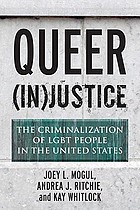
booknotes: queer (in)justice
The third installment in Beacon Press's Queer Action/Queer Ideas series, edited by Michael Bronski, Queer (In)justice: The Criminalization of LGBT People in the United States is co-authored by law professor Joey L. Mogul, police misconduct attorney Andrea J. Ritchie, and community organizer Kay Whitlock. Hanna saw it on the new book wall at the library and correctly ascertained it was the sort of title I'd be interested in. So she brought it home, I read it, and now I'm gonna blog about it.
Queer (In)justices is far more than an examination of the ways in which our legal system polices "deviant" gender and sexuality qua gender and sexuality. Yes, the authors look at the laws and policing practices related specifically to penalizing folks who engage in (publicly or privately) non-heteronormative sexual practices, or whose appearance suggests that they identify outside the gender/sex/sexuality binary. However, their analysis goes much deeper than these targeted laws. Instead, they argue that "the policing of sex and gender 'deviance' is central to notions of crime, and serves both as a tool of race-based law enforcement and as an independent basis for punishment" (xiii). In other words, notions about the relationship between non-normative sex and gender expression and criminality influence the way in which the legal system treats people perceived to be queer whether or not they are caught in the system specifically because of sex- or gender related policing. As they argue:
Being queer, or being perceived as queer can cause law enforcement officials to treat individuals as criminally guilty whether or not they actually are -- and can bring harsher punishments (when compared to those perceived as straight and gender conforming) when those individuals are sentenced. Likewise, criminal behavior is often associated -- implicitly or explicitly -- with sexual depravity. Using examples that will be familiar to anti-sexual harassment or anti-sexual violence activists, Mogul, Ritchie, and Whitlock describe how individuals known or perceived to be queer are treated by law enforcement officials as if they are incapable of being victims of sexual violence. They describe victims of same-sex domestic violence who themselves were put in jail or ruled incapable of being abused because of their orientation or gender identity.
Ultimately, Queer (In)justice argues that LGBT activists must take a much more comprehensive approach to their agitation for change within the framework of law and law enforcement. While much of the mainstream LGBT work in this area in recent years has involved the quest to enact anti-discrimination and anti-hate crime legislation, and to grant same-sex couples the right to marry, Mogul, Ritchie, and Whitlock point out that a much broader cultural shift within law enforcement must take place in order for such changes in the law to have an on-the-ground effect. As they write, "The hate crime framework is ... compromised by placing primary responsibility for preventing violence in the hands of a criminal legal system that is itself responsible for much LGBT violence" (129). We would do well, they seem to be pointing out, to pay closer attention to the experiences of those most vulnerable to police brutality, discrimination and abuse sanctioned by the legal system, and persecution based on presumptive criminality ... not just because of their sexual identity, but because their mere presence as a non-conforming body evokes powerful notions of danger and violence whether or not these reactions are warranted in specific instances. Comprehensive reform is needed before the passage of laws will have real-world implications for the majority of the LGBT population.
Queer (In)justice is a must-read for anyone who wants to re-consider the current LGBT approach to legal reform.
*This point is exactly why I am uneasy with Jim Wallis' argument that police force is preferable to military force. Wallis' assumption that police only use force when it is necessary to enforce agreed-upon laws ignores all of the situations in which law enforcement officials abuse the power vested in them ... something which, as a person who works in anti-poverty and anti-racism circles, Wallis ought to know full well.
Queer (In)justices is far more than an examination of the ways in which our legal system polices "deviant" gender and sexuality qua gender and sexuality. Yes, the authors look at the laws and policing practices related specifically to penalizing folks who engage in (publicly or privately) non-heteronormative sexual practices, or whose appearance suggests that they identify outside the gender/sex/sexuality binary. However, their analysis goes much deeper than these targeted laws. Instead, they argue that "the policing of sex and gender 'deviance' is central to notions of crime, and serves both as a tool of race-based law enforcement and as an independent basis for punishment" (xiii). In other words, notions about the relationship between non-normative sex and gender expression and criminality influence the way in which the legal system treats people perceived to be queer whether or not they are caught in the system specifically because of sex- or gender related policing. As they argue:
As queer identities substituted for individual perverse acts [in the late nineteenth century] the process of criminalizing sexual and gender nonconformity was facilitated through the construction of ever-shifting and evolving archetypal narratives [of deviance]. Rooted in historical representations of Indigenous peoples, people of color, and poor people as intrinsically deviant, fueled and deployed by mass media and cultural institutions, these narratives now permeate virtually every aspect of the criminal legal system (19).They make a compelling case for us to question the usefulness of narrowing our focus specifically on anti-gay laws, and on enacting new laws seeking to protect LGBT people from homophobia ... particularly when the very law enforcement officials meant to ensure those laws are respected are among the primary culprits when it comes to bigotry and violence around sexual and gender nonconformity. In chapters on gender and sex policing on the street, in the courtroom , in prison, and in uneven police responses to violence against LGBT people, we see how presumptions of criminality systematically influence how queer people are treated in the context of the legal system, whether they are perpetrators, victims, or both. They make the particularly important point that, regardless of what laws are officially on the books, "police and other law enforcement agents are given considerable latitude in deciding which laws to enforce, how to enforce them, and which people to target for law enforcement" (48).*
Being queer, or being perceived as queer can cause law enforcement officials to treat individuals as criminally guilty whether or not they actually are -- and can bring harsher punishments (when compared to those perceived as straight and gender conforming) when those individuals are sentenced. Likewise, criminal behavior is often associated -- implicitly or explicitly -- with sexual depravity. Using examples that will be familiar to anti-sexual harassment or anti-sexual violence activists, Mogul, Ritchie, and Whitlock describe how individuals known or perceived to be queer are treated by law enforcement officials as if they are incapable of being victims of sexual violence. They describe victims of same-sex domestic violence who themselves were put in jail or ruled incapable of being abused because of their orientation or gender identity.
Ultimately, Queer (In)justice argues that LGBT activists must take a much more comprehensive approach to their agitation for change within the framework of law and law enforcement. While much of the mainstream LGBT work in this area in recent years has involved the quest to enact anti-discrimination and anti-hate crime legislation, and to grant same-sex couples the right to marry, Mogul, Ritchie, and Whitlock point out that a much broader cultural shift within law enforcement must take place in order for such changes in the law to have an on-the-ground effect. As they write, "The hate crime framework is ... compromised by placing primary responsibility for preventing violence in the hands of a criminal legal system that is itself responsible for much LGBT violence" (129). We would do well, they seem to be pointing out, to pay closer attention to the experiences of those most vulnerable to police brutality, discrimination and abuse sanctioned by the legal system, and persecution based on presumptive criminality ... not just because of their sexual identity, but because their mere presence as a non-conforming body evokes powerful notions of danger and violence whether or not these reactions are warranted in specific instances. Comprehensive reform is needed before the passage of laws will have real-world implications for the majority of the LGBT population.
Queer (In)justice is a must-read for anyone who wants to re-consider the current LGBT approach to legal reform.
*This point is exactly why I am uneasy with Jim Wallis' argument that police force is preferable to military force. Wallis' assumption that police only use force when it is necessary to enforce agreed-upon laws ignores all of the situations in which law enforcement officials abuse the power vested in them ... something which, as a person who works in anti-poverty and anti-racism circles, Wallis ought to know full well.
2011-01-13
booknotes: same difference
Same Difference: How Gender Myths Are Hurting Our Relationships, Our Children, and Our Jobs, by Rosalind Barnett and Caryl Rivers (New York: Basic Books, 2004) is the latest in a series of books I've read in the past year on the science of quantifying and categorizing sex and gender difference. (For links to the other titles, see the end of the post). Written earlier than most of the others I've reviewed so far, Same Difference was also the least satisfying of all the books to date. While some of that may have to do with "subject fatigue" (that is, they're going over ground that is now very familiar to me), I also felt that in their attempt to make a persuasive and readable argument concerning the mis-use of science to support the theory of innate sex and gender difference, they missed some key nuances and distinctions between what certain researchers claim and what the public hears.
For example, they open with a chapter on the work of Carol Gilligan, an extremely well-known and prolific research psychologist who, in the 1970s, was a pioneer in the field of women's psychology. As a bit of historical background, it's important to know that Gilligan began her academic career at a time when the majority of studies involving humans took men and male bodies as the starting point -- the norm. Then, when female bodies failed to conform to predictions (made based on a pool of male research subjects), women would be classified as abnormal. It was also a period during which the influence of American Freudian psychology was only just starting to be challenged by alternative ways of understanding human behavior. Gilligan, in a break from the faculy supervisors with whom she worked as a graduate student, insisted that in order to make claims about women's behavior and psychological health, actual women would need to be studied. Which is what she went on to do. She also argued that those aspects of humanity traditionally thought of as "feminine" (and often pathologized or otherwise denigrated) actually played an important role in society. Caring and empathy, for example, should not be seen as a sign of weakness -- but a quality of human interaction that is as important as making rational judgments or prioritizing actions. To us this sounds simplistic, but at the time Gilligan offered a psychological framework encouraged people to value behaviors that are disproportionately found among women, or associated with women.
Now, I should make it clear that I have only ever read excerpts of Gilligan's most influential work, In a Different Voice (1982). But I have read her more recent The Birth of Pleasure (2002), and I have certainly read about her research. The distinction Barnett and Rivers fail to make in their assessment of Gilligan is between observations concerning human behavior or socialization and conclusions drawn from that behavior concerning innate preferences or abilities. In The Birth of Pleasure, Gilligan makes value judgments about certain types of behavior, and suggests that women have learned to be better care-takers then men (on average). However, the whole point of the book -- as I remember it -- is to encourage men to value and learn from women these care-taking, empathic skills. Gilligan is therefore making an argument about socialization (nuture) rather than innate "hard-wiring" (nature). Yes Barnett and Rivers fail to distinguish the popularization of Gilligans work (which used it to support "hard-wiring" arguments) from Gilligan's actual thesis.
Similarly, in the chapter on Mary Pipher's Reviving Ophelia (1994), the authors blur the boundaries between Pipher's own arguments and the public reaction to the book. Barnett and Rivers suggest that the evidence does not bear out Pipher's "anecdotal" assessment of adolescent girls' crisis in self-confidence. Now, I read the book when it first came out, as an adolescent girl myself - as well as two counter-publications, Ophelia Speaks and Sense of Self, both of which were "holla-back" type responses to Pipher's characterization of young women under seige from a toxic, misogynist culture. (She doesn't explicitly use feminist language in Reviving Ophelia, but her assessment of American culture is an essentially feminist one; I count RO as one of the texts that introduced me to feminist cultural analysis.)
So as a reader who at the time was a member of the very group Pipher was supposedly describing, I think Barnett and Rivers are ignoring or down-playing the key aspect of Pipher's argument: i.e. that it was the toxic culture not the girls' sex or gender identity that precipitated the crisis. Whereas previous theories about teenage girls' psycho-sexual development (Freud anyone?) might have characterized adolescent girls as problematic or vulnerable because of their inherent nature qua female, Pipher was saying: "Look at the toxic cultural messages these young women are getting about what it means to be female!"
I should be clear here that I certainly didn't see myself in the "Ophelias" Pipher described -- though I knew plenty of friends who were struggling with issues similar to Pipher's troubled patients. And I identified with certain aspects of the young women whom she idenfied as having successfully distanced themselves from many of those toxic messages, and had found a way to thrive. Once again, Barnett and Rivers are confusing the cultural reception of an author's work -- which really did verge on the hysterical and essentialist ("omg girls can't handle the realities of the adult world! they must be sheltered!") -- from what the author is actually arguing. And what she argued was much less essentialist than it was a critique of misogyny in our culture, which (for obvious reasons) often comes down like a shit-ton of bricks on the backs of young women when they hit puberty and start moving through the world as more obviously female-bodied persons.
In addition to this skewed glossing-to-make-a-point reading of authors I am familiar with, it was frustrating to have sex and gender difference discussed so consistently in heteronormative terms. Assumptions of sex difference permeate our beliefs about sexual orientation and gender identity. It is beliefs about the innate and oppositional differences between "men" and "women" that feed the resistence to accepting trans* peoples' self-definitions. Our cultural stereotypes of lesbian women as inherently more masculine and gay men as inherently more feminine derive from assumptions about how straight men and women behave (and the belief that if you're attracted to men, for example, you must therefore resemble the profile of the prototype group that is attracted to men: straight women). Barnett and Rivers fail to address these issues entirely.
Which isn't to say I did not enjoy the roasting Same Difference gave to many authors whose work is patently essentialist at its very core: John Gray (Men are From Mars, Women Are From Venus), for example, and Deborah Tannen (You Just Don't Understand), both of whom take the idea of "difference" to such an extreme that they assume men and women cannot and never will be able to successfully communicate and have meaningful relationships. And people such as Lionel Tiger and David Blankenhorn who believe that the blending of gender roles (fathers taking a more active role in parenting their children, for example) will damage men and ultimately be the downfall of civilization.
I also appreciated the fact that each chapter wraps up by talking in concrete terms about how these ideas about difference are influencing the way Americans live their lives, and often causing us real material harm. Often, analysis of scholarship can come across as squabbles between academics. By contrast, Barnett and Rivers take pains to point out that ideas have real-life consequences. For example, if a woman believes that she -- and only she -- is qualified to care for the children she gives birth to, it may cause her to give up a successfull and enjoyable career over the protests of her husband (who is willing to be the primary stay-at-home parent), making them both miserable and causing financial and emotional strain for the entire family. Powerful ideas -- especially when they're supposedly backed up by the cultural authority of "science" -- can constrain peoples' willingness to experiment with non-normative family arrangements that may suit individual couples better than a cookie-cutter approach.
The verdict? Worth skimming if this is an area of interest to you, but for an in-depth analysis of the actual research involved (and why it's shite), I'd recommend any of the other books I've read so far. You can find all the links in my post about Cordelia Fine's Delusions of Gender.
For example, they open with a chapter on the work of Carol Gilligan, an extremely well-known and prolific research psychologist who, in the 1970s, was a pioneer in the field of women's psychology. As a bit of historical background, it's important to know that Gilligan began her academic career at a time when the majority of studies involving humans took men and male bodies as the starting point -- the norm. Then, when female bodies failed to conform to predictions (made based on a pool of male research subjects), women would be classified as abnormal. It was also a period during which the influence of American Freudian psychology was only just starting to be challenged by alternative ways of understanding human behavior. Gilligan, in a break from the faculy supervisors with whom she worked as a graduate student, insisted that in order to make claims about women's behavior and psychological health, actual women would need to be studied. Which is what she went on to do. She also argued that those aspects of humanity traditionally thought of as "feminine" (and often pathologized or otherwise denigrated) actually played an important role in society. Caring and empathy, for example, should not be seen as a sign of weakness -- but a quality of human interaction that is as important as making rational judgments or prioritizing actions. To us this sounds simplistic, but at the time Gilligan offered a psychological framework encouraged people to value behaviors that are disproportionately found among women, or associated with women.
Now, I should make it clear that I have only ever read excerpts of Gilligan's most influential work, In a Different Voice (1982). But I have read her more recent The Birth of Pleasure (2002), and I have certainly read about her research. The distinction Barnett and Rivers fail to make in their assessment of Gilligan is between observations concerning human behavior or socialization and conclusions drawn from that behavior concerning innate preferences or abilities. In The Birth of Pleasure, Gilligan makes value judgments about certain types of behavior, and suggests that women have learned to be better care-takers then men (on average). However, the whole point of the book -- as I remember it -- is to encourage men to value and learn from women these care-taking, empathic skills. Gilligan is therefore making an argument about socialization (nuture) rather than innate "hard-wiring" (nature). Yes Barnett and Rivers fail to distinguish the popularization of Gilligans work (which used it to support "hard-wiring" arguments) from Gilligan's actual thesis.
Similarly, in the chapter on Mary Pipher's Reviving Ophelia (1994), the authors blur the boundaries between Pipher's own arguments and the public reaction to the book. Barnett and Rivers suggest that the evidence does not bear out Pipher's "anecdotal" assessment of adolescent girls' crisis in self-confidence. Now, I read the book when it first came out, as an adolescent girl myself - as well as two counter-publications, Ophelia Speaks and Sense of Self, both of which were "holla-back" type responses to Pipher's characterization of young women under seige from a toxic, misogynist culture. (She doesn't explicitly use feminist language in Reviving Ophelia, but her assessment of American culture is an essentially feminist one; I count RO as one of the texts that introduced me to feminist cultural analysis.)
So as a reader who at the time was a member of the very group Pipher was supposedly describing, I think Barnett and Rivers are ignoring or down-playing the key aspect of Pipher's argument: i.e. that it was the toxic culture not the girls' sex or gender identity that precipitated the crisis. Whereas previous theories about teenage girls' psycho-sexual development (Freud anyone?) might have characterized adolescent girls as problematic or vulnerable because of their inherent nature qua female, Pipher was saying: "Look at the toxic cultural messages these young women are getting about what it means to be female!"
I should be clear here that I certainly didn't see myself in the "Ophelias" Pipher described -- though I knew plenty of friends who were struggling with issues similar to Pipher's troubled patients. And I identified with certain aspects of the young women whom she idenfied as having successfully distanced themselves from many of those toxic messages, and had found a way to thrive. Once again, Barnett and Rivers are confusing the cultural reception of an author's work -- which really did verge on the hysterical and essentialist ("omg girls can't handle the realities of the adult world! they must be sheltered!") -- from what the author is actually arguing. And what she argued was much less essentialist than it was a critique of misogyny in our culture, which (for obvious reasons) often comes down like a shit-ton of bricks on the backs of young women when they hit puberty and start moving through the world as more obviously female-bodied persons.
In addition to this skewed glossing-to-make-a-point reading of authors I am familiar with, it was frustrating to have sex and gender difference discussed so consistently in heteronormative terms. Assumptions of sex difference permeate our beliefs about sexual orientation and gender identity. It is beliefs about the innate and oppositional differences between "men" and "women" that feed the resistence to accepting trans* peoples' self-definitions. Our cultural stereotypes of lesbian women as inherently more masculine and gay men as inherently more feminine derive from assumptions about how straight men and women behave (and the belief that if you're attracted to men, for example, you must therefore resemble the profile of the prototype group that is attracted to men: straight women). Barnett and Rivers fail to address these issues entirely.
Which isn't to say I did not enjoy the roasting Same Difference gave to many authors whose work is patently essentialist at its very core: John Gray (Men are From Mars, Women Are From Venus), for example, and Deborah Tannen (You Just Don't Understand), both of whom take the idea of "difference" to such an extreme that they assume men and women cannot and never will be able to successfully communicate and have meaningful relationships. And people such as Lionel Tiger and David Blankenhorn who believe that the blending of gender roles (fathers taking a more active role in parenting their children, for example) will damage men and ultimately be the downfall of civilization.
I also appreciated the fact that each chapter wraps up by talking in concrete terms about how these ideas about difference are influencing the way Americans live their lives, and often causing us real material harm. Often, analysis of scholarship can come across as squabbles between academics. By contrast, Barnett and Rivers take pains to point out that ideas have real-life consequences. For example, if a woman believes that she -- and only she -- is qualified to care for the children she gives birth to, it may cause her to give up a successfull and enjoyable career over the protests of her husband (who is willing to be the primary stay-at-home parent), making them both miserable and causing financial and emotional strain for the entire family. Powerful ideas -- especially when they're supposedly backed up by the cultural authority of "science" -- can constrain peoples' willingness to experiment with non-normative family arrangements that may suit individual couples better than a cookie-cutter approach.
The verdict? Worth skimming if this is an area of interest to you, but for an in-depth analysis of the actual research involved (and why it's shite), I'd recommend any of the other books I've read so far. You can find all the links in my post about Cordelia Fine's Delusions of Gender.
2010-12-16
from the archive: "queen everett"
One of the things I love about working in an archive is the serendipity: the way a search for something else entirely can lead you into a gem of a story that takes you in a whole new direction. This certainly isn't unique to the archival world -- but it's something that historians and archivists tend to start talking about together when they're in the same room long enough!
Earlier this week, while hunting down the location of a photograph we had scanned several years ago at Northeastern but failed to properly identify, I was going through a folder of images from Northeastern's annual Winter Carnival from the 1960s and 70s. Many of the photographs were of the individuals nominated for the position of Winter Carnival Queen -- sort of the spring term equivalent of a Homecoming Queen. Lots of 8 x 10 glossies of young women posed alone and in groups, in winter coats throwing snowballs, in ball gowns and (in the case of the girls who won) a sparkling tiara.
Then I came to a small yellowed clipping that featured a photograph of the five young women nominated in 1971 ... and the young man, Everett Nau, who had been crowned the Winter Carnival Queen of 1970. The brief caption to the photograph read (in part)
So I did a little digging, and here (gentle readers) is what I found out about Everett Nau (class of '71) and his reign as Winter Carnival Queen of 1970.
Nau was an Education major, member of the campus ROTC, columnist for the student newspaper, self-identified as "moderate-right" in political leanings ... and also self-identified as male-gendered person.
It appears that Everett's original nomination barely caused a stir on Northeastern's campus -- most likely because the nominee himself seemed to view the event as something of a lark. The campus newspaper, Northeastern News, offered a full-page spread of photographs showcasing the five nominees on 23 January 1970 (page 5); Everett -- like all the other candidates -- is shown in a formal head-and-shoulders portrait and more informal poses. It is in these informal shots that Everett's gender is highlighted -- whereas the women's photographs bear a resemblance to fashion photographs, Everett is pictured dressed in his ROTC uniform, rifle in hand: we are clearly meant to read him as masculine. Yet at that moment, this masculinity did not seem to be a barrier to nomination.
And a few weeks later, it was not a barrier to being crowned Winter Carnival Queen.
Once he'd actually been crowned, "Queen Everett" became a bit of an overnight sensation, the Northeastern News reported (13 February 1970). He was interviewed by newspapers and radio shows nationwide and appearing in news stories as far away as Paris. The 6' 5" newlywed (as the newspaper described him) was invited to appear on a game show called To Tell the Truth in which a panel of four celebrities were challenged to identify the true "Queen Everett" among a group of three men (the real Everett and two imposters).
While Nau's gender was seen as something of an oddity in the context of the Winter Carnival Queen competition, what is striking to a modern-day reader of the newspaper coverage is that his nomination and crowning were not portrayed at the time as any sort of deliberate attempt to disrupt conventional gender roles. Nau's gender or sexuality is not questioned, and it is only in the aftermath that male candidates are ruled ineligible.
I've been unable thus far to find any record of why the post-facto changes in the competition rules were made; I'd be really interested to know who felt Nau's presence was a threat and why. In the midst of a turbulent year of student protests, women's liberation, antiwar activism and other upheavals, Nau was hardly positioning himself as a radical -- his column for the student paper regularly admonished his fellow students for their disruptive activities (and, as I said, self-identified as "moderate-right" in his politics). This was not some gender-bending longhair out to mock the system. Which makes makes me that much more inclined to believe that the subsequent rule changes had much more to do with peoples' underlying discomfort with cross-gender categorization than Nau as some sort of radical.
Amazing what lengths we will go to preserve the binary gender system.
Earlier this week, while hunting down the location of a photograph we had scanned several years ago at Northeastern but failed to properly identify, I was going through a folder of images from Northeastern's annual Winter Carnival from the 1960s and 70s. Many of the photographs were of the individuals nominated for the position of Winter Carnival Queen -- sort of the spring term equivalent of a Homecoming Queen. Lots of 8 x 10 glossies of young women posed alone and in groups, in winter coats throwing snowballs, in ball gowns and (in the case of the girls who won) a sparkling tiara.
Then I came to a small yellowed clipping that featured a photograph of the five young women nominated in 1971 ... and the young man, Everett Nau, who had been crowned the Winter Carnival Queen of 1970. The brief caption to the photograph read (in part)
NAU GOOD LUCK GIRLS ... Everett Nau, last year's Winter Carnival Queen, bestows his best wishes upon this year's recently selected finalists (all girls if you'll notice). ... In this year's campaign, the judges ruled it mandatory that the contestants be of the female gender.Well, how could I possibly leave it at that?
So I did a little digging, and here (gentle readers) is what I found out about Everett Nau (class of '71) and his reign as Winter Carnival Queen of 1970.
![]() |
| Nominees for Winter Queen, 1971 Linda Clare, Kathy McCarthy, Marie Petralia, Delio Pio, and Everett Nau (image in Northeastern's Historical Photographs digital collection) |
It appears that Everett's original nomination barely caused a stir on Northeastern's campus -- most likely because the nominee himself seemed to view the event as something of a lark. The campus newspaper, Northeastern News, offered a full-page spread of photographs showcasing the five nominees on 23 January 1970 (page 5); Everett -- like all the other candidates -- is shown in a formal head-and-shoulders portrait and more informal poses. It is in these informal shots that Everett's gender is highlighted -- whereas the women's photographs bear a resemblance to fashion photographs, Everett is pictured dressed in his ROTC uniform, rifle in hand: we are clearly meant to read him as masculine. Yet at that moment, this masculinity did not seem to be a barrier to nomination.
And a few weeks later, it was not a barrier to being crowned Winter Carnival Queen.
Once he'd actually been crowned, "Queen Everett" became a bit of an overnight sensation, the Northeastern News reported (13 February 1970). He was interviewed by newspapers and radio shows nationwide and appearing in news stories as far away as Paris. The 6' 5" newlywed (as the newspaper described him) was invited to appear on a game show called To Tell the Truth in which a panel of four celebrities were challenged to identify the true "Queen Everett" among a group of three men (the real Everett and two imposters).
While Nau's gender was seen as something of an oddity in the context of the Winter Carnival Queen competition, what is striking to a modern-day reader of the newspaper coverage is that his nomination and crowning were not portrayed at the time as any sort of deliberate attempt to disrupt conventional gender roles. Nau's gender or sexuality is not questioned, and it is only in the aftermath that male candidates are ruled ineligible.
I've been unable thus far to find any record of why the post-facto changes in the competition rules were made; I'd be really interested to know who felt Nau's presence was a threat and why. In the midst of a turbulent year of student protests, women's liberation, antiwar activism and other upheavals, Nau was hardly positioning himself as a radical -- his column for the student paper regularly admonished his fellow students for their disruptive activities (and, as I said, self-identified as "moderate-right" in his politics). This was not some gender-bending longhair out to mock the system. Which makes makes me that much more inclined to believe that the subsequent rule changes had much more to do with peoples' underlying discomfort with cross-gender categorization than Nau as some sort of radical.
Amazing what lengths we will go to preserve the binary gender system.
2010-12-07
movienotes: life with father (1947)
Last night, Hanna and I took a couple of hours out of our evening to screen the 1947 William Powell / Irene Dunn film Life With Father. Why did we do this? We were looking for something holiday-centric (Holiday Inn, Miracle on 34th Street) but came up dry ... and decided to give this a try instead. While I can't say it was an unqualified "win," I definitely found myself fascinated by the entire package for a variety of reasons.
First, the original trailer.
This film is wrong on so many levels I'm only going to hit the highlights in hopes of encouraging you to check it out. Why? Because I think films from previous eras, much like our own, are fascinating windows into the normative pressures of certain periods in time.
In this case, the way in which American cinema in the postwar era was enlisted to construct a certain narrative of gender, of family, of class, and of the American past. This film is further complicated by the fact that it is a costume drama: it employees the collective memory of/nostalgia for a bygone era -- in this case, a particular understanding of upper-middle-class New York City in the 1880s.
So, a few observations.
1) According to this film, men make and understand money while women spend money without any ability to understand finance. The titular father of the film (played by William Powell) is a banker and supports his wife and four sons in a luxurious townhouse complete with servants. Nevertheless, he and his wife (Irene Dunn) constantly bicker about the household budget which "mother" is incapable of managing in the manner which her husband believes is appropriate. Some of the best comic exchanges in the movie, in fact, revolve around Father attempting to get Mother to explain how she has spent the money he has given her, and Mother attempting earnestly to account for her purchases. This trope of gender differentiation is employed for comic value without ever being challenged. Neverthess, it's fascinating to watch how blatently the paternalism is.
2) The whole movie is worth watching for the scene where Father explains to Jr. all he needs to know about women. When the eldest son falls in love with a young Elizabeth Taylor (only three years after her breakout role in National Velvet) Father takes him aside to explain a thing or two about women. What follows is instruction in how to avoid women's advances, what to do when they cry, and a stern dismissal of Jr.'s (veiled) questions concerning heterosexual relations. I wish I had been taking notes at the time, because it really was self-parodying.
3) Making and breaking your promises is totally manly as long as you think your wife is dying. The central conflict in the film is, for reasons that defy my understanding, that Father has never been baptized and Mother is convinced this means their marriage is invalid and that he will go to hell. So she extracts promises from him to be baptized, all of which he breaks until (spoiler) the very end, of course, when he finally capitulates and the whole family goes off together in a horse-drawn cab into the happily-ever-after. The thing that struck me was the fact that every time Father promises to be baptized, he is inevitably extending the promise as a way to get Mother to do something (or stop doing something) he wants (or doesn't want) ... including die. Then, when the situation ceases to irritate him, or distress him, he immediately retracts the promise. It made me think of Toad of Toad Hall in the Wind in the Willows protesting, "Oh, in there! I would have said anything in there!"
4) Women (and to some extent children) care only about men as providers. This is an extention of the first point about women and math: the narrative of the entire film, to some extent, could be read in terms of consumption. The children want new clothes and toys. The mother wants jewelry. The household must be provided for. Friends come to the city to go shopping. And Father, above all, spends the entire film fretting about how much his family is spending of "his" money. The entire household, he feels (and often says -- though perhaps not in so many words) should be arranged around his needs and desires as the wage-earner. And instead, his life is "controlled" by his wife and children who spend all his money and disrupt his peace, giving him very little gratitude in return. This resentment was at the forefront of postwar gender politics, and I don't think it's a mistake that this narrative is so blatant. I'd argue it says more about the era in which it was made than the era it was made about.
5) Religion is the sphere of women and children. Similar to the narrative of money and gender, the narrative of religion and gender is at once drawing upon 19th-century notions of women's particular piety and purity and twentieth-century, postwar perceptions of religion as a particularly feminine practice. The central tension in the film revolves around the discovery that Father has never been baptized (into the Episcopal Church ... the main rift in the film appears to be between Methodists and Episcopalians; any holy rollers or other non-mainstream, and/or non-protestant religious groups, including Catholics, are entirely absent). Mother is appalled and distressed by this revelation, fearing for her husband's immortal soul as well as for the sanctity of their marriage. Father insists that baptism is a formality, a waste of time, and resists the pressure of his wife for most of the two hours before finally surrendering to her desires and thus restoring unity back to the household.
The centrality of religious practice -- if not the more personalized faith we've become used to in recent years -- is startling to see on the big screen, incorporated into the narrative of what it means to be a White, middle-class, urban family.
That's about all I've got at the moment. You can check the film out on Netflix streaming or free through the Internet Archive's Moving Image Archive: Feature Films collection.
First, the original trailer.
This film is wrong on so many levels I'm only going to hit the highlights in hopes of encouraging you to check it out. Why? Because I think films from previous eras, much like our own, are fascinating windows into the normative pressures of certain periods in time.
In this case, the way in which American cinema in the postwar era was enlisted to construct a certain narrative of gender, of family, of class, and of the American past. This film is further complicated by the fact that it is a costume drama: it employees the collective memory of/nostalgia for a bygone era -- in this case, a particular understanding of upper-middle-class New York City in the 1880s.
So, a few observations.
1) According to this film, men make and understand money while women spend money without any ability to understand finance. The titular father of the film (played by William Powell) is a banker and supports his wife and four sons in a luxurious townhouse complete with servants. Nevertheless, he and his wife (Irene Dunn) constantly bicker about the household budget which "mother" is incapable of managing in the manner which her husband believes is appropriate. Some of the best comic exchanges in the movie, in fact, revolve around Father attempting to get Mother to explain how she has spent the money he has given her, and Mother attempting earnestly to account for her purchases. This trope of gender differentiation is employed for comic value without ever being challenged. Neverthess, it's fascinating to watch how blatently the paternalism is.
2) The whole movie is worth watching for the scene where Father explains to Jr. all he needs to know about women. When the eldest son falls in love with a young Elizabeth Taylor (only three years after her breakout role in National Velvet) Father takes him aside to explain a thing or two about women. What follows is instruction in how to avoid women's advances, what to do when they cry, and a stern dismissal of Jr.'s (veiled) questions concerning heterosexual relations. I wish I had been taking notes at the time, because it really was self-parodying.
3) Making and breaking your promises is totally manly as long as you think your wife is dying. The central conflict in the film is, for reasons that defy my understanding, that Father has never been baptized and Mother is convinced this means their marriage is invalid and that he will go to hell. So she extracts promises from him to be baptized, all of which he breaks until (spoiler) the very end, of course, when he finally capitulates and the whole family goes off together in a horse-drawn cab into the happily-ever-after. The thing that struck me was the fact that every time Father promises to be baptized, he is inevitably extending the promise as a way to get Mother to do something (or stop doing something) he wants (or doesn't want) ... including die. Then, when the situation ceases to irritate him, or distress him, he immediately retracts the promise. It made me think of Toad of Toad Hall in the Wind in the Willows protesting, "Oh, in there! I would have said anything in there!"
4) Women (and to some extent children) care only about men as providers. This is an extention of the first point about women and math: the narrative of the entire film, to some extent, could be read in terms of consumption. The children want new clothes and toys. The mother wants jewelry. The household must be provided for. Friends come to the city to go shopping. And Father, above all, spends the entire film fretting about how much his family is spending of "his" money. The entire household, he feels (and often says -- though perhaps not in so many words) should be arranged around his needs and desires as the wage-earner. And instead, his life is "controlled" by his wife and children who spend all his money and disrupt his peace, giving him very little gratitude in return. This resentment was at the forefront of postwar gender politics, and I don't think it's a mistake that this narrative is so blatant. I'd argue it says more about the era in which it was made than the era it was made about.
5) Religion is the sphere of women and children. Similar to the narrative of money and gender, the narrative of religion and gender is at once drawing upon 19th-century notions of women's particular piety and purity and twentieth-century, postwar perceptions of religion as a particularly feminine practice. The central tension in the film revolves around the discovery that Father has never been baptized (into the Episcopal Church ... the main rift in the film appears to be between Methodists and Episcopalians; any holy rollers or other non-mainstream, and/or non-protestant religious groups, including Catholics, are entirely absent). Mother is appalled and distressed by this revelation, fearing for her husband's immortal soul as well as for the sanctity of their marriage. Father insists that baptism is a formality, a waste of time, and resists the pressure of his wife for most of the two hours before finally surrendering to her desires and thus restoring unity back to the household.
The centrality of religious practice -- if not the more personalized faith we've become used to in recent years -- is startling to see on the big screen, incorporated into the narrative of what it means to be a White, middle-class, urban family.
That's about all I've got at the moment. You can check the film out on Netflix streaming or free through the Internet Archive's Moving Image Archive: Feature Films collection.
2010-09-30
quick hit: men + books
My friend Danika @ The Lesbrarian alerted me to this blog post at The New Yorker: What We Talk About When We Talk About Men Not Reading by Macy Halford @ The Book Bench. The post was written in response to a recent article in Publisher's Weekly about the body count in the publishing industry: the fact that there are more women in the book trade then men. They speculate, "does the lack of men in publishing hurt the industry?" meaning, does the higher proportion of women in publishing mean that fewer books of interest to men will be published? (queue hand-wringing).
This anxiety, of course, could be situated within the context of conservative fears that feminism and/or economic and political gains for women equals a loss for men (as if it were a zero-sum game). More specifically, though, Halford situates this article within late-twentieth century anxieties about whether boys and men, in fact, read books -- and if they do, what kind of books they read.
What if, instead of being preoccupied about the gender of the people choosing books, we asked (for example) about their expertise in certain fields of nonfiction and literature? Their depth or breadth of knowledge about (for example) science fiction and fantasy literature? graphic novels? genre romances? nonfiction military histories? science journalism? I have known women and men who read and enjoy all of these categories of printed matter, and who are knowledgeable about current trends.
Yet despite our own anecdotal experience (which, I admit, cannot stand in place of solid social science analysis) that the individual men and boys in our lives do, in fact, read -- and read across a great variety of publication type, writing style, and subject matter -- the idea that men and women approach reading differently is a powerful narrative because gender in our culture is a powerful organizing narrative. We take for granted that men and women are innately different, and so it makes "sense" according to our narrative of the world that women and men would read differently, and read different things. Sadly (or happily, depending on your point of view!) the fact that this is a powerful story that we tell ourselves, and that it makes sense does not also make it right or useful.
I just finished reading a book on brain organization theory by sociomedical scientist Rebecca Jordan-Young called Brain Storm: The Flaws in the Science of Sex Differences. I plan to write up a booknote on Brain Storm once I've digested it a little more, but for now the point I want to make is this: the scientific evidence we currently have to support the commonplace idea that male and female brains are differently organized (and thus process the world, including books and reading) differently because of their sex is weak at best and often poorly-conducted and poorly-reported science. This is not to say differences in brain organization have been categorically disproved -- it simply means that there is no solid evidence to support what most Americans understand to be proven fact.
Which brings me back to men + books. Since we're primed to believe there's a difference between men and women when it comes to reading habits, we see statistics like the gender imbalance in the publishing industry and it fits with our expectations concerning men and reading to interpret that imbalance as somehow related to men's (supposed) disinterest in books, or interest in different books than those women are interested in. We construct a gender-based explanations, rather than stopping to ask a) if the imbalance is problematic, and b) if so, how is it problematic? rather than assuming we already know.
My friend Danika @ The Lesbrarian alerted me to this blog post at The New Yorker: What We Talk About When We Talk About Men Not Reading by Macy Halford @ The Book Bench. The post was written in response to a recent article in Publisher's Weekly about the body count in the publishing industry: the fact that there are more women in the book trade then men. They speculate, "does the lack of men in publishing hurt the industry?" meaning, does the higher proportion of women in publishing mean that fewer books of interest to men will be published? (queue hand-wringing).
![]() |
| Man watching books by Davide Rappucci @ Flickr.com |
The article does nod at the problems of low pay and "gendered jobs" (and doesn't nod at the fact that there are indeed many books "for men" published each year), but if we're going to continue having this conversation, and it seems that we are, I think we should stop conflating the issues, of which there are four, at least:
- Reading practices among men.
- What gets published and what doesn't (and the reasoning behind it).
- Low-paying, dead-end entry-level jobs in publishing (and the structuring of the entire industry).
- Women being willing to take these jobs and men not being willing and/or senior editors' hiring practices.
Each of these needs more serious investigation before we can draw any conclusions, but I'm fairly certain that, however low reading rates among men are, the blame for them can't be laid at the feet of the army of female assistants. So let's stop talking about them as if they could.
A couple of observations I would add to Halford's (really good) list of things we need to think about when we think about boys and men reading.
The first is the fact that these conversations about boys and men reading are curiously separated from the conversations about men writing, and that both of these conversations about men + books are ahistorical. With all the brouhaha recently surrounding Jonathan Franzen's place in the American literary scene and the way we gender writing (by style, by genre, by level of "serious" literary merit), it seems clear to me that as a culture we sex-type the activities of writing and reading, expecting different types of writing and reading from individual people based on their gender. Yet most of these conversations in the mainstream media take as a common sense fact that male and female human beings approach these activities differently, rather than questioning the belief that one's sex, gender, and (implicitly) perhaps one's sexuality shapes one's reading and writing habits. In scholarly terms, this is known as "denaturalization": taking something that we assume to be "natural" or "innate" and examining how and why we have come to this belief, and whether it is, in fact, true according to the evidence.
A little awareness of historical change over time might aid the cause of this denaturalization. Today, for example, it is "common sense" that men prefer non-fiction to fiction; in the late 18th and early 19th century fiction was considered dangerous for women's physical and moral well-being. Reading was coded as a masculine activity; now it is coded feminine. The fact that we have seen a shift over time in our understanding of how reading and gender relate suggests that what we believe to be true about men and their relationship (or non-relationship) to books and reading is at least in part culturally constructed.
Which leads me to my second observation: the fact that the assumption underlying the majority of these stories about men + books is that books for "men" and books for "women" are two distinct categories. Or, at the very least, that they are highly differentiated: perhaps overlapping a bit in the muddy middle, but on the whole make up an industry that is sex-typed by shelves of books for "him" and shelves of books for "her." If we didn't believe that gender mattered in relation to reading habits, then there would be no cause for alarm about the gender of the people involved in making publishing decisions -- aside from a concern about economic inequality.What if, instead of being preoccupied about the gender of the people choosing books, we asked (for example) about their expertise in certain fields of nonfiction and literature? Their depth or breadth of knowledge about (for example) science fiction and fantasy literature? graphic novels? genre romances? nonfiction military histories? science journalism? I have known women and men who read and enjoy all of these categories of printed matter, and who are knowledgeable about current trends.
Yet despite our own anecdotal experience (which, I admit, cannot stand in place of solid social science analysis) that the individual men and boys in our lives do, in fact, read -- and read across a great variety of publication type, writing style, and subject matter -- the idea that men and women approach reading differently is a powerful narrative because gender in our culture is a powerful organizing narrative. We take for granted that men and women are innately different, and so it makes "sense" according to our narrative of the world that women and men would read differently, and read different things. Sadly (or happily, depending on your point of view!) the fact that this is a powerful story that we tell ourselves, and that it makes sense does not also make it right or useful.
I just finished reading a book on brain organization theory by sociomedical scientist Rebecca Jordan-Young called Brain Storm: The Flaws in the Science of Sex Differences. I plan to write up a booknote on Brain Storm once I've digested it a little more, but for now the point I want to make is this: the scientific evidence we currently have to support the commonplace idea that male and female brains are differently organized (and thus process the world, including books and reading) differently because of their sex is weak at best and often poorly-conducted and poorly-reported science. This is not to say differences in brain organization have been categorically disproved -- it simply means that there is no solid evidence to support what most Americans understand to be proven fact.
Which brings me back to men + books. Since we're primed to believe there's a difference between men and women when it comes to reading habits, we see statistics like the gender imbalance in the publishing industry and it fits with our expectations concerning men and reading to interpret that imbalance as somehow related to men's (supposed) disinterest in books, or interest in different books than those women are interested in. We construct a gender-based explanations, rather than stopping to ask a) if the imbalance is problematic, and b) if so, how is it problematic? rather than assuming we already know.
2010-08-18
quick hit: defending one's manhood
My colleague, Jeremy, receives the print edition of The Atlantic magazine and I happened to notice, yesterday, the following query and response on the back page of the most recent issue (September 2010), in Jeffrey Goldberg's "What's Your Problem?" column.I’ve noticed that The Atlantic has become very anti-male lately. My proof lies in recent articles by Sandra Tsing Loh, Caitlin Flanagan, and of course Hanna Rosin, whose July/August cover story, “The End of Men,” argued that men will no longer be necessary as our economy changes. How do you protect your manhood while working at a magazine that is so hostile to men?
P. W., Chicago, Ill.
Dear P. W.,
I take active countermeasures to protect myself against the rampant feminization of The Atlantic. For instance, I eat only what I kill, except for sandwiches from Potbelly, which are killed by someone else. I also chop down the trees that provide the paper on which this magazine is printed, using only an extremely dull axe and my signature bad-ass attitude. Other prophylactic measures I employ include hiring Chuck Norris as a guest blogger, and then firing him, by fax, for being insufficiently manly; and using actual prophylaxis, in the form of a full-body condom I wear to protect myself from the effects of airborne estrogen. I also refuse to participate in the mandatory office-wide “All Guys Have to Wear Jimmy Choos on Fridays” morale-building exercise. And though I was ultimately forced to appear in The Atlantic’s staging of The Vagina Monologues, I purposefully delivered an indifferent performance as Eve Ensler’s labia.
As a feminist, I feel honor-bound to point out that Sandra Tsing Loh, Caitlin Flanagan, and Hanna Rosin are, in fact, often very anti-man (the scene from Parenthood where Dianne Wiest's character says to her daughter, just as her young son walks into the room, "Men are such jerks!" comes to mind) they are often anti-woman as well. Or rather, they tend to subscribe to very gender-essentialist concepts of what it means to be a man or a woman, neither of which serve human beings all that well.
The idea that being anti-male, anti-manhood, and "hostile to men" are all roughly equivalent positions is a fallacy anyway. As a feminist, I'm fairly anti-"womanhood" (since womanhood, in our culture, is a very specific type of cultural performance) and yet hardly anti-women or hostile to women as human beings. Nor do I have a problem with female-bodied persons.
Which is all to say, I love the way Goldberg plays up all the stereotypes of masculinity in his response. Because really, it's about the level of attention all of those articles -- and the concern they seem to have sparked -- deserve.
2010-07-24
quick hit: "oh, inversion. how I shake my fist at you"!
Danika @ The Lesbrary has a fun post up sharing notes from a conversation between herself and a friend Cass about Radclyffe Hall's The Well of Loneliness (1928). C[ass]: The term ‘homosexuality,’ while in use in 1928, didn’t yet have its modern definition or its now understood division from gender. Inversion, on the other hand, completly tied sexual orientation to one’s gender and gender expression. A person labelled female at birth could not, by defition, be an invert without displaying masculine traits and masculine leanings. Therefore, in order to be a novel ABOUT inversion, Stephen has to be masculine. If we are using our modern lens here, then we can agree that, despite her masculinity, Stephen is not automatically male. The fact that her parents gave her a traditionally male name is out of her control. Lots of girls who continue to identify as women like to dress in pants rather than dresses because they are easier to walk and play in. Looking “like a man” or being masculine doesn’t make a person a man.
The conversation with her father is trickier, but if she has a crush on a girl, and thinks that only men and women can have relationships together, it’s logical that she would want to be a man in order to be happily in love with a woman.
D[anika]: True, but coming from a modern perspective, that assumes that you are by default the gender you were assigned at birth and only the opposite if there is overwhelming evidence. We don’t have overwhelming evidence that Stephen would identify as a man, but we have a lot less evidence than there is for Stephen identifying as a woman. She can’t stand to even be around women, except the ones she falls in love with.
That makes sense, but it isn’t just around having a partner that Stephen is frustrated at being labelled a girl. In fact, as some point she said “Being a girl ruins everything” (not an exact quote)
C: [...] [H]er gender and gender expression can be on the trans-masculine spectrum without her necessarily being trans. In 1928(ish), being a girl DID ruin everything!
I think you are the gender you understand yourself to be, but sadly I can’t ask Stephen. ;)
Check out the whole thing at The Lesbrary (and if you enjoy part one, then check out part two posted by Cass @ Bounjour, Cass!).
2010-06-03
in which I have some thoughts on men, pregnancy, and parenting
There have been a couple stories in the news lately revolving around men and procreation that have caught my eye in the last couple of weeks, and due to the phenomenon known as "needing something to post about today" I thought I'd throw them together in a post and share a few thoughts about them -- or, more accurately, about the cultural narratives and expectations about men and manhood they represent.
The first is a post by Mary Elizabeth Williams @ Salon that provocatively asks whether "men have a right to choose an abortion," or, more accurately how much right they have to decide when and how to become a parent. Although she links to a story by Stephanie Fairyington @ Elle in which a man named George Bruell tried to pressure his girlfriend to have an abortion after she unexpectedly got pregnant after the couple (he thought) had agreed they didn't want to have children.
The Elle article contains a lot of crap from anti-feminist "men's rights activists" whose entire goal seems to be the struggle to free men from relational responsibilities supposedly forced upon their freewheeling selves by scheming women and their dependent children. Although updated for the 21st century, this is a narrative surprisingly reminiscent of virulently misogynistic views of women and families found in 1950s and 60s-era diatribes by men who were as unhappy with the postwar mythology of the Father Knows Best lifestyle as feminists, but rather than blame institutionalized sexism they blamed women and women's essentially domestic, acquisitive nature that required men to work long hours to support a suburban lifestyle.
Like these postwar misogynists, the "men's rights activists" in this story are not interested in dismantling sexist structures that warp expectations of heterosexual relationships; they're not interested in fighting for better reproductive justice for all -- they already think women have all the power and they feel aggrieved. As Fairyington writes of Mel Feit, head of the National Center for Men,
Feit’s list of grievances range from sexist social standards -- why should men still be expected to foot the bill on dates? Why is crying or showing weakness verboten for them? -- to what he considers discrimination enforced by the state: men’s lack of reproductive rights combined with unfair child support laws. "Reproductive choice isn’t a fundamental right if it’s only limited to people who have internal reproductive systems," Feit says. "If it only applies to women, it’s a limited right and that weakens it." In his view, Planned Parenthood’s motto -- "Every child a wanted child" -- should apply to both people who make the baby.
Most of these arguments, taken individually, are issues feminist have championed for years. The insidious problem with these grievances is not that (most of them) are inaccurate but that they are not connected to any analysis of the cultural construction of gender or understanding of institutionalized sexism. Or an awareness of how -- in our culture -- gender operates dualistically and women are disproportionately vulnerable in a world where patriarchal structures are still the default. This doesn't mean patriarchy doesn't hurt men too -- as feminists, male and female, remind us continually -- but it does mean that deconstructing masculinity and the expectations of men and manhood must be done with an awareness of women's position in the here-and-now-society. Men's rights activists seem to imply that somehow women, as a group, are (for example) forcing them to pay for dates, whereas most feminists wound point to our cultural construction of manliness that associates male power and sexual appeal with economic power to such an extent that feminist calls for an end to gendered dating expectations are usually met with anxious speculation about how feminists are trying to emasculate men. Ditto on the issue of crying and/or showing weakness.
Women as a group, in other words, are not these guys' biggest enemy. Their enemy is anyone (male or female) who supports oppositional, essentialist gender roles.
But back to the question of men, pregnancy and "choice." Here's what I have to say about men and the "right to choose."
1) The final decision whether or not to have an abortion is always the pregnant woman's. Like any medical procedure, it is the patient who needs to have the final say about what happens to her body. End of story. Obviously, this happens in the context of a medical profession in which doctors (ideally) advise patients about the full range of options available to them. Ideally a pregnant woman trying to decide whether to carry an unplanned or dangerous pregnancy to term would consult with her partner, family, friends, trusted religious adviser, therapist -- whomever she needs to help her make the best decision given the choices available. But at the end of the day, it's her body and therefore her decision to make. If the pregnant person is male-identified or in part male bodied, then the decision would be his. This isn't a gender-bias, it's a question of bodily integrity and who has a say about what happens or doesn't happen to your body.
2) Apart from abortion, men have as many options for preventing parenthood as women. If you don't want to get pregnant at a given time, with a given partner, take steps to prevent it. Men are not at the mercy of women in this arena. Here are some of the ways male-bodied persons can prevent pregnancy.
a) refrain from sexual activity that could result in pregnancy such as penetrative penis-in-vagina sex with women, or other types of sexual activity in which your sperm risks getting on or in a woman's vagina. The plus side to this method of pregnancy prevention is that it might encourage you to realize how many other types of sexual activity are out there to enjoy, either on your own or with a partner. One totally risk-free option for anyone who's bisexual is deciding you're only going to have sex with other men -- no chance of pregnancy there! Cunnilingus is another way to enjoy your partners body with no chance of sperm + egg = pregnancy. Look on this as a change to experiment and discover new forms of sexual pleasure.
b) use various types of birth control which hopefully you are already familiar with when it comes to prevention of sexually transmitted diseases. there's sadly no birth control pill yet on the market for men, but in the meantime you have condoms which are pretty damn reliable when used correctly and consistently. If you're sure you never want to have children, you can always decide to get a vasectomy which solves the accidental pregnancy problem in all but extremely rare cases and puts the choice of pregnancy prevention squarely in your hands.
c) this should go without saying but usually it doesn't, so I'm going to say it: COMMUNICATION is incredibly important to a satisfying sex life, and that includes doing everything you can to make sure you and your partners are on the same page when it comes to babymaking. Obviously, in situations like Bruell's story above, communication failed and people are now stuck with the messy real-life consequences. But good communication upfront can certainly prevent a great deal of messy post facto problems, just like securing enthusiastic consent to sexual activity helps prevent instances of sexual assault.
Finally, 3) While difficult, I do think it's viable (and not anti-feminist or anti-child) to create a legal framework for men to surrender parental rights and responsibilities up-front if a sexual partner with whom they are no longer involved decides to carry a pregnancy to term. As feminists, we have argued that it is the best-case scenario for parents and children when all children are wanted -- when parenthood is a role enthusiastically chosen and when children are cared for both by their primary caregivers and by society as a whole. Women who do not choose abortion have the option to surrender the child they birth either to an adoptive family or to the state system. This often isn't an ideal situation for the child, but it is a legal framework that recognizes that mothers sometimes feel the task of parenting to be beyond them.
There's a whole tangle of social and legal issues here relating to competing visions of a social welfare state and the responsibility of society as a whole to enable primary caregivers to parent -- but for the moment, let's assume the birth parent has chosen not to parent and wants to hand that responsibility over to someone else. Mothers who give birth can choose to surrender their parental rights and responsibilities legally, and I believe men should have similar legal options.
I just wish the men who are advocating for them wouldn't ask for them in a way that is hostile to women's basic right to bodily integrity and decisions surrounding their physical person. It shows a pretty stunning lack of awareness of reproductive rights and justice issues that Feit and company really ought to be engaged in, or at least aware of. Instead, they seem to have adopted the rhetoric of women's rights in much the same way Sarah Palin has taken to using the language of feminism -- to peddle a toxic tangle of misplaced misogynist resentment that lashes out at vulnerable targets rather than working to dismantle the sociocultural structures that constrain us all.
* * *
The second story comes from Amelia Hill @ The Guardian (hat tip to Hanna for the link). I knew we were in trouble from the opening sentence, "Expecting men to take an active role in their partner's pregnancy and attend the birth of their children can deskill them as potential fathers and damage paternal bonding, an expert has claimed." While I'm not an anti-intellectual, and I believe in the value of expertise (our highly complex modern world necessitates a certain amount of specialization), I'm always skeptical when an "expert" claims to have the final word on how a certain activity is going to affect complex human beings.
The disappointment and feeling of failure experienced by men expecting to have an intimate and proactive role as their baby gestates, only to find their function is largely one of passive support for their partner, can cause emotional shutdown, according to Dr Jonathan Ives, head of the Centre for Biomedical Ethics at the University of Birmingham.
"Having begun the fathering role already feeling a failure may destroy his confidence," Ives said. "It can then be very difficult for him to regain faith in himself once the baby is born and move from that passive state to being a proactive father. His role in the family is no longer clear to him. He effectively becomes deskilled as a parent and this can lead to problems bonding with the child."
Oh, I have so many issues with this way of understanding parenthood! "Support" for a pregnant partner is somehow the opposite of being "intimate" and active? Men are somehow incapable of grasping that their pre-natal and post-partum roles will, like women's, be different? Men as a general rule have so little self-confidence that being asked to do something like being present and supporting during pregnancy might actually destroy their ability to parent? And I have to say I'm baffled by the assumption that this feeling of inadequacy is unique to fathers -- it's always been my understanding that most parents, regardless of gender, feel profoundly inadequate for the task at hand.
And this might actually be a good thing, as the article (thankfully!) goes on to point out.
Adrienne Burgess, head of research at the Fatherhood Institute, said: "That experience of helplessness that Ives is saying is so dangerous, is, in fact, the perfect preparation for fatherhood: there are times as a parent when you can't do anything to help your baby, when it's crying all night and can't be soothed. Part of being a parent is being there for your partner and child without doing anything except providing love."
I just really want to emphasize what Burgess says here, because I think it highlights the chasm that exists between the neotraditional conception of masculinity and fatherhood that relies on rigid separation of male and female duties and a conception of masculinity and fatherhood that, well, relies on the notion that men are human beings capable of a full range of human responses. In the neotraditional version of masculinity, men must be protected at all costs from being made to feel helpless, from being (in a word) emasculated. Helplessness sets them up for "failure" and failure is so shameful and world-ending that men must avoid it at all costs -- up to and including the cost of not being present to their partner during pregnancy and at their child's birth.
In the men-as-humans model that Burgess puts forward, however, helplessness is simply part of the human condition, a run-of-the-mill part of parenting and family life. That we've elevated the power of parents (fathers perhaps particularly?) to such Godlike heights that the notion that inability to change the course of events necessarily equals "failure" is stunning to me. To argue that men should be encouraged to avoid the parts of family life that entail helplessness is, in my mind, a wildly unhelpful (at best) perhaps even unethically negligent (at worst) recommendation. It is akin to arguing that if a friend or family member is diagnosed with incurable cancer you should just quit spending time with them because you can't do anything to cure them.
More often than not, it's our simple presence -- loving, nonjudgmental, patient presence -- in the lives of others that is what matters. This is a skill that all of us could do well to hone, whether we are parents or children, spouses or partners, friends or extended family members. It is a skill that should be genderless, and one which we would do well to encourage all soon-to-be parents to practice with one another and, once the child arrives -- by birth or other means -- with that child as well.
2010-04-26
reading and gender: a couple of links
Thanks to Hanna, I have a couple of book-and-gender-related links to share with you this afternoon, despite the fact I haven't spent much time on the internet in the last few days.
George @ Bookninja shares a recent variation on the narrative-that-won't-die, the libelous fiction (pun intended) that men don't read. While admittedly I am not male-bodied, male-identified or even very butch or masculinely inclined, I know guys. And the guys I know read. At least, the guys I know read or don't read in equal proportion to the women I know who read or don't read. Their maleness has nothing to do with their interest (or lack thereof) in the printed word.
As an historian, I find it fascinating that our current cultural narrative around books and reading (possibly even writing?) is that it is a feminine pursuit: back in the late 18th century, polemicists fretted about girls being exposed to works of literature, particularly fiction, as fiction was seen as inherently libidinous in nature and might lead them to masturbation (Thomas Laqueur, Solitary Sex). In the 19th century, people worried about the power of a gothic romance to encourage girls' imprudent liaisons (recall Catherine in Jane Austen's Northanger Abbey?) and later on feared that too much reading led to neglect of household chores (Lydia Maria Child). By the late 19th and early 20th century, mental exertion (particularly reading and writing) caused concern among advice-givers to both women and men: Charlotte Perkins Gilman was, famously, denied writing and reading as part of her treatment for postpartum depression; male academics and clergymen fretted that their chosen professions doomed them to a life of effeminacy and poor health (Gail Bederman, Manliness & Civilization).So, somehow, by the twentieth century, "manliness" and the life of the mind had evolved -- at least in the humanities (as opposed to the sciences) -- into something that was both the province of women as well as a threat to the health of "civilized" human beings, regardless of gender.
And now, today, we have folks wringing their hands over a culture of masculinity that discourages being smart, articulate, literary (except, perhaps, if you can use language to bully others in the manner of public intellectuals like Christopher Hitchens and Richard Dawkins -- thus proving your uber-manliness by the way in which you wield language as a weapon with which to take down your opponents*). Whole books are written about encouraging literacy and reading among boys, and websites devoted to the subject exist on the internet.
My point is that this story we tell ourselves, about how boys (and the men who these boys become) are not readers, or only readers of very specific genres -- technical manuals, graphic novels, thrillers for example -- is just that: a story. It's fiction. Or at the very least, it's a sociological truth that we've mostly created through our formulation of what's "manly" in our culture, and reinforcing that every chance we get.**
So where does this association of genders (masculine and feminine) with certain types of literary behavior fit in with this second story Hanna found me from Sharon Bakar @ bibliobibuli on a new "women concept" bookstore that just opened in Malaysia? As Bakar observes
I don't like the cliched assumptions that women should like certain things whether in terms of decor (usually frilly, flowery pink things) or in the choice of books. The concept of women's bookshops is nothing new, but around the globe most have been independents which promoted feminist and/or lesbian thought.
I'm with Bakar on this one. Women's bookstores historically (and here we're talking 1970s-present) have been associated with the underground feminist/separatist culture that grew up around the surge in feminist activism and lesbian visibility in the mid-twentieth century across the globe (and particularly in the West). These cultural institutions obviously have a long and complicated history, given that they often promoted the work of activists and artists who had no outlet in the mainstream (in my mind a positive) while also, at times, fostering a separatist, essentialist feminism that perpetuates bigotry in various forms (in my mind an obvious negative). While safe(r) spaces for the marginalized folks are, I would argue, absolutely essential, it's also important to keep alive the conversation about how (in creating those spaces) whom we are excluding and why. And for what purpose.
A "women's concept store" that -- according to the news item Bakar links to -- highlights "chick lit" (itself a problematic category!) and wedding stationary is a far cry from that sort of separate space. Space that by its very existence challenged (and occasionally continues to challenge) our assumptions about sex, sexuality, and gender. Instead, this space seems more like the homosocial spaces of yore, which reinforce oppositional gender stereotypes. In this instance, possibly reinforcing the stereotype that bookshops are for women, while dudes go off and do, well, more manly things.
Presumably not-with-books.
*I make no claim that women do not, also, use words to bully: I think it happens all the time. However, I do think men are encouraged in our culture to equate being "smart" with taking down the competition in a way that women, possibly, are not.
**Again, this is a story about guys and reading, but we could just as easily write a story about women and the gendered way they are marketed certain types of literature and not others: I'm a fan of graphic novels, for example, despite the fact that graphic novels and comic books are often seen as the province of boys, and in need of a make-over in order to appeal to girls.
Subscribe to:
Posts (Atom)