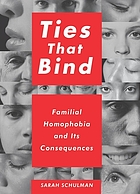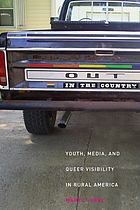
Last week I reviewed Sarah Schulman's Ties That Bind which explored from a very personal perspective the ravages of familial homobigotry. This week I picked up and read Mary L. Gray's Out in the Country: Youth, Media, and Queer Visibility in Rural America (New York University Press, 2009). Gray's ethnographic study of queer teen lives in rural Kentucky took place in the early 2000s and she published her book in the same year as Schulman. Both authors write thoughtfully about the importance of family in the lives of their queer subjects -- though from very different perspectives. Ironically -- given our usual narrative of urban tolerance vs. rural bigotry -- Gray's consideration of the place of family within queer lives is much more nuanced than Schulman's.
As a researcher, Gray came from a rural California childhood followed by an urban California adulthood working with queer youth organizations. Her exploration of teen lives in rural Kentucky was prompted by national attention on the ways in which the Internet and other media connectivity and queer visibility might work differently in the lives of rural young people rather than urban young people. As she (and others before her) have pointed out, much of our understanding of queer coming-of-age posits a rural-to-urban migration in which our queer selves are incapable of being fully discovered and/or nourished until we "escape" our hometown settings and find the LGBT community in physical locales -- gay bars, lesbian bookstores, gay ghettos, queer action groups. Pushing back against this assumption, Gray sought out youth who were either unable or uninterested in making such a migratory journey of self-discovery. How would young queer people without the resources or desire to leave rural life for the city construct a queer identity?
In Ties That Bind, urban-based adult writer Schulman struggles with familial rejection in the face of her queer activism and chosen family of fellow lesbian, gay, and other non-straight friends. Ties is firmly situation in the milieu of Gay New York, a landscape we all (at least think we) know well, and situates its lesbian protagonist (Schulman) as an adult who struggles to connect with her parents and siblings, but as an adult dragging them to therapy appointments or participating (or not) in rituals like the weddings of relatives. Schulman's pain is that of an adult attempting to reconcile with the failures of her parents' parenting.
In contrast, Gray explores the dense interconnectivity necessary for survival in isolated rural settings. Families of origin, she argues, make or break the experience of rural queer folk in communities where the familiar is often the key to acceptance. Straight family members can act as brokers for their queer youths -- turning the queer into the familiar, making one of "them" into one of "us". The most resilient teens whom Gray encountered were typically youths whose parents supported their identity explorations and attempts to build broader support networks: paying for internet or access to health services, driving them long distances to regional meet-ups, participating in protest actions, or other acts which communicated to fellow townsfolk that their child was not to be disavowed. The more vulnerable children were those whose families either could not or would not provide such support -- in part because, unlike urban queer adults, these youths could not take the city bus to the "gay" district or surreptitiously visit the "women's" bookstore.
In some ways Gray's work underscores the central point that Schulman makes: that queer family members can't just disown their families of origin -- no matter how anti-gay those families are -- and replace them with chosen families without consequence. For Schulman, those consequences are mostly emotional and psychological: the pain of rejection, the loss of future relationship. For Gray's teens, in addition to the emotional support (or pain) a family can provide (or cause) for their queer members in a hostile culture, families are also the gateway to material resources and community belonging. The visibility of queer culture in the media, and access to information -- plus the ability to connect to far-flung networks -- that the Internet provides cannot replace, for queer youth, the insulation that local relationships provide. Nor does an urban-oriented narrative of queerness reliably serve these young people as they work to create usable identities for themselves and their communities.
This was a useful read, one which I might pair with Pray the Gay Away (also about queer folk in the Bible Belt around Louisville, Kentucky) and Not in This Family (challenging the narrative of universal familial rejection of queer family members in postwar America).
"as if the world weren't full enough of history without inventing more." ~ granny weatherwax, wyrd sisters.
~oOo~
Showing posts with label sexual identity. Show all posts
2014-07-28
2014-07-21
booknotes: ties that bind
Me, footnote hopping. The story of my life.
I found Sarah Schulman's Ties That Bind: Familial Homophobia and Its Consequences (New Press/Perseus, 2009) reading The Tolerance Trap and requested it inter-library loan thinking it was going to be a study of the ravages of anti-gay animus within families. Instead, it is more of a philosophical-political reflection on the practices within families (and by extension within the wider culture) that create we queer people as a lesser group. Schulman draws powerfully on work done by feminist activists around domestic violence and the workings of other types of prejudice such as antisemitism to describe how queer family members are isolated and scapegoated within families -- and how the social systems these families are a part of support that violence through passive bystander behaviors. She illustrates a lot of her observations with stories about her own family's unwillingness to maintain positive connections with her because of her lesbian identity: parents who say in front of her that she was born "bad'; siblings who refuse to allow her contact with her their children.
Reading Ties That Bind was personally disorienting as an experience; I kept checking the publication date -- really? 2009? -- because so much of what she was describing felt like the climate of the 1970s and 80s rather than the early 2000s. Which is definitely a good reminder that our experience, as queer individuals, of homobigotry is far from uniform, and that our treatment at the hands of friends and family shapes how we interpret and react to the structural and more distant social inequalities that continue to color all of our lives. Because of my family's support, and because of the social norms of my immediate community (expecting nondiscrimination), when I do encounter erasure or hostility I experience it as a departure from, rather than a reinforcement of, the morality of my people. That is, not only do I believe that there's no reason to fear my sexuality would harm children, but all of my friends and family members would look at someone like they were right bastards for suggesting such a thing.
That kind of support, in turn, leads to resilience for those of us who have it: with our many-layered communities behind is, we aren't isolated in the face of structural discrimination or individual acts of bigotry. For those whose families do disown them, as Schulman points out, the recourse is the much more difficult and contingent road of creating your own support system from scratch, always with the voices in the back of your head -- the parental authorities of your childhood -- telling you how worthless, how lesser-than, you are. These messages, in turn, reinforce the messages of the dominant culture that continue to erase, tokenize, or segregate the narratives of queer lives -- treating them as specialist subjects, "adult" content, something uninteresting to a more general readership or audience. As Elizabeth of Spilt Milk pointed out just this past week, Western culture still resists the notion that queer lives are human lives and as such deserve representation within popular cultures, curricula, and as commonplace within society. This is, essentially, the same message Schulman sought to impart in 2009, and despite legal gains in the rights arena we haven't made much headway in queering the mainstream.
In short, check Schulman out if you'd like to be reminded that things don't inevitably get better, and that our survival and resilience as non-straight people still depends a frightening amount on contingencies such as what family we were born in, what location(s) we grew up, where we find jobs, and how mainstream our queer performances are (not to mention all the other intersectional aspects of self we juggle: class, race and ethnicity, gender, citizenship, religion, body size, dis/ability, etc. etc. etc.).
I found Sarah Schulman's Ties That Bind: Familial Homophobia and Its Consequences (New Press/Perseus, 2009) reading The Tolerance Trap and requested it inter-library loan thinking it was going to be a study of the ravages of anti-gay animus within families. Instead, it is more of a philosophical-political reflection on the practices within families (and by extension within the wider culture) that create we queer people as a lesser group. Schulman draws powerfully on work done by feminist activists around domestic violence and the workings of other types of prejudice such as antisemitism to describe how queer family members are isolated and scapegoated within families -- and how the social systems these families are a part of support that violence through passive bystander behaviors. She illustrates a lot of her observations with stories about her own family's unwillingness to maintain positive connections with her because of her lesbian identity: parents who say in front of her that she was born "bad'; siblings who refuse to allow her contact with her their children.
Reading Ties That Bind was personally disorienting as an experience; I kept checking the publication date -- really? 2009? -- because so much of what she was describing felt like the climate of the 1970s and 80s rather than the early 2000s. Which is definitely a good reminder that our experience, as queer individuals, of homobigotry is far from uniform, and that our treatment at the hands of friends and family shapes how we interpret and react to the structural and more distant social inequalities that continue to color all of our lives. Because of my family's support, and because of the social norms of my immediate community (expecting nondiscrimination), when I do encounter erasure or hostility I experience it as a departure from, rather than a reinforcement of, the morality of my people. That is, not only do I believe that there's no reason to fear my sexuality would harm children, but all of my friends and family members would look at someone like they were right bastards for suggesting such a thing.
That kind of support, in turn, leads to resilience for those of us who have it: with our many-layered communities behind is, we aren't isolated in the face of structural discrimination or individual acts of bigotry. For those whose families do disown them, as Schulman points out, the recourse is the much more difficult and contingent road of creating your own support system from scratch, always with the voices in the back of your head -- the parental authorities of your childhood -- telling you how worthless, how lesser-than, you are. These messages, in turn, reinforce the messages of the dominant culture that continue to erase, tokenize, or segregate the narratives of queer lives -- treating them as specialist subjects, "adult" content, something uninteresting to a more general readership or audience. As Elizabeth of Spilt Milk pointed out just this past week, Western culture still resists the notion that queer lives are human lives and as such deserve representation within popular cultures, curricula, and as commonplace within society. This is, essentially, the same message Schulman sought to impart in 2009, and despite legal gains in the rights arena we haven't made much headway in queering the mainstream.
In short, check Schulman out if you'd like to be reminded that things don't inevitably get better, and that our survival and resilience as non-straight people still depends a frightening amount on contingencies such as what family we were born in, what location(s) we grew up, where we find jobs, and how mainstream our queer performances are (not to mention all the other intersectional aspects of self we juggle: class, race and ethnicity, gender, citizenship, religion, body size, dis/ability, etc. etc. etc.).
2014-07-18
"which materials in [your] collections support gendered stereotypes?" [comment post]
![]() |
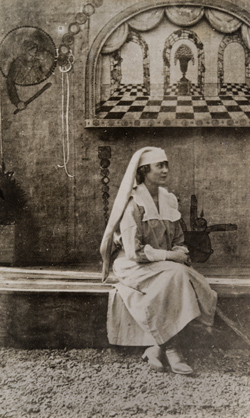
| Mildred Mitchell sitting under a frescoed wall (1918). Massachusetts Historical Society |
4. Which materials in [your] collections support gendered stereotypes? Are there any examples materials which subvert these stereotypes?
I find the framing of this question strange and confusing, perhaps because I am trained first and foremost as a historian. As a historian, I approach all collection materials as sources which can be understood in many ways. Most cultural artifacts do not in and of themselves support or subvert limited or fixed stereotypes or agendas; these artifacts are what we (the researchers) and any other individuals who interact with them (from creation to destruction) make of them. Rather than asking whether any particular item in our collections supports or subverts a particular understanding of gender (or sexuality or race or etc. etc. etc.), I would ask what the item might be able to tell us about how its creators and contemporaries understood gender (or etc.) in a multivalent sense. How did human beings make meaning using this item? What can this item tell us about the time and place in which it was created and used?
To use an example from the MHS collections which I, personally, have incorporated into my work as a historian, there is a deposition in the Godfrey Cabot Lowell Papers taken in 1914. It is the deposition, by a male member of the legal-judicial system, of a female office/retail worker about her experience of sexual-medical impropriety at the hands of a male doctor treating her for gynecological ailments. The deposition, as far as I have been able to piece together, is part of a larger case being assembled against the doctor for his activities, medical and personal. You can read the conference paper I wrote about the document here.
If we were to ask your question(s) of this item: does it support or subvert gender stereotypes, what would a meaningful answer be? One could argue the deposition was constructed in a context over-determined by a number of gender-based narratives: the female office worker, the sexually-naive spinster, the predatory male gynecologist, the hard-boiled private detective, the patriarchal morality police, the sexually immoral widow/madame with whom the doctor is living and working. The deposition and associated detective’s reports draw on all of these. Yet the deposition also offers up gender surprises, given its historical context. How did Nellie Keefe, the deposed woman, decide to speak out against the treatment that made her feel uncomfortable? How should we think about the persecution of a doctor for living with a woman (and perhaps enjoying a consensual sexual relationship with her) while unmarried? What bearing does that have on his medical practice? How are the women patients understood within the context of the case as gendered subjects? How does their agency in speaking out against the treatment they were uncomfortable with play into the “long game” persecution of the doctor for his domestic arrangements? Was the doctor acting inappropriately, based on the standard medical training of the day, in giving the treatment he did? To what extent are both women and men in this narrative leveraging and falling victim to narratives of gender salient in their specific time and place. Most historical texts (like our lived experiences!) are complex, multi-layered things which work within and against dominant narratives simultaneously.
As a reference librarian who works with researchers doing scholarship in the areas of women, gender, and sexuality -- along with other intersecting aspects of subjectivity and identity -- I see my job as helping a researcher to ask new questions of materials; to complicate our reading of what might at first glance seem self-evident as a source. I spend time brainstorming with researchers about where they might find documents or artifacts that speak in some way to their questions about gender and sexuality -- and the work they do with those items is quite often fresh and unique, challenging us to see particular moments in history and culture in new ways.
5. Should women’s collections, both those created by women and those about women’s activities, be kept in separate repositories or locations? Why?
I believe in the organizational power (in a positive sense) of designated spaces and groups whose mandate is specifically to collect, preserve, and make accessible the documentary record of historically marginalized populations. The genesis of many special collections repositories for under-represented groups (people of color, religious minorities, women, LGBTQ folks, etc.) has often been within those communities themselves through grassroots organizing -- e.g. the Lesbian Herstory Archive. I believe those community-based archives have done (and continue to do) important work. I am also glad to see more conventional archives beginning to collect materials that more fully document all aspects of our culture and society. It is my hope that we will continue to have both types of archival repositories into the future, since I believe the “activist archive” and the institutional archive both serve important purposes within the ecosystem of the library/information professions.
Historically, the physical location of an archive or a collection has had significant bearing on who is able to access the materials the archive holds. Hence, it has often made sense for similar / like materials to be gathered in a specific location so that researchers can access them for a topical research project: e.g. lesbian pulp novels. Collecting policies often reflect this -- we don’t just take every collection we are offered, but rather consider whether it complements the other collections we have, or the goals of our repository in documenting certain aspects of history and culture: here at the MHS environmental history, for example, and Massachusetts family papers of the 18th and 19th centuries. My wife works at a repository that collects materials related to the history of medicine, so they collect physicians’ and medical researchers’ papers as well as print materials. As we are able to make collections more accessible through digitization, such geographical proximity can matter less (but still matter today, and will continue to matter for decades to come).
As an “activist archivist,” what I care about is that someone, somewhere, is collecting the materials related to histories of a wide range of people and groups. I want the employees at the institutions that care for these collections to believe in their worth and the necessity of their preservation. I’m pretty impartial as to whether those materials are held in an identity-based archive (e.g. a “women’s collection”) or whether they are held at a more eclectic institution. What I care about is that they are findable and accessible to whomever wishes to use them to further our knowledge of peoples and pasts. I would further complicate the issue of “women’s collections, both those created by women and those about women’s activities” by pointing out that each of us exists in the world with multiple facets of identity, and that making a present-day argument for the creation of women-focused collections (as opposed to historically women-centered collections) raises questions about how we would formulate a collecting policy for such an institution, and what such a policy implies or outright states about the notion of “women” as a discrete category of being.
Say you have a collection of personal and professional papers of a woman with both African (recent immigrant) and Euro-American ethnic and racialized heritage; she attended a historically-black college as an undergraduate, and then went on to seminary for an M.Div. Following several years as minister in the Reformed Church of America she left the ministry in order to openly marry her partner. She decides to pursue midwifery training so that she and her wife (a primary care physician) can set up a practice working with bisexual, lesbian, and trans* female couples around pregnancy, childbirth, and post-partum care. They become central movers and shakers in the women of color-led reproductive justice grassroots movement. The woman grew up in Georgia, attended graduate school in Michigan, then settled in Chicago with her wife whose family has roots in upstate New York and Western Massachusetts. After a long career in urban community-based women’s health activism, they retire to the Minneapolis/St. Paul (to be near the wife’s brother and his family). So, what’s the best place for these personal-professional records? In an archive that specializes in records of African-Americans? Women? Queer folks? People in the health sciences? Ordained individuals? Social justice activism? Should the records stay local to the Chicago area? Should they go to the HBCU institutional repository as an alumna collection?
I’m a cisgendered woman, but my womanhood is only SOMETIMES the most salient aspect of my identity (like when the Supreme Court decides because I’m a person with a uterus my workplace could pass judgement on my healthcare decisions). I’m also a librarian, a historian, a writer, a Euro-American with strong Scottish heritage, a bisexual lesbian -- where do my papers “best” belong, thirty years from now? It’s an imperfect science at best.
Any additional comments?
In reflecting on your questions, I will say that it seems important to note that as a graduate student in library science / archives, with a background in women’s studies and history, I would have said my “ideal” job would be to work at a place like the Lesbian Herstory Archives, the Schlesinger Library, the Sophia Smith Collection -- somewhere that specializes in the historical subjects I find most interesting as a scholar. However, the job I found was here at the MHS, a repository that does not focus intentionally on any of my subjects of interest (history of sexuality, history of women and gender, history of social justice activism, history of religion, history of education, all emphasizing twentieth century American contexts…). Over time, I have grown to appreciate the important role I can play as a reference librarian in a more “generalist” research library in suggesting entry points into our collections that get at some of these subcultural and/or marginalized histories. Because of course even when we aren’t visible in the mainstream narratives, we have always been there -- to take queer sexuality as an example, it’s not like women sexually desiring women, and building relationships with them, is an invention of the twentieth century (though “Lesbian” as an identity construct, like “Straight” or “Cis” or “Trans*,” arguably is). So it’s important to remind researchers that they don’t have to go to “women’s collections” or “lesbian archives” to find stories that include queer folk. Which is not to say that finding us (people similar to us) isn’t harder in mainstream repositories, where finding guides and catalog records don’t necessarily indicate those aspects of an individual’s identity … to the extent that those aspects of identity are knowable.
2014-07-07
on being "brought out" [anniversary reflections]
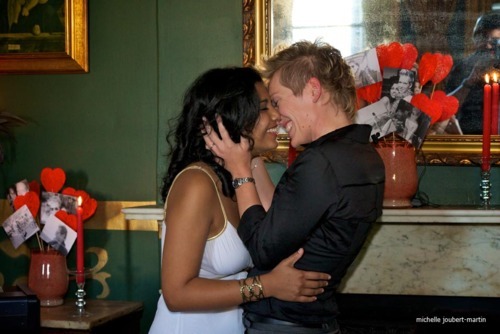
It's been roughly five years since Hanna and I started snogging one another.
For twenty-eight years.
On the other hand, I remember having casual conversations with my mother, or reflecting in my diary, as early as age eleven or twelve, that I might possibly could maybe be a Lesbian.
I didn't know Bisexuality was an option, really, back then.
That was part of the problem.
I mean, I knew technically that there was this category of sexual identity "Bisexuality" and that it meant people who were sexually attracted to both men and women, but no one I encountered treated it very seriously. It was an elusive, moving target. Something frivolous, a subject of scorn. Men were liars if they claimed bisexuality and women (mostly college girls) were probably just using it as attention-seeking behavior.
We all know the stereotypes. I internalized many of them. I kept my mouth shut when lesbian women -- women I desperately wanted to like and mentor me -- dismissed bisexuality as tantamount to betraying the sisterhood. I judged my own desires along the gay/straight binary and determined that I didn't have enough Gay Thoughts to be properly Gay. And therefore was, by default, Straight.
So: closeted. Definitely.
Except that I had a floating question mark above myself internally as to my sexual desires, and was open about that speculation, so can I say I was ever in the closet, properly speaking?
I remained Straight for twenty-eight ... well, scratch that, more like twenty-six years. Because meeting Hanna in September 2007 began the long slow process of bringing me out.
It took eighteen months.
Though I started telling people I "wasn't entirely straight" almost immediately. Well, within the first six months. I emailed my mother -- reminding her of those conversations we'd had back in when I was twelve -- and wrote letters to friends, angsting about my crush. I started with the gay buddy whose hand I'd held through the winding path he'd taken out of the Mormon faith and into the imagined (and actual) community of queers.
Now I was joining him there, and I know for a fact he wasn't all that surprised.
Most people weren't. At least not to my face.
I was kind of insulted, actually, at the time. Especially by a few second-hand reports I received from my mother back home of family acquaintances who'd claimed they'd practically known before I did what my sexual preferences were. Who did they think they were?!
But I think their larger point was true: straight or otherwise I'd been choosing the queer path for years. I just hadn't found the right person to share it with until that moment.
Which is part of Walters point -- that for some of us same-sex desires are just one part of what it means to be queer. That for us, "coming out" isn't just about leaving the closet -- but also about being "brought out" into a larger community of people who are non-straight, non-normative in their sexuality and gender, their family formation or way of life.
I was a feminist before I was queer, and queerness suited my feminism just fine.
We've always held hands in public.
Yet I made it a promise to Hanna, even before she knew I'd made it (because she didn't know I wanted her), that I would never ask her to cover, never ask her to elide -- no matter how passively -- the nature of our relationship.
I kiss her goodbye outside work every morning, and hello again when I pick her up every evening.
I like to grab her ass while we're standing in the grocery aisle, or waiting for the subway.
These are acts both quotidian and queer. Quotidian in the sense that, as I tried to tell my mother back in the 90s, girls have definitely been possible for me for a long, long time. Quotidian in that this life of ours fits like a well-worn pair of Birkenstocks (yup, I own two pairs). That falling into bedwith a woman with Hanna and building a life with her felt like my kind of normal. Like the kind of life I'd been angling for since I'd first read Anne of Green Gables or maybe ElfQuest (probably both).
Oh; this is what I wanted. It came as both a surprise and a homecoming, tangled up together like our limbs as we fell asleep at night.
On some level I must have always known.
Of course, always knowing isn't always synonymous with being known.
On some level, in the first flush of besotted love, I wanted the politics of the personal to be beside the point, but of course politics are never beside the point. Politics are intimately entangled with the possibilities of our lives, the pleasures, the dangers, what can (or must) remain private and what must (or can) become public. In recent weeks we've marked the first anniversary of the downfall of DOMA and then -- whiplash style -- heard two Supreme Court cases that etched bold messages across our legal landscape as to the rights and respect as human subjects we people with uteri have in this country.
As my rights as a lesbian bisexual expand, however modestly, my rights as a woman contract, inexorably.
My embodied self, and the choices I have made with it, are never been far from being the center of others' self-righteous debate.
So even though I framed myself as always the truth of the matter was that in needing to articulate the "always" I made clear that I had, in fact, been raised in a world that was still, itself, the closet. Entangled in a conservative political climate that framed the issues as "gay vs. straight," silenced by explicit biphobia and implicit bi erasure. I needed the safety of both a community (which I found first, online, through women in the constellations that make up the feminist blogosphere) and a person, Hanna, to "bring me out" into self-knowledge and public visibility.
I needed them to find a home.
Which is why I've circled around to respect the paradigm of coming / bringing out into the open that which has been hidden (from ourselves, from others) and celebrating its existence (our existence) in the world as something tangible and joyful -- something achieved rather than something we've always had.
Because we might always have "known" but we haven't always known.
And its only those around us who make it possible for us to share. Only those around us who make a vibrant, joyful community of sexually-various, gender-flexible people with whom it's possible to imagine a life better than the one you're currently living. Those around us who make it possible to choose queerness with pleasure.
So I say it more often these days: I'm gay. I'm bi. I'm a lesbian. I'm a dyke. I'm queer.
Because people, implicitly, explicitly, told me I couldn't be. Shouldn't be. Wouldn't be.
I tell them, now, with every act of visible queerness: I am, I should, and I will.
I choose my wife over all of them, every day.
And, well, other things. It all happened in a bit of a rush; I never was a very patient person once I'd finally determined it was time to do something new. And for us, apparently, the time for sexytimes was late June 2009.
So yay anniversary!
![]() |
| (via) |
This weekend I was reading The Tolerance Trap: How God, Genes, and Good Intentions are Sabotaging Gay Equality by Susanna Danuta Walters (New York Univ. Press, 2014) and was reminded of the now anachronistic corollary to "coming out," that of being "brought out" into the queer community by one's first same-sex partner. Walters writes:
Being "brought out" has within it that dual sense of sexuality and community. One is "brought out" by another queer person and simultaneously brought into the queer community ... coming out in these earlier and sometimes explicitly political iterations was understood as both a process personal and social, both confessional and performative, narrating a "shared fate" but also an "imagined community" (70).This got me thinking about my own experience of coming out / being brought out into self-awareness and visible queer sexuality. My attitudes toward coming out as a helpful narrative (for myself; for others) have fluctuated a lot over the years. On the one hand, I definitely experienced the silencing pressure of presumptive heterosexuality, experienced the feeling of being closeted. People assumed I was straight and I mostly didn't correct them.
For twenty-eight years.
On the other hand, I remember having casual conversations with my mother, or reflecting in my diary, as early as age eleven or twelve, that I might possibly could maybe be a Lesbian.
I didn't know Bisexuality was an option, really, back then.
That was part of the problem.
I mean, I knew technically that there was this category of sexual identity "Bisexuality" and that it meant people who were sexually attracted to both men and women, but no one I encountered treated it very seriously. It was an elusive, moving target. Something frivolous, a subject of scorn. Men were liars if they claimed bisexuality and women (mostly college girls) were probably just using it as attention-seeking behavior.
We all know the stereotypes. I internalized many of them. I kept my mouth shut when lesbian women -- women I desperately wanted to like and mentor me -- dismissed bisexuality as tantamount to betraying the sisterhood. I judged my own desires along the gay/straight binary and determined that I didn't have enough Gay Thoughts to be properly Gay. And therefore was, by default, Straight.
So: closeted. Definitely.
Except that I had a floating question mark above myself internally as to my sexual desires, and was open about that speculation, so can I say I was ever in the closet, properly speaking?
I remained Straight for twenty-eight ... well, scratch that, more like twenty-six years. Because meeting Hanna in September 2007 began the long slow process of bringing me out.
It took eighteen months.
Though I started telling people I "wasn't entirely straight" almost immediately. Well, within the first six months. I emailed my mother -- reminding her of those conversations we'd had back in when I was twelve -- and wrote letters to friends, angsting about my crush. I started with the gay buddy whose hand I'd held through the winding path he'd taken out of the Mormon faith and into the imagined (and actual) community of queers.
Now I was joining him there, and I know for a fact he wasn't all that surprised.
Most people weren't. At least not to my face.
I was kind of insulted, actually, at the time. Especially by a few second-hand reports I received from my mother back home of family acquaintances who'd claimed they'd practically known before I did what my sexual preferences were. Who did they think they were?!
But I think their larger point was true: straight or otherwise I'd been choosing the queer path for years. I just hadn't found the right person to share it with until that moment.
Which is part of Walters point -- that for some of us same-sex desires are just one part of what it means to be queer. That for us, "coming out" isn't just about leaving the closet -- but also about being "brought out" into a larger community of people who are non-straight, non-normative in their sexuality and gender, their family formation or way of life.
I was a feminist before I was queer, and queerness suited my feminism just fine.
We've always held hands in public.
Yet I made it a promise to Hanna, even before she knew I'd made it (because she didn't know I wanted her), that I would never ask her to cover, never ask her to elide -- no matter how passively -- the nature of our relationship.
I kiss her goodbye outside work every morning, and hello again when I pick her up every evening.
I like to grab her ass while we're standing in the grocery aisle, or waiting for the subway.
These are acts both quotidian and queer. Quotidian in the sense that, as I tried to tell my mother back in the 90s, girls have definitely been possible for me for a long, long time. Quotidian in that this life of ours fits like a well-worn pair of Birkenstocks (yup, I own two pairs). That falling into bed
Oh; this is what I wanted. It came as both a surprise and a homecoming, tangled up together like our limbs as we fell asleep at night.
On some level I must have always known.
Of course, always knowing isn't always synonymous with being known.
On some level, in the first flush of besotted love, I wanted the politics of the personal to be beside the point, but of course politics are never beside the point. Politics are intimately entangled with the possibilities of our lives, the pleasures, the dangers, what can (or must) remain private and what must (or can) become public. In recent weeks we've marked the first anniversary of the downfall of DOMA and then -- whiplash style -- heard two Supreme Court cases that etched bold messages across our legal landscape as to the rights and respect as human subjects we people with uteri have in this country.
As my rights as a lesbian bisexual expand, however modestly, my rights as a woman contract, inexorably.
My embodied self, and the choices I have made with it, are never been far from being the center of others' self-righteous debate.
So even though I framed myself as always the truth of the matter was that in needing to articulate the "always" I made clear that I had, in fact, been raised in a world that was still, itself, the closet. Entangled in a conservative political climate that framed the issues as "gay vs. straight," silenced by explicit biphobia and implicit bi erasure. I needed the safety of both a community (which I found first, online, through women in the constellations that make up the feminist blogosphere) and a person, Hanna, to "bring me out" into self-knowledge and public visibility.
I needed them to find a home.
Which is why I've circled around to respect the paradigm of coming / bringing out into the open that which has been hidden (from ourselves, from others) and celebrating its existence (our existence) in the world as something tangible and joyful -- something achieved rather than something we've always had.
Because we might always have "known" but we haven't always known.
And its only those around us who make it possible for us to share. Only those around us who make a vibrant, joyful community of sexually-various, gender-flexible people with whom it's possible to imagine a life better than the one you're currently living. Those around us who make it possible to choose queerness with pleasure.
So I say it more often these days: I'm gay. I'm bi. I'm a lesbian. I'm a dyke. I'm queer.
Because people, implicitly, explicitly, told me I couldn't be. Shouldn't be. Wouldn't be.
I tell them, now, with every act of visible queerness: I am, I should, and I will.
I choose my wife over all of them, every day.
2014-04-07
presentation @ boston college
On March 29th I attended the Biennial Boston College Conference on History of Religion and presented a paper that tried, for the first time, to offer up some analysis regarding my current project. A big thanks to the conference coordinators for a great experience!
This project is, broadly, exploring the ways in which the Christian left negotiated sex, sexuality, and gender during the thirty year period between 1960 and 1980. Narrowly, for this paper, I looked at a ten-year period of the Methodist publication motive for clues regarding mainline Protestant conceptions of gender and sexuality. As I've mentioned before in this space, I'm particularly interested in what the magazine had to say about sexuality because after breaking with the church, the publication's final two issues focused on the topics of gay liberation and lesbian/feminism (their terminology). Rather than seeing this break as a natural, inevitable conflict between a traditionalist anti-gay church and more radical youth activists, I am asking why Christian left theology ultimately failed to provide a hospitable atmosphere for meaningful, nuanced discussion about queer sexual morality.
At least, that's what I'm fumbling my way toward asking. I'm not sure how close this one conference paper gets to that goal -- but it is a start. So for those who've been following my research this past year, I offer this work-in-progress as a reward.
Access the PDF online via Google Drive.
I'd also like to give a shout-out to my two excellent and inspiring co-panelists, Trevor Burrows (Purdue University) and Casey Bohlen (Harvard University), both of whom are working on aspects of Christian faith and political action during what we might term the "long Sixties" -- looking back into the 1950s and forward toward the 1980s. I look forward to watching their progress as scholars and writers in the field.
2014-02-17
romance & inequality: migraine listening
I was going to write a joint book review this weekend of The American Way of Poverty and The New Deal: A Modern History, both of which I've read in the past month. But then I got socked with a two-day migraine, the kind that comes around about once a season and has me making friends with the toilet bowl, the ice pack, dark, dark rooms, and narcotics.
So writing didn't happen. But to distract myself from the pain, listening did.
I started with this most enjoyable hour of On Point discussing the romance novel industry. It had surprisingly little condescension, and although I would have liked some acknowledgement of non-hetero markets and amateur writers (*kof*kof*fanfiction*kof*kof*), overall it was a thoughtful reflection on the enduring popularity of narratives that center around relationship formation.
Then I moved on to Boston and socioeconomic inequality, which has been in the news a lot recently due to the nationwide media attention and due to the fact we have a new mayor (Marty Walsh) assuming office who was elected in part because of his working-class background and pledge to make Boston more affordable for those of us not in the 1%.
And finally, an hour of the Diane Rehm show devoted to gay rights in "law and sports" (an opportunistic conglomeration if I ever saw one!). I can't say I learned anything new during this hour, but did appreciate the articulate presence of the Department of Justice's Stephen Delery (emphasis mine):
I hope y'all have a good week ahead, and -- health willing! -- I'll be back next Monday with the promised book reviews.
So writing didn't happen. But to distract myself from the pain, listening did.
Then I moved on to Boston and socioeconomic inequality, which has been in the news a lot recently due to the nationwide media attention and due to the fact we have a new mayor (Marty Walsh) assuming office who was elected in part because of his working-class background and pledge to make Boston more affordable for those of us not in the 1%.
And finally, an hour of the Diane Rehm show devoted to gay rights in "law and sports" (an opportunistic conglomeration if I ever saw one!). I can't say I learned anything new during this hour, but did appreciate the articulate presence of the Department of Justice's Stephen Delery (emphasis mine):
REHM
10:12:01
And you have the National Organization for Marriage, Brian Brown, the group's president, saying, "The changes being proposed here to a process as universally relevant as the criminal justice system serve as a potent reminder of why it's simply a lie to say that redefining marriage does not affect everyone in society."
DELERY
10:12:37
Well, I do think, Diane, that, as the Supreme Court recognized in Windsor, the Defense of Marriage Act had real consequences for real people by denying a whole range of benefits to people in the course of many federal programs. Some of these programs are critical to people who need them for health insurance, for example.
DELERY
10:13:01
And so, if you look at what the agencies have done over the last few months, the same-sex marriages are now recognized for all federal tax purposes, including filing joint returns. Spousal benefits are now available to military service members who are serving overseas. Health insurance is available for same-sex spouses of federal employees.
DELERY
10:13:24
And citizens who are in same-sex marriages can now sponsor their spouses for immigration benefits. And the list goes on. All of these things are federal benefits, provided under federal law, and the agencies, like the Department of Justice, have concluded, following the Supreme Court, that the marriages that are lawful where they're performed should be recognized for these purposes.
2013-10-13
on being out day [a belated post]
This Friday, October 11th, was International Coming Out Day.
I thought, in passing, about writing something but I was distracted by trying to get things done at work and by the fact my wife was getting a chest x-ray for pneumonia. And then picking up antibiotics (thank goddess for antibiotics) for her. And remembering to feed the cats. And pick up something for dinner.
So this is a belated post on the theme of coming/being out. I don't have anything particularly original to say, except that I am grateful to all of the people throughout history, past and present, who have conspired to make International Coming Out Day an unremarkable occasion in our day lives. Hanna and I live in a time and place where our bisexual inclinations and same-sex relationship are known and largely honored structurally in our workplaces, with our landlord, at our health center, in our city, state (and now, finally, the federal government), by our friends and relations. We hold hands and kiss in public, speak of things sexual while dining out, review queer porn, blog about being dykes.
We don't fear being evicted, fired, blacklisted, jailed, physically attacked, disowned or disinherited, treated as sick because of our sexual selves, or otherwise grossly discriminated against. And if any of these things were top happen to us, we would have advocacy organizations and a network of supporters to turn to for aid.
In many ways, our security is exceptional: many queer folks still live in the toxic closet, or cover aspects of their identities, for fear of social and material marginalization. The young and the old, the gender non-confirming, trans folks, queer people in nations that still actively persecute sexual minorities.
There is obviously still work to be done.
But this week, I'm grateful in my own small domestic way for the work of activists and the kindness of those people in our lives who together made it possible for my Friday to be, in part, a story about leaving work half an hour early so I could get to the pharmacy and pick up Hanna's antibiotics. A story about a boss and colleagues who sent well-wishes for Hanna's quick recovery. A story about a health clinic that knows were a couple and has no problem letting me pick up her medications.
A story about going home to my wife.
I thought, in passing, about writing something but I was distracted by trying to get things done at work and by the fact my wife was getting a chest x-ray for pneumonia. And then picking up antibiotics (thank goddess for antibiotics) for her. And remembering to feed the cats. And pick up something for dinner.
| Hanna in the redwoods (Sept. 2013) |
We don't fear being evicted, fired, blacklisted, jailed, physically attacked, disowned or disinherited, treated as sick because of our sexual selves, or otherwise grossly discriminated against. And if any of these things were top happen to us, we would have advocacy organizations and a network of supporters to turn to for aid.
In many ways, our security is exceptional: many queer folks still live in the toxic closet, or cover aspects of their identities, for fear of social and material marginalization. The young and the old, the gender non-confirming, trans folks, queer people in nations that still actively persecute sexual minorities.
There is obviously still work to be done.
But this week, I'm grateful in my own small domestic way for the work of activists and the kindness of those people in our lives who together made it possible for my Friday to be, in part, a story about leaving work half an hour early so I could get to the pharmacy and pick up Hanna's antibiotics. A story about a boss and colleagues who sent well-wishes for Hanna's quick recovery. A story about a health clinic that knows were a couple and has no problem letting me pick up her medications.
A story about going home to my wife.
2013-09-25
booknotes: my brother, my sister
| Molly Haskell at a book signing for My Brother, My Sister (via) |
Part of my disappointment comes from the fact that cis* family members and friends of trans individuals often struggle to get up to speed on trans issues after a loved one opens up about their experience -- and there is a need for personal narratives by individuals who have struggled through ignorance and misconception into better understanding. Such stories don't need to paper over the messy reality of feeling that often accompanies such a journey. I have a friend whose spouse came to the realization of their transness within the last two years, and as a partner my friend struggled with many of the same feelings a major life change will bring: grief over the loss of "before," fear about what the future will bring, uncertainty about what this change meant for their relationship and family life, sometimes anger at their spouse for being at the epicenter of this upheaval -- and for mostly not sharing in the grieving process. Like many trans individuals, the partner was mostly elated and relieved to be finally bringing their self-presentation into alignment with their interior self: to no longer be living a dissonant life. To my friend, whose emotions were much more ambivalent, it often felt like there was no safe or sanctioned place to process their complexity of feeling. With economic barriers to therapy and other social supports often prohibitively high, books like Transitions of the Heart (written by parents of trans and gender-nonconforming children) can help mitigate what could otherwise be intense isolation.
My Brother, My Sister could have been an addition to this small but growing literary offerings. In my estimation, it was not.
Let's begin with the most basic trap of all, the way the memoir's narrative is structured around and saturated in the physical aspects of transition, most particularly fixated on gender confirmation surgery and Haskell's assessment of how well or appropriately she believes her sister is presenting as a woman. While acknowledging that authors sometimes have little control over book jacket design, the plain red cover with a youthful photograph of Ellen "before" and a current "after" photograph invites the reader to center Ellen's appearance and physical transition rather than Haskell's experience as the cisgendered sister having to assimilate her sibling's late-in-life changes. A set of photographs at the center of the volume likewise foreground the "before" and "after" images.
As authors like Julia Serano and S. Bear Bergman have pointed out, the narrative of "passing" places the onus on a trans person to conform to the world's high expectations of gendered behavior rather than demanding that the world accept a person's self identification regardless of presentation. A trans person -- just like any of us -- may be a butch or lipstick lesbian, a twink or a jock, a sorority girl or tomboy. Bodies come in all shapes and sizes, and sartorial taste ranges across a field of more-gendered and less-gendered style choices. Historically, we (the public) have required a high level of stereotypical gender performance from trans women -- at the same time as we (feminists) blame trans people for perpetuating sexism through that same exploration of femininity.** Haskell perpetuates this scrutiny by making physical transformation the benchmark of transition, and by dwelling on the surgeries, the clothing choices, the gender-coded vocal and physical mannerisms, and other aspects of her sister's self-presentation.
While her sister's pleasures and anxieties around offering up her newly-visible self to the world are understandably preoccupying, Haskell's perspective is more often one of harsh judgment than it is attempt to follow where her sister leads. She frets that her sister will be unattractive, considers her clothing choices to slutty, and considers anyone who can't or is unwilling to fit into her neat categories of gender to be somehow at fault. For example, she writes of a trans woman her sister knows, "One man, though convinced he's a she, refuses to do anything to alter his rough male appearance" (158). As if this "refusal" to care about her appearance somehow invalidates the woman's self-articulated gender identity. She also offers unsolicited opinions on the femininity of other high-profile trans women:
From photographs, Jennifer [Finney Boylan], being younger and more typically feminine, seems to have made an attractive looking female, while [Jan] Morris by most accounts, before settling into dignified-dowdy, went through a grotesquely awkward wannabe-girl period (122).I scribbled in the margins “seriously. out. of. line. judgy.”
When Ellen visits Haskell after a period of cloistered transformation, Haskell nervously invites friends over and then grills them afterward on Ellen's ability to perform femininity: "The verdict ... she's very convincing. I said the hair's too blond, and Lily and Patty agree, the hair is too blond, but they're surprised at how good she looks" (146).
I think possibly a large part of my irritation is that I couldn't find Molly Haskell very likable, as a sister or as a feminist. She's critical of other women's appearances, ageist towards both the old (women who might be unable to catch a man) and the young (who are too slutty in appearance and too casual about identity), and hews close to gender expectations. One of her first reactions to her sister's coming out as trans is to fear that the tech- and number-savvy brother she relied on will no longer be good at computer repair or math. While she sidles up to the notion that this first reaction was unfounded, she never demonstrates for her readers that she has since come to revise her binary thinking when it comes to girl brains and boy brains.
At what might be a low point of the book, she even suggests that Brandon Teena, the trans man who was the subject of the biopic Boys Don’t Cry somehow “asked for it” by dressing in clothing appropriate to his gender and not disclosing his trans status:
Yes, the yahoos were uptight and murderous, but she in some sense invited the violence by taunting their manhood, pulling the wool over their eyes, and acting in bad faith (106).Yes, she willfully mis-genders him. To fall back on the trope of the deceptive transsexual (who supposedly invites violence through the act of passing) in a throwaway comment, in a book pitching itself as one about understanding trans lives, seems to me a fairly basic mis-step that, again, both Ms. Haskell and her editor should have caught before the manuscript went to press. That they did not suggests neither understood how problematic it was.
Which in turn calls the entire project into question, at least as far as its worth as a positive contribution to trans literature goes.
At the end of the day, I am glad that Molly and her sister have remained in good relationship, and I am glad that Molly gained more understanding of trans experience and trans history than she had when her sister first came out to Molly and her husband. I imagine that, at the end of the day, there are far worse reactions to have had from one’s family upon coming out trans (see: transgender remembrance day). Yet I also wish that Haskell had let her own learning process cook a bit longer before publishing a book on the subject. As it stands, My Brother, My Sister is a tepid-at-best, damaging-at-worst popular memoir that does little to invite a more complex understanding of trans people or sex and gender identity more broadly. I expected better from a self-identified feminist author, although I’m sure trans feminists would laugh at my (cis-privileged) wishful thinking.
For those interested in learning more about trans lives, I would recommend The Lives of Transgender People by Genny Beemyn and Susan Rankin, Whipping Girl by Julia Serano -- who has also just published a book on trans-inclusive feminism that I can't wait to get my hands on -- and also Anne Fausto-Sterling's excellent Sexing the Body.
Luna, a young adult novel by Julie Ann Peters, is also an intimate fictional portrait of a sister coming to terms with her siblings trans identity.
*Cis or cissexual refers to individuals whose gender assigned at birth (usually based on external sex characteristics) matches their internal sense of their own physiological sex and gender identity.
**Trans men have, historically, had a very different socio-political experience within both mainstream culture (where they are often rendered invisible) and mainstream feminism (where they are more often embraced while trans women are actively marginalized).
2013-09-18
the statement on trans-inclusive feminsm and womanism [signed!]
I've been seeing this statement coming through on my RSS and Twitter feed for the last few days, and have finally had a moment to sit down and sign it.
It should be upsetting to us all that the need to specify trans-inclusive feminism and womanism exists, but it does so I want to spell out my support. I also want to take this opportunity to thank the trans people and allies who have pushed me -- in person and in print -- over the past ten years to learn about trans issues and un-learn toxic myths and stereotypes. You have immeasurably enriched my life and my feminism. I will do my best to live up to the vision all you have challenged us to fulfill.
[text via feministsfightingtransphobia]
We, the undersigned trans* and cis scholars, writers, artists, and educators, want to publicly and openly affirm our commitment to a trans*-inclusive feminism and womanism.
There has been a noticeable increase in transphobic feminist activity this summer: the forthcoming book by Sheila Jeffreys from Routledge; the hostile and threatening anonymous letter sent to Dallas Denny after she and Dr. Jamison Green wrote to Routledge regarding their concerns about that book; and the recent widely circulated statement entitled “Forbidden Discourse: The Silencing of Feminist Critique of ‘Gender,’” signed by a number of prominent, and we regret to say, misguided, feminists have been particularly noticeable. And all this is taking place in the climate of virulent mainstream transphobia that has emerged following the coverage of Chelsea Manning’s trial and subsequent statement regarding her gender identity, and the recent murders of young trans women of color, including Islan Nettles and Domonique Newburn, the latest targets in a long history of violence against trans women of color. Given these events, it is important that we speak out in support of feminism and womanism that support trans* people.
We are committed to recognizing and respecting the complex construction of sexual/gender identity; to recognizing trans* women as women and including them in all women’s spaces; to recognizing trans* men as men and rejecting accounts of manhood that exclude them; to recognizing the existence of genderqueer, non-binary identifying people and accepting their humanity; to rigorous, thoughtful, nuanced research and analysis of gender, sex, and sexuality that accept trans* people as authorities on their own experiences and understands that the legitimacy of their lives is not up for debate; and to fighting the twin ideologies of transphobia and patriarchy in all their guises.
Transphobic feminism ignores the identification of many trans* and genderqueer people as feminists or womanists and many cis feminists/womanists with their trans* sisters, brothers, friends, and lovers; it is feminism that has too often rejected them, and not the reverse. It ignores the historical pressures placed by the medical profession on trans* people to conform to rigid gender stereotypes in order to be “gifted” the medical aid to which they as human beings are entitled. By positing “woman” as a coherent, stable identity whose boundaries they are authorized to police, transphobic feminists reject the insights of intersectional analysis, subordinating all other identities to womanhood and all other oppressions to patriarchy. They are refusing to acknowledge their own power and privilege.
We recognize that transphobic feminists have used violence and threats of violence against trans* people and their partners and we condemn such behavior. We recognize that transphobic rhetoric has deeply harmful effects on trans* people’s real lives; witness CeCe MacDonald’s imprisonment in a facility for men. We further recognize the particular harm transphobia causes to trans* people of color when it combines with racism, and the violence it encourages.
When feminists exclude trans* women from women’s shelters, trans* women are left vulnerable to the worst kinds of violent, abusive misogyny, whether in men’s shelters, on the streets, or in abusive homes. When feminists demand that trans* women be excluded from women’s bathrooms and that genderqueer people choose a binary-marked bathroom, they make participation in the public sphere near-impossible, collaborate with a rigidity of gender identities that feminism has historically fought against, and erect yet another barrier to employment. When feminists teach transphobia, they drive trans* students away from education and the opportunities it provides.
We also reject the notion that trans* activists’ critiques of transphobic bigotry “silence” anybody. Criticism is not the same as silencing. We recognize that the recent emphasis on the so-called violent rhetoric and threats that transphobic feminists claim are coming from trans* women online ignores the 40+ – year history of violent and eliminationist rhetoric directed by prominent feminists against trans* women, trans* men, and genderqueer people. It ignores the deliberate strategy of certain well-known anti-trans* feminists of engaging in gleeful and persistent harassment, baiting, and provocation of trans* people, particularly trans* women, in the hope of inciting angry responses, which are then utilized to paint a false portrayal of trans* women as oppressors and cis feminist women as victims. It ignores the public outing of trans* women that certain transphobic feminists have engaged in regardless of the damage it does to women’s lives and the danger in which it puts them. And it relies upon the pernicious rhetoric of collective guilt, using any example of such violent rhetoric, no matter the source — and, just as much, the justified anger of any one trans* woman — to condemn all trans* women, and to justify their continued exclusion and the continued denial of their civil rights.
Whether we are cis, trans*, binary-identified, or genderqueer, we will not let feminist or womanist discourse regress or stagnate; we will push forward in our understandings of gender, sex, and sexuality across disciplines. While we respect the great achievements and hard battles fought by activists in the 1960s and 1970s, we know that those activists are not infallible and that progress cannot stop with them if we hope to remain intellectually honest, moral, and politically effective. Most importantly, we recognize that theories are not more important than real people’s real lives; we reject any theory of gender, sex, or sexuality that calls on us to sacrifice the needs of any subjugated or marginalized group. People are more important than theory.
We are committed to making our classrooms, our writing, and our research inclusive of trans* people’s lives.
Signed,
Anna J. Clutterbuck-Cook (librarian, historian, writer)
Allston, Massachusetts
USA
[click through for the full list of signatories]
It should be upsetting to us all that the need to specify trans-inclusive feminism and womanism exists, but it does so I want to spell out my support. I also want to take this opportunity to thank the trans people and allies who have pushed me -- in person and in print -- over the past ten years to learn about trans issues and un-learn toxic myths and stereotypes. You have immeasurably enriched my life and my feminism. I will do my best to live up to the vision all you have challenged us to fulfill.
[text via feministsfightingtransphobia]
We, the undersigned trans* and cis scholars, writers, artists, and educators, want to publicly and openly affirm our commitment to a trans*-inclusive feminism and womanism.
There has been a noticeable increase in transphobic feminist activity this summer: the forthcoming book by Sheila Jeffreys from Routledge; the hostile and threatening anonymous letter sent to Dallas Denny after she and Dr. Jamison Green wrote to Routledge regarding their concerns about that book; and the recent widely circulated statement entitled “Forbidden Discourse: The Silencing of Feminist Critique of ‘Gender,’” signed by a number of prominent, and we regret to say, misguided, feminists have been particularly noticeable. And all this is taking place in the climate of virulent mainstream transphobia that has emerged following the coverage of Chelsea Manning’s trial and subsequent statement regarding her gender identity, and the recent murders of young trans women of color, including Islan Nettles and Domonique Newburn, the latest targets in a long history of violence against trans women of color. Given these events, it is important that we speak out in support of feminism and womanism that support trans* people.
We are committed to recognizing and respecting the complex construction of sexual/gender identity; to recognizing trans* women as women and including them in all women’s spaces; to recognizing trans* men as men and rejecting accounts of manhood that exclude them; to recognizing the existence of genderqueer, non-binary identifying people and accepting their humanity; to rigorous, thoughtful, nuanced research and analysis of gender, sex, and sexuality that accept trans* people as authorities on their own experiences and understands that the legitimacy of their lives is not up for debate; and to fighting the twin ideologies of transphobia and patriarchy in all their guises.
Transphobic feminism ignores the identification of many trans* and genderqueer people as feminists or womanists and many cis feminists/womanists with their trans* sisters, brothers, friends, and lovers; it is feminism that has too often rejected them, and not the reverse. It ignores the historical pressures placed by the medical profession on trans* people to conform to rigid gender stereotypes in order to be “gifted” the medical aid to which they as human beings are entitled. By positing “woman” as a coherent, stable identity whose boundaries they are authorized to police, transphobic feminists reject the insights of intersectional analysis, subordinating all other identities to womanhood and all other oppressions to patriarchy. They are refusing to acknowledge their own power and privilege.
We recognize that transphobic feminists have used violence and threats of violence against trans* people and their partners and we condemn such behavior. We recognize that transphobic rhetoric has deeply harmful effects on trans* people’s real lives; witness CeCe MacDonald’s imprisonment in a facility for men. We further recognize the particular harm transphobia causes to trans* people of color when it combines with racism, and the violence it encourages.
When feminists exclude trans* women from women’s shelters, trans* women are left vulnerable to the worst kinds of violent, abusive misogyny, whether in men’s shelters, on the streets, or in abusive homes. When feminists demand that trans* women be excluded from women’s bathrooms and that genderqueer people choose a binary-marked bathroom, they make participation in the public sphere near-impossible, collaborate with a rigidity of gender identities that feminism has historically fought against, and erect yet another barrier to employment. When feminists teach transphobia, they drive trans* students away from education and the opportunities it provides.
We also reject the notion that trans* activists’ critiques of transphobic bigotry “silence” anybody. Criticism is not the same as silencing. We recognize that the recent emphasis on the so-called violent rhetoric and threats that transphobic feminists claim are coming from trans* women online ignores the 40+ – year history of violent and eliminationist rhetoric directed by prominent feminists against trans* women, trans* men, and genderqueer people. It ignores the deliberate strategy of certain well-known anti-trans* feminists of engaging in gleeful and persistent harassment, baiting, and provocation of trans* people, particularly trans* women, in the hope of inciting angry responses, which are then utilized to paint a false portrayal of trans* women as oppressors and cis feminist women as victims. It ignores the public outing of trans* women that certain transphobic feminists have engaged in regardless of the damage it does to women’s lives and the danger in which it puts them. And it relies upon the pernicious rhetoric of collective guilt, using any example of such violent rhetoric, no matter the source — and, just as much, the justified anger of any one trans* woman — to condemn all trans* women, and to justify their continued exclusion and the continued denial of their civil rights.
Whether we are cis, trans*, binary-identified, or genderqueer, we will not let feminist or womanist discourse regress or stagnate; we will push forward in our understandings of gender, sex, and sexuality across disciplines. While we respect the great achievements and hard battles fought by activists in the 1960s and 1970s, we know that those activists are not infallible and that progress cannot stop with them if we hope to remain intellectually honest, moral, and politically effective. Most importantly, we recognize that theories are not more important than real people’s real lives; we reject any theory of gender, sex, or sexuality that calls on us to sacrifice the needs of any subjugated or marginalized group. People are more important than theory.
We are committed to making our classrooms, our writing, and our research inclusive of trans* people’s lives.
Signed,
Anna J. Clutterbuck-Cook (librarian, historian, writer)
Allston, Massachusetts
USA
[click through for the full list of signatories]
2013-05-26
"homosexual marriage?" (1953) & "the gay guide to wedded bliss" (2013)
![]() |
| (via) |
Many opponents of same-sex marriage talk as if the quest for marriage equality is some latter-day issue invented around 1995 by activist judges. Even some queer rights activists assume that the push for marriage rights either came out of the AIDS crisis of the eighties (which certainly gave it a boost), and/or is a domestication of the movement -- something palatable for mainstream America to swallow (also a partial truth). In light of those attitudes, I think it's interesting to see that as early as 1953 -- sixty years ago -- the LGBT community was exploring the question of same-sex marriage.
Relatedly, anyone else notice the cover story in the latest issue of The Atlantic?
In "The Gay Guide to Wedded Bliss," Liza Mundy asks, "What can gay and lesbian couples teach straight ones about living in harmony?" and "What if same-sex marriage does change marriage, but primarily for the better?" She points out (as many feminists and queer folks have been doing for, um, decades):
Same-sex spouses, who cannot divide their labor based on preexisting gender norms, must approach marriage differently than their heterosexual peers. From sex to fighting, from child-rearing to chores, they must hammer out every last detail of domestic life without falling back on assumptions about who will do what. In this regard, they provide an example that can be enlightening to all couples. Critics warn of an institution rendered “genderless.” But if a genderless marriage is a marriage in which the wife is not automatically expected to be responsible for school forms and child care and dinner preparation and birthday parties and midnight feedings and holiday shopping, I think it’s fair to say that many heterosexual women would cry “Bring it on!”I have to say, painting a picture of same-sex couples "hammering out" our domestic lives makes it sound like we're drawing up intensive prenups and chore charts. Perhaps some people do (and if it helps you, go for it)! In my experience, it's more just the freedom from falling into cultural patterns of "wives cook, husbands wash up" (my grandparents' pattern), or "husbands wash the car and mow the lawn, wives do laundry and remember family birthdays." In our case, we're also aided by the fact that both sets of (hetero) parents were mindfully and/or of necessity non-traditional in their spousal roles -- something that I think is often overlooked when people ask why some relationships are more egalitarian than others: parental modeling! (Perhaps because, sadly, it's still a rarity.)
I have grumbles about The Atlantic penning this article as if it's a possibility that's just occurred to them -- what queer folk might have something to offer the wider world! And I'm also slightly irritated (paradoxically, it seems) for the framing of marriage equality as a "control group" for heterosexual marriage. Um -- don't we get to simply exist without being one half of a scientific experiment.
Also, what's up with the sudden resurgence in mainstream articles hauling up the myth of "lesbian bed death" from the murky depths? First last week's woefully glossy and irritating NYT magazine article on female arousal, and now this, where a researcher suggests that the "lesbians [in her study] may have had so much intimacy already that they didn’t need sex to get it."
... O_O
That suggestion implies a) that women use sex to gain intimacy or they don't need it and therefore, b) there may be such a thing as "so much intimacy" that you kill your sex life.
O_O ...
This is just such a limited understanding of the role of sex in human life that I can't even.
But I'm also struck by the fact that a publication as culturally staid, if not hard-core conservative, as The Atlantic, has published such an article -- a mere sixty years after the August 1953 issue of ONE Magazine was held for three weeks by the post office while they tried to determine whether it was violating U.S. obscenity laws.
Anyway. Have you read the Atlantic piece? If so, what did you think of it?
2013-04-02
what matters in "gay marriage" - "gay" or "marriage"?
cross-posted from the family scholars blog.
I often joke with friends and family about how my wife and I are "gay married," as if this is something different from being ... "married." Perhaps we same-sex couples do everything with our sexual orientation front and center? In that case, this past weekend I celebrated a gay birthday by going gayly out to dinner at a restaurant. I did some gay crocheting, took a gay nap, and wrote a few gay letters to friends.
I thought of this other, less amusing use of the phrase "gay marriage" or "same-sex marriage" last Friday when I listened to an On Point news hour reviewing the Supreme Court oral arguments on DOMA and Proposition 8. The host, Tom Ashbrook, spoke with two guests -- law professors Suzanne Goldberg (pro-marriage equality) and Teresa Collett (anti-) -- about the arguments. In discussing DOMA, Collett followed the lead of defense lawyer Paul Clement, representing BLAG, in arguing that what the DOMA law sought to achieve was not any sort of discrimination between gay and straight marriages, but rather to impose legal uniformity.
From the oral argument transcript (p. 62-63):
The first is that Clement (and Collett, on air) are attempting to erase the anti-gay sentiment that animated the passage of DOMA, something which Justice Kagan highlighted when she read aloud from the House Report during the argument (see p. 74 of the transcript). This "softer" argument makes the case that what the federal government really wanted was sameness -- equality if you will! -- so that despite marital diversity at the state level, the federal government would only recognize certain types of marriage as actually legal nationwide.
I find this in itself disturbing, in that it attempts to turn DOMA into something that's almost supposed to benefit same-sex married couples rather than harming them -- as if we're supposed to be comforted, somehow, that our citizenship rights will be the same nationwide ... by ensuring that no matter what level of relationship recognition our state of residence provides us, we'll be firmly denied recognition at the federal level. Consistently.
Equality! Yay! .... oh, wait.
The second (and I think key) feature of this uniformity framing, and the exchange Clement had with Justice Sotomayor above, is that Clement is emphasizing the gay part of being "gay married" and Sotomayor is emphasizing the married part of being "gay married."
Clement is arguing that regardless of whether a same-sex couple lives in Massachusetts (where we can legally marry), in Illinois (where they have civil unions) or in Michigan (where same-sex couples are denied any form of legal recognition), we will be met with federal uniformity ... in that we won't be recognized, regardless of our state-honored status.
Based on the fact that we're gayly married, instead of straight married.
Sotomayor pushes back against this emphasis, asking instead "isn't this treating the married couples differently"? Placing the emphasis on marriage, Sotomayor is correctly pointing out that we do not seek to treat all straight couples similarly, regardless of relationship status. We treat a cohabiting straight couple differently from a married straight couple differently from a divorced straight couple. One might ask, following Clement's line of argument, why the federal government distinguishes between an unmarried cohabiting couple in Wyoming and a married couple in Maine -- shouldn't they be concerned about uniformity in the treatment of straight couples on a national level?
(As an aside, I actually think this is a legitimate line of questioning -- the differential treatment of married and unmarried partnerships -- but that is not, realistically speaking, the argument Clement was making. So it is the topic of another post.)
This is not to say that understanding LGBT* identities as political in nature, as social class identities, is never legitimate. Identity politics -- coming together with a group of people based on some facet of your identity in order to effect political change -- is, of course, sometimes a necessary thing. Often, such class consciousness is made necessary by the way we are targeted as a group by those who hold anti-gay beliefs or take anti-gay actions. I move through my life aware that my bisexuality and my lesbian relationship are key components of my self-conception -- and also aspects of my self by which other people both understand and judge me.
I am proud of being both "gay" and "married."
But I do think that when it comes to marriage law, it should be the married part of that equation that has bearing, not the gay. As someone who is legally married, under laws that pertain to marriage it should be that status which determines whether I am a person to whom the law applies or not.
I often joke with friends and family about how my wife and I are "gay married," as if this is something different from being ... "married." Perhaps we same-sex couples do everything with our sexual orientation front and center? In that case, this past weekend I celebrated a gay birthday by going gayly out to dinner at a restaurant. I did some gay crocheting, took a gay nap, and wrote a few gay letters to friends.
![]() |
| (via) |
This is, by and large, a lighthearted amusement. But the "joke" is also grounded in our bone-deep recognition that some people do view every aspect of our lives as unalterably tattooed by our sexual "perversions." Our being gay -- or practicing gay sex -- is the attribute that marks us out for differential treatment. Some people would argue it requires differential treatment.
From the oral argument transcript (p. 62-63):
Mr. CLEMENT: ... Ms. Windsor wants to point to the unfairness of the differential treatment of treating two New York married couples differently, and of course for purposes of New York law that's exactly the right focus, but for purposes of Federal law it's much more rational for Congress to -- to say, and certainly a rational available choice, for Congress to say, we want to treat the same-sex couple in New York the same way as the committed same-sex couple in Oklahoma and treat them the same. Or even more to the point for purposes -I want to point out a couple of features of this exchange.
JUSTICE SOTOMAYOR: But that's begging the question, because you are treating the married couples differently.
The first is that Clement (and Collett, on air) are attempting to erase the anti-gay sentiment that animated the passage of DOMA, something which Justice Kagan highlighted when she read aloud from the House Report during the argument (see p. 74 of the transcript). This "softer" argument makes the case that what the federal government really wanted was sameness -- equality if you will! -- so that despite marital diversity at the state level, the federal government would only recognize certain types of marriage as actually legal nationwide.
I find this in itself disturbing, in that it attempts to turn DOMA into something that's almost supposed to benefit same-sex married couples rather than harming them -- as if we're supposed to be comforted, somehow, that our citizenship rights will be the same nationwide ... by ensuring that no matter what level of relationship recognition our state of residence provides us, we'll be firmly denied recognition at the federal level. Consistently.
Equality! Yay! .... oh, wait.
The second (and I think key) feature of this uniformity framing, and the exchange Clement had with Justice Sotomayor above, is that Clement is emphasizing the gay part of being "gay married" and Sotomayor is emphasizing the married part of being "gay married."
Clement is arguing that regardless of whether a same-sex couple lives in Massachusetts (where we can legally marry), in Illinois (where they have civil unions) or in Michigan (where same-sex couples are denied any form of legal recognition), we will be met with federal uniformity ... in that we won't be recognized, regardless of our state-honored status.
Based on the fact that we're gayly married, instead of straight married.
Sotomayor pushes back against this emphasis, asking instead "isn't this treating the married couples differently"? Placing the emphasis on marriage, Sotomayor is correctly pointing out that we do not seek to treat all straight couples similarly, regardless of relationship status. We treat a cohabiting straight couple differently from a married straight couple differently from a divorced straight couple. One might ask, following Clement's line of argument, why the federal government distinguishes between an unmarried cohabiting couple in Wyoming and a married couple in Maine -- shouldn't they be concerned about uniformity in the treatment of straight couples on a national level?
(As an aside, I actually think this is a legitimate line of questioning -- the differential treatment of married and unmarried partnerships -- but that is not, realistically speaking, the argument Clement was making. So it is the topic of another post.)
This is not to say that understanding LGBT* identities as political in nature, as social class identities, is never legitimate. Identity politics -- coming together with a group of people based on some facet of your identity in order to effect political change -- is, of course, sometimes a necessary thing. Often, such class consciousness is made necessary by the way we are targeted as a group by those who hold anti-gay beliefs or take anti-gay actions. I move through my life aware that my bisexuality and my lesbian relationship are key components of my self-conception -- and also aspects of my self by which other people both understand and judge me.
I am proud of being both "gay" and "married."
But I do think that when it comes to marriage law, it should be the married part of that equation that has bearing, not the gay. As someone who is legally married, under laws that pertain to marriage it should be that status which determines whether I am a person to whom the law applies or not.
2013-03-26
comment post: friendships, "crushes," and heteronormativity
About a year ago, I had the pleasure of being interviewed by London-based journalist Rachel Hills for her forthcoming book, The Sex Myth (Simon & Schuster, 2014). Last week, she was in touch with some of us to ask a follow-up question about "boy talk." For those of us who grew into our sexuality desiring women, or who didn't identify as female, Rachel wanted to know what such "boy talk" girl bonding rituals felt like to us.
Here are the thoughts I sent in response.
What an interesting question you pose, Rachel!
I have several distinct-yet-inter-related thoughts and memories:
First, I did not attend gradeschool (I homeschooled until college). Because of this, I don't recall a lot of intense pressure to perform gender in the "boyfriend"/"crush" way in my pre-adolescent years. I remember pressure from my childhood friends to pick a "best friend" among them, and feeling confused about how to handle that without hurt feelings. I remember lots of gender play in terms of dressing up and playing princess and "runaway princess" (which usually involved setting up house together, as sister-princesses, in the "woods").
It's true that, apart from my younger brother and his little group of male friends, I didn't have male friends who survived much into gradeschool. When I was very young, I remember playing with the children in my mother's circle of friends irrespective of gender, but when those children started attending school the boys were definitely under pressure NOT to be friends with girls (and vice versa, I imagine), so we drifted apart. The boys I knew in the neighborhood were more casual acquaintances, and even then they tended to be identified as my brother's friends, even if we all played together outside.
Second, I remember being intensely embarrassed and upset when older people (babysitters, adult friends of the family) framed my relationships, celebrity interests, etc., as (sexualized) "crushes." I vividly remember in the 9-10-11-year-old period specific instances of being teased -- I'm sure in a well-meaning way! -- about my passion for the tennis player Andre Agassi whom I idolized when, for a brief while, I was into tennis. Perhaps some of the intensity I felt about him WAS pre-pubescent romantic interest, but I really hated the teasing because I was confused by my own feelings, didn't identify them as romantic or sexual, and didn't like the feeling that other people were assigning terms to my feelings that I didn't agree to. It also felt like very private feelings were then being hauled into public in ways that were potentially embarrassing.
So during that period, the framework of "the crush" actually served the opposite purpose from bonding with my peers or same-gender compatriots: it made me feel uncomfortably singled out and limited in my passions. It served to make it clear that I needed to police my feelings (and the expression of those feelings), particularly about boys and men, if I didn't want to come under unwanted scrutiny.
As I'm typing this, I'm thinking about the way in which my passions for same-gender friendships were NOT similarly sexualized or policed by others, and the freedom that allowed me to develop emotional intimacy with my close female friends during pre- and early adolescence.
Third, I definitely remember the way in which my teenage friendships with other girls organized themselves around "boy talk." Our "boy talk" manifested in two distinct ways (as I recall), one of which I felt comfortable engaging in and the other of which I didn't. I do remember enjoying "boy talk" that circled around fictional characters in films and books. My girlfriends and I would read novels and portion out who had the "rights" to certain dashing heroes (or anti-heroes). We gossiped about what was happening between our favorite (hetero) couples in these fictional narratives and celebrated the successful marriage plots for the characters we felt were deserving and well-suited to one another. All of this I very much enjoyed.
What I felt more uncomfortable about, and artificially performative of, as time went on, was the more personal boy-crazy talk about crushes within my friendship circle. It felt awkwardly forced -- particularly for the friends (and we were a shy group of girls) who never acted on their supposed crushes by initiating a relationship with the person in question. It very much felt like an activity engaged in to earn points with other girls. You talked about who you had a crush on because it was what everyone was supposed to do.
I remember really hating the awkwardness of this period (adolescence), and the way in which girls and boys were relentlessly sorted into same-gender groups, and their mixed interactions chaperoned with the expectation on all sides that such mixed-gender interactions (whether single-y or in groups) were going to be fraught with sexual tension. I didn't like the way you suddenly were supposed to be aware of your bodily boundaries, who was touching whom, and how things that seemed nice (and possibly proto-sexual) were suddenly inappropriate. Like, I remember once being on a camping trip and helping a boy wash his hair in the river. We were both wearing bathing suits and I didn't touch anything other than his head, to help with the shampoo, and it was really nice to be enjoying ourselves. But afterwards, there was this clear message from some of the camp counselors (and later, parents) that this interaction was somehow fraught and potentially worrisome in a way that it would never have worried anyone if I'd helped a same-gender friend wash her hair.
Thoughout my adolescence, I kept asking people what was difference about sexual attraction versus intense, passionate friendship and they kept telling me that I'd understand when I had the experience. What I eventually figured out (embarrassingly enough, not until my mid-twenties!) was that the reason I couldn't decipher the difference was that I in fact had the potential for sexual desire for both men and women. My attraction to women had been burbling along all throughout my childhood and adolescence and had simply been allowed to run its course through passionate friendships -- without all of the constraints imposed upon interactions with boys.
The one passionately intimate friendship I developed with a boy in my adolescence was with a young man who eventually came out as gay. We're still very close friends, but it's definitely illustrative to look at the way he and I navigated our friendship in the context of heteronormative culture. While my passionate same-gender friendships were just as intense and intimate as my relationship with this boy (part of the patchwork of clues that finally led me to understand my bisexuality / sexual fluidity), those girls and I never problematized our relationship -- and neither did our families or wider circle of friends. In contrast, this male friend and I were both very aware of the emotional intensity of our relationship, and about the expectation that we needed to police the boundaries of that passionate relationship in order to respect one anothers' (emerging) sexual identities and to manage the expectations of our respective social circles. Our letters (for much of our relationship during that period we were long-distance correspondents) are full of discussion about the nature of our relationship, whether or not we felt a sexual relationship was in the cards, why or why not, how we might piece together a continued friendship even if one of us was sexually attracted to the other and the other did not reciprocate. We looked for models in history and literature for passionate, non-sexually-active, cross-gender relationships like ours. All of this activity was never explicitly prompted by our peers or the adults around us, but was definitely something we felt we needed to do. While no analogous process ever took place between me and the young women I was close to, despite the fact that I would (looking back now) argue the emotional intensity of female-female relationships were commensurate to what I felt with this male friend.
My point in recounting this story is that as a woman who grew up queer in heteronormative culture, I still felt pressure to sexualize cross-gender relationships and the absence of pressure to sexualize same-gender relationships. This meant that I was often bewildered and frustrated by the way cross-gender relationships that did NOT feel particularly sexual to me were nonetheless inscribed with those feelings from the outside, and simultaneously it delayed my recognition of the sexual potential within same-gender relationships because no one in the culture around me was encouraging me to think in those terms. While I'm glad for the protected, private space that gave me to explore my same-sex desires without the social scrutiny I would have endured for cross-gender desires (if/when they became socially visible), heteronormativity also meant I had a lack of language to speak about those desires even when I had begun to acknowledge them.
Whew! More thoughts than I anticipated when I started this reply ... I'll leave it there. Good luck with the final week of revisions, and thank you so much for staying in touch! I'm looking forward to reading and reviewing the final work.
Best,
Anna
Here are the thoughts I sent in response.
![]() |
| when you do a Google image search for "sleepover" you get a bajillion images like this (via) |
I have several distinct-yet-inter-related thoughts and memories:
First, I did not attend gradeschool (I homeschooled until college). Because of this, I don't recall a lot of intense pressure to perform gender in the "boyfriend"/"crush" way in my pre-adolescent years. I remember pressure from my childhood friends to pick a "best friend" among them, and feeling confused about how to handle that without hurt feelings. I remember lots of gender play in terms of dressing up and playing princess and "runaway princess" (which usually involved setting up house together, as sister-princesses, in the "woods").
It's true that, apart from my younger brother and his little group of male friends, I didn't have male friends who survived much into gradeschool. When I was very young, I remember playing with the children in my mother's circle of friends irrespective of gender, but when those children started attending school the boys were definitely under pressure NOT to be friends with girls (and vice versa, I imagine), so we drifted apart. The boys I knew in the neighborhood were more casual acquaintances, and even then they tended to be identified as my brother's friends, even if we all played together outside.
Second, I remember being intensely embarrassed and upset when older people (babysitters, adult friends of the family) framed my relationships, celebrity interests, etc., as (sexualized) "crushes." I vividly remember in the 9-10-11-year-old period specific instances of being teased -- I'm sure in a well-meaning way! -- about my passion for the tennis player Andre Agassi whom I idolized when, for a brief while, I was into tennis. Perhaps some of the intensity I felt about him WAS pre-pubescent romantic interest, but I really hated the teasing because I was confused by my own feelings, didn't identify them as romantic or sexual, and didn't like the feeling that other people were assigning terms to my feelings that I didn't agree to. It also felt like very private feelings were then being hauled into public in ways that were potentially embarrassing.
So during that period, the framework of "the crush" actually served the opposite purpose from bonding with my peers or same-gender compatriots: it made me feel uncomfortably singled out and limited in my passions. It served to make it clear that I needed to police my feelings (and the expression of those feelings), particularly about boys and men, if I didn't want to come under unwanted scrutiny.
As I'm typing this, I'm thinking about the way in which my passions for same-gender friendships were NOT similarly sexualized or policed by others, and the freedom that allowed me to develop emotional intimacy with my close female friends during pre- and early adolescence.
Third, I definitely remember the way in which my teenage friendships with other girls organized themselves around "boy talk." Our "boy talk" manifested in two distinct ways (as I recall), one of which I felt comfortable engaging in and the other of which I didn't. I do remember enjoying "boy talk" that circled around fictional characters in films and books. My girlfriends and I would read novels and portion out who had the "rights" to certain dashing heroes (or anti-heroes). We gossiped about what was happening between our favorite (hetero) couples in these fictional narratives and celebrated the successful marriage plots for the characters we felt were deserving and well-suited to one another. All of this I very much enjoyed.
What I felt more uncomfortable about, and artificially performative of, as time went on, was the more personal boy-crazy talk about crushes within my friendship circle. It felt awkwardly forced -- particularly for the friends (and we were a shy group of girls) who never acted on their supposed crushes by initiating a relationship with the person in question. It very much felt like an activity engaged in to earn points with other girls. You talked about who you had a crush on because it was what everyone was supposed to do.
I remember really hating the awkwardness of this period (adolescence), and the way in which girls and boys were relentlessly sorted into same-gender groups, and their mixed interactions chaperoned with the expectation on all sides that such mixed-gender interactions (whether single-y or in groups) were going to be fraught with sexual tension. I didn't like the way you suddenly were supposed to be aware of your bodily boundaries, who was touching whom, and how things that seemed nice (and possibly proto-sexual) were suddenly inappropriate. Like, I remember once being on a camping trip and helping a boy wash his hair in the river. We were both wearing bathing suits and I didn't touch anything other than his head, to help with the shampoo, and it was really nice to be enjoying ourselves. But afterwards, there was this clear message from some of the camp counselors (and later, parents) that this interaction was somehow fraught and potentially worrisome in a way that it would never have worried anyone if I'd helped a same-gender friend wash her hair.
Thoughout my adolescence, I kept asking people what was difference about sexual attraction versus intense, passionate friendship and they kept telling me that I'd understand when I had the experience. What I eventually figured out (embarrassingly enough, not until my mid-twenties!) was that the reason I couldn't decipher the difference was that I in fact had the potential for sexual desire for both men and women. My attraction to women had been burbling along all throughout my childhood and adolescence and had simply been allowed to run its course through passionate friendships -- without all of the constraints imposed upon interactions with boys.
The one passionately intimate friendship I developed with a boy in my adolescence was with a young man who eventually came out as gay. We're still very close friends, but it's definitely illustrative to look at the way he and I navigated our friendship in the context of heteronormative culture. While my passionate same-gender friendships were just as intense and intimate as my relationship with this boy (part of the patchwork of clues that finally led me to understand my bisexuality / sexual fluidity), those girls and I never problematized our relationship -- and neither did our families or wider circle of friends. In contrast, this male friend and I were both very aware of the emotional intensity of our relationship, and about the expectation that we needed to police the boundaries of that passionate relationship in order to respect one anothers' (emerging) sexual identities and to manage the expectations of our respective social circles. Our letters (for much of our relationship during that period we were long-distance correspondents) are full of discussion about the nature of our relationship, whether or not we felt a sexual relationship was in the cards, why or why not, how we might piece together a continued friendship even if one of us was sexually attracted to the other and the other did not reciprocate. We looked for models in history and literature for passionate, non-sexually-active, cross-gender relationships like ours. All of this activity was never explicitly prompted by our peers or the adults around us, but was definitely something we felt we needed to do. While no analogous process ever took place between me and the young women I was close to, despite the fact that I would (looking back now) argue the emotional intensity of female-female relationships were commensurate to what I felt with this male friend.
My point in recounting this story is that as a woman who grew up queer in heteronormative culture, I still felt pressure to sexualize cross-gender relationships and the absence of pressure to sexualize same-gender relationships. This meant that I was often bewildered and frustrated by the way cross-gender relationships that did NOT feel particularly sexual to me were nonetheless inscribed with those feelings from the outside, and simultaneously it delayed my recognition of the sexual potential within same-gender relationships because no one in the culture around me was encouraging me to think in those terms. While I'm glad for the protected, private space that gave me to explore my same-sex desires without the social scrutiny I would have endured for cross-gender desires (if/when they became socially visible), heteronormativity also meant I had a lack of language to speak about those desires even when I had begun to acknowledge them.
Whew! More thoughts than I anticipated when I started this reply ... I'll leave it there. Good luck with the final week of revisions, and thank you so much for staying in touch! I'm looking forward to reading and reviewing the final work.
Best,
Anna
2013-03-20
booknotes: from the courtroom to the altar
I have book review out in the most recent issue of NEHA News (Spring 2013, vol. 39), the bi-annual newsletter of the New England Historical Association. This time, the title is Michael J. Klarman's From the Closet to the Altar: Courts, Backlash, and the Struggle for Same-Sex Marriage (New York: Oxford University Press, 2012). You can read the full review in the PDF version of the newsletter, but here's a snippet to whet your appetite:
You can read the whole thing thanks to NEHA's willingness to make their newsletter available online for free!
In his most recent work, legal historian Michael J. Klarman (Harvard Law School) turns his attention from the role of the courts in ending racial segregation (From Jim Crow to Civil Rights: Brown v. Board and the Civil Rights Movement) to the history of gay rights activism -- specifically the legal struggle around same-sex marriage. Klarman explores how gay marriage emerged as a key marker for both pro- and anti-gay sentiment, and assesses “the costs and benefits of gay marriage litigation” as a path toward greater social justice. As a scholar of Constitutional history, Klarman is particularly keen to understand the role of judicial opinion and court action in changing public sentiment (and, conversely, the role of public sentiment
or action in changing judicial reasoning or decisions).
You can read the whole thing thanks to NEHA's willingness to make their newsletter available online for free!
2013-03-16
it's not just about marriage law
cross-posted from the family scholars blog.
We've been talking a lot lately, at the Family Scholars Blog, about the upcoming DOMA/Prop 8 cases before the Supreme Court and debating the cases for and against marriage equality. Sometimes "gay marriage" can seem like the only or most important issue for LGBT folks. In fact, many of us have had the experience of talking with someone who assumes that once gay marriage is legal then anti-gay prejudice and marginalization will -- poof! -- be a thing of the past. We'll be able to put down our "activist" hats and embrace our mainstream status.
But the marginalization of LGBT individuals and families goes a lot deeper than marriage law. One such example comes from my home state of Michigan, which has some of the most restrictive laws in the nation regarding recognition of same-sex relationships -- including a ban on same-sex partners adopting together. While heterosexual couples and single people are welcomed as prospective adoptive parents, gay and lesbian couples are explicitly denied the ability to provide their children with two legal parents.
A lesbian couple who are parenting three adopted children have sued the state for the right to co-adopt. From the NPR story on their case:
There have been a number of people at the Family Scholars Blog who have expressed varying degrees of concern about the sanctioning of same-sex relationships through marriage because they feel this legitimizes gay and lesbian parents as procreative partners in some way.
What I think gets lost in such abstract discussions -- about same-sex couples somehow, in future, creating new life together -- is the fact that LGBT parents are already parenting without the full legal recognition that, in hundreds of little ways, ties parents to their children and ensures kids will have their parents or guardians present for them -- advocating and decision-making as necessary -- throughout their childhood. Statistically speaking, LGBT parents are also generally caring for their own biological children or adopting children who would otherwise spend their lives in the foster system. Parents (straight, gay, lesbian, or otherwise) who have used assisted reproductive strategies, too, are parenting children who -- regardless of their origins -- deserve the security of knowing they will have access to their parent-carers when they need them.
The argument that legalizing same-sex marriage gives social approval to all manner of assisted reproductive practices glosses over the fact that by supporting restrictive adoption laws, marriage laws, and other legal restrictions on the recognition of same-sex families, those who oppose recognition of same-sex relationships are actively marginalizing existing children and their parents. You aren't stopping future families from being created; people of all sexual orientations have, and will continue, to create families irrespective of the law. Instead, you're stopping already-established families from accessing the full range of social supports that, as a nation, we've decided interdependent couples and parents with dependent children need to thrive.
Maybe your concerns regarding reproductive ethics are strong enough that such a cost is worth it to you. But I don't think it's honest or responsible to simply ignore the human cost of such discriminatory practices.
![]() |
| April DeBoer (second from left) sits with her adopted daughter Ryanne, 3, and Jayne Rowse and her adopted sons Jacob, 3, and Nolan, 4, at their home in Hazel Park, Mich., on Tuesday. [caption by NPR] |
But the marginalization of LGBT individuals and families goes a lot deeper than marriage law. One such example comes from my home state of Michigan, which has some of the most restrictive laws in the nation regarding recognition of same-sex relationships -- including a ban on same-sex partners adopting together. While heterosexual couples and single people are welcomed as prospective adoptive parents, gay and lesbian couples are explicitly denied the ability to provide their children with two legal parents.
A lesbian couple who are parenting three adopted children have sued the state for the right to co-adopt. From the NPR story on their case:
As foster parents, Rowse and DeBoer shared legal guardianship of Jacob. When they decided to adopt the boy, they faced the same decision they'd faced with the two other children: which of them would be the legal parent. They chose Rowse, who is also Nolan's legal mother. That meant DeBoer actually lost legal rights she had as a foster parent.You can read the whole story over at NPR.
"I lose the right to make medical decisions for my boys," DeBoer says. "I can't enroll my boys in school. I am on an emergency card at school — I am listed as just an emergency contact person. I am not a parent. I am nothing."
There have been a number of people at the Family Scholars Blog who have expressed varying degrees of concern about the sanctioning of same-sex relationships through marriage because they feel this legitimizes gay and lesbian parents as procreative partners in some way.
What I think gets lost in such abstract discussions -- about same-sex couples somehow, in future, creating new life together -- is the fact that LGBT parents are already parenting without the full legal recognition that, in hundreds of little ways, ties parents to their children and ensures kids will have their parents or guardians present for them -- advocating and decision-making as necessary -- throughout their childhood. Statistically speaking, LGBT parents are also generally caring for their own biological children or adopting children who would otherwise spend their lives in the foster system. Parents (straight, gay, lesbian, or otherwise) who have used assisted reproductive strategies, too, are parenting children who -- regardless of their origins -- deserve the security of knowing they will have access to their parent-carers when they need them.
The argument that legalizing same-sex marriage gives social approval to all manner of assisted reproductive practices glosses over the fact that by supporting restrictive adoption laws, marriage laws, and other legal restrictions on the recognition of same-sex families, those who oppose recognition of same-sex relationships are actively marginalizing existing children and their parents. You aren't stopping future families from being created; people of all sexual orientations have, and will continue, to create families irrespective of the law. Instead, you're stopping already-established families from accessing the full range of social supports that, as a nation, we've decided interdependent couples and parents with dependent children need to thrive.
Maybe your concerns regarding reproductive ethics are strong enough that such a cost is worth it to you. But I don't think it's honest or responsible to simply ignore the human cost of such discriminatory practices.
2013-01-31
comment post: pressure to self-disclose in the classroom
![]() |
| unidentified classroom, possibly in Georgia (Library of Congress) |
Several faculty contributed ideas about "getting to know you" activities that included some sort of topical self-disclosure and/or exercise designed to prompt personal reflection about sexuality and gender. For example:
I teach an introductory class ... and it's often fun to make them stand up and ask them to sit if the statement you make applies to them . . . to see who is the last one standing. You can use all kinds of "gender" statements like "I've dressed as the 'opposite' sex" or "I've seen a drag show." They seem to like this exercise.And:
I have found that simple writing a three paragraph first person narrative as an opposite gender as useful exercises. Students have responded initially as very difficult to do. But in the end they find it increased awareness of gender issues.Or:
Think of a pivotal experience that made you aware of the construction of gender in your own life. Use details to describe a specific incident or two. It could be either a positive (empowering) incident, or negative (discriminatory, hurtful) incident...Not only does it get them thinking of the issues we'll be covering, but it has turned out to be a wonderful "getting to know you" kind of exercise.To which some people pushed back, suggesting that such activities can be experienced as threatening or alienating to some students:
You don't want to instantly lose shy, introverted students who have not faced explicit or alternate understandings of sex and gender. Some students do NOT want to talk in front of large groups. Further, there might be students from very conservative backgrounds who will be lost if they are pushed too quickly.Or, as another contributor pointed out:
We might want to reconsider activities that require students to self-expose by standing or moving or agreeing/admitting to statements. This can be very problematic for any students who are/identify/gravitate toward the non-normative (i.e., trans- and genderqueer students, students who may be questioning their gender and/or sexual orientations, as well as for students who are disabled). There requires a lot of imposed confession of students. Ditto the activity that requires students to write as the "opposite" gender -- what do I write about if I am identifying as trans or gender queer?What I think is most interesting is the resistance that these cautions provoked among some other contributors. One person wrote:
If students aren't exposed to this theorization of the personal and personal theorization in our classrooms with forthcoming discussion leaders that role model critical thinking then where exactly will they be exposed to it? A puritanical fear of sharing about gender and sex and sexuality seems to me counter-productive to the very purpose of feminism and women's/gender/sexuality studies.That was the contribution that finally prompted me to enter into the discussion myself, from the perspective of someone who has been in the study, not instructor position, as well as someone who has thought deeply and observed closely the power dynamics in the classroom. Here is my full comment [with a few clarifications added in brackets]:
In response to the observation "A puritanical fear of sharing about gender and sex and sexuality seems to me counter-productive to the very purpose of feminism and women's/gender/sexuality studies," I would just like to offer a couple of thoughts.I had at least one participant email me off-list to thank me for speaking up. I think the entire exchange is a really important example of how mindful we all need to be about the situation nature of self-disclosure and the way that power dynamics can make something that sounds liberating (and might even be liberating for some people in the space) coercive, an abuse of professorial power.
I am a former women's studies student (B.A., self-designed major) and have experience in graduate school in gender studies classrooms as well, although my advanced degrees are in History and Archives Management. I believe in the power of self-disclosure in the classroom, but I also think that it is important that student[s] feel INVITED rather than REQUIRED to share aspects of their life story, particularly in a classroom setting where there is a power dynamic (all classroom settings) and before trust between students and between each student and the faculty member has been established (e.g. on the first day of class). I have been in situations where there was pressure to share aspects of my life story that I didn't feel comfortable sharing, and later felt a (low-grade, admittedly) kind of violation [as a result]. I have also been in class with students who do NOT experience schools as safe spaces, OR who experience schools as safe spaces precisely because they don't require that level of self-disclosure (which the students associate with bullying, etc.).
So while sharing personal experience can be very powerful in the right setting, it can also feel violating and can cause students to turn away from the very type of gender theorizing we hope to encourage them to pursue. Perhaps if such exercises are done early on in class (or, indeed, at any point during the semester), the sharing of reflections by the student could be optional? (And I mean truly optional, with no pressure from the professor to disclose what they don't feel comfortable disclosing.) Obviously, the professor can do everything possible to model an open and non-judgmental space, but it is impossible to know what baggage every student may carry into the classroom -- particularly around experiences of sex and gender which are so deeply personal (and often private, even if not shameful) experiences.
I think the success of such sharing turns on consent. Think, for example, of the psychological difference between choosing to self-disclose one's sexual orientation or gender identity and being "outed" by someone when you weren't ready or didn't feel safe doing so.
I am all for open discussion about gender and sexuality, but I think every student is in a different place in terms of their willingness and ability to speak in deeply personal terms about what those things mean to them. The option for speaking about those ideas with a little more distance and self-protection, particularly at first, seems respectful of that variation among learners.
Yes, as the faculty member responsible for teaching the class, you can ask your students to do difficult intellectual and even emotionally-stretching tasks. In a class on sexuality and gender a responsible professor will likely push most of their students to the edge (or beyond) of their comfort zone at some point during the semester. However, there is a difference between requiring students to think critically about gender and sexuality and demand that they share aspects of their identity or experiences in a room full of quasi-strangers, at least some of whom are likely to hold negative beliefs -- or at least misconceptions about -- those qualities. I would not have felt safe, for example, speaking about my emerging bisexual desires in the women'e studies classes I took as an undergraduate because of remarks other students had made about bisexual promiscuity. I would have not felt safe talking about my interest in pornography or BDSM role-play around some of my women's studies faculty. In graduate school, I had a trans friend who came out (voice shaking) in order to combat some of the stereotypes being tossed around in class, and felt conflicted about that self-disclosure after the fact. I had friends from working-class backgrounds who struggled with feelings of difference; simply saying as an introductory exercise that they came from a household below the poverty line wouldn't have made them feel any more like they belonged in the classroom space.
There are ways to allow for self-disclosure without demanding it -- mostly by modeling acceptance as a mentor and encouraging students to examine their pre-conceptions about others. When you speak up as a faculty member and challenge a student's sloppy thinking you're sending a message to that quiet student in the back room that they can also raise challenges to similar statements, without prefacing those arguments with a litany of self-identity qualifications. And I'd argue that this ultimately makes the classroom a safer space for everyone within it to listen, to speak, and stand a chance of being heard.
Subscribe to:
Posts (Atom)