~oOo~
Showing posts with label human rights. Show all posts

2012-08-21

booknotes: the radical doula guide

I don't actually remember how I first happened upon Miriam Zoila Perez' blog Radical Doula, but it must have been fairly early on in the site's existence since she and I have been active in the feminist blogosphere for about the same amount of time (since 2007). I've been a virtual observer/admirer as Miriam has taken her radical doula journalism from its earliest personal musings to a much more high-profile presence in such spaces as Feministing and RhRealityCheck -- although I still have particular place in my heart for her earliest, most personal, internet home.

It's with a great deal of affection and feminist pride, then, that I've followed updates these past few months concerning Miriam's first book: The Radical Doula Guide: A Political Primer (self-published, 2012). I was able to support its creation in a modest way by contributing to the kickstarter campaign at IndieGoGo which raised over $4,000 in seed money for the project, and as a thank you gift for that contribution I received an advance review copy of the finished publication in the mail last week.

\o/

And it did not disappoint. Miriam's 52-page "political primer" discusses the political nature of what she terms "full spectrum pregnancy and childbirth support" -- a concept that covers not only childbirth and postpartum doula work, but also abortion and miscarriage doula care, a relatively new service some trained doulas are offering. There are books and training workshops available for learning doula techniques, and The Radical Doula Guide doesn't seek to replicate those resources. Instead, Miriam offers some reflections on how doula work intersects with political systems: "a starting point to understanding the social justice issues that interface with doula and birth activism" (4).

In four brief sections, Miriam acts as a tour guide through different aspects of full-spectrum doula care and brief analyses of three broad categories of intersection between pregnancy and politics: "bodies" (race, gender, sexual orientation, size, age, and HIV/AIDS), "systems" (immigration and incarceration), and "power" (class and intimate violence/abuse). Using these broad categories with the more familiar nodes of inequality as sub-categories draws our attention back from specific issues to think in more expansive terms about the ways our bodies and lives are policed within society in both informal and formal ways. And specifically, how those constraints shape the experience of pregnancy and parenting.

Miriam is particularly eloquent on the difference between politics and personal agendas. For as she points out, to practice as a doula means leaving one's own agenda at the door -- but it should not mean leaving behind one's mindfulness of how political circumstances shape the experience of the pregnant person you're working with. You may believe, for example, that having a C-section is unnecessary while the person you're supporting wishes to have one. It's not your job to convince the pregnant person not to have a Cesarean -- but it is appropriate to suggest resources for informed decision-making (especially if you're concerned about pushy medical staff).

This guide would be a great starting point for further discussion in a reading group or classroom setting; I definitely felt like the brevity -- a definite strength in many respects -- bordered on too brief at times. I imagine that folks new to social justice terms and concepts, or skeptics who need convincing that these issues matter might be frustrated. However, that is not Miriam's main audience. As a "primer" pointing outward to further exploration, The Radical Doula Guide is lovingly crafted and inspirational. It's definitely a must-have for any (personal or institutional) collection with a focus on reproductive justice issues.

The Radical Doula Guide is available to order online at WePay for $12.00 per copy (and discounted rates for orders of 10+).

2012-07-31

booknotes: confronting postmaternal thinking

I've been threatening to write a review of Julie Stephens' Confronting Postmaternal Thinking: Feminism, Memory, and Care (Columbia University Press, 2012) for over a month now but for some reason my thoughts will not gel. It's a slim book that is trying to do lots of cultural work, pulling together threads of philosophy, political science, history, memory studies, feminism, and ethics. I had very intense reactions while I was reading it, but those reactions feel ... half-digested still. In another six months or a year I may have to go back and give it another pass. A second reading might help clarify my reactions. In the meantime, here are some of my initial impressions and reactions.
  • As I said in my review of Love the Sin, Julie Stephens, in Postmaternal, is likewise critiquing our neoliberal conception of who gets to be a citizen, and who is a good citizen. She is particularly interested in the way care-giving and caregivers are tolerated only insofar as they manage to fit the norm of a citizen-worker. For example, she observes that workplace concessions to working parents -- and especially working mothers -- are often designed to streamline women's return to full capacity as workers, to make invisible their care-giving responsibilities, rather than restructuring work and the workplace to accommodate care-giving cycles in family life. Her reflections on the role of  "worker" and the role of "mother" experience unstable moral and market values reminded me of Katha Pollitt's reflections on how "stay at home mom" and "welfare queen" are two class-based conceptions of the same care-giving responsibilities, dependent on economic resources. Ultimately, care-giving in our society is an activity one only gets to perform if either a) it's a monetized activity, or b) one's obligations as a worker-citizen are met by one's self or a proxy (e.g. husband). 
  • Stephens has made a deliberate choice to focus on care-giving as "women's work," a position that reminded me of the way in which Carol Gilliganrecognizes care and empathy as universal human abilities that have, historically, fallen to women in patriarchal culture. I was intensely uncomfortable with this choice -- something I'd like to think about more deeply. While I understand her decision not to erase the way our culture genders care-giving, I'm less comfortable with the way respect for historically-feminine care-giving to an emphasis on gender difference. For example, she argues at one point that "the only way to address this failure [of neoliberal societies to account for the necessity of care] would be to reinvigorate the strands of feminism that are attuned to gender difference" (137). I can't underscore enough how uncomfortable this makes me, and I think there are ways to address the erasure of the bodily aspects of care (e.g. breastfeeding, pregnancy and childbirth) Stephens is concerned about without gender essentialism -- a type of feminism I would really rather not see revivified. Which brings me to my next point:
  • In writing about possible policy- and personal-level solutions to the modern-day marginalization of care -- solutions that do not rely on the gender binary -- I wish Stephens had referenced more queer activists and theorists, such as legal scholar Nancy Polikoff, whose work moved beyond the theoretical to lay out very concrete suggestions about how law and public policy could support and respect networks of care. And birth activist Miriam Perez, whose recent piece on trans birth parents suggests ways to take into account the embodied aspects of nurture without falling back on binary notions of gender.
  • I found Stephens' use of oral history and memory studies literature an intriguing approach. In what I think is one of the strongest aspects of her analysis, Stephens examines the way mid-twentieth-century feminist activism around maternal and care-giving activities has been erased from cultural memory. She uses oral histories with "second wave" feminists as a way to recover these narratives and explore how their activism was never solely about getting ahead in a man's world and rejecting the mother/motherhood/maternalism (as backlash culture has often argued). "[My] interviews [with "second wave" feminists] depart from culturally prevailing assumptions about work-centered feminism. Unexpectedly irreverent attitudes toward paid work are expressed," she writes (91). I wish she had lingered a bit more on this relationship between feminist activism and how feminist activists remember their own life choices (and imagine the life choices of previous generations).
  • Building on these oral histories and the notion of a  forgotten politics of the maternal, Stephens argues that non-market relationships and care-giving are primary sites of moral and ethical development and action. Postmaternal is, in part, a call for neoliberal Western cultures (Stephens is Australian, and her sources are primarily Australian and American) to re-assert non-market values into political culture, reclaiming care as a non-marginal, legitimate activity even if it is not contributing to the national economy. As she writes,
"What a culture chooses to remember and forget has decidedly political character. In the deep discomfort surrounding the maternal in feminist reminiscence, it is possible to see a glimpse of an alternative politics where human dependency and vulnerability are imagined as the primary connection between people, not market performance" (70).
This assertion of an "alternative politics where human dependency and vulnerability are imagined as the primary connection between people," and the connection Stephens draws between that political imagination and feminist activism is the strongest part of her argument. In revisiting/revising feminist collective memory to re-center a politics of care (which has always been present, but often actively forgotten) is what I would consider to be vitally-important work. And I hope to see her build on this aspect of her thesis -- while perhaps letting go some of her reliance on gender essentialism as the path to that politics of connectivity.

I don't think gender essentialism needed. I think we can honor the embodied experience of persons, even birth-and breast feeeding parents, without linking embodiment and the bodily aspects of care to femaleness and womanhood -- at least in any more than an historical sense. I don't believe there is anything wrong with acknowledging the historically-feminine nature of caregiving; I do believe there is something harmful about basing present-day efforts to re-center care on gendered notions of women's particular abilities and priorities. I am hoping that we can use Postmaternal as a building block toward a more inclusive, more caring future -- without relying on beliefs about gendered bodies and identities that have troubled our past.

All in all, I'm really glad I read Stephens provocative book and I'm looking forward to discussing it with friends -- I've already promised to lend my copy to Molly (of first the egg) and I'm looking forward to what she has to say after reading it!

2012-07-24

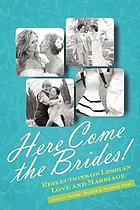
booknotes: here come the brides!

I recently finished reading the heartfelt collection Here Come the Brides: Reflections on Lesbian Love and Marriage, edited by Audrey Bilger and Michele Kort (Seal Press, 2012). After making my way through the super-angsty I Do, I Don't (2004) earlier in the summer, I was a little burned out on the whole queers and marriage combination. I Do, I Don't felt -- and you know I don't often say this -- too political. Reading the earlier anthology I was left feeling weighed down with the social import of my marriage. Half the authors seemed to feel marrying will contribute to the revolution (I believe it will, but that wasn't the deciding factor); the other half seemed to feel marrying was tantamount to betraying the revolution (if it is, answer me this: why does it terrify the conservatives so frickin' much?). Throw in a salting of stories about heart-wrenching breakups and there was a serious deficit of personal joy. 

Here Come the Brides! is far from apolitical. From Heather Purser's "Suquamish Family Values" (about the role she played encouraging her tribe to recognize same-sex marriage) to "Emily Douglas' "We Have to Talk About It, Someday" (in which Douglas muses on how her job at GLAD as a recent college grad brought home how important marriage was -- queer theories aside -- to the actual queer community) Brides! interweaves the political and legal revolution taking place throughout North America as queer couples form legally- and religiously- recognized relationships with one another in the presence of family and friends. Yet overall, the energy of Brides! is much more effervescent and forward-looking than that of I Do -- even when the topic was divorce or death. (Yes, I actually wept on the subway while reading Susan Goldberg's "Four (Same-Sex) Weddings and a Funeral," in which she describes how her wedding was a race against her mother's cancer). Artist Patricia Cronin contributes an essay on the creation of her sculpture Memorial to a Marriage, which stands in Woodlawn Cemetery on the plot that will one day serve as Cronin's grave -- as it will the grave of her wife, Deborah Kass. Authors express their doubts and fears about marriage, describe the messiness of gay divorce (how do you get divorced as a lesbian in a state that refuses to recognize your marriage?). They tell hilarious stories of over-involved parents, wedding-cake sagas, and serial weddings -- all to the same woman! -- made logical or necessary by the patchwork of same-sex marriage laws in our Land of the Free and Home of the Brave.

I think, overall, I was struck by the normality of the essays in Brides! -- the way the stories told are (mostly) human marriage-and-relationship stories, perhaps with a queer twist. In the years between 2004 and 2012 we -- as a country, as a culture -- have moved from a moment in which marriage equality was a dicey political proposition to a moment when it's become (knock on wood) an historical inevitability. DOMA will eventually be ruled unconstitutional -- perhaps as early as next year -- and once the federal government is constitutionally required to recognize, once again, all state-sanctioned marriages then states will be able to move forward at their own two-steps-forward-one-step-back pace toward civil marriage for all consenting adult couples (and hopefully poly relationships as well, not long behind). And religious communities can continue their tedious-yet-necessary process of coming to terms with the full spectrum of love that is possible in this world. Brides! rides this wave and treats getting gay-married more or less the same as, well, getting married.

While a part of me enjoys the frisson of rebellion inherent in Hanna and I marrying today (yes, I get a kick out of the notion that by doing what I want in my own private life I'm freaking people out), I'm also grateful to all of the women (and men) who have done the emotional, political, and cultural work necessary to make it possible that our marriage is almost totally unremarkable.

2012-07-05

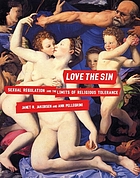
booknotes: love the sin

It's frankly been awhile since I read a book on ethics or theory that expanded my brain so that it felt like it was slightly too big for my skull (aka getting intellectually hot 'n bothered), but in the past ten days I've actually read two of them! The first was Janet R. Jacobsen and Ann Pellegrini's Love the Sin: Sexual Regulation and the Limits of Religious Tolerance (New York University Press, 2003). The second was Julie Stephens' recently-released Confronting Postmaternal Thinking: Feminism, Memory, and Care (Columbia University Press, 2012), which I'm going to review next week. Both are slim volumes that tackle complex issues of embodiment, identity, the relationship between public and private, between citizens and the state, and ultimately the way in which we understand individual persons in relation to collective cultural and political spaces.

Reading Love the Sin and Confronting Postmaternal Thinking back-to-back brought out a lot of resonances. Both books are critical of the way in which individuals have been constructed in the modern liberal democracy. They ask hard questions about who counts as a full and worthy citizen under the laws and policies of such democracies (particularly in the United States). They point to ways in which the mid-twentieth-century rights movements -- especially the gay and lesbian liberation movement and mainstream feminist movement -- have been undercut and co-opted by a majority hostile to their more radical re-visioning goals. This is due, both works contend, at least in part because of the narrow "rights" rhetoric these movements have depended upon. In Stephens' work, we see how the language of feminism has been deployed in order to shore up a neoliberal notion of citizen-as-worker, while political ethics grounded in care and connectedness ("mothering") are erased from the collective memory and public discourse. In Love the Sin, Pellegrini and Jacobsen argue that notions of liberal "tolerance" and a reliance on innate/natural ("born this way") justifications for non-normative sexual orientation have unnecessarily compromised our ability to advocate for a robust freedom-of-practice in the public realm.

While I have persistent reservations about Stephens' framing of the maternal (which I'll get to in next week's review), I was thoroughly seduced by Jacobsen and Pellegrini's passionate and articulate advocacy of "freedom" as a more expansive, humane, way of framing the question of sexual citizenship -- and other types of citizenship -- than the notion of tolerance. "In a situation framed by the rhetoric of tolerance," they write,
It becomes impossible to distinguish between the perpetrators of racism or homophobia or misogyny (this list is hardly exhaustive) and the objects of various forms of discrimination. Rather, when the situation is characterized by tolerance, the public is not expected to take a stand against injustice, but merely tolerate both sides of the "conflict," which is supposedly between opposing groups of people who are circumscribed outside of those who constitute "the public" or "the American people" writ large (59).
Drawing on media coverage of gay and lesbian activism and of violence motivated by anti-homosexual bigotry, Jacobsen and Pellegrini persuasively show how tolerance encourages the same us/them thinking that can lead to violence, despite liberal claims that tolerance is the way out of the hate that leads to violence. For to "tolerate" those who are different from you implicitly assumes alienation, "the other," a distance between queer folks, for example, and "the public." The public "tolerates" the homosexual, which means the homosexual is outside of the group. Therefore, as much as we'd like to believe tolerance is our answer to violence, it offers no escape:
Tolerance disavows violence and those who commit heinous crimes, but along the way it offers no exit from the us-them logic that structures hate and tolerance in our society. It also gives us no logical exit from the mandate to tolerate those who hate. (p. 65)
Jacobsen and Pellegrini go one step further and argue that we are further hobbled by the notion that our claims to toleration of homosexuality are grounded in the fact that one's sexual orientation is supposedly hard-wired and therefore immutable:
Characteristics that are taken to be immutable, such as skin color or sex, will be tolerated. But when traits or behaviors are taken to be discretionary and volitional, people can be asked, indeed compelled, to change their behavior and assimilate to the dominant norm ... Gay identity may be protected by the courts ... but 'homosexual conduct' certainly is not (94).
As they point out, this is hardly simply a problem for left-progressive causes, such as gender or sexuality. The notion that only immutable characteristics are protected, not behavior, means that an Orthodox Jew can be asked to cut his hair, or a Muslim woman asked to remove her headscarf, in order to keep their job. It means that Christians are not protected from being fired for refusing to work on Sunday.

How, then to get ourselves out of the (violence-enabling) cul-de-sac of identity-based tolerance? This is where Jacobsen and Pellegrini's theorizing takes what I think is a paradigm-expanding turn. They argue that rather than a framework of "human rights," social justice movements around sexual expression (and potentially other things) would do better to argue on the ground of religious freedom. Essentially, they argue that sexual freedom is analogous to the freedom of religion in that both are practices that express core values, and that not just beliefs but also individual expression of belief deserve protection, in public as well as private.

This shift frees us from the interminable question of what "causes" sexual variation, which -- while theoretically interesting --  is actually ultimately unhelpful when it comes to determining what is lawful. Grounding rights claims on the basis of one's inclinations being "natural" will do little to answer critics who (quite rightly) point out that human beings are not compelled to follow every inclination without thought, and that our ability to regulate impulsive behavior is, in fact, part of what makes us human. Just because something is "natural" doesn't make it "right" in the moral sense -- since morality is a human creation, and deeply embedded in time and place. As Jacobsen and Pellegrini write:
An important virtue of the paradigm shift we are advocating [from identity-based "rights" to freedom to live out ones values] is that it does not force us to finally settle the question of what 'causes' homoesexuality. In the end it just does not -- or should not -- matter how an individual came to be homosexual, any more than it matters how heterosexuals became heterosexual. Rather, homosexual life and experience are to be valued, are in fact sources of value. (98).
This shift also helps us to combat arguments to the effect of, "It's okay for homosexuals to practice their lifestyle as long as they don't flaunt it in front of me":
Free exercise does not depend on the boundary between public and private that protects liberal freedom. In a liberal democracy, some people are allowed to live lives freely in both public and private; others are allowed freedom only if they keep significant aspects of their lives private and privatized; and still others ... are not allowed even the protections of a 'private life.' But if 'free exercise' and 'democracy' are to mean anything at all, everyone must have access to life both in public and in private (106).
I see productive parallels here with discussions of ability and access, about what it means to work "toward restructuring our public life so that everyone is included in categories like 'the general public,' 'the public at large,' or 'all Americans' " (72). The majority culture has a strong normative power -- sanctioned by the language of "tolerance" -- to enforce their own notions of civility, rather than practice radical acceptance and lovingkindness toward those whose behavior as well as identity challenge their notions of propriety. The perennial (and perennially heated) "debate" about children's behavior in public spaces comes immediately to mind for me: because children are constituted as "other" in our society (as non-workers they are understood as future/potential citizens, but not full participants in their own right), we feel entitled to ask that their behavior meet our own criteria of acceptability, rather than ask how we might re-formulate our public spaces to better serve them. The same could be said for the elderly, the non-English-speaking, the mentally- or physically struggling.

Angus Johnston has a powerful post on this subject, in which he writes:
Here’s my secret: my kid doesn’t actually behave as well as I do. Sometimes she whines. Sometimes she has to be reminded to to keep her voice down, or not to run. So yeah, when I take her to the Museum of Modern Art, we do impose on other patrons, at least a little.

And you know what? A little imposition on other patrons is okay. I’ll apologize sincerely to anyone she disturbs, but I’m not going to apologize for her presence. Because MoMA is her space as much as it is mine.

My [cognitively disabled] sister whines in public sometimes, too. Sometimes she gets overwhelmed and cries. Sometimes she raises her voice. (Running in museums is not an issue with her, I’m happy to say.) If we say that my daughter shouldn’t go to museums because she might whine or cry or raise her voice, then we have to say that my sister can’t go either — and one of the best days I ever spent with my sister was the day that we visited a MoMA exhibit of design for people with disabilities. MoMA is my sister’s space as much as it is mine.
You can (and should) read the whole piece over at Student Activism.

The basic point both Jacobsen and Pellegrini are making here is that in the framework of "tolerance," in which we tolerate non-Christians, non-straight folks, children, the disabled, in "our" public square is that through the mechanism of toleration we are perpetuating the hierarchy in which some people are more entitled to freedom of expression than others.

"The public" -- understood to be the white, male, economically self-sufficient, heterosexual Christian (I'm sure that's not exhaustive, but you get the idea) -- "tolerates" those of us who diverge from that which feels comfortable to. But that toleration is conditional on our normative behavior. Jacobsen and Pellegrini remind us that such conditional acceptance is, well, otherwise known as being an entitled asshole.

I encourage anyone who cares about effective social change toward a more egalitarian, inclusive world to read Love the Sin. Even if sexual freedom isn't your issue, per se, the framework Jacobsen and Pellegrini lay out is an effective one for any area where the personal and political intertwine.

Related Read: If you're psyched by the ideas Love the Sin outlines, be sure to check out Kenji Yoshino's Covering: The Hidden Assault on Our Civil Rights (Random House, 2006) which explores the legal side of these "freedom of expression" issues.

2012-05-03

booknotes: the straight state

Modern-day campaigns for civil rights and equal citizenship for queer folks tend to conjure up a progressive trajectory from exclusion to inclusion: from a dark past when the homosexual was excluded from equal citizenship (or forced to live closeted) to a not-yet-realized future in which one's sexual identity, desires, and behaviors, do not exclude one from enjoying the rights and responsibilities of the American citizenry. The ability to apply for citizenship in the first place, the responsibility to serve in the armed forces, the personhood status to form legally-recognized kinship networks and access the welfare benefits distributed through those kinship systems. In our collective memory, we look backward in time to a period during which homosexual acts were illegal and homosexual identity stigmatized; we look forward to a period during which our bodies and relationships won't ipso facto criminalize us (at worst) or shuffle us off as second-class or invisible citizens (still a precarious state of affairs).

Yet as Hanne Blank pointed out, in her recently-released Straight: The Surprisingly Short History of Heterosexuality, the notion of the heterosexual being (in opposition to the homosexual being) only developed in the late nineteenth century. While certain sexual activities (most obviously sodomy, commonly interpreted as anal penetration) were criminalized, the homosexual person was not constituted in either cultural or legal understanding until well into the twentieth century. In The Straight State: Sexuality and Citizenship in Twentieth-Century America (Princeton University Press, 2009), historian Margot Canaday argues, in fact, that the identity category of "homosexual" developed in symbiosis with the United States' state-building activities to such an extent that it was, in part, the legal conception of homosexual persons that led to the mid-century emergence of our modern-day gay or queer political identities:
An increasingly invasive state would in time also help to create rights consciousness for some queer individuals who, embracing the state's own emphasis on legal rather than medical categories, began to ask not whether they might be sick, but whether they might be citizens. They came to agree with the state's simple common sense definition of homosexuality, then, but could see less and less that was commonsensical about its placement outside national citizenship (254).
This is a fascinating argument, well-grounded in historical evidence. Canaday's footnotes exhaustively document the hours she spent in the National Archives reading through years worth of military court marshals, personnel files, proceedings from immigration hearings, congressional records, and Works Progress Administration memoranda. What this detailed historical research reveals is how much our "common sense definition of homosexuality" was created through a process of trial and error, through attempts to police the bodies and social lives of those individuals coded undesirable. In example, let me glean from Canaday's evidence a few instances of such creation that I found particularly delightful and thought-provoking.

First, in her chapter on immigration and "perverse" bodies during the first quarter of the twentieth century, Canaday discovered in reading INS records that aliens were generally turned away at the border or deported not for homosexual acts but for gender non-conformity.  This is merely the most recent book in my readings on the history and politics of sex and gender that has made me think about how much policing of our sexual lives speaks to a (larger?) fear of bodies that fail to fit our ever-changing yet stubbornly dualistic notions of appropriate gender performance. As Tanya Erzen observes in her study of ex-gay conversion therapy literature, for people and institutions concerned with gender role divisions, same-sex sexual behavior becomes a marker of gender inversion or confusion, rather than something of primary concern. That is, a woman who has sex with another woman is worrying because she is becoming masculine or enacting a "male" role. Not because she's enjoying same-sex sex in and of itself.

Along similar lines, Canaday suggests that those policing same-sex sexual acts among men in the military, particularly during the early years of the twentieth century, distinguished between men who penetrated during sex (the "male" role) and men who were -- willingly or unwillingly -- penetrated either orally or anally (the "female" role). Rather than imagining lovemaking as a more fluid series of encounters in which one might penetrate and be penetrated in turn, military police imagined that men's sexual identities were constituted and static. To some extent, they were following the lead of the men whose activities they were punishing, since barracks culture appears to have encouraged the tom/bottom hierarchical dynamic. However, Canaday's narrative suggests that the policing of same-sex sex, and the differential punishment meted out according to who fucked whom reinforced the notion that what one did somehow followed from (or led to) who one was. It made me wonder if, in these military proceedings, we were seeing the nascent beginnings of our modern-day notion (in some circles) that gay men are either "tops" or "bottoms."

While the military was fairly clear about the illegality of same-sex acts between men (though their policing of such activity was uneven), some of the most hilarious passages in the book deal with the inability of military police to agree on what exactly women do together when making love. The perplexity with which society responds to lesbian sex never fails to amuse me. Is it really that difficult to understand? Seriously? Like -- clits and tongues and fingers and natural lubricant? Hello? But apparently, for mid-century MPs, women doing it was just beyond the realm of possibility. When, in 1952, two military police on patrol happened across two women having energetic oral sex in the back of a vehicle, they were so "bewildered" by what was happening that they turned and went away in "shock." "It was just one of those things that you read about and hear about but never see," one of the MPs admitted during testimony when asked why the incident had gone unreported (191-192). Because of this mystification of female sexuality, Canaday demonstrates, the anti-gay purges of women in the military relied not on evidence of acts (as it did with men) but on extensive documentation of women's homosociality, emotional ties, and gender performance. Canaday observes that, while men and women alike were harassed during the lavender scare (see David K. Johnson), discharge files for men are typically 1/4-1/2 inch thick while women's routinely run 2-3 inches. Not a commentary on the relative suffering of men and women accused of homosexuality, this difference represents the comparable difficulty of evidence gathering when what you're trying to document is something as nebulous as tendencies and identities rather than trying to answer the question of whether so-and-so gave John Smith a blow job.

Finally, in her two chapters on the Depression-era welfare state, Canaday explores the long-term effects of structuring the social safety net in such a way as to reinforce the heteronormative family. A precursor to the destructive obsession with marriage as an alternative to unemployment and welfare benefits, federal programs targeting the unemployed and itinerant in the 1930s, and the benefits of the G.I. Bill post-WWII, became tied to an individual's ability and/or willingness to fulfill a role (mother, father, husband, wife, son, daughter) within the ideal "straight" family. While this had little per se to do with one's sexual identity, it had everything to do with domesticating individual human beings whose free-floating sexual desires were closely associated with criminality. Work programs for unemployed men, for example, often included some sort of requirement that the individual's monthly allotment be sent to a designated "dependent," usually a family member along the order of a parent, a wife, or children (118). Some "unattached" men were able to work around this requirement by designating a male friend as their dependent, but overall the government structured twentieth-century benefits schemes to encourage hetero-familial ties and discourage both sustained single-ness and unorthodox relationships. In the postwar era, this structural dis-incentive was joined by overt discrimination as those who had been discharged from the military for homosexuality were denied veterans benefits and experienced widespread stigma and economic hardship for suspected or actual same-sex attractions, behavior, and relationships.

Overall, Canaday's study is one of the most impressive examples of historical inquiry into sex and gender that I've read in recent years, and I highly recommend it to anyone interested in the historical context of our present-day notions of gender, sex, sexual orientation, and citizenship.

Cross-posted at The Pursuit of Harpyness.

2012-04-26

booknotes: families apart

The University of Minnesota Press was kind enough to send me a review copy of Geraldine Pratt's fascinating study of migrant domestic workers and their families who have traveled from the Philippines to Canada as part of Canada's Live-in Caregiver Program (LCP). Families Apart: Migrant Mothers and the Conflicts of Labor and Love (University of Minnesota, 2012) is the result of Pratt's collaboration with the Philippine Women Centre of British Columbia. With the assistance of the PWC, Pratt identified and interviewed twenty-seven families: mothers (the primary LCP participants), children, and sometimes partners, who have emigrated to Canada in hopes of economic and social mobility. Families Apart draws on these interviews, with analysis and reference to the relevant bodies of literature, to explore and theorize the long-term effects of the LCP on family relationships.

I came at this book from several perspectives: that of a former care provider (though in very different circumstances from those of the LCP participants), that of a family member, that of a feminist, and that of an oral historian. I want to talk briefly about each of these lenses through which I considered Pratt's work, and suggest that her research is of potential worth to those with a personal, as well as academic and political, interest in the intersection of family with wage-work and caregiving labor.

Pratt overtly encourages self-reflection in her readers, many of whom she presumes will be white, middle-class academics like herself, whose experience of parenting and family life is, materially speaking, worlds apart from the experience of the participants in her research interviews. Throughout Families Apart, she tries to break down the barriers to empathy and suggest that cross-class, cross-cultural experience of familial bonds of affection and care can help those outside the LCP program understand the trauma of separation and conflicting responsibilities and desires expressed by those who are (or have) lived through it. Pratt juxtaposes, for example, images of her own child (with his permission) and testimony from immigrant children recalling the trauma of their mothers' departure. Through such attempts at self-conscious narrative voice, Pratt pushes us not to imagine the families whom she interviewed as "others" whose emotional attachments are somehow qualitatively different from our own due to race, class, or culture. Instead, she argues, the pain of long-distance parenting for both adults and children is a point of connection.

This thread of Pratt's book prompted me to think about how our culture values separation and togetherness in family life. I read Families Apart long before the campaign-related kerfluffle over how parenting and work are valued in our society, but Katha Pollitt's ever-articulate analysis of the Ann Romney/Hilary Rosen dust-up could be read alongside Pratt's trans-national analysis as an example of how the relative value of wage-work and family care shifts in relation to social status:
The difference between a stay-home mother and a welfare mother is money and a wedding ring. Unlike any other kind of labor I can think of, domestic labor is productive or not, depending on who performs it. For a college-educated married woman, it is the most valuable thing she could possibly do, totally off the scale of human endeavor. What is curing malaria compared with raising a couple of Ivy Leaguers? For these women, being supported by a man is good—the one exception to our American creed of self-reliance. Taking paid work, after all, poses all sorts of risks to the kids. (Watch out, though, ladies: if you expect the father of your children to underwrite your homemaking after divorce, you go straight from saint to gold-digger.) But for a low-income single woman, forgoing a job to raise children is an evasion of responsibility, which is to marry and/or support herself. For her children, staying home sets a bad example, breeding the next generation of criminals and layabouts.
Substitute "welfare mother" with "LCP worker" and this equation of worth applies. Women participating in the LCP program are caught in a double-bind of judgment. Expected to give up their personal and family lives in order to care around-the-clock for another family's children (traveling halfway around the globe to do so, often not seeing their own children for years at a time), they are judged by their families and society at large for abandoning their children. Their often-crucial financial support for the family back home often comes at the price of losing their partner and the alienation of their children. Pratt skilfully navigates the gendered dimensions of the LCP program, exploring the differing expectations of maternal and paternal care while not ignoring the real psychic pain for all concerned when a parent is absent for years of a child's life.

Families Apart echoed certain themes explored in Schalet's Not Under My Roof which I read shortly before Pratt's study. I'd argue that both books take a cross-cultural look at how we constitute families and value different types of families (and different types of family members) unequally. Notions of "good" and "bad" mothering (or fathering), what is a family unit deserving of respect, how young people should behave in relation to their parents -- who is the proper person, parent or otherwise, to care for a child and help them grow into an adult who can participate meaningfully as a grown-up person in society.

Finally, as a practitioner of oral history, I really appreciated the sections of Pratt's book where she stepped back to examine the process by which she and the PWC made the materials collected during research accessible in a variety of venues: through a multi-media exhibition, in theatre performance featuring monologues crafted from the interviews, in ongoing collaboration with the families whose stories Families Apart documents and synthesizes. Researchers within the social sciences and humanities whose research intersects with human lives are engaged in an ongoing discussion about the ethics of such work, and how to document without exploitation. I believe that Pratt's work is a valuable contribution to that professional conversation. While she herself is the first to argue that the social inequality between herself and the LCP women she collaborated with cannot be erased or overcome by this work alone, I'd argue that her example is a useful one for all those planning future collaborative projects to examine and learn from.

Anyone who wants the chance to think anew about how we value families (and what families we value) in our North American culture of inequality should definitely check out this book.

Cross-posted at The Pursuit of Harpyness.

2012-04-12

"have a moment for gay rights?"

via ACLU
Last week outside Trader Joe's I was accosted by charity muggers from the ACLU. 

This happens regularly in Coolidge Corner and I generally ignore them across the board. I make it a rule not to support any organization via street harassment, even if they're a group with a mission I support. (And yes, I have, in fact, been a card-carrying member of the ACLU when personal finances allow).

But anyway. Last Wednesday was the day the federal appeals court in Boston heard oral arguments against the Defense of Marriage Act (DOMA). And the chipper young woman in the ACLU vest was asking passers-by if they had "a moment for gay rights?" so I thought perhaps they had some sort of petition to sign vis a vis the whole DOMA-is-stupid-not-to-mention-unconstitutional thing. So after the internal debate while grocery shopping ("you should just suck it up, self, and be a good citizen and a social person for once") I actually stopped on my way out of the store and volunteered to hear what she was about.

"So do you have a petition you want me to sign or something?" I asked.

She seemed surprised I was even stopping, but gathered herself together and launched into what the ACLU was about, as an organization, and specifically some of the things they were doing to support queer folks who'd been discriminated against because of their sexuality. It turned out she didn't have any sort of petition to sign, but was just trawling for donations.

"I'm asking people to make a donation of $29 dollars today for each of the twenty-nine states where it's legal to discriminate against someone due to their sexual orientation!" she wrapped up with a note of breathless relief in her voice that I'd actually let her finish a thought.

"Well, I don't give out my financial information on the street," I tried to break it to her gently, "But I'll definitely keep you guys in mind."

"But you're behind what we stand for, right?" She asked, anxiously.

"Um --sure!" I said, shook her hand politely, and headed off down the street.

It took me most of the walk home to realize what was the most frustrating and surreal part of the interaction. It was that the young woman in question was pitching her persuasive skills at someone she presumed to be straight. Did I stand for "gay rights"? Well, yeah, actually, I'm pretty into having equal civil rights. The whole reason I'd stopped to speak with her in the first place was that I'd been thinking about DOMA that day. Because the fate of the Defense of Marriage Act has a direct effect on my life. Because Hanna and I are talking about getting married and even though we can do that perfectly legally here in the state of Massachusetts, as far as the federal government is concerned (taxes, social security benefits, etc.) we won't be a family unit.

So I'm not behind the idea of "gay rights" as this abstract great-good-thing that all card-carrying members of the ACLU should, you know, be in support of because it's the right thing to do. (Though I'm behind it for that reason too). I'm actually in support of it because it's about my equality of personhood before the law.


I'm not pissed at the young woman I spoke with (well, not much). She's getting paid probably minimum wage (if she's getting paid at all) to stand on the pavement and harass people at rush hour for what is probably an incredibly, incredibly low rate of return. And I'm sure whatever job training she received was cursory at best.

But I do find it note-worthy that the ACLU spiel is constructed in such a way that assumes the person to whom the spiel is pitched is outside the group of interest. I think I would have been less irritated by the encounter if I'd been told, "Here's what we're doing to support your right to equal protection under the law, regardless of sexual orientation or gender identity." If you're standing on a street corner flagging people down, you can't actually tell whether they're gay or lesbian, bi or poly, trans, genderqueer, or otherwise. Whether their sexual practices put them at risk of arrest, whether they're afraid to us public restrooms, or whether they've got two partners waiting at home, only one of whom they could legally marry -- even in the state of Massachusetts.

So a tip to all you charity muggers out there? Keep in mind when you ask the question, "Are you for gay rights?" The chances are at least one in ten (more of you count family members of queer folks who identify as straight) that the person you're talking to isn't a supporter of gay rights 'cause it's a trendy liberal cause, but because it actually has an effect on their quality of life.

I'd say, just assume everyone's queer until proven otherwise. It might actually up your success rate.

Cross-posted at The Pursuit of Harpyness.
2012-03-28

I (heart) dahlia lithwick (again) + rant re: healthcare oral arguments

via @eskenosen

On the way to work this morning, Hanna and I were discussing how utterly nonsensical and frustrating the anti-healthcare folks are. First they didn't want government-supported, single-payer healthcare. So the Obama administration patched together something using private insurers. And now they're pissed about that. Dahlia Lithwick, as usual, highlights the inanity:
It’s always a bit strange to hear people with government-funded single-payer health plans describe the need for other Americans to be free from health insurance. But after the aggressive battery of questions from the court’s conservatives this morning, it’s clear that we can only be truly free when the young are released from the obligation to subsidize the old and the ailing. Justice Samuel Alito appears to be particularly concerned about the young, healthy person who “on average consumes about $854 in health services each year” being saddled with helping pay for the sick or infirm—even though, one day that will describe all of us. Or as Justice Antonin Scalia later puts it: “These people are not stupid. They're going to buy insurance later. They're young and need the money now.” (Does this mean that if you are young and you pay for insurance, Scalia finds you “stupid”?)
Read the whole thing over at Slate. Emphasis mine.

Apart from everything else that's angry-making about the healthcare "debate," I'm particularly appalled by the endemic ageism and ableism embedded in these arguments about how we shouldn't have to pay for what other people need. As if those "others" (the sick, the infirm) aren't actually us. And will never be us. Or, once we become the other we'll be left out in the cold to cope with our ill-health all on our own.

Say what?

The argument that young people don't need healthcare services implies that youth per se = healthy. This is an idealization of youth that runs rampant in our culture, and it's poisoning our collective consciousness by encouraging us to imagine that to be young is in itself a protection against ill-health. This is nonsense. I know plenty of young people, myself and my partner included, who need not only preventative care (so we hopefully won't need more expensive care later), but also actual expensive care. Being young doesn't protect you from physical infirmity, both organic and accidental. Young people get cancer. Young people have thyroid disorders. Young people get infections. Young people break bones, are involved in traffic accidents, must cope with sports injuries. Young people need dental work done, require eye care, need regular reproductive health check-ups (I just made my annual pelvic exam appointment last week).

This Friday I'll be celebrating my 31st birthday. I know very few of my peers who haven't already, in their relatively youthful lives, had need of medical services for all of these things. And who haven't avoided desperately-needed medical care because they were temporarily un- or under-insured and couldn't afford to pay out of pocket for that care.

As Lithwick points out, even if we experience a relatively healthful youth, we will all one day age and become infirm of body. There is a stunning arrogance and lack of self-awareness to the suggestion that those "others" who get sick and need medical care are the ones who much bear the burden of procuring those services. Seriously: Do certain Supreme Court Justices / conservative lawmakers actually believe they will never become ill/sustain an injury/need end-of-life care?

Once again, I am reminded of historian Gerda Lerner's observation that "All of us, ultimately, will join one of the most despised and abused groups in our society--the old and the sick."

There's a conversation to be had about the financial burden of healthcare services, and whether the cost should be as high as it is. But that conversation should be separate from the conversation about individual healthcare needs, because when it comes to health, like our environment, we're all in this together. There is no way to escape sickness, there is no way to prevent death. We will all experience physical suffering. We will all need medical care. And there is absolutely no way to reliably predict who will need what services and when.

It frightens me that the supposedly wise persons on the Supreme Court seem to have forgotten their own mortality.

2011-12-29

quick hit: belfast project oral history lawsuit

via
Earlier this year, the British Government requested the audio recordings and transcripts of interviews from a Boston College-based oral history project documenting the history of conflict in Northern Ireland. The oral history narrators who participated in the project originally granted interviews on the condition (agreed to in writing) that the interviews remain sealed until after their death. English officials are arguing that the interviews are required as part of an ongoing criminal investigation and claiming that the United States government is under treaty obligation to obtain the materials from BC and hand them over.

After initially resisting the request, Boston College appears to be on the brink of complying with a Judge's order to hand over select interviews. This decision not only represents a breach of promises made to human beings whose lives (and the lives of countless others) will now be under renewed threat, but will have a widespread chilling effect on the practice of oral history in situations where, perhaps, the oral historical record is particularly vital: sites of conflict where normal modes of documentation are lost or never created.

You can listen to an interview with the former director of the Belfast Project, Ed Moloney, on WBUR's Radio Boston.

You can read more about the lawsuit at Boston College Subpoena News (a blog set up to follow the story, which is unaffiliated with BC), as well as access many of the publicaly-available legal documents related to the case.

Neither the Oral History Association nor the American Historical Association have weighed in on this issue recently -- at least that I can find -- although the AHA did acknowledge back in May that the issues are "murky" and raise complex ethical questions about the practice of oral historical research.


2011-10-05

our bodies, ourselves @ forty (+ me!)

(photo by Hanna)
The feminist classic, Our Bodies, Ourselves, turns forty this year and has just been issued in a revised edition that was multiple years in the making. How do I know this? Because I got to be a part of the process! Long-time readers might remember when I posted a call for participants in the revision process back in January 2010. Well, in addition to broadcasting the call I also submitted my own name to the editors and was invited to join them in a virtual focus group discussion on intimate relationships. This conversation eventually turned into the "Relationships" chapter in the new edition, and many of the passages that didn't make it into that chapter have been used in other sections -- I found bits and pieces from my contributions in the chapters on sexual orientation and on sexuality, for example.*

my contributor's copy, signed by the editorial team!
(photo by Hanna)
I don't think I can adequately convey to you how proud I am to be a part of the OBOS project. My mother's battered copy of Our Bodies, Ourselves was my constant companion through adolescence and, among other things, was my first exposure to explicitly feminist analysis, my first exposure to the idea of same-sex relationships, and my introduction to masturbation and how to do it. One of the first things I did when I moved out to Boston in 2007 was to visit the Schlesinger library at Radcliffe and browse the records of the Boston Women's Health Book Collective -- the group that put together the first mimeographed edition of OBOS back in 1970. It's an incredible honor to have had the opportunity to add my perspective to the myriad other voices that have been part of this international endeavor throughout the past forty years.

It's so strange to see your own words on the printed page...
This past Saturday, women from around the globe gathered here at Boston University for a symposium in honor of the new edition. I wasn't able to make the gathering because of a scheduling conflict (and, frankly, because it sounded like a long day with too many new people to make small talk with!) ... but I'm looking forward to checking out the web video of the talks once those go up online. If/when they become available, I'll be sure to post a link here!

Here's hoping that OBOS (and I!) will be around in another forty years to celebrate eighty incredible years of women teaching and learning one another about their bodies, their sexuality, their relationships, their values, and their lives.

Update: Thanks to OBOS for mentioning this post in their introduction to the Relationships chapter online! Welcome to anyone who's come to visit the feminist librarian via their link. You are most welcome.

*It's standard OBOS practice to keep all of the in-text quotations anonymous in order to protect contributors' privacy. For the "Relationships" chapter we all chose pseudonyms; if you know me and you care to figure it out you'll be able to identify me through my bio at the beginning of the chapter.

2011-09-02

booknotes: birth matters

I must have hallucinated starting the review of this book, because I have a clear memory of doing so but now cannot find the draft anywhere. Och, well. We'll just have to begin again.

I need to admit upfront that I'm an entirely biased reviewer of anything Ina May Gaskin writes. My mother's copy of Spiritual Midwifery was, along with Our Bodies, Ourselves, one of my adolescent introductions to feminism, as well as to female bodies and the amazing things they're capable of. I think what Gaskin and the other midwives at The Farm have been doing for the past forty years is hands-down one of the most awesome things to come out of the 1960s, the women's health movement, and feminist activism. So when my friend Molly offered up Ina May Gaskin's Birth Matters: A Midwife's Manifesta (New York: Seven Stories Press, 2011) as one of the reading options for her GoodReads reading group on feminist pregnancy, birth, and parenting, I jumped at the chance.

UPDATE: You can read Molly's review over at first the egg.

That having been said, I also approached the Gaskin's memoir with some trepidation: how would her work and her writing come across in a new book, one that would be impossible to read through the filter of "that's just how they talked about things back in the 70s..."? I was a little bit worried about being let down, much in the same way one's favorite books from childhood often feel a bit tarnished upon re-reading.

My fears, however, were (mostly) all for naught. Birth Matters is highly readable, compelling, contemporary, and unapologetically feminist in its approach to the political and cultural barriers to high-quality pregnancy, birth, and parent-and-child care in our society. "The way a culture treats women in birth is a good indicator of how well women and their contributions to society are valued and honored," Gaskin argues in chapter one, "The Importance of Birth and Birth Stories":
My intention in this book is not to persuade those women who want to avoid pregnancy to change their minds -- far from it. But I do want to convince even women with no interest in motherhood that the right to a positive and safe birth is just as important as the right to choose whether or not to have a child (7).
She gently points out that the often bitter divisions between parents and non-parents is an unhelpful model for making our world a better place for all humanity: "It is time for feminists to realize that pitting the needs of nonmothers against those of mothers is a way of weakening -- not strengthening -- women. Women should not lose their human rights when they become mothers" (41). Beyond looking at women and mothers, she articulates what I think should be shouted from the rooftops by us all: that the way we welcome children into the world speaks volumes about how we value humanity -- and as such, birth matters to all of us simply because we are part of that human community. The way we were welcomed into the world and cared for as infants and children is part of that story, even if we don't ever plan on becoming parents ourselves.

Gaskin has been in the enviable (for most midwives) position of enjoying strong, positive working relationships with practicing OB/GYN physicians throughout her tenure as a midwife at The Farm, and her belief in the ability of medical doctors and lay or nurse-midwives to work together to foster positive birth experiences for families is evident throughout the book. I really appreciated the way she highlighted the work of medical doctors who trust birthing parents' bodies and offer their expertise without trying to direct the process or fueling fear of the body's work during pregnancy. Yes, sometimes life-threatening complications develop during pregnancy and birth -- but too often in our culture we attempt medical interventions in childbirth that end up being detrimental to the health and well-being of both infants and their birth parents. Gaskin offers an alternative vision of how birth practices can be (and have for the nearly three thousand births Gaskin and her team have overseen in the forty years between 1970-2010). Indeed, it is the outcomes of Gaskin's practice that will likely be most compelling for skeptics of out-of-hospital childbirth: of the 2,844 births attended at the Farm 94.7% were completed at home with a maternal death rate of 0% and a neonatal death rate of 1.7 deaths per 1,000 births. The Farm's rate for c-sections stands at 1.7% which nation-wide hovers between 30-50% (far exceeding the World Health Organization's recommendation of 5-10% of all births*).

Most of what Ina May Gaskin has to say will sound familiar to anyone who has read recent books on pregnancy and birth, particularly Born in the USA by Marsden Wagner and Pushed by Jennifer Block (I highly recommend them both). However, there is some valuable material here that even those familiar with the arguments for the midwifery model of care will likely be interested in. Interspersed throughout are birth narratives written by women who have given birth at The Farm. From my point of view, there can never be too many birth narratives out there for us to draw upon. It's particularly useful to read how different each person's story is, even though they have made some of the same basic choices about the type of care they want to receive. I was also glad to see a chapter on sexuality and childbirth -- something I wish Gaskin had done more with. The midwives at the farm have long advocated for sexual interaction between a laboring woman and her partner(s) as a way of facilitating a less painful, more effective labor. The idea of "orgasmic childbirth" might seem obscene to some, idealistic to others, but even if you don't want to think about childbirth itself as a sexual experience, I think Gaskin has some important points to make about the way medicalizing childbirth (treating it as an illness) has removed women's bodies and their physical presence -- sexual and otherwise -- from the active birth process.

My one frustration with Birth Matters is the consistency with which Gaskin's language choices and examples reinforce the assumption that all birthing takes place within the context of heterosexual, gender-normative lives. The birth parent is consistently a woman/mother and is never identifiably partnered with a woman, although in several stories it is unclear whether the birth parent is single or has a partner. This seemed like an odd oversight for someone who is otherwise so clearly open to the possibility that families come in many shapes and sizes. At times, Gaskin also over-simplifies the history of midwifery and falls into the trap of romanticizing the sacred feminine and female bodies -- something that makes me slightly uncomfortable since I try to avoid essentializing femininity/femaleness. I'd recommend, as a supplement to reading this, the wonderful essay "The Manly Art of Pregnancy," by j wallace (found in Gender Outlaws: The Next Generation, edited by S. Bear Bergman and Kate Bornstein, 2010) which just might be my favorite thing written about pregnancy ever. And I would hope that future editions of this work acknowledge more overtly that people with many different sex and gender identities and family contexts become pregnant and wish to give birth in supportive, low-intervention settings such as The Farm.

The final verdict: Read this book if you care about the cultural and political contexts in which we come into the world, and if you question -- even a little bit -- the medicalization of pregnancy and childbirth that has become the norm in our country at this point in history. Gaskin's memoir-manifesta is a beautiful testament to how there is a different way -- not just in the future, but here and now.

*See the WHO report The Global Numbers and Costs of Additionally Needed and Unnecessary Caesarean Sections Performed per Year: Overuse as a Barrier to Universal Coverage [PDF]

2011-08-05

booknotes: helping teens stop violence

My latest early reviewer book from LibraryThing was the 20th anniversary edition of Allan Creighton and Paul Kivel's Helping Teens Stop Violence, Build Community, and Stand for Justice (Alameda, CA: Hunter House, 2011). The authors have worked together in the field of violence prevention and social justice activism since the mid-1970s. This book is a workbook for adults seeking to work with young people, specifically teenagers, to identify and combat the various types of institutional and cultural injustice they encounter in their lives. "Professional literature about adolescents, social-service priorities, and funding trends all [emphasize] programs that [build] self-esteem," the authors observe. "Many youth workers convey to young people that if they just had higher self-esteem, they could overcome any obstacle and succeed at anything they set out to do," ignoring the institutionalized, systemic injustices young people as well as adults face in securing life necessities and building a satisfying life for themselves and their families (60). We do a grave disservice to youth, the authors argue, by implying that if they are struggling it is largely because of personal failure when, in fact, the problem is an imbalance of power:
Our problem [when we were young people ourselves] was not based on low self-esteem or any of the other psychologically defined problems. Rather, we had no real power over our lives. Without power to protect ourselves, we were constantly restricted, disrespected, and abused by adults. Everywhere we went, adults had the authority to decide how we should dress, where we could be, and who we could be with. They decided our future through daily decisions including discipline, records, diagnoses, arrests, report cards, evaluations, and allowences, or just by ignoring, interrupting, or neglecting us.(60-61)
The imbalance, of course, is not just one of age but also intersects with many other inequalities from which adults also suffer: poverty, sexism, racism, religious bigotry, discrimination based on disability and sexual orientation or gender identity ... the list is a long and familiar one. Creighton and Kivel call on adult allies to work with youth in identifying these power imbalances and combat them. Those who benefit from inequality seek to divide the attention and alliances of those who are struggling to get by under oppressive systems. By forging networks of support among ourselves at the bottom of the inequality pyramid, the authors suggest, we can more effectively enact lasting social change as well as survive in present day far-less-than-optimal conditions.

Since the book is designed primarily as a workbook for group trainings, those who are reading Helping Teens Stop Violence outside of that context may find themselves skimming a bit and taking note of various exercises for later usefulness, rather than reading in a straightforward manner. I found myself skipping around quite a bit, once I'd read the introduction and gathered the gist of the authors' perspective and approach. Some general impressions:
  • The authors have made an effort throughout to discuss the ways in which different types of injustice overlap and interact, so that even though (for example) a given chapter may be about "class" the exercises continually push us to think about how things like race, sexual orientation, immigrant status, etc., shape our class identities and economic opportunities.
  • As someone who is continually frustrated with the invisibility of ageism in our culture -- even among groups of people willing to discuss and dismantle other "isms" such as sexism and racism, or address homophobia and access issues for folks with disabilities -- I was really excited to see the first few chapters devoted to age-based discrimination, and exercises designed to get adults remembering their own teenage years and the lack of agency they had as young people in a world controlled by adults.
  • The authors emphasize the fluidity of what they call "target" and "non-target" categories (i.e. various types of social privilege), reminding us that our social status and agency is highly dependent on context and can change as the context changes -- so that each of us have experienced both being part of a target group and being part of a non-target (privileged) group at various points in our lives.
  • Even without using this book as a workbook with a group, as it was intended, the various exercises often contain useful suggestions for how to intervene in situations where you see oppression happening in order to name it and (hopefully) stop the cycle of violence from continuing.
  • They also offer some good guidelines for having constructive and saf(er) discussions about difficult topics, recognizing that "we have all been hurt in various ways and have had lots of experience of not being listened to well, so we have developed a billion ways to protect ourselves from getting close to each other and becoming vulnerable to further hurt" (170). By structuring discussions in ways that may seem a bit stilted at first, groups can build enough trust by which they can have productive conversations about prejudice, violence, and institutionalized inequality.
Helping Teens Stop Violence will obviously be most useful to those who have immediate practical application for its suggested exercises and the resources listed in the back of the book (though I found their resource lists a rather odd mix, with curious gaps -- particularly when it comes to the available literature on violence in education and violence against youth). However, it's a worthwhile read for anyone who is interested in the practical aspects of social justice work at the grassroots level, and who is interested in thinking a bit more deeply about the way in which our culture has institutionalized ageism and systematically disenfranchises young people and children.

2011-06-30

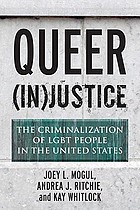
booknotes: queer (in)justice

The third installment in Beacon Press's Queer Action/Queer Ideas series, edited by Michael Bronski, Queer (In)justice: The Criminalization of LGBT People in the United States is co-authored by law professor Joey L. Mogul, police misconduct attorney Andrea J. Ritchie, and community organizer Kay Whitlock. Hanna saw it on the new book wall at the library and correctly ascertained it was the sort of title I'd be interested in. So she brought it home, I read it, and now I'm gonna blog about it.

Queer (In)justices is far more than an examination of the ways in which our legal system polices "deviant" gender and sexuality qua gender and sexuality. Yes, the authors look at the laws and policing practices related specifically to penalizing folks who engage in (publicly or privately) non-heteronormative sexual practices, or whose appearance suggests that they identify outside the gender/sex/sexuality binary. However, their analysis goes much deeper than these targeted laws. Instead, they argue that "the policing of sex and gender 'deviance' is central to notions of crime, and serves both as a tool of race-based law enforcement and as an independent basis for punishment" (xiii). In other words, notions about the relationship between non-normative sex and gender expression and criminality influence the way in which the legal system treats people perceived to be queer whether or not they are caught in the system specifically because of sex- or gender related policing. As they argue:
As queer identities substituted for individual perverse acts [in the late nineteenth century]  the process of criminalizing sexual and gender nonconformity was facilitated through the construction of ever-shifting and evolving archetypal narratives [of deviance]. Rooted in historical representations of Indigenous peoples, people of color, and poor people as intrinsically deviant, fueled and deployed by mass media and cultural institutions, these narratives now permeate virtually every aspect of the criminal legal system (19).
They make a compelling case for us to question the usefulness of narrowing our focus specifically on anti-gay laws, and on enacting new laws seeking to protect LGBT people from homophobia ... particularly when the very law enforcement officials meant to ensure those laws are respected are among the primary culprits when it comes to bigotry and violence around sexual and gender nonconformity.  In chapters on gender and sex policing on the street, in the courtroom , in prison, and in uneven police responses to violence against LGBT people, we see how presumptions of criminality systematically influence how queer people are treated in the context of the legal system, whether they are perpetrators, victims, or both. They make the particularly important point that, regardless of what laws are officially on the books, "police and other law enforcement agents are given considerable latitude in deciding which laws to enforce, how to enforce them, and which people to target for law enforcement" (48).*

Being queer, or being perceived as queer can cause law enforcement officials to treat individuals as criminally guilty whether or not they actually are -- and can bring harsher punishments (when compared to those perceived as straight and gender conforming) when those individuals are sentenced. Likewise, criminal behavior is often associated -- implicitly or explicitly -- with sexual depravity. Using examples that will be familiar to anti-sexual harassment or anti-sexual violence activists, Mogul, Ritchie, and Whitlock describe how individuals known or perceived to be queer are treated by law enforcement officials as if they are incapable of being victims of sexual violence. They describe victims of same-sex domestic violence who themselves were put in jail or ruled incapable of being abused because of their orientation or gender identity.

Ultimately, Queer (In)justice argues that LGBT activists must take a much more comprehensive approach to their agitation for change within the framework of law and law enforcement. While much of the mainstream LGBT work in this area in recent years has involved the quest to enact anti-discrimination and anti-hate crime legislation, and to grant same-sex couples the right to marry, Mogul, Ritchie, and Whitlock point out that a much broader cultural shift within law enforcement must take place in order for such changes in the law to have an on-the-ground effect. As they write, "The hate crime framework is ... compromised by placing primary responsibility for preventing violence in the hands of a criminal legal system that is itself responsible for much LGBT violence" (129). We would do well, they seem to be pointing out, to pay closer attention to the experiences of those most vulnerable to police brutality, discrimination and abuse sanctioned by the legal system, and persecution based on presumptive criminality ... not just because of their sexual identity, but because their mere presence as a non-conforming body evokes powerful notions of danger and violence whether or not these reactions are warranted in specific instances. Comprehensive reform is needed before the passage of laws will have real-world implications for the majority of the LGBT population.

Queer (In)justice is a must-read for anyone who wants to re-consider the current LGBT approach to legal reform.

*This point is exactly why I am uneasy with Jim Wallis' argument that police force is preferable to military force. Wallis' assumption that police only use force when it is necessary to enforce agreed-upon laws ignores all of the situations in which law enforcement officials abuse the power vested in them ... something which, as a person who works in anti-poverty and anti-racism circles, Wallis ought to know full well.

2011-06-28

quick hit: SCOTUS on young peoples' free speech rights

I'm in Michigan for a whirlwind visit to attend my brother and sister-in-law's wedding celebration. I thought I might have fun photos to share with you today, but not yet. Instead, I'll post this story that I heard on National Public Radio this afternoon.

The Supreme Court on Monday struck down a California law banning the sale of violent video games to children, saying it ran afoul of the First Amendment right to free speech.

In one of the most closely watched cases this term, in a 7-to-2 vote, the justices said governments did not have the authority to "restrict the ideas to which children may be exposed."
I was struck, when I heard the story on All Things Considered, that the issue was being framed as a free-speech issue. That is, that children have a constitutional right to information...even if its information we find disturbing and wish to protect them from on a legal level.

This may be the first (and only!!) time I find myself agreeing with Antonin Scalia:

Writing for the majority, Justice Antonin Scalia said the country has no tradition of restricting depictions of violence for children. He said California's law did not meet a high legal bar to infringe on the First Amendment or the rights of parents to determine what's best for their children.
Note that parents still have the authority to determine what their children can and cannot access; it's just that the government cannot legislate one particular type of parental values for all children.

The article goes on to note:

Although regulating children's access to depictions of sex has long been established, Scalia said there was no such tradition in the United States in relation to violence. He pointed to violence in the original depiction of many popular children's fairy tales like Hansel and Gretel, Cinderella and Snow White.

"Certainly the books we give children to read — or read to them when they are younger — contain no shortage of gore," Scalia added.
Read the whole thing over at NPR.

While I agree with Scalia that as a society we routinely expose children to a high level of violent stories and imagery (not to mention leaving them vulnerable to actual physical and emotional violence), I think it's interesting that the question of restricting access to sexual materials was left unquestioned. If children have a constitutional right to play first-person shooters, don't they also have a constitutional right to see images of people making love, if that is what they wish to do? (Most young children are probably more interested in violence than sex ... but for the sake of legal consistency they should be allowed either).

I have a lot of questions about the nuances of this ruling, and no time in the next 48 hours to do any background reading. But I'll let you know if there are further developments!

2011-05-02

thoughts on the death of a man

Hanna and I woke up this morning to near-ceaseless NPR coverage of Osama Bin Laden's death during an American military raid on his compund in Pakistan. I have a lot of ill-formed thoughts here, and reading through the blog posts that have gone up over night on the topic is making me rather sick to my stomach so this is not destined to be the most cogent of blog posts. But with all of the media speculation about what this means for the "war on terror" and with the coverage of celebrations of death that seem to be taking place across the United States, I feel compelled to point out

a human being died last night.

Yes, he was a sick and twisted person who was responsible (directly and indirectly) for the suffering of thousands upon thousands of other people.

Kind of like we, as a nation, are responsible for the suffering of thousands upon thousands of people due to the two wars we started ten years ago in retribution for the suffering we held this man responsible for.

And now here we are celebrating death in the streets.

I'm just not comfortable with that.

The first thing my mind presented to me this morning when I heard the news was a memory of hearing, ten years ago this coming October, that the United States had begun bombing Afghanistan in retaliation for 9/11. I was huddled around a campfire on a beach in Oregon among a group of folks with whom, for the past month, I'd been reading about the horrific things human beings do to one another in wartime.

It's hard to imagine bombing or invasion is the way to solve the pain of loss or to drive away the fear of vulnerability when the first thing that comes to mind is the seige of Sarajevo or the violence of South African apartheid or the war of attrition that is (to this day) taking place between Israel and Palestine.

It's equally hard for me to imagine that assassinating Osama Bin Laden will bring any sort of political or personal resolution to the violence of the past decade (and beyond).

A human being died last night.

The world that he (and we) created remains. There is still suffering, there is still inequality, there is still anger ... there will still be violence.

Adding to that violence will not make us safe.

And the purposeful killing any human being should never lead to dancing in the streets.

UPDATE: My friend eskenosen @ kai ho logos sarx egeneto has put it much more eloquently than I ever could:
I mourn with those who still mourn, after 10 years, the absence of their friends, coworkers, and family members. I understand those who celebrate the death of bin Laden as long-awaited justice.

But I also grieve for our nation, that instead of crying out to God in our shock and horror, we cried for bombs, for guns, for shock and awe. That a human has died, and people sing in the streets.

2011-02-24

booknotes: making it legal

Through LibraryThing's Early Reviewer program I was sent an advance review copy of the second edition of NOLO's Making It Legal: A Guide to Same-Sex Marriage, Domestic Partnerships & Civil Unions, by attorneys Frederick Hertz and Emily Doskow (Berkeley, CA: NOLO, 2009; 2011). The book aims to be a practical nuts-and-bolts guide for same-sex couples considering marriage. It offers a whirlwind tour of the history of same-sex marriage, the current international and domestic context for such marriages, and the nitty-gritty of marriage and divorce laws as they apply to all couples -- as well as specific advice for same-sex couples who are considering forming legal relationships.

The authors go beyond describing legal rights and obligations and also discuss political activism and the emotional and sociocultural meaning -- and potential downsides -- of marriage commitments. Hertz, who appears to be the primary author of the text, describes himself as a cautious in his advice to couples seeking to enter marriage. "I'm often branded an antimarriage lawyer," he ruefully admits, "because I tend to focus on the risks and downsides of this powerfully attractive institution." He points out that "the legal structures of conventional marriage and the patchwork of nonrecognition by other jurisdictions create fairly serious legal problems for many couples, and it is just plain unwise for anyone to get married without understanding the potential risks and benefits" (3).

As someone in a lesbian relationship, and as someone who has actually discussed marriage with my partner, I found a lot of the practical legal information in this text helpful. Particularly useful are the state-by-state charts detailing what options, rights, and responsibilities same-sex couples have when entering into formal partnership agreements in different states. Hanna and I are fortunate enough to live in Massachusetts, one of the states that currently allows us to marry and enjoy all of the same state benefits as heterosexual married couples. However, these benefits do not extend to the federal level, nor would that marriage be considered valid in a number of other states (including my home state of Michigan) -- that's where the "nonrecognition" issue comes in. This means, practically, that same-sex marriage can be a bureaucratic headache. For example -- since it's that time of year -- married same-sex couples in the state of Massachusetts file a joint tax return at the state level ... but are single for the purposes of their federal tax returns. Which means creating a mock joint federal tax return and using those numbers for the state level returns. Even more tax paperwork -- the joy!

And if we ever moved across state lines for work or family need (or hell, for the pleasure of it) then the state we moved to would get to determine whether we were married or not, based on their own local laws. Not to mention if we decided to move internationally.

I found Making It Legal at its most annoying when it shifted away from describing the practial ramifications of same-sex partnership options (both forming and dissolving those partnerships) and attempted to tackle the other aspects of marriage, such as "applying logic to picking a partner." Wtf? Dude! You're not a trained marriage counselor so back the fuck off!

On the whole, though, it was a highly readable guide to the legal landscape, and one which I definitely plan on consulting as Hanna and I move forward with the business of making our relationship into a long-term reality ... however we decide to formally recognize it.