~oOo~
Showing posts with label education. Show all posts

2014-06-25

booknotes: hollowing out the middle

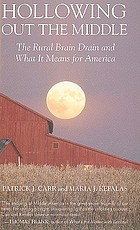
Footnote mining from Paying for the Party, I ordered Patrick Carr and Maria Kefelas' Hollowing Out the Middle: The Rural Brain Drain and What it Means for America (Beacon Press, 2009) through ILL and read it last week. This slim volume is based on an ethnographic study Carr and Kefelas of three hundred high school graduates from a small, rural town in Iowa they call "Ellis." With a population of about two thousand, Ellis' economy is primarily agriculture and industrial; high school graduates who go on to college rarely return. Those who remain struggle with social isolation and financial solvency. Carr and Kefelas surveyed over three hundred Ellis high school graduates from the 1990s (who at the time of their study were about ten years out from the end of twelfth grade) and conducted approximately one hundred interviews of young adults who had either stayed in, left, or returned to their hometown. Hollowing Out attempts to describe the motivations and experiences of each group of individuals, and ends with some reflections on the role that social policy can (and cannot) play in supporting and reinvesting in rural life nationwide.

What Carr and Kefelas found was that high school graduates were tracked / self-sorted into a handful of broad categories: the Achievers and Seekers, the Stayers and Returners. Achievers were tracked from a very young age by their parents, school system, and socioeconomic status, to leave Ellis and attend a four-year college and possibly graduate school. Most will never return to live in their hometown, having built lives elsewhere with career opportunities and social connections. Seekers don't have the resources to attend a four-year college, even a good state school, and so often join the military; they will leave to explore the world, but have limited socioeconomic mobility and often struggle to find a place in the world beyond the armed forces. Stayers have dropped out of high school or obtained limited qualifications, usually struggle with un- or underemployment, wed and/or become parents much earlier than those who leave. They, and the Returners, often have negative perceptions of the world beyond their small town community -- either because they tried and failed to find a foothold there, or because they have no desire to leave the familiar. Returners are usually "Boomerang" individuals (often women) who may have relocated for an associates degree or attempted a four-year college education but never established connections that made them feel comfortable beyond Ellis. They can also sometimes be Achievers who, for a variety of individual reasons, return home (familial responsibilities, political ambitions, occasionally the right job at the right time). However, these "High Flyers" -- the ones so desperately sought by states with struggling economies -- are few and far between.

In the end, Carr and Kefelas encourage policy-makers to focus less on trying to lure these "High Flyers" back to their states, since individual motivations usually have little to do with initiatives to woo the Achievers into returning, and instead focus their resources on the Stayers and Returners who are already the backbones of their communities and remain an un- and undertapped social and economic resource.

The authors do, eventually, touch upon some of the non-economic reasons that Achievers and others who leave Ellis may resist returning -- reasons such as prioritizing racial diversity or acceptance of queer identity and relationships -- that I think should have been foregrounded a bit more. Granted, interesting work is currently being done to highlight the lives of queer folk in rural America. Rural Americans are not inherently more or less prejudiced toward Othered groups than urban or suburban Americans. However, smaller communities are often self-selecting and more homogeneous; they're also often extremely isolating for those who are somehow different, even if they (we) don't experience overt prejudice or violence. Simply put, it was harder for me, as a bi woman, to find potential female partners (and even potential male partners!) in a medium-sized Midwestern town than it is.

And now, as a married lesbian, I have structural as well as cultural reasons not to return to Michigan: our marriage would not be honored by the state government. So whenever I read about state campaigns for professional Michiganders to return and invest in the state where I grew up -- and which I continue to love in many respects -- I admit I'm not exactly feeling the love. Many of us Leavers have left precisely because our communities scarred us, deeply, and returning to live there would open old wounds.

But in the end, I was uneasy with the way in which the authors' solution seems to encourage a "circling the wagons" approach to social policy, where the parochial reasons that people leave certain communities are glossed over rather than challenged. I wanted them to dig more into the ways, for example, racial prejudice, the gendered division of labor in working class communities, or anti-gay sentiment not only drives Achievers away but harms those who stay behind. Not every person who embodies a marginalized identity (queer, physically disabled, non-white, Muslim, etc.) has the resources to "get out of Dodge" even though we may have strong push-pull factors to do so. While I'm comfortable with studies of rural America that ask us to reconsider our prejudices toward "hicks" living in "flyover" states, the fact that homogeneity was a fact of small town life the authors' touched on but never developed is something I found troubling.

Still, I'd recommend this book to anyone with an interest in how education and social policy reproduce class and cultural divides here in America. The personal narratives woven throughout the sociological analysis will resonate with many readers who grew up in rural or quasi-rural Midwestern communities (raises hand), and provoke reflection beyond personal experience toward broader social trends.

2014-06-23

booknotes: paying for the party

Amanda Hess at Slate recently reminded me that I had meant to read Elizabeth A. Armstrong and Laura T. Hamilton's longitudinal, ethnographic study of a cohort of undergraduate women, Paying for the Party: How College Maintains Inequality (Harvard Univ. Press, 2013). Armstrong and Hamilton's research team spent a year in residence at "Midwest University" living with a group of first-year women assigned to one of the school's party dorms; they continued to follow the cohort on their floor for five years -- the typical four years to degree and one year after. What began as a study of young women's sexual agency at a large public university quickly turned into a study of class, and how strongly pre-existing socioeconomic conditions in the lives of each student determined her trajectory through college and into her immediate post-college circumstances. Hess' article at Slate highlights some of what the research team did discover about the sexualization of college women during their work; Paying for the Party delves into the class issues that define many young women's path through university.

The central thesis of Party is that undergraduates at large state universities (the researchers hesitate to generalize from a single case study) are constrained by the available cultures of their schools -- and often the specific dorms to which they are assigned -- in ways that limit the ability of less privileged students to utilize college as a tool for class mobility.

What the researchers found was that the majority of students entered MU on course to take one of three readily-available "pathways" through the college years: the party pathway, the professional pathway, and the mobility pathway. The researchers acknowledge that other pathways exist, both at MU and elsewhere, but for the cohort they studied, these were the three dominant ways of approaching college. The dominant pathway was the "party" pathway; the elite and upper-middle-class women of the cohort arrived on campus with plans to strengthen their already-privileged social networks through the Greek system, tracked to areas of study that facilitated this way of life, and left college with low GPAs and degrees that would have been useless without their high-powered family connections and financial resources. Less privileged women who attempted to access the party pathway typically suffered a high loss of resources and low return. The party pathway also ruthlessly policed the performance of femininity according to a very specific set of elite standards which required money and time to cultivate and maintain.

In addition to the struggles of women on the party pathway who were unable to compete with the elite partiers in terms of time, resources, social connections, and conventional beauty, Paying for the Party also chronicles the way the party pathway culture encroaches on those beyond its borders. Even women who tried to follow the professional or mobility pathway found their efforts stymied by the dominant party cohort. The researchers argue that non-elite students need more robust support for non-party alternatives in order for college to be both cost effective and life enhancing.

There are limitations to the study. For example, I couldn't help but feel that even taking broad social categories into account, the party/professional/mobility pathways schema left out crucial segments of the undergrad population. Perhaps because the research team chose a "party" dorm, or perhaps because they were at a land grant research university instead of a liberal arts college, they failed to identify the pathway that I and many of my closest friends were on: What I might call the "how to live" pathway. This is the pathway that treats learning as a goal in and of itself, and self-knowledge -- as well as wider horizons -- as a valuable part of the college experience on par with skill acquisition/job training. And it's not a pathway exclusively available to the rich; I know students across the economic spectrum who used college as a step-stone to a meaningful life (not necessarily a well-heeled one). Armstrong and Hamilton hint at such rewards toward the end of the book when they profile a student who had limited economic resources, struggled in school, and yet one year after graduating is building a meaningful life for herself working as a ski instructor and living with her partner in the wilderness setting that drew them together.

They also suggest throughout the book that MU has other subcultures of students whose subcultures provide a robust alternative to the party pathway and help students succeed: the arts students, the African-American learning community, the LGBT group. But it seems that none of their cohort originally assigned to the party dorm found their way to these rich subcultures, a telling finding in and of itself that shows how segregated a campus can be, and how the crap shoot of first-year campus housing may make or break students. Particularly the most vulnerable ones whose families have little or no experience navigating higher education.

Despite the study's necessarily narrow focus on its original cohort, I highly recommend Paying for the Party to anyone interested in higher education, economic inequality, and the ways in which gender plays out in specific ways in both social class and college contexts.

2013-12-04

quick hit: a must-read piece on ex-homeschool activists

The American Prospect has a most excellent article up today, The Homeschool Apostates, by Kathryn Joyce, exploring the growing visibility of young adults who are organizing and pushing back against their parents' decision to use home education as a tool for familial control:
Even conservative Patrick Henry felt like a bright new reality. While much about the college confirmed the worldview Lauren grew up in, small freedoms like going out for an unplanned coffee came as a revelation. She describes it as “a sudden sense of being able to say yes to things, when your entire life is no.”

Family ties began to fray after she met John, a fellow student who’d had a more positive homeschooling experience growing up; he took her swing dancing and taught her how to order at Starbucks, and they fell in love. Her parents tried to break the couple up—at one point even asking the college to expel Lauren or take away her scholarship for disobeying them. Their efforts backfired; soon after her graduation, Lauren married John and entered law school.
As someone who grew up within the early unschooling wave of the modern home education movement, and thrived within it, I often find myself frustrated by most media coverage of homeschooling -- it is too often simplistic, judgmental, one part awe (such well-behaved children!) one part hysteria (equating home education, per se, with child abuse). In contrast, Joyce does an excellent job of covering a specific type of homeschooling, as well as teasing out the highly gendered nature of Christian homeschooling culture. She also foregrounds the thoughtful, passionate voices of home-educated young people who look back on their childhoods and the Christian subculture they were immersed in with a critical eye.

While I don't agree with everything these ex-homeschoolers have to say, I think their voices are crucial ones for us to listen to -- particularly those of us who have benefited from the low level of state oversight that enabled our families to do our own thing while these controlling parents to did theirs. I don't always agree with the remedies these ex-homeschoolers propose, but I do believe their experiences must be taken seriously. We can't in good faith build a culture of learner-led education on the backs of young people who have been denied a very basic level of self-determination and autonomy.

Anyway. Go read the whole thing.

2013-03-28

politics, pornography, and combating queer isolation

cross-posted from the family scholars blog.

Conner Habib, an actor who performs in gay male pornographic films, was recently invited by a student group at Corning Community College (Corning, NY) to speak on sex and culture. When the college president found out that Habib, in addition to being a thoughtful and articulate human being, had appeared in erotic film, she took steps to cancel Habib's talk and has apparently moved to further obstruct attempts to host the talk in a non-college-sponsored locale.

Habib has written an excellent piece about his own perspective on these events which can be read in full over at BuzzFeed. In the essay he reflects on the place pornographic materials have in mitigating the isolation sexual minorities can experience, particularly in rural areas. He writes:
Where I grew up, just outside of Allentown, PA, I watched, right through my adolescence into adulthood and early college years, while straight people paired off and experienced sex. They were able to engage with a basic aspect of human life that seemed unavailable and distant to me. Unlike today, there was no discussion about gay marriage, nor were there many gay characters on TV. But even if there had been, neither would have rounded out my experience as a man with homosexual feelings because so many of those feelings were — unsurprisingly for a young man — sexual. Gay sex was a lonely venture. It wasn't easy to find, and was only mentioned in slurs and the butt of jokes. ... Whether I bought it from the adult video store or, later, downloaded it, gay porn helped me encounter positive images of gay men enjoying the act of sex. Gay porn was a window into gay sexuality that was free of shame and guilt, and revealed a different world where sex wasn't a lonely prospect, confined to the shadows or just my imagination.
Habib describes how, being a man of Arab descent, he receives fan mail from gay men in Middle Eastern countries who "[express] gratitude and relief for my having portrayed gay sex in a positive light on camera."

Perhaps most relevant to readers of Family Scholars, Habib articulates the importance of discussion, rather than silence or evasion, in the face of conflicting interests or concerns:
When [Corning Community College Vice President] Don Heins called me and stated that [college President] Katherine Douglass canceled the talk because she had concerns about the controversial subject on campus, I told him that I understood those concerns. They are serious and real concerns - if they weren't, I'd have no need to give talks, after all. I have similar and additional concerns in my own life: How will having done porn intersect with my other interests? How can I pursue porn and speak openly about sex without making other people feel alienated? What have I noticed about the porn industry that I find supportive of or a hindrance to freedom — particularly for LGBT communities? ... the question here isn't whether or not we have concerns, but whether or not we have the courage to address them.
(Emphasis mine. Read the whole piece here.)

As someone who believes in the power of articulate and thoughtful speaking and writing, I believe that the Corning Community College administration has erred in canceling Habib's talk. Particularly without even approaching him first with their concerns (presumably about his acting career) and attempting to find a workable solution short of banning him from campus.

As an undergraduate student, I experienced a similar situation in which a controversial speaker was brought to campus -- in this case, a leader from an ex-gay ministry, Mario Bergner, who was invited by the chapel staff to speak as part of a series on Christian sexual ethics. The group of faculty, staff, and students who objected to the invitation put together a coalition and sponsored, during the same week, the evangelical gay rights activist Mel White.  The power dynamics were different in our case: the administration supported Bergner and the chaplain's office, while White was brought in through grassroots action. At Corning, a student group invited Habib and the administration used institutional authority to veto that action. I also don't claim my college community found a wholly successful method for conflict resolution: participants in the Bergner-White event(s) will likely remember how incredibly difficult it was to navigate the divisions within the community which these dual invitations exposed, divisions which fifteen years later still remain unresolved. 

However, I -- like Habib -- would contended that it is far better to have difficult, even painful, conversations than no conversation at all. Because Habib and the students who wanted to hear him speak have gone public with this story, a conversation is happening anyway: the conversation that the school administration sought to stifle, as well as a conversation about how and why they sought to stifle it.

I hope members of the Corning Community College administration are listening closely, and perhaps learning a thing or two in the aftermath which they might have learned more productively learned by attending Habib's talk as originally scheduled.

2013-03-14

booknotes: the end of sex

It's always slightly embarrassing to admit you've requested an advance review copy of a book mostly to make fun of it and/or get angry at it -- even more so when the book in question actually turns out to be much better than you suspected it was going to be at first glance. Sometimes you really can't judge a book by its cover. Or, in this case, its title.

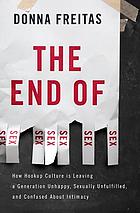
The book in question, this time, was Donna Freitas' The End of Sex: How Hookup Culture is Leaving a Generation Unhappy, Sexually Unfulfilled, and Confused About Intimacy (Basic Books, 2013). Oh, god, no, I thought. Another hand-wringing book about how Kids These Days Are Doing It Wrong. Another book blaming feminism or men or pornography or youth or [insert favorite moral panic here]. Another book where an adult spends an inordinate amount of time focused on the sex lives of teenagers: how much they're having sex, how they're having it, with whom they're having it, and how they are (or should) feel about it when they do.

Yet I was pleasantly surprised. Donna Freitas is a skillful critic who manages to avoid many of the standard pitfalls of such journalistic studies. A professor of religion and gender studies, who also has a background in student life, Freitas' previous work, Sex and the Soul (2008), examined the role of religion and spirituality in adolescent sexual decision-making. This new work centers the voices of undergraduates themselves, letting them describe in their own words how they navigate the sexual culture(s) of residential college life. Although Freitas does not discuss her research methods in detail, it sounds from the text itself that she collected written surveys, conducted face-to-face individual interviews, and asked study participants to keep a written journal documenting their reflections about sexuality and selfhood. These primary sources inform Freitas' narrative throughout and serve to make her argument stronger -- though not unassailable. I'll get to my outstanding questions and irritations below, but first let's talk about what I appreciated about The End of Sex:
  • An insistence on both female and male voices. Too often, books and articles on so-called "hook up culture" (i.e. Sessions Stepp's Unhooked) focus on women almost exclusively. They take for granted that the hook up is a situation designed by and for men (who, our narrative of masculinity goes, are always ready for no-strings-attached sexual encounters) while women are losing out. Freitas actually admits that this was a narrative she herself bought into before she began her research. But in listening to actual young men, she discovered what sociologists like Amy Schalet have pointed out to us: that young men, like young women, yearn for emotional connection and meaningful sex. Yet they have learned to bury those desires under the shell of masculine bravado.
  • Calling out the gender binary. Freitas does a good job of pointing out how the cultural expectations around male and female sexuality constrain students' ability to act on their authentic desires. Men, straight and gay, feel pressured to want sex all the time and bury their emotional-relational desires deep; to the extent they acknowledge those feelings, they're likely to feel isolated without anyone to discuss them with (because all the other men around them are similarly self-protective and silent on the subject). Women, meanwhile, are walking the tightrope of that old no-win situation, the virgin/slut double bind. They're expected to be willing (but not too willing); sexually " pure" (but not too pure). Much like the high school "slut" -- who may or may not have ever had sex -- female college students struggle to manage their reputations in a world where too much and too little are equally derided.
  • Listening to students thoughtfully, and encouraging sexual agency. Too often, books on young peoples' sexual habits end up caught in a rescue narrative, calling on us to "save the children (from themselves)." Otherwise known as concern trolling. Freitas resists condescension, writing with confidence in young peoples' ability to change hook up culture from within into something that better suits their needs. Freitas also tries, with middling success, to resist a one-size-fits-all solution to young peoples' dissatisfaction with hook up culture. While I think she could have gone further with this, that she acknowledged difference at all (including the fact that some students might thrive on casual sexual interactions) deserves a nod.
  • Distinguishing between the cultural narrative and personal reality. She points out that her study participants consistently report that "everyone else" is engaging in casual sex, while they themselves are dissatisfied with the scene and are seeking alternatives. Freitas could have interrogated this dissonance a little more closely, but, again, points for acknowledging that not all (or even most?) students are throwing themselves into a life of no-strings-attached sexual experimentation.
  • Human sexual variety. Unlike many of the writers who have looked critically at the practice of hooking up, Freitas intentionally brings queer students and queer relationships into the picture. One of the students she profiles at length -- as someone who successfully resisted engaging in sexual activities he didn't feel ready for or comfortable with -- is a young gay man now happily in a serious, sexually-active relationship. She also notes the way young people report moving in and out of the hook up scene, rather than imagining once they've fallen off the deep end there's no going back.
  • Encourages us to help young people learn good sex. And by "good sex" she doesn't mean "sex only within marriage" or simply "safer sex" practices -- but sexual intimacy that is wanted and enjoyable. Too many of the students Freitas spoke with seemed to feel caught in a cycle of sexual behavior they hadn't actively chosen to engage in, yet didn't feel able to say no to. The landscape of sex appears, in their view, to be one of "on" or "off," where once you've said yes one time you might as well keep saying yes again and again -- whether you really desire to or not. If this is an accurate depiction, it's heartbreaking -- and points toward the need sexuality relationship education that refuses to reduce the message to "abstinence only," or public health messages about STI prevention.
  • The problem of alcohol replacing communication. While I question the extent to which all students everywhere depend on alcohol to grease the sexual relationship wheels, where it does happen, I agree with Freitas that it's a worrying trend. Not only for the usual alcohol-consumption reasons but also because it isn't serving users' sexual pleasure and sexual agency well. Students report using the "I was trashed" and/or "my partner was trashed" line to explain away all manner of sexual activities in which consent was dubious at best, and mutual pleasure a distant ideal rather than a lived reality. 
So those are the good parts: This is a thoughtful, evidence-based study that centers the voices of the population Freitas is studying (male and female students of all orientations in four-year residential colleges). It resists gender stereotyping and heterocentrism. It also, for the most part, resists reactionary solutions such as calling on students to "wait until marriage," or suggesting a (female) "return to modesty." Instead, Freitas encourages educators and adult mentors to give students the cognitive and emotional tools to critically engage with their own sexual cultures, evaluate their sexual values, resist sexual activities that make them unhappy, and create sexual relationships (whether fleeting or long-term) that will bring them physical and emotional pleasure and satisfaction. There is little in this agenda that I would argue with.

Still, there are some outstanding questions I have about the way Freitas frames the problem of hook up sex and some of the solutions she has offered. In brief:
  • Blaming the usual suspects. In trying to identify where "hook up culture" comes from, Freitas relies in part on a number of usual suspects: pornography (for teaching poor sexual scripts), online social networking (for supposedly robbing young people of interpersonal skills), the pervasive use of alcohol by college students (see above), and the changing "rules" of relationship formation (without a "dating" template, and without clear gender roles, how and when to make the first move?). I find all of these unsatisfying in their explanatory power, though I'd agree that some of them are concerning in their own right. 
  • If hook up culture is a story about other students, how many young people are actually participating? I was confused by the fact that Freitas repeatedly pointed toward the way the majority of her interviewees were unhappy with the dominant campus cultural narrative of hook up sex, yet a) pointed toward everyone but themselves engaging in it, and b) even when they did report participating it, were doing so to a limited and unhappy extent. I kept wondering: if hooking-up-as-a-way-of-life is always something that someone else does, how much of a reality is it, really? To what extent is it a story we tell ourselves about college culture because we fear/envy college students and -- since at least the turn of the twentieth century -- have continually imagined their lives were sexually hedonistic? If students themselves have inherited this cultural narrative of college promiscuity -- and thus imagine everyone around them is leading a much more sexually wild life than they are themselves -- that's definitely a cause for concern. But not equivalent to students actually engaging in said behaviors.
  • If students are so unhappy, why don't they get off the merry-go-round? I admit my blind spot here: I attended college between 1998-2005 as a part-time undergraduate who only spent three semesters in on-campus housing (when studying on, paradoxically, off-campus programs). I was never steeped in student culture, generally interacting with peers in class and limited extracurricular activities. So perhaps I had greater social independence than most undergraduates to pick and choose the aspects of college culture to engage in. Living in my hometown, I still had the social networks of long-term friendships, extended family, church, and workplace to fall back on when it came to "opting out" of aspects of student culture I didn't like -- whether it was opting out of conservative evangelical chapel services or drink-fueled parties! Still, if students are truly expressing unhappiness with the college scene in such great numbers as Freitas suggests, why oh why are they not revising it? Students are, after all, the primary creators and perpetuators of student culture. 
  • The "her hands caressed" problem. I was having a conversation with a couple of fellow erotica writers recently in which we were joking about the problem of limbs with volition. You're proofing a piece and you realize you've got someone's hands or lips acting independently of the person who, in fact, controls the action. I felt like Freitas often fell into this trap with regards to hook up culture, writing about it as of this culture were an entity with independent agency. Cultural discourses, it is true, can exert powerful pressure on individuals and populations ... but, usually, they only exist because someone benefits, or thinks they benefit, from maintaining that particular cultural narrative. The discourse of gender difference, for example, has vocal proponents who believe that men and women are essentially different. They have something at stake (religiously, relationally, or otherwise) in a vision of gender difference. Who are the defenders of hook up culture? By Freitas' account, not the students themselves! And school administrators, faculty, and parents seem shocked by accounts of its existence. So what accounts for the rise of "the hook up" as something which young people feel they must engage in or at least contend with? This question went unanswered in The End of Sex.
  • What about young people not living in dorms on four-year residential college campuses? This is not really a criticism, since any research investigation has its limitations, but I found myself wondering throughout this discussion of hook up culture how generalizable it might be. I pointed out above that my own non-residential status as an undergraduate insulated me somewhat from campus culture. Surely this is true for others as well. Is the hegemony of hook up culture, as reported by Freitas' subjects, isolated to certain types of undergraduate campuses? (She acknowledges, for example, that it is not so present on evangelical Christian colleges.) What is it like at community colleges? In trade schools? Art schools? Not in college at all? Are there certain populations within large campuses more immune or resistant to hook up culture than others? (i.e. commuter students, international students, students involved in sports? drama? politically engaged? religious students? students who have previously experienced a serious relationship?) I feel like the differences among students is often lost in Freitas' narrative, subsumed under her urgent sense that all students experience the relentless pressure of hook up culture's (disembodied) demands.
  • She blames (in part) technology for young peoples' bewilderment about how to get to know potential romantic partners outside of drunken make-out session. I feel this is a simplistic cop-out. I am, admittedly, biased: my wife and I were introduced via email and spent a lot of our get-to-know-you time via chat and email. We both hate the telephone; for the six months before we moved in together (initially as roommates), I would get up extra early on workdays to catch her online before she had to leave for work; I did my homework after she went to bed, so we could talk online until she shut her computer down for the night. All of this internet connectivity supplemented and facilitated the things we did together in person: walks, movies, lunch at the campus cafeteria, sitting next to one another in class, theater and concerts, shopping excursions. In non-romantic life, I have sustained key relationships, from childhood through into adulthood, by "virtual" means: through postal correspondence, email, blogging, and other social networking tools. Thus, it is difficult for me to take seriously the argument that virtual communication somehow impedes... communication.
  • Why is "dating" the main solution offered to the problems of "hooking up"? Toward the end of The End of Sex, Freitas suggests that students might benefit from relationship education (yes! I agree!) and points toward a professor at Boston College (a Catholic university) who teaches a popular 1-credit class on relationships in which one required assignment for all students (regardless of gender and sexual orientation) is to take a romantic interest out on a date during the semester. The date assignment was, according to the professor, a terrifying and bewildering one for her students -- although they also expressed appreciation that they were forced outside their comfort zone in order to pass the class. Freitas' suggestion is that the structure of the date, however terrifying it is to initiate, provides a safe framework for getting to know a potential sexual partner without being wasted and without the pressure for instant sexual contact. I appreciate her point, but I also wonder why she overlooks the fact that more informal friendships can evolve into sexual relationships in healthy ways -- and the more problematic aspects of dating culture that we don't necessarily want to resuscitate? When I ran a draft of this blog post by my writing group, several members recoiled at the date assignment, not only because it felt intrusive to them, but also because their experience with dating wasn't so hot either. As one member observed, "My son just graduated a small residential college where going on a date was extremely normative. This not only did not stop hooking-up and/or drunken sex, it also didn't seem to improve relationships. It also really strengthened rather restrictive gender norms (who asked who, who paid, etc)." Another concurred, pointing out that her "dating" relationships had suffered from many of the same problems as more casual encounters. Perhaps, we mused together, the problem is not the hook up, per se, but rather misogyny?
  • What about "hanging out"? My wife and I were friends and roommates first, an intense relationship that evolved into courtship over a two-year period, and eventually into a sexually-active, committed partnership. We never formally "dated," yet we weren't hooking up either. Instead, we were good friends who eventually acted on the sexual possibility we both felt in our relationship. A third member of my writing group suggested that between "the date" and "the hook up" there's this thing called "hanging out" -- where you connect in the student lounge over pizza and a Walking Dead marathon and discover you fit together really well, in more ways than one.  "Hanging out," at least in my experience, also carries a lot less baggage in terms of gender-based expectations for behavior. In my informal friend survey, "hanging out" seems to be an option for straight as well as queer couples, so I wonder why it's invisible in Freitas' narrative. Particularly when it has the potential to offer the best of both worlds: getting-to-know-you time without excessive alcohol or the pressure for immediate sexual activity.
In the end, Freitas' The End of Sex is an addition to the literature on hook up culture that is better than many, despite its limitations. I devoutly hope it signals the beginning of a (dare I hope?) sea-change in the way we talk about relationship culture in the twenty-first century. As I finished this review, Tracy Clark-Flory of Salon.com offered up a lengthy interview with author Leslie Bell, who has recently published (yet another!) book on hook up culture, Hard to Get: Twenty-Something Women and the Paradox of Sexual Freedom. Clark-Flory enthuses that Hard to Get is "a nuanced look at hook up culture" that refuses to either downplay its pitfalls or deny its pleasures. That one's on order at my local public library, and I'm looking forward to reading (and reviewing) it soon.

cross-posted at the family scholars blog.

2013-01-31

comment post: pressure to self-disclose in the classroom

unidentified classroom, possibly in Georgia (Library of Congress)
I subscribe to a number of listservs through H-Net, an online hub for humanities scholars. This past week, on  H-HistSex, the list for History of Sexuality, there's been a discussion about class exercises for the first day of class in a gender/sexuality course. I can't link to the conversation "thread" as a stable link, but you can find all of the relevant emails in the January 2013 log with the subject heading Re: Exercise for first day of class in gender/sex course. The resulting conversation was one that I thought some people who read this blog might be interested in. So I'm sharing a few excerpts here (all publicly accessible through the message log above) and wrapping up the post with my own comment which I sent out this afternoon to the group.

Several faculty contributed ideas about "getting to know you" activities that included some sort of topical self-disclosure and/or exercise designed to prompt personal reflection about sexuality and gender. For example:
I teach an introductory class ... and it's often fun to make them stand up and ask them to sit if the statement you make applies to them . . . to see who is the last one standing. You can use all kinds of "gender" statements like "I've dressed as the 'opposite' sex" or "I've seen a drag show." They seem to like this exercise.
And:
I have found that simple writing a three paragraph first person narrative as an opposite gender as useful exercises. Students have responded initially as very difficult to do. But in the end they find it increased awareness of gender issues.
Or:
Think of a pivotal experience that made you aware of the construction of gender in your own life.  Use details to describe a specific incident or two.  It could be either a positive (empowering) incident, or negative (discriminatory, hurtful) incident...Not only does it get them thinking of the issues we'll be covering, but it has turned out to be a wonderful "getting to know you" kind of exercise.
To which some people pushed back, suggesting that such activities can be experienced as threatening or alienating to some students:
You don't want to instantly lose shy, introverted students who have not faced explicit or alternate understandings of sex and gender. Some students do NOT want to talk in front of large groups.  Further, there might be students from very conservative backgrounds who will be lost if they are pushed too quickly.
Or, as another contributor pointed out:
We might want to reconsider activities that require students to self-expose by standing or moving or agreeing/admitting to statements. This can be very problematic for any students who are/identify/gravitate toward the non-normative (i.e., trans- and genderqueer students, students who may be questioning their gender and/or sexual orientations, as well as for students who are disabled). There requires a lot of imposed confession of students. Ditto the activity that requires students to write as the "opposite" gender -- what do I write about if I am identifying as trans or gender queer?
What I think is most interesting is the resistance that these cautions provoked among some other contributors. One person wrote:
If students aren't exposed to this theorization of the personal and personal theorization in our classrooms with forthcoming discussion leaders that role model critical thinking then where exactly will they be exposed to it? A puritanical fear of sharing about gender and sex and sexuality seems to me counter-productive to the very purpose of feminism and women's/gender/sexuality studies.
That was the contribution that finally prompted me to enter into the discussion myself, from the perspective of someone who has been in the study, not instructor position, as well as someone who has thought deeply and observed closely the power dynamics in the classroom. Here is my full comment [with a few clarifications added in brackets]:
In response to the observation "A puritanical fear of sharing about gender and sex and sexuality seems to me counter-productive to the very purpose of feminism and women's/gender/sexuality studies," I would just like to offer a couple of thoughts.

I am a former women's studies student (B.A., self-designed major) and have experience in graduate school in gender studies classrooms as well, although my advanced degrees are in History and Archives Management. I believe in the power of self-disclosure in the classroom, but I also think that it is important that student[s] feel INVITED rather than REQUIRED to share aspects of their life story, particularly in a classroom setting where there is a power dynamic (all classroom settings) and before trust between students and between each student and the faculty member has been established (e.g. on the first day of class). I have been in situations where there was pressure to share aspects of my life story that I didn't feel comfortable sharing, and later felt a (low-grade, admittedly) kind of violation [as a result]. I have also been in class with students who do NOT experience schools as safe spaces, OR who experience schools as safe spaces precisely because they don't require that level of self-disclosure (which the students associate with bullying, etc.).

So while sharing personal experience can be very powerful in the right setting, it can also feel violating and can cause students to turn away from the very type of gender theorizing we hope to encourage them to pursue. Perhaps if such exercises are done early on in class (or, indeed, at any point during the semester), the sharing of reflections by the student could be optional? (And I mean truly optional, with no pressure from the professor to disclose what they don't feel comfortable disclosing.) Obviously, the professor can do everything possible to model an open and non-judgmental space, but it is impossible to know what baggage every student may carry into the classroom -- particularly around experiences of sex and gender which are so deeply personal (and often private, even if not shameful) experiences.

I think the success of such sharing turns on consent. Think, for example, of the psychological difference between choosing to self-disclose one's sexual orientation or gender identity and being "outed" by someone when you weren't ready or didn't feel safe doing so.

I am all for open discussion about gender and sexuality, but I think every student is in a different place in terms of their willingness and ability to speak in deeply personal terms about what those things mean to them. The option for speaking about those ideas with a little more distance and self-protection, particularly at first, seems respectful of that variation among learners.
I had at least one participant email me off-list to thank me for speaking up. I think the entire exchange is a really important example of how mindful we all need to be about the situation nature of self-disclosure and the way that power dynamics can make something that sounds liberating (and might even be liberating for some people in the space) coercive, an abuse of professorial power.

Yes, as the faculty member responsible for teaching the class, you can ask your students to do difficult intellectual and even emotionally-stretching tasks. In a class on sexuality and gender a responsible professor will likely push most of their students to the edge (or beyond) of their comfort zone at some point during the semester. However, there is a difference between requiring students to think critically about gender and sexuality and demand that they share aspects of their identity or experiences in a room full of quasi-strangers, at least some of whom are likely to hold negative beliefs -- or at least misconceptions about -- those qualities. I would not have felt safe, for example, speaking about my emerging bisexual desires in the women'e studies classes I took as an undergraduate because of remarks other students had made about bisexual promiscuity. I would have not felt safe talking about my interest in pornography or BDSM role-play around some of my women's studies faculty. In graduate school, I had a trans friend who came out (voice shaking) in order to combat some of the stereotypes being tossed around in class, and felt conflicted about that self-disclosure after the fact. I had friends from working-class backgrounds who struggled with feelings of difference; simply saying as an introductory exercise that they came from a household below the poverty line wouldn't have made them feel any more like they belonged in the classroom space.

There are ways to allow for self-disclosure without demanding it -- mostly by modeling acceptance as a mentor and encouraging students to examine their pre-conceptions about others. When you speak up as a faculty member and challenge a student's sloppy thinking you're sending a message to that quiet student in the back room that they can also raise challenges to similar statements, without prefacing those arguments with a litany of self-identity qualifications. And I'd argue that this ultimately makes the classroom a safer space for everyone within it to listen, to speak, and stand a chance of being heard.

2012-12-04

booknotes: histories of food, women's colleges, queers in Canadian & US law, and Victorian porn

With four weeks to go in the year, I've got fourteen books to read in order to make my 2012 goal of one hundred and four titles (two books per week). I don't think I'll make it. If there were a way to count reading of a non-book sort (journals, blogs, fan fiction) I'd be golden, but while I'll about match my 2011 level of book consumption, I probably won't read fourteen volumes by midnight on December 31st. Particularly since I'd like to put in some quality time on my epic, currently 30k and climbing, Carter/Stark fic, have a book review due for the NEHA News, and Hanna and I hope to get out for some good long walks.

BUT. The fear of "failure" has not deterred me from reading, as always (I'm really not sure what could actually. It's sort of what I do, the way some people can't think without music on in the background). So here are some brief reviews of books I read during the month of November.

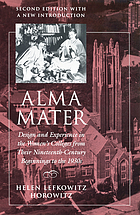
Horowitz, Helen Lefkowitz. Alma Mater: Design and Experience in the Women's Colleges from Their Nineteenth-Century Beginnings to the 1930s (University of Massachusetts Press, 1984; 1993).  For a book originally researched in the 70s and published nearly thirty years ago, Alma Mater feels refreshingly current -- not that I doubted Helen Horowitz's skill in research and writing (I've long been a fan), but historiography just as much as any other field has its tells for certain eras. Perhaps Horowitz lucked out by coming of academic age after the reign of Freud (see my review of The Other Victorians below) and before the ascendancy of Foucault in the 1980s. This history of the Seven Sisters is an exploration of the culture of education through the lens of architecture: how the spatial organization of seminaries like Mount Holyoke and Vassar, colleges like Smith and Wellesley, Bryn Mawr, and the university affiliates Radcliffe and Barnard, reflect the assumptions, expectations, and fears about women and higher education across roughly a century of change. I was particularly fascinated by the way in which each institution's administrators sought to both foster and manage female intimacy: the single-sex environment was both encouraged (for its protective and training purposes) and feared (for its potential for same-sex romantic and sexual intimacy, and  the way it led to "unfeminine" roles). In other words, the tension between the value of an all-female environment and its perceived downsides -- whether because it turns young women into lesbians (!) or because it perpetuates a separate-yet-equal passivity concerning gender equality -- have changed only in variation and not in substance since the 1830s. It will be interesting to see what the state of single-sex education is by the time we begin to reach the two-hundredth anniversary of women's higher education in this country. I really can't recommend Horowitz enough; as an historian of higher education in America I know of few more thoughtful or articulate.

Levenstein, Harvey A. Fear of Food: A History of Why We Worry About What We Eat (University of Chicago Press, 2012). This slim, engaging volume is less a history of "why" twentieth-century Americans fear food than how we choose to do so: each chapter presents a case of food fear, beginning with Progressive Era fears about food contamination spread by flies and infected milk for infants and ending with the present-day lipid-phobia (fear of dietary fat). An historian of food culture, Levenstein is on solid footing here in terms of research and a lively storyteller. My one complaint is that at times it is difficult to distinguish between food claims made in the context of a particular food scare and the more recent, evidence-based knowledge that Levenstein sometimes draws upon to refute or revise the basis of historical food scares. For example, in the chapter on "vitamania," it can be difficult to parse out what benefits of vitamains are still supported by the evidence, and what claims by vitamin manufactures have no solid backing in research and outcomes. In the end, though, I really appreciated that this narrative was not triumphalist the way so many health and science histories are: Levenstein's argument is not that American science has triumphed over superstision -- quite the contrary, he argues that we persist in demonizing (and celebrating) certain foods beyond all evidential backing. He also makes the key point that time and again throughout the twentieth century, the food industry and medical industry (including the public health sector) have powerful lobbies with their own profit-driven agendas, successfully exploiting food fears to their own gain (and American citizens' loss). I'd be making this essential reading in all public health programs around the country, and required reading by anyone who uncritically parrots the phrase "obesity epidemic."

MacDougall, Bruce. Queer Judgements: Homosexuality, Expression, and the Courts in Canada (University of Toronto Press, 1999). I picked this volume up while we were honeymooning on the Cape, but it took a while to wade through -- while thoroughly interesting, the textual analysis was dense and the Canadian legal framework just different enough that I needed to do some on-the-fly cultural translation to make sense of the arguments. MacDougall's central argument is that judicial opinions concerning homosexuality matter as much as, if not more than, the material effects of their rulings. Combing through written decisions involving homosexual identity or expression from the 1960s to 1997, MacDougall finds that the Canadian courts have consistently framed homosexuality as disordered and marginal, a sexuality that is of potential threat to children, something that (because of its shameful nature) needs particular policing. For example, he points to the ways in which divorce court judges often express concern about a gay or lesbian parent's sexuality being evident to the children of the family in a way that they would not likely fret about straight parents bringing an opposite-sex partner home. Likewise, a whole chapter is devoted to the erasure of speech about homosexuality from institutions of education (primary, secondary, and higher education alike). While works such as The Right to Be Out and Queer (In)Justice have -- at least for a U.S. context -- superseded this volume, I did find it a worthwhile addition to my queer studies/queer history collection.

Marcus, Stephen. The Other Victorians: A Study of Sexuality and Pornography in Mid-Nineteenth-Century England (xxx, 1966; 2009). In the early 1960s, scholar of Victorian literature Stephen Marcus was approached by the Kinsey Institute to write a study of Victorian erotic literature. The Other Victorians is what emerged: an oddly episodic work that has aged well in some aspects more than others. He begins with a study of  doctor William Acton's works on sexual function and advice on sexual well-being, moves into an examination of Henry Spencer Ashbee's extensive bibliography of known pornographic literature, published in the 1870s-1880s, and then spends two lengthy chapters on a delightful, anonymous eleven-volume erotic autobiography My Secret Life, published in the 1880s-1890s. These chapters are for the most part grounded in specific texts and hold up fairly well. Marcus's own sexual tastes and knowledge gaps seep through every now and then -- such as when he is baffled by the autobiographer's interest in BDSM, and when he insists that the autobiographer is exaggerating because women don't ejaculate -- but overall he was more aware of gender and class and the nuances of authorial voice than I might have expected. It's the chapter on the literature of flagellation and his concluding remarks that really let him down. I'm not exactly sure why he chose to take up flagellation narratives other than that they were apparently prevalent in the pornography of the period. His descriptions of the literature's conventions is quite fascinating, but then he gets all sorts of judgy and Freudian about how flogging fantasies are sad and infantile and coded homosexuality. He also claims, in passing, that the Victorians produced no homosexual pornography -- an assertion that runs directly counter to the many passages depicting same-sex sexual encounters he has detailed in previous chapters, so I was baffled by the sudden reversal. And his final conclusions about pornography are, it seemed to me anyway, clearly written by a person who ultimately has no innate passion for or interest in the genre which he is studying. He argues that pornography lags behind fiction in its development, that it lacks in emotion and relational development, that the point of pornography is to depict acts outside of time and space, rather than human sexuality in the context of a deeper lived experience. Again, these assertions seem to run counter to the examples he himself has selected for review in the preceding chapters.*

Vaid, Urvashi. Irresistible Revolution: Confronting Race, Class and the Assumptions of Lesbian, Gay, Bisexual, and Transgender Politics (Magnus Books, 2012). This collection of essays by movement organizer Urvashi Vaid is a quick read -- I finished it in an afternoon -- and a bracing one. A national figure in LGBT politics, Vaid calls the mainstream queer movement to task on its unwillingness to engage in social justice activism that is not explicitly "gay." That is, activism around issues of racism, class disparity and poverty, misogyny, gender policing (particularly trans* issues), the prison-industrial complex, labor organizing, immigration, and freedom of family formation and sexual expression not necessarily grounded in heternormative marriage rights. My own feelings reading Irresistible Revolution were complicated. On the one hand, I am basically on the same page with Vaid in terms of wanting a broad-based social justice movement that centers the most vulnerable among us and doesn't rest until all are treated with respect and have the basic provisions necessary for well-being (healthcare, housing, food security, access to education, workplace safety, a healthy environment, etc.). And I feel comfortable with her lesbian-feminist roots and her critique of mainstream organizations (the Human Rights Campaign, National Gay and Lesbian Task Force, etc.) which may pay lip service to caring for all -- but in reality speak only to middle- and upper-middle-class priorities and aspirations. However, as a radical voice working from within these organizations, she fails to draw upon and engage with the scrappy, marginalized groups and individuals who are doing the work she longs to see done. At least as much as she could have. The result is a book that feels like a lot of finger-wagging at the self-satisfaction of the elder generations of activists (and those with the most material resources) and the complacency of the younger generations -- without enough acknowledgement of the people who do not fit into either of those categories, and who are doing transformative and back-breaking labor being the change they wish to see.** Vaid is a high-profile voice whose commitments are key to a more just future, so I hope she is listened to by the "insider" audience she wishes to reach.

And that's all for now, folks! Off to see what else I can read before to clock for 2012 runs out.


*I couldn't help wondering if such judgmental attitudes came out of an extreme desire to be "objective" about the subject matter -- to the extent that he was unable to examine the material with an eye toward what an eager reader might get out of the experience. For example, he excerpts a lengthy and charming passage from My Secret Life in which the autobiographer and a friend arrange a visit to a flogging parlor to watch a gentleman be spanked by the "abbess" in charge. Also present is a prostitute. All five people are participants in the action on some level, and although the autobiographer evinces no interest in being beaten himself, he is clearly curiously engaged and pleased (and aroused on some level) to be participating in someone else's erotic scene. Marcus, however, dismisses the scene as one "we" modern-day folk would obviously find sad and grim. Whoops!

**And to be clear, I don't include myself in this category. People who have the stamina and vision for professional movement work are brave and better souls than I; I'm glad they do what they do and I will support them as I am able ... but I have never been, and likely will never be, a queer organizer.
2012-09-06

in which I write letters: dear alma mater ... again

Diane De Young
Associate Director of the Hope Fund
Hope College
PO Box 9000
Holland, MI 49424-9000
4 September 2012 

Dear Ms. De Young,

Thank you for your recent letter alerting me to the upcoming Hope College Phonathon. I am writing to explain why I will not be contributing to the campaign; you are welcome to share my reasons with whomever might benefit from this information. 

As I'm sure your records indicate, I attended Hope College from 1998-2005, graduating with a BA in Women's Studies and History (double major). During my seven years at Hope, I formed lasting relationships with my faculty mentors and received what I would consider a superior college education. While at Hope, I benefited from merit and need-based scholarships, as well as the tuition benefit awarded to children of Hope College employees (my father is Mark Cook, director of the Hope-Geneva Bookstore). The quality of my Hope College experience was part of what enabled me to make the most of my graduate education at Simmons College, where I completed an MA in History and an MS in Library Science. Today, I serve as the Reference Librarian at the Massachusetts Historical Society, and this past March I had the rewarding experience of returning to Hope College as a guest speaker at the Women's Studies Celebration. I was recently asked to provide a letter of support for Dr. Jeanne Petit as she is considered for promotion to the rank of Full Professor, a request it was my pleasure to fulfill.

However, as a woman who will shortly be marrying my girlfriend of the past three years here in Massachusetts, I am a Hope College alumni who feels unwelcome and unloved by the institution as a whole. In April 2010, as the Board of Trustees was revisiting their support of the current Institutional Statement on Homosexuality, I wrote to then-Chairperson Joel Bowens and explained that until Hope College alters its position on human sexuality to be affirming of all a full range of human orientations, identities, and desires, I will not support the college financially. I cannot in good conscience send money to an institution that does not recognize the legitimacy of my primary relationship. I will speak up whenever given the opportunity -- such as during fundraising campaigns -- against the actions and words of the Board, and of Hope as an institution, that continue to create a hostile environment for faculty, staff, students, and alumni who are not straight or do not believe that non-straight sexuality is immoral.

I will continue to speak highly of the faculty who mentored me, and provide what support I can to individuals and programs that are welcoming and affirming to all (such as the Women's Studies program). Yet I will not be participating in the Phonathon, in the Hope Fund, or any other fundraising campaigns until Hope College as an institution recognizes and affirms the lives of those of us who find joy and meaning in same-sex relationships.

I look forward to watching Hope's progress toward a more inclusive future, and hope that someday I will be able to respond to your requests without reservation.

Sincerely,

Anna

Anna J. Cook ('05)
# Xxxxxxx Xx. Apt #
Xxxxxxx, MA
02134

2012-09-04

in which I write letters: the problem with throwing religious home-educators under the bus

Dear Claire,

I'm writing to you as a long-time reader of The Tenured Radical, as a fellow blogger, fellow leftist, and individual who spent the first seventeen years of my life learning outside of school -- as did my fiancee, until she entered public high school. I wanted to respond to your post regarding home education and the religious right.

I realize that in our contemporary landscape "homeschooling" in the public eye has become virtually synonymous with conservative Christian organizations like the Home School Legal Defense Fund (which actually financed a lot of the court battles that made home education legal for families of all political persuasions), and families who take their children out of public schools for fundamentalist religious reasons. However, I find your characterization of home education "as a grassroots movement" being anti-intellectual and anti-citizenship troubling.

Yes, you are talking about a specific subset of home-educating families and philosophies, but throughout your piece you obscure the wide variety of motivations to home education and styles of learning and teaching by using "home schoolers" as a substitute for "fundamentalist-evangelical Christian conservative homeschoolers." As a woman who grew up as part of the "grassroots" home education movement in Michigan during the 1980s and 90s, this erases my experience -- and the experience of many of my contemporaries -- whose home-based education expanded horizons, rather than limiting and controlling them.

You say in your post:
Public education is about putting citizens in the making in one place to talk to each other and learn together.  Is it an accident that when large numbers of voters fail to participate in a common enterprise with Americans not of their choosing that we have so little to say to each other during an election season?
I have seen a lot of anti-homeschooling liberals express similar sentiments, that home education is somehow inherently un-democratic because it removes children from the public square. This is a very limited understanding of the potential of learning outside of school, and in fact many of the progressive home-education folks I know would argue precisely the opposite: that home-based education takes children out of the age-segregated ghetto of school and brings them into the community at large.

As a home-educated child, rather than spending my days in a school building I volunteered at cultural institutions such as the public library and the local history museum, participated in community art classes and music groups, in sports activities and "field trips." I held part-time jobs as a teenager that not only gave me excellent work experience but also further grounded me in the community. I was involved in church, another locus of social interaction and civic participation.

Obviously, this is not an automatic benefit of home-based education. But I would argue that exposure to a wide range of viewpoints, diversity, and the values of civic participation is not an automatic benefit of public education either. Public schools can be homogeneous, and educators narrow-minded, just like individual parents and families can be. My siblings both attended public high school for part of their grade-school education and benefited from that experience; my brother now teaches art in a public middle school. I am grateful that public provision of education is part of our nation's commitment to its citizens, and feel that -- like hospitals or roads! -- public schools are our responsibility to fund whether or not we choose to, or need to, access those services.

Suffice to say, I believe it is a profound mis-characterization of home-education per se to suggest it is at root an anti-democratic, anti-public-spirited endeavor. Obviously, some people who make the choice to home-educate will do so for sectarian reasons, to withdraw from the society at large, because of profound disagreement with mainstream policies. There are examples to be found on the left as well as the right in this regard. But I would argue that this is a freedom-of-conscience decision. There is a long tradition in the United States of allowing parents to decide what the best method of education provision for their family is; compulsory education does not mandate form or content for good reason -- local, familial, and religious priorities and needs vary. There is no "one size fits all" that would work well for the majority.

I believe that demonizing/scapegoating people who choose to home-educate for religious reasons actually threatens the freedom of all of us to form and organize our families as we see fit (see: same-sex marriage, polyamory, attachment parenting, etc.). It is certainly within our rights to point out that some forms of parenting foster us/them thinking -- but home education is not the cause of that parenting outcome. It is simply the chosen method of delivery for some families. It is a tool, not a uniform ideology, and the values a family holds will shape how home education works for that family, rather than home education pre-determining an exclusionist, reactionary outcome.

In closing I want to thank you for your articulate, insightful blogging at The Chronicle; I have your blog in my Google Reader and regularly click in to read what you have to say. As a fellow blogger I realize that no one post can cover all aspects of an issue. In this instance, I just wanted to share my perspective as someone "on the ground" as a home-educated adult, who has been on the receiving end of fellow liberals' suspicion of home-based education for many years! I think that the picture is (as always) much more complex than outsiders perceive it to be, and conflating "home education" with "reactionary conservative isolationist" does more harm than good.

Sincerely,
Anna

2012-02-17

to me, being "progressive" actually means supporting family diversity and resource equity -- not just putting the kids in public school

So Dana Goldstein has a piece over at Slate.com about how "progressive homeschooling" is an oxymoron because parents who remove their children from the public school system are thumbing their noses at civic responsibility. She argues that: 
[Liberal homeschooling and unschooling] is rooted in distrust of the public sphere, in class privilege, and in the dated presumption that children hail from two-parent families, in which at least one parent can afford (and wants) to take significant time away from paid work in order to manage a process—education—that most parents entrust to the community at-large.
The idea that education outside of school is the sole province of crazed Christian fundies and upper-middle-class elites would certainly surprise my partner, whose family lived below the poverty line for much of her childhood and yet still chose to home-educate her until ninth grade. It would likely also surprise the family of my best friend growing up, whose mother was a divorced parent who worked part-time and yet still homeschooled her two daughters throughout their childhood. The notion that homeschooling requires "at least one parent ... to take significant time away from paid work" to function would surprise another friend of mine whose parents both worked from home and thus shared the parenting and income-earning responsibilities equally when their children were young.

I realize that anecdotes do little to refute data, and it is certainly irrefutable that financial and cultural resources (i.e. social privilege) confer choices.  The ability to sit down as a family and co-create a home life that runs counter to the dominant culture is, no doubt about it, much, much easier when (and therefore, more prevalent in families where) you're not juggling multiple minimum-wage jobs, worried about losing your mortgage, or wondering whether you can afford to get that needed root canal. This ability to not only name our desires but also (at least to a point) act upon them is a function of class privilege, and in evidence among families where children attend public school as it is among families who make other arrangements.

Sure, there are homeschooling families who are privileged assholes (I've met some of them), but privileged assholery is not a symptom of home-education. It's a symptom of, well, being a privileged asshole.

See, I think Goldstein's argument about how education that takes place outside of school (whether we call it "homeschooling," "unschooling," or something else entirely) is crap progressivism turns family diversity into a proxy for talking about class. Because class is really hard to talk about in American culture. We don't want to talk about the unequal distribution of economic resources, and how we've lost the war on poverty (or just surrendered to it). We cling to the notion that education (via public schools, or charter schools, or elite prep schools, whatever) is the pathway out of that inequality when, in fact, better distribution of economic resources is the pathway out of that problem.

Maybe schools should be better. I'm not, as a person who grew up outside of school, opposed to that. My siblings both made use of the public high school in our town. A lot of families I know who have engaged, or currently are engaging, in some type of home-based education avail themselves of the public school resources they pay taxes to support. Home-educated kids often go to colleges, some of which are state-supported. Goldstein sets up a world in which there are two oppositional communities: families who use public schools, and families who home-educate. This simply isn't what the world looks like. While I don't necessarily fault her for this outsider's assumption -- much of the literature in the lefty home-education movement does see institutional schooling as fundamentally flawed and/or inhumane -- that narrative ignores the reality that these two populations are flexible, fluid, and inter-twined to a high degree.

Since homeschooling families stopped living in fear of prosecution if they were discovered by local authorities, many kids move back and forth between out-of-school learning and institutional learning. Whether it's participating in extracurricular activities, attending one or two classes a term, going to school for a year or two to try out that way of life, or some other creative option, civic involvement in the form of using public school resources is often a daily reality for home- and un-schooling families these days. There are public school teachers home-educating their kids, and former unschoolers teaching in public schools. Goldstein's all-or-nothing argument values rhetoric over reality.

That's the "we're more normal than you think" point. Now I want to make the "why are you scapegoating our non-normative lives?" one. Goldstein's argument is that all "good" or truly progressive families should support the public school system by sending the school-age members of the family to school. Because:
Government is the only institution with the power and scale to intervene in the massive undertaking of better educating American children, 90 percent of whom currently attend public schools. (And it’s worth remembering that schools provide not just education, but basic child care while parents are at work.) Lefty homeschoolers might be preaching sound social values to their children, but they aren’t practicing them. If progressives want to improve schools, we shouldn’t empty them out. We ought to flood them with our kids, and then debate vociferously what they ought to be doing.
I agree with Goldstein that high-quality socialized childcare and education should be available to families that want them. And I imagine that a majority of families would take advantage of those resources, if the continued feminist-led campaign for affordable high-quality daycare is any indication. The life choices of middle- and upper-middle-class families who have viable options suggest that few families these days would opt for full-time parenting and out-of-school learning for their youngest members. So I don't think full-scale flight from institutional schooling is any realistic vision of America's future. As much as it might personally pain me to say it, unschooling will never be a majority family-life choice.

But neither will polyamory, or open marriage. And data suggest that even acknowledging human sexual variety (and right-wing fears to the contrary) the majority of households in our country will never be headed by couples, threesomes, or moresomes of the same sex and gender identity. Dykes To Watch Out For is (again disappointingly!) the wet dream of our future utopia only in my little corner of the universe.

Yet I doubt Goldstein would argue that supporting the ability of people to form consenting, mutually-supporting relationship agreements of whatever kind works best for the folks in question is not a "progressive" (dare I say liberal? leftist? radical?) value. If families work best when they are organized to meet the needs of their constituent members, then it seems common-sensical that there would be no one-size-fits-all solution to dependent care-giving, to wage-earning, to physical home arrangement, to negotiations over who does what, when, where, and with whom.

In fact, it seems fundamentally non-progressive to argue for a one-size-fits-all model for parenting and education -- which is what Goldstein is essentially doing when she argues that good liberals should all use public schools. How is that different from the conservative argument, all evidence to the contrary, that children thrive best in a two-parent household in which one parent is a man and the other is a woman? How is that different from the argument mothers are innately suited to care for dependents? How is that different from asserting that the heterosexual dyad is the only type of union that should be recognized by the sate?  It's not. It simply replaces one restrictive notion of good parenting with another. Instead, we should be recognizing that "good" parenting, and meaningful education, will inevitably have as many embodied forms as there are human beings to embody them.

I'd argue that, rather than re-hashing the tired argument that non-school-based learning is inevitably the preserve of the elite, we should be asking ourselves how to more equitably share our resources so that all families will have the highest degree of agency to decide how to put together the activities of parenting, employment, and learning. Bickering about which site for learning is optimal for most obscures the reality that no single site of learning will ever be optimal for all. It also perpetuates the myth that public school education can fix the problems of inequality -- when, in fact, only fixing the problems of inequality will fix the problem of inequality.

Don't make children and parents whose lives are atypical scapegoats for a society that has failed, en masse. to deal with its issues of class privilege.

2012-02-11

the porn debate: first thoughts

but is it porn?
Last night, thanks to my friend Minerva, who is currently at the Boston University School of Public Health, I was able to attend a screening at BUSPH of The Price of Pleasure: Pornography, Sexuality, and Relationships (2008) and the subsequent Q&A-cum-debate with anti-porn activist and author Gail Dines and sexuality educator Carol Queen. Lots to process. I'll be writing a review of the film and a more coherent summary and reaction to the debate portion of the evening once I've had some time to organize my thoughts. But meanwhile, are a few first responses.
  • The Price of Pleasure had an agenda which wasn't very subtle -- and that was to make porn appear monochromatic, exploitative, and seedy. This wasn't a surprise, but I found myself fascinated by the way the construction of the film itself conveyed that narrative. More about this in the review. It was a fairly masterful piece of propaganda ... if you didn't sit there with your media literacy lenses on and go "what just a minute!" (And if anyone wonders what the scary voice man does between election cycles, he was totally hired to do the voice over in this documentary).
  • I was struck by the level of powerlessness expressed by people interviewed in the film, by Gail Dines in the Q&A, and by some of the audience members who asked questions. Commercially-produced video porn is depicted as an all-powerful, pervasive, thought-controlling medium that somehow renders consumers (and even non-consumers) incapable of imagining or practicing alternative sexualities. Since my experience has been that a) avoiding porn one doesn't like is relatively simple, and b) finding or creating porn one does like is also pretty easy, I can't say I understand this line of reasoning. Having just finished Amy Schalet's new book Not Under My Roof: Parents, Teens, and the Culture of Sex (review forthcoming) I can't help wondering if this feeling of helplessness doesn't go back to what Schalet terms the "dramatization" (vs. normalization) of sex in American culture.
  • I understand there's a larger argument being made about how the narratives in porn reflect and shape some of the crappy narratives of our society (for example, society is racist and sexist -- surprise! porn is also racist and sexist), but I don't understand why the solution presented is not the two-fold critique and creation solution we'd use in virtually any other field. That is, 1) encourage people to watch porn with a critical eye, much like Jenn Pozner encourages people to watch reality television with a critical eye (see Reality Bites Back), and 2) support the creation of better porn. See for example the feminist porn awards and the recent piece by Erika Christakis, Is it Time for Fair Trade Porn? For some reason, when it comes to porn, all of our usual skills for working to change culture are jettisoned out the window? That doesn't seem right to me.
  • I continue to be frustrated by the way "porn" and even "sexually explicit material" has become short-hand for "video pornography." I took an online survey recently designed to capture information about women's consumption of online porn -- and it became apparent almost instantly that they were assuming the porn in question was filmed live-action sequences. Why aren't we talking about sexually explicit fiction and nonfiction, photographs, erotic audio, and other materials that depict sexual activities and are designed to elicit arousal? This isn't to say video porn is bad either, but I feel our analysis of the genre might be more nuanced if we looked across mediums, rather than focusing just on film.
  • If Carol Queen hadn't been there, no one in the room would have spoken to the fact that pornography is, in fact, not solely a product of the heterosexual male imagination, created for consumption by heterosexual men. The discourse about porn in the film and throughout most of the Q&A rested on the erasure of women and queer folks who create and consume erotic material without being coerced or exploited into doing so by the patriarchal overlords. Dines seems to believe that in her perfect (socialist feminist) universe, no one would make porn she didn't like, because of course no one would voluntarily make pornography that squicks her out. I didn't hear any evidence last night that Dines would have been able to make sense of me as a queer woman who creates and consumes erotic materials, in both solitary and relational contexts. Who has both an incredibly egalitarian, loving sexual relationship with another woman and enjoys some kinky and rough sex fantasies, which work together symbiotically to enrich my relational life. In Dines' narrative of porn, my experience is rendered completely invisible -- and while one person's experience does not a data-set make, that dissonance makes me doubt her theory's explanatory power.
  • Also, while we're at it, men who enjoy sex with women are not, in fact, controlled by their dicks -- and men's penes aren't somehow inherently threatening and oppressive to women who enjoy having sex with men. Male sexuality is not some mysterious, all-powerful, aggressive, violent, controlling force that must be contained and managed externally (i.e. "domesticated"). I believe people of all sexes, sexualities, and genders, are equally capable of exploring their sexual desires in ways that aren't -- for lack of a better word -- "antisocial."
I come to this conversation with my own experience of pornography, obviously. I've seen a vanishingly small amount of video porn -- most of it filtered through secondary sources like documentaries or embedded within feature films (where we just call them "sex scenes"). I've never experienced sexually explicit materials in the context of emotional coercion or physical abuse, and have never felt the presence of sexually explicit materials compromised my intimate relationships. Aside from some early childhood peer-to-peer situations that made me passingly uncomfortable (and probably deserve a post at some point), I've basically felt like I had bodily autonomy and sexual self-determination. My teenage years and young adulthood were characterized by self-directed exploration of human sexuality and my own sexual desires, mostly through fiction and non-fiction, and solitary sex. When I didn't find sexually explicit narratives that satisfied me, I decided to create my own.

Did I have sexual struggles? Certainly. I was reflexively anti-porn early on because I'd imbibed the cultural narrative of "porn" as relationship destroying, the last resort of the lonely, as anti-feminist objectification. At the same time, I was discovering that mild bondage scenarios and actual mild bondage were a huge turn-on for me. Together, these two conflicting messages me feel like a bad feminist, and made me feel overwhelmed by my own sexual desires. But if pornography hadn't been demonized by those around me, maybe I would have realized before my mid-twenties that fantasizing about ceding control in a sexual situation isn't the same as wanting to be literally helpless. I don't wish my younger self hadn't been exposed to bondage imagery or narratives -- I wish I'd been given better tools with which to analyze both it and my responses to what I saw.

I just don't experience the existence of sexually explicit materials -- even if its porn I'm turned off by -- as threatening to my own sexual self-determination or my ability to find, and form meaningful connection with, other sexually-compatible human beings. I don't see "porn" as an enemy.

Overall, I wish we -- as a culture -- could move beyond the moral panic that sexually-explicit material seems to engender in a fairly high percentage of the population  and talk instead about all of the tools we already have at our disposal to critique unhelpful cultural narratives in porn, to advocate for workers' rights, and to develop our own sense of sexual self-determination. I heard Carol Queen making a bid for that shift to take place last night, and I heard Gail Dines resisting it with all her rhetorical might.

Since writing this post, I've published a review of the film, The Price of Pleasure, and a more thorough summary and analysis of the debate itself. Finally, some thoughts on the positive potential of porn.

2011-11-17

congratulations doctor jay!

Joseph Tychonievich, Ph.D.
(taken May 2005, wearing my hat)
Earlier today, my friend Joseph successfully defended his PhD dissertation in horticulture, plant breeding, and plant genetics before his advisory committee at Michigan State University. We're drinking a fine zinfandel tonight in his honor. Congratulations!

Verbena bonariensis with bronze fennel
photo by Joseph