~oOo~
Showing posts with label racial identity. Show all posts

2012-12-01

real-life adventures in class, gender, race, and sexuality

Last night I was working an event at the MHS that involved spending one portion of my evening standing out on the sidewalk, a few blocks away from the building, holding an electric lantern to light the way for guests moving from one location to another. I was one of about seven lantern-bearers spread out across a quarter-mile path from Point A to Point B.

Standing in one spot for 45 minutes, not soliciting nor waiting for public transit, and holding a lantern, certainly attracts attention in the city. Maybe a dozen individuals and/or groups of people stopped to ask me politely what I was doing, particularly if their path had taken them past one or more of the other lantern-bearers in the chain.

I happened to be standing at a station on a fairly busy stretch of sidewalk near a bus shelter, but on a bridge crossing over the Massachusetts Pike. It was long after dark, about eight o'clock, and my back was against the high fence that stops people from committing suicide off the bridge. I could see my fellow lantern-bearers down the way in both direction, each across an intersection though in plain sight.

(via)
A (likely homeless) man with a shopping cart containing his belongings came up the sidewalk. I nodded to him and he took this as an invitation to stop and talk with me.

I wasn't particularly opposed to chatting with him; I've had some nice -- if brief -- conversations with folks who live on the streets in Boston, mostly the familiar vendors of the Spare Change newspapers Hanna and I purchase when we have cash on hand.

Still. It was dark, and I was alone. He was a man, taller than me.

Still again: he was homeless, while I was working a fundraising event for the cultural institution I work for that pays me a healthy living wage with generous benefits. He was African-American and I am White.

I didn't want to be impolite.

"Can I have your lantern?" He asked me.

"No," I said, with regret, "I need it. It belongs to my place of work."

He mumbled something further that the wind snatched from my ears. "I'm sorry, I don't have any money with me," I apologized, assuming he was asking for spare change.

Perhaps he wasn't, as he was undeterred: "You have a husband?"

"I have a wife." I corrected him, in what I meant to be a fairly light and playful tone.

"You have a husband." It was a statement, not a question.

"No, I have a wife." I corrected him again in the same tone.

He had parked his shopping cart to my left, not entirely blocking my movement in that direction, but definitely an obstacle on the pavement. People were passing by at a steady rate, but no one was slowing down to check out the situation. I nodded and made eye contact with a few, just to be clear there were folks around.

"You ever been with a man?" He asked, crowding toward me where I stood against the the fence, arms out as if to hug/grab/grope me.

"Not at all interested!" I said firmly, and slipped away to my right, walking swiftly down the sidewalk to the nearest corner, well lit and populated, where I waved to my compatriot across the way.

The man didn't follow me.

As I said in my email reporting the incident (on-the-job harassment, after all, should always be documented), I never felt truly unsafe. I was in a busy neighborhood, connected to people who stood shouting distance away. We had a traffic cop at the intersection to my left to help with foot traffic, who had exchanged pleasantries with me earlier in the evening.

I'm not sorry I nodded at the man.

(I am sorry he's homeless.)

I'm not sorry he stopped to talk with me.

(I am sorry for all the times people have treated him like he's invisible or unwelcome.)

I'm not sorry that I made it clear I was queer.

What I am most definitely sorry about is that he thought it was appropriate to invade my personal space and try to get friendly in an uninvited, anti-gay, sexual way.

But there's an even deeper set of reasons why I didn't feel unsafe, and I want to acknowledge them: I've never been the target of sexual aggression or anti-gay violence. I've never been truly vulnerable to street harassment. I haven't had to learn, out of necessity, to avoid the gaze of strangers. I have almost never not felt entitled to walk and stand wherever, whenever, in the city I now call home.

I was aware, even as the words came out of my mouth ("I have a wife.") that they could be dangerous words to say.

For many people, in many places, they are life-threatening words to speak allowed.

The fact that they tumbled from my lips with only a split-second hesitation, that I repeated them -- asserting my truth in public spaces --, that I felt confident in my right to do so, and that I could return to my place of work and document the incident, including what I said and what was said back, without fear of victim-blaming or slut-shaming, all of these facts are hard-won privileges still denied too many queer folks here in Boston and around the world.

So I'm not sorry, and I don't think I'd do anything different if I had the exchange to do over. I'd like to think there are times and places to educate people who pull shit like that on how inappropriate it is, but I doubt this particular exchange was the place or the time.

I hope Man on the Bridge learns, eventually, that sort of behavior is Not Cool.

And I hope the rest of us keep on working toward a world in which no one has to experience sexual aggression for standing alone on a sidewalk at night, for making eye contact with and speaking to a stranger, and for telling the truth about their relationships when asked.

2011-08-05

booknotes: helping teens stop violence

My latest early reviewer book from LibraryThing was the 20th anniversary edition of Allan Creighton and Paul Kivel's Helping Teens Stop Violence, Build Community, and Stand for Justice (Alameda, CA: Hunter House, 2011). The authors have worked together in the field of violence prevention and social justice activism since the mid-1970s. This book is a workbook for adults seeking to work with young people, specifically teenagers, to identify and combat the various types of institutional and cultural injustice they encounter in their lives. "Professional literature about adolescents, social-service priorities, and funding trends all [emphasize] programs that [build] self-esteem," the authors observe. "Many youth workers convey to young people that if they just had higher self-esteem, they could overcome any obstacle and succeed at anything they set out to do," ignoring the institutionalized, systemic injustices young people as well as adults face in securing life necessities and building a satisfying life for themselves and their families (60). We do a grave disservice to youth, the authors argue, by implying that if they are struggling it is largely because of personal failure when, in fact, the problem is an imbalance of power:
Our problem [when we were young people ourselves] was not based on low self-esteem or any of the other psychologically defined problems. Rather, we had no real power over our lives. Without power to protect ourselves, we were constantly restricted, disrespected, and abused by adults. Everywhere we went, adults had the authority to decide how we should dress, where we could be, and who we could be with. They decided our future through daily decisions including discipline, records, diagnoses, arrests, report cards, evaluations, and allowences, or just by ignoring, interrupting, or neglecting us.(60-61)
The imbalance, of course, is not just one of age but also intersects with many other inequalities from which adults also suffer: poverty, sexism, racism, religious bigotry, discrimination based on disability and sexual orientation or gender identity ... the list is a long and familiar one. Creighton and Kivel call on adult allies to work with youth in identifying these power imbalances and combat them. Those who benefit from inequality seek to divide the attention and alliances of those who are struggling to get by under oppressive systems. By forging networks of support among ourselves at the bottom of the inequality pyramid, the authors suggest, we can more effectively enact lasting social change as well as survive in present day far-less-than-optimal conditions.

Since the book is designed primarily as a workbook for group trainings, those who are reading Helping Teens Stop Violence outside of that context may find themselves skimming a bit and taking note of various exercises for later usefulness, rather than reading in a straightforward manner. I found myself skipping around quite a bit, once I'd read the introduction and gathered the gist of the authors' perspective and approach. Some general impressions:
  • The authors have made an effort throughout to discuss the ways in which different types of injustice overlap and interact, so that even though (for example) a given chapter may be about "class" the exercises continually push us to think about how things like race, sexual orientation, immigrant status, etc., shape our class identities and economic opportunities.
  • As someone who is continually frustrated with the invisibility of ageism in our culture -- even among groups of people willing to discuss and dismantle other "isms" such as sexism and racism, or address homophobia and access issues for folks with disabilities -- I was really excited to see the first few chapters devoted to age-based discrimination, and exercises designed to get adults remembering their own teenage years and the lack of agency they had as young people in a world controlled by adults.
  • The authors emphasize the fluidity of what they call "target" and "non-target" categories (i.e. various types of social privilege), reminding us that our social status and agency is highly dependent on context and can change as the context changes -- so that each of us have experienced both being part of a target group and being part of a non-target (privileged) group at various points in our lives.
  • Even without using this book as a workbook with a group, as it was intended, the various exercises often contain useful suggestions for how to intervene in situations where you see oppression happening in order to name it and (hopefully) stop the cycle of violence from continuing.
  • They also offer some good guidelines for having constructive and saf(er) discussions about difficult topics, recognizing that "we have all been hurt in various ways and have had lots of experience of not being listened to well, so we have developed a billion ways to protect ourselves from getting close to each other and becoming vulnerable to further hurt" (170). By structuring discussions in ways that may seem a bit stilted at first, groups can build enough trust by which they can have productive conversations about prejudice, violence, and institutionalized inequality.
Helping Teens Stop Violence will obviously be most useful to those who have immediate practical application for its suggested exercises and the resources listed in the back of the book (though I found their resource lists a rather odd mix, with curious gaps -- particularly when it comes to the available literature on violence in education and violence against youth). However, it's a worthwhile read for anyone who is interested in the practical aspects of social justice work at the grassroots level, and who is interested in thinking a bit more deeply about the way in which our culture has institutionalized ageism and systematically disenfranchises young people and children.

2011-07-15

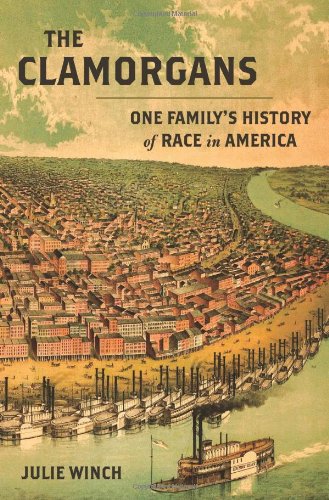
booknotes: the clamorgans

Last week, I picked up an advanced review copy of Julie Winch's The Clamorgans: One Family's History of Race in America (New York: Hill and Wang, 2011) from the free book cart at work. It was a relatively quick, though also a bit daunting, read. Winch, an historian based at the University of Massachusetts - Boston, focuses on the "lives and genealogies" of African-Americans in the Revolutionary War era and the period of the Early Republic. Her previous books focus on elite black families and individuals in Philadelphia; in The Clamorgans she turns her attention to a multiracial family based in St. Louis, beginning in the decades before the Louisiana Purchase (1803) and navigating its labyrinthian way to the mid-twentieth century.

The Clamorgan clan, at least as Winch documents it, began with a French entrepeneur (read: shady financial speculator) named Jacques Clamorgan in the 1780s, who settled in St. Louis when it was still (nominally) part of the Spanish empire. He had a number of children by three different women, all of whom were black and during one point during their lives were enslaved (some owned by Jacques himself). From this root, Winch traces in exhaustively-documented detail the fates of the descendents of this family tree. She is aided by the fact that Jacques Clamorgan was a litigious man who turned to the courts whenever he was unhappy with how his affairs (financial and familial) had been settled ... and that his children and grandchildren and great-grandchildren followed suit. Jacques died in the early 1800s with extensive land claims, which he had finessed from the Spanish administrators, left unresolved following the Louisiana Purchase and the entrance of St. Louis and its environs into the expanding boundaries of the United States. For subsequent generations, these land claims became the promise of riches they turned to again and again whenever their (rapidly rising and falling) fortunes waivered.

The Clamorgan story is one not only of economic and social class but, inevitably, also a story of race, since all of Jacques Clamorgan's descendents were in some measure mixed race, and often able to "pass" as white or of Native American ancestory. In a period where black and white society was so sharply divided, the relative ease of each Clamorgan descendent to move with ease in and out of white and black communities directed effected their economic and social fortunes. Some Clamorgans chose (or had no option other than) to rise to the top of the black elite in St. Louis or other locales around North and Central America. Other branches of the family were light-skinned enough that they attempted to cross the racial divide and pass themselves and their children off as "white," usually for specific social and economic advancement (access to "white" jobs, schools, and neighborhoods).

The strength of this book is the sheer volume of research Winch has undertaken (I imagine with a bevy of student assistants and a very good data management system, though I could be mistaken!). Through the minute details offered up in court documents, newspaper columns, census records, and other archival sources Winch opens a window for readers onto the gritty details of how one specific American family struggled to gain a viable foothold in the volatile economic climate of the nineteenth century. Anyone who claims that our "addiction" to credit or predatory lending is an invention of our current epoch really just exposes themselves as a poor student of economic history: lines of credit, properties bought and sold on speculation, double-dealing lawyers -- all of these make more than cameo appearances in The Clamorgans saga.

What I found myself wishing for more of, as both a reader-for-pleasure and an historian, was more analysis  and context. Winch provides us with a rich narrative of one family's history ... what I wanted to know was how their journey up and down the economic ladder and back and forth across the color line fit into broader national patterns. Was their story typical? Atypical? How so? Was their recourse to the law usual for the time and place in which they lived, or did it set them apart? What contribution does the Clamorgan family story make to our understanding of how race and class (and to a lesser extent, though indubitably present, gender) function in American society? How do all of the details Winch has uncovered about the Clamorgan clan inform the work of other historians on these topics? Do they fit into previous hypotheses about how social categories functioned during this period, or do they challenge those interpretations in new ways? It was this historiographical discussion that I found myself missing. I hope that historians who utilize Winch's work in the future will be able to fill this gap in the scholarship.

Final verdict: Incredibly useful for historians who are studying this period or topics related to the history of race and class in America ... engaging for anyone else who is willing to put in the effort to keep the sprawling clan Clamorgan straight for however long it takes to read the book!