~oOo~
Showing posts with label sociology. Show all posts

2014-07-28

booknotes: out in the country

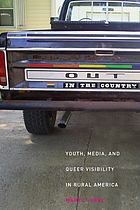
Last week I reviewed Sarah Schulman's Ties That Bind which explored from a very personal perspective the ravages of familial homobigotry. This week I picked up and read Mary L. Gray's Out in the Country: Youth, Media, and Queer Visibility in Rural America (New York University Press, 2009). Gray's ethnographic study of queer teen lives in rural Kentucky took place in the early 2000s and she published her book in the same year as Schulman. Both authors write thoughtfully about the importance of family in the lives of their queer subjects -- though from very different perspectives. Ironically -- given our usual narrative of urban tolerance vs. rural bigotry -- Gray's consideration of the place of family within queer lives is much more nuanced than Schulman's.

As a researcher, Gray came from a rural California childhood followed by an urban California adulthood working with queer youth organizations. Her exploration of teen lives in rural Kentucky was prompted by national attention on the ways in which the Internet and other media connectivity and queer visibility might work differently in the lives of rural young people rather than urban young people. As she (and others before her) have pointed out, much of our understanding of queer coming-of-age posits a rural-to-urban migration in which our queer selves are incapable of being fully discovered and/or nourished until we "escape" our hometown settings and find the LGBT community in physical locales -- gay bars, lesbian bookstores, gay ghettos, queer action groups. Pushing back against this assumption, Gray sought out youth who were either unable or uninterested in making such a migratory journey of self-discovery. How would young queer people without the resources or desire to leave rural life for the city construct a queer identity?

In Ties That Bind, urban-based adult writer Schulman struggles with familial rejection in the face of her queer activism and chosen family of fellow lesbian, gay, and other non-straight friends. Ties is firmly situation in the milieu of Gay New York, a landscape we all (at least think we) know well, and situates its lesbian protagonist (Schulman) as an adult who struggles to connect with her parents and siblings, but as an adult dragging them to therapy appointments or participating (or not) in rituals like the weddings of relatives. Schulman's pain is that of an adult attempting to reconcile with the failures of her parents' parenting.

In contrast, Gray explores the dense interconnectivity necessary for survival in isolated rural settings. Families of origin, she argues, make or break the experience of rural queer folk in communities where the familiar is often the key to acceptance. Straight family members can act as brokers for their queer youths -- turning the queer into the familiar, making one of "them" into one of "us". The most resilient teens whom Gray encountered were typically youths whose parents supported their identity explorations and attempts to build broader support networks: paying for internet or access to health services, driving them long distances to regional meet-ups, participating in protest actions, or other acts which communicated to fellow townsfolk that their child was not to be disavowed. The more vulnerable children were those whose families either could not or would not provide such support -- in part because, unlike urban queer adults, these youths could not take the city bus to the "gay" district or surreptitiously visit the "women's" bookstore.

In some ways Gray's work underscores the central point that Schulman makes: that queer family members can't just disown their families of origin -- no matter how anti-gay those families are -- and replace them with chosen families without consequence. For Schulman, those consequences are mostly emotional and psychological: the pain of rejection, the loss of future relationship. For Gray's teens, in addition to the emotional support (or pain) a family can provide (or cause) for their queer members in a hostile culture, families are also the gateway to material resources and community belonging. The visibility of queer culture in the media, and access to information -- plus the ability to connect to far-flung networks -- that the Internet provides cannot replace, for queer youth, the insulation that local relationships provide. Nor does an urban-oriented narrative of queerness reliably serve these young people as they work to create usable identities for themselves and their communities.

This was a useful read, one which I might pair with Pray the Gay Away (also about queer folk in the Bible Belt around Louisville, Kentucky) and Not in This Family (challenging the narrative of universal familial rejection of queer family members in postwar America).

2014-06-25

booknotes: hollowing out the middle

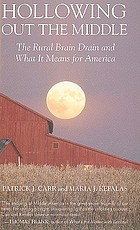
Footnote mining from Paying for the Party, I ordered Patrick Carr and Maria Kefelas' Hollowing Out the Middle: The Rural Brain Drain and What it Means for America (Beacon Press, 2009) through ILL and read it last week. This slim volume is based on an ethnographic study Carr and Kefelas of three hundred high school graduates from a small, rural town in Iowa they call "Ellis." With a population of about two thousand, Ellis' economy is primarily agriculture and industrial; high school graduates who go on to college rarely return. Those who remain struggle with social isolation and financial solvency. Carr and Kefelas surveyed over three hundred Ellis high school graduates from the 1990s (who at the time of their study were about ten years out from the end of twelfth grade) and conducted approximately one hundred interviews of young adults who had either stayed in, left, or returned to their hometown. Hollowing Out attempts to describe the motivations and experiences of each group of individuals, and ends with some reflections on the role that social policy can (and cannot) play in supporting and reinvesting in rural life nationwide.

What Carr and Kefelas found was that high school graduates were tracked / self-sorted into a handful of broad categories: the Achievers and Seekers, the Stayers and Returners. Achievers were tracked from a very young age by their parents, school system, and socioeconomic status, to leave Ellis and attend a four-year college and possibly graduate school. Most will never return to live in their hometown, having built lives elsewhere with career opportunities and social connections. Seekers don't have the resources to attend a four-year college, even a good state school, and so often join the military; they will leave to explore the world, but have limited socioeconomic mobility and often struggle to find a place in the world beyond the armed forces. Stayers have dropped out of high school or obtained limited qualifications, usually struggle with un- or underemployment, wed and/or become parents much earlier than those who leave. They, and the Returners, often have negative perceptions of the world beyond their small town community -- either because they tried and failed to find a foothold there, or because they have no desire to leave the familiar. Returners are usually "Boomerang" individuals (often women) who may have relocated for an associates degree or attempted a four-year college education but never established connections that made them feel comfortable beyond Ellis. They can also sometimes be Achievers who, for a variety of individual reasons, return home (familial responsibilities, political ambitions, occasionally the right job at the right time). However, these "High Flyers" -- the ones so desperately sought by states with struggling economies -- are few and far between.

In the end, Carr and Kefelas encourage policy-makers to focus less on trying to lure these "High Flyers" back to their states, since individual motivations usually have little to do with initiatives to woo the Achievers into returning, and instead focus their resources on the Stayers and Returners who are already the backbones of their communities and remain an un- and undertapped social and economic resource.

The authors do, eventually, touch upon some of the non-economic reasons that Achievers and others who leave Ellis may resist returning -- reasons such as prioritizing racial diversity or acceptance of queer identity and relationships -- that I think should have been foregrounded a bit more. Granted, interesting work is currently being done to highlight the lives of queer folk in rural America. Rural Americans are not inherently more or less prejudiced toward Othered groups than urban or suburban Americans. However, smaller communities are often self-selecting and more homogeneous; they're also often extremely isolating for those who are somehow different, even if they (we) don't experience overt prejudice or violence. Simply put, it was harder for me, as a bi woman, to find potential female partners (and even potential male partners!) in a medium-sized Midwestern town than it is.

And now, as a married lesbian, I have structural as well as cultural reasons not to return to Michigan: our marriage would not be honored by the state government. So whenever I read about state campaigns for professional Michiganders to return and invest in the state where I grew up -- and which I continue to love in many respects -- I admit I'm not exactly feeling the love. Many of us Leavers have left precisely because our communities scarred us, deeply, and returning to live there would open old wounds.

But in the end, I was uneasy with the way in which the authors' solution seems to encourage a "circling the wagons" approach to social policy, where the parochial reasons that people leave certain communities are glossed over rather than challenged. I wanted them to dig more into the ways, for example, racial prejudice, the gendered division of labor in working class communities, or anti-gay sentiment not only drives Achievers away but harms those who stay behind. Not every person who embodies a marginalized identity (queer, physically disabled, non-white, Muslim, etc.) has the resources to "get out of Dodge" even though we may have strong push-pull factors to do so. While I'm comfortable with studies of rural America that ask us to reconsider our prejudices toward "hicks" living in "flyover" states, the fact that homogeneity was a fact of small town life the authors' touched on but never developed is something I found troubling.

Still, I'd recommend this book to anyone with an interest in how education and social policy reproduce class and cultural divides here in America. The personal narratives woven throughout the sociological analysis will resonate with many readers who grew up in rural or quasi-rural Midwestern communities (raises hand), and provoke reflection beyond personal experience toward broader social trends.

2013-03-01

quick hit: american sociological association on same-sex parenting and child outcomes

cross-posted at the family scholars blog.

via Religion Dispatches.

The American Sociological Association has filed an amicus brief in the Proposition 8 case pending before the U.S. Supreme Court strongly supporting marriage equality as a positive step for child well-being. They also offer an extensive critique of the Regnerus study used in other amicus briefs as support for upholding the ban on same-sex marriage.

You can read the entire 32-page brief here (PDF) and Peter Montgomery at Religion Dispatches, above, discusses the critique of the Regnerus study specifically, with lengthy excerpts.

Here, I thought I would share the succinct conclusion from the brief itself:
The social science consensus is both conclusive and clear: children fare just as well when they are raised by same-sex parents as when they are raised by opposite sex parents. This consensus holds true across a wide range of child outcome indicators and is supported by numerous nationally representative studies. Accordingly, assuming that either DOMA or Proposition 8 has any effect on whether children are raised by opposite-sex or same-sex parents, there is no basis to prefer opposite-sex parents over same-sex parents and neither DOMA nor Proposition 8 is justified. The research supports the conclusion that extension of marriage rights to same-sex couples has the potential to improve child wellbeing insofar as the institution of marriage may provide social and legal support to families and enhances family stability, key drivers of positive child outcomes. The Regnerus study and other studies relied on by BLAG, the Proposition 8 Proponents, and their amici provide no basis for their arguments, because they do not directly examine the wellbeing of children raised by same-sex parents These studies therefore do not undermine the consensus from the social science research and do not establish a “common sense” basis for DOMA or Proposition 8.
While I would be the first to agree that just because something is said by a professional organization that doesn't make it true (exhibit A: the classification of homosexuality as a pathological disorder), it is true that professional consensus backed up by a body of literature that consistently demonstrates a set of outcomes requires an equally strong body of evidence to refute. And the anti-equality spokespeople are not offering up that body of evidence.

I encourage those interested to at least skim through the ASA brief.

2013-01-08

booknotes: what is marriage for?

Last week, I reviewed Public Vows which explored the history of American custom and law surrounding marriage. This week, I have some reflections on journalist E. J. Graff's book on roughly the same subject: What is Marriage For?: The Strange Social History of Our Most Intimate Institution (Beacon Press, 1999).

While Cott is an academic historian, Graff is a journalist -- and the differences in these two books reflects that to a great extent. This is not to say one is better than the other: Nancy Cott's work is a carefully-delineated study of American marriage from the Revolution to the late twentieth century while Graff's is a more wide-ranging exploration of what marriage has been and meant in the West over the past two millennia. Both work in their own ways to point out that the present-day arguments about the demise of "marriage culture" and/or the end of civilization as we know it because of [insert marriage change of your choice] is actually nothing new. Reactionaries have been raising a hue and cry in every era about the passing of one concept of marriage in favor of another, and our current notion of what "traditional" marriage looks like (what Cott referred to as Christian monogamy grounded in affection and entered by mutual consent) is actually a fairly new -- Graff would even say radical -- departure from the marriage norms of our forebears.

While for Cott the question of same-sex marriage is almost a coda to the main body of her argument -- which centers around non-white peoples' and women's citizenship rights and how they interact with marriage law -- same-sex relationships are the raison d'etre of Graff's work. After marrying her partner, Madeline, in 1992, Graff began to explore the slippery history of "marriage" and its meaning, with the goal of answering the question of whether same-sex couples can or do reasonably occupy the same space as other-sex couples in the present-day landscape of marriage beliefs, law, and practice. It will perhaps come as no surprise that Graff's answer is, again and again, that yes same-sex couples fit quite abley into our current notion of what a marriage is and does:
There remains an uneasy tension between, on the one hand, marriage as a way to resist consumer capitalism's pressure on the individual soul -- and, on the other, to fulfill consumer capitalism's ideology of individual love and commitment. But [today's reactionaries] wrongly choose those who love among the same sex as their scapegoats. The move toward same-sex marriage is the consequence, not the cause, of many other changes in Western life -- changes like legalized contraception, already inscribed in Western laws. A pluralistic democracy cannot fairly bar as pariahs people who fully fit its ideology of the meaning of sex within marriage (87). 
There were a few details in analysis upon which Graff and I disagree, such as her argument that the logic that allows for same-sex relationships (modern notions of love and personal choice) does not allow for polygyny, since the reasons for polygyny have traditionally been about political alliances and patriarchal kinship consolidation. While true insofar as it goes, her conclusion that therefore same-sex relationship recognition is in NO WAY related to recognition of more-than-two marriage models seems to ignore the way in which modern polyamory also draws on notions of love and personal choice. But that's overall a small quibble with what is an entertaining and well-researched exploration into the slippery meaning of something we think we all "know" when we see (or enter into) it.

2012-08-28

booknotes: pray the gay away

Between the winter of 1987 and the summer of 1988, Boston-based journalist Neil Miller traveled across the United States "in search of gay America." Though he spoke to women and men in the "well-trodden ... urban gay ghettos" of Washington, D.C., New York City (the "gay metropolis"), and San Francisco, his primary purpose was to document the experience of queer folks living in what coasters refer to as "flyover" states, the "red state" regions of the American South, Great Lakes, Midwest, and Plains states. As Miller writes:
Acceptance and self-acceptance amidst the anonymity of cities like New York and Los Angeles and even Boston meant little, I was convinced. One had to travel beyond the large metropolitan areas on the two coasts to places where diversity was less acceptable, where it was harder to melt into the crowd ... that was where the majority of gay people lived anyway, even if you didn't read about them in the gay press or see them on the evening news (In Search of Gay America, 11).
What Miller found in his travels was that queer people in the heartland were often less visible than their East and West coast counterparts; they kept their heads down and their mouths shut, maybe living in a community where everyone knew they were gay but no one openly acknowledged it. Many of Miller’s interviewees talked about the social isolation, particularly if they were un-partnered; in the pre-internet era single lesbians and gay men often had to travel regularly to urban centers to meet and socialize with others like themselves.

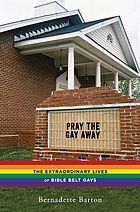
In the two decades since Miller's travels, much has changed in the world of LGBT visibility, culture, and activism -- yet our collective understanding of queer culture remains focused on urban, coastal areas as gay-friendly, while the rest of the country is dismissed (especially by those who don't live there) as a place where "diversity is less acceptable" and life is harder for queer men and women trying to make their way in the world.  Bernadette Barton's new study, Pray the Gay Away: The Extraordinary Lives of Bible Belt Gays (New York University Press, October 2012) both confirms and complicates this narrative.

A Massachusetts-born academic who moved with her partner to Kentucky, Barton was taken aback when a neighbor denounced homosexuality as a sin after Barton came out to him. Curious to understand how "Bible Belt gays" experienced this climate of casual anti-gay sentiment, she began interviewing gays and lesbians who grew up in what she terms the "Bible Belt panopticon," the southern mid section of the nation in which tight-knit communities and strong evangelical, fundamentalist Christian culture come together to create and police conservative norms. When the normative culture is implicitly anti-gay, open bigotry is not needed to encourage self-policing. For example, Barton quotes an interviewee reacting to a church billboard proclaiming, "Get Right or Get Left":
Get right means to be saved and get left means to be left behind at the Resurrection, but this also conveys the dual message of the church's political affiliation as well. It's very polarizing, and when I read it, it sounds like a threat.
Barton observes:
This is an example of how antigay rhetoric, especially to a Bible Belt gay, doesn't have to say anything at all about homosexuality. It's the associations. A Bible Belt gay knows homosexuality isn't included in the right column.
Pray the Gay Away explores different ways in which this Bible Belt panopticon manifests, from family expectations to ex-gay ministries, gay-unfriendly workplaces and legislation to ban same-sex marriage. Throughout, the voices of Barton’s interviewees are powerful evidence in support of her thesis. One graduate student, for example, tells Barton about how his parents tried exorcism when they found out he was in a same-sex relationship. When he remained unrepentant they not only disowned him and cut all financial support, but also removed all of his belongings from his dorm room before they returned home. Through the support of his campus community, the student was able to remain in school -- but the resilience of the child does nothing to redeem the horrific behavior of his parents.

I grew up in West Michigan, an area that is -- though technically outside the Bible Belt proper -- incredibly religiously and politically conservative. Reading Barton's work, I found much to identify with in its descriptions of life in a community that resists difference and where anti-gay feeling is commonplace. I was particularly struck by her observation that in such communities, "gay" and "straight" are the only two categories a person can belong to. Anyone who is something other than straight is “gay.” You're either "right," after all, or "left." That observation made me wonder whether it took me so long to recognize my own sexual fluidity in part because I literally had no language with which to describe myself.

Though I no longer have to live in a culture that makes it difficult (if not dangerous) to speak of my existence, I am mindful that what Barton terms the “toxic closet” effects everyone whom anti-gay bigotry touches, not just queer folk. My parents, for example, felt profoundly alienated when the city council rejected an anti-discrimination ordinance last year. And my grandmother is uncertain with whom she can safely share the joyful news of my marriage. The “Bible Belt panopticon” constrains us all.

At times, Pray the Gay Away seems to paint the Bible Belt as a monolithic culture of hate. I was pleased to see how careful Barton is to point out that she "deliberately sought out individuals who grew up in homophobic families and churches to best explore their consequences," and that her narrative describes the normative culture of the Bible Belt, rather than attempting to describe all people therein. (For a broader examination of queer folks' relationships with their families of origin, see the excellent Not in This Family by Heather Murray.) Barton’s conversations with gay Christians and gay-friendly church leaders, as well as her nuanced exploration of ex-gay ministries help show that even situations which appear toxic at first glance often contain more complex realities.

Yet ultimately, Barton argues that in the Bible Belt region "rampant expressions of institutional and generalized homophobic hate speech in the region bolster individually held homophobic attitudes and encourage those who have dissenting opinions to remain silent." One lesbian student whom she interviews theorizes that it might even be accurate to identify these anti-gay attitudes and actions as "gay cultural genocide.”

I highly recommend Pray the Gay Away to anyone with an interest in contemporary queer experience, in Bible Belt Christianity, and the intersection of the two. I’d go so far as to say it’s required reading for anyone who cares about what it means to be gay in America today. Whether or not you’ve ever lived in the “toxic closet” yourself, too many of our fellow citizens still wake up there every morning. We owe it to them to listen to the stories they have so generously shared.

Cross-posted at In Our Words.

2012-04-26

booknotes: families apart

The University of Minnesota Press was kind enough to send me a review copy of Geraldine Pratt's fascinating study of migrant domestic workers and their families who have traveled from the Philippines to Canada as part of Canada's Live-in Caregiver Program (LCP). Families Apart: Migrant Mothers and the Conflicts of Labor and Love (University of Minnesota, 2012) is the result of Pratt's collaboration with the Philippine Women Centre of British Columbia. With the assistance of the PWC, Pratt identified and interviewed twenty-seven families: mothers (the primary LCP participants), children, and sometimes partners, who have emigrated to Canada in hopes of economic and social mobility. Families Apart draws on these interviews, with analysis and reference to the relevant bodies of literature, to explore and theorize the long-term effects of the LCP on family relationships.

I came at this book from several perspectives: that of a former care provider (though in very different circumstances from those of the LCP participants), that of a family member, that of a feminist, and that of an oral historian. I want to talk briefly about each of these lenses through which I considered Pratt's work, and suggest that her research is of potential worth to those with a personal, as well as academic and political, interest in the intersection of family with wage-work and caregiving labor.

Pratt overtly encourages self-reflection in her readers, many of whom she presumes will be white, middle-class academics like herself, whose experience of parenting and family life is, materially speaking, worlds apart from the experience of the participants in her research interviews. Throughout Families Apart, she tries to break down the barriers to empathy and suggest that cross-class, cross-cultural experience of familial bonds of affection and care can help those outside the LCP program understand the trauma of separation and conflicting responsibilities and desires expressed by those who are (or have) lived through it. Pratt juxtaposes, for example, images of her own child (with his permission) and testimony from immigrant children recalling the trauma of their mothers' departure. Through such attempts at self-conscious narrative voice, Pratt pushes us not to imagine the families whom she interviewed as "others" whose emotional attachments are somehow qualitatively different from our own due to race, class, or culture. Instead, she argues, the pain of long-distance parenting for both adults and children is a point of connection.

This thread of Pratt's book prompted me to think about how our culture values separation and togetherness in family life. I read Families Apart long before the campaign-related kerfluffle over how parenting and work are valued in our society, but Katha Pollitt's ever-articulate analysis of the Ann Romney/Hilary Rosen dust-up could be read alongside Pratt's trans-national analysis as an example of how the relative value of wage-work and family care shifts in relation to social status:
The difference between a stay-home mother and a welfare mother is money and a wedding ring. Unlike any other kind of labor I can think of, domestic labor is productive or not, depending on who performs it. For a college-educated married woman, it is the most valuable thing she could possibly do, totally off the scale of human endeavor. What is curing malaria compared with raising a couple of Ivy Leaguers? For these women, being supported by a man is good—the one exception to our American creed of self-reliance. Taking paid work, after all, poses all sorts of risks to the kids. (Watch out, though, ladies: if you expect the father of your children to underwrite your homemaking after divorce, you go straight from saint to gold-digger.) But for a low-income single woman, forgoing a job to raise children is an evasion of responsibility, which is to marry and/or support herself. For her children, staying home sets a bad example, breeding the next generation of criminals and layabouts.
Substitute "welfare mother" with "LCP worker" and this equation of worth applies. Women participating in the LCP program are caught in a double-bind of judgment. Expected to give up their personal and family lives in order to care around-the-clock for another family's children (traveling halfway around the globe to do so, often not seeing their own children for years at a time), they are judged by their families and society at large for abandoning their children. Their often-crucial financial support for the family back home often comes at the price of losing their partner and the alienation of their children. Pratt skilfully navigates the gendered dimensions of the LCP program, exploring the differing expectations of maternal and paternal care while not ignoring the real psychic pain for all concerned when a parent is absent for years of a child's life.

Families Apart echoed certain themes explored in Schalet's Not Under My Roof which I read shortly before Pratt's study. I'd argue that both books take a cross-cultural look at how we constitute families and value different types of families (and different types of family members) unequally. Notions of "good" and "bad" mothering (or fathering), what is a family unit deserving of respect, how young people should behave in relation to their parents -- who is the proper person, parent or otherwise, to care for a child and help them grow into an adult who can participate meaningfully as a grown-up person in society.

Finally, as a practitioner of oral history, I really appreciated the sections of Pratt's book where she stepped back to examine the process by which she and the PWC made the materials collected during research accessible in a variety of venues: through a multi-media exhibition, in theatre performance featuring monologues crafted from the interviews, in ongoing collaboration with the families whose stories Families Apart documents and synthesizes. Researchers within the social sciences and humanities whose research intersects with human lives are engaged in an ongoing discussion about the ethics of such work, and how to document without exploitation. I believe that Pratt's work is a valuable contribution to that professional conversation. While she herself is the first to argue that the social inequality between herself and the LCP women she collaborated with cannot be erased or overcome by this work alone, I'd argue that her example is a useful one for all those planning future collaborative projects to examine and learn from.

Anyone who wants the chance to think anew about how we value families (and what families we value) in our North American culture of inequality should definitely check out this book.

Cross-posted at The Pursuit of Harpyness.

2012-04-17

booknotes: not under my roof

Ever since I heard about Amy Schalet's research and her forthcoming book, Not Under My Roof: Parents, Teens, and the Culture of Sex (University of Chicago Press, 2011), I've been eagerly waiting to get my hands on a copy. Thus, when Not Under My Roof came out earlier this winter, I had ordered it from Amazon and read it before the month of February was out.

And I've been waiting ever since then for inspiration to strike vis a vis how to review the book. I'm not exactly sure why. It's got a whole host of things that usually cause an explosion of thoughts and words in my head: human sexuality, cross-cultural analysis, discussion of cross-generational family relationships, overall encouragement to re-examine our historical-cultural assumptions that a particular set of events or circumstances (in this case coming of age and emerging adult sexuality) just is a certain way. If you want me to experience the scholarly equivalent of an orgasm, throw an articulate article or book in my direction that suggests some naturalized assumptions about sex or gender are actually historically contingent. Not Under My Roof has all the above covered, in spades.

But mostly, it made me incredibly sad. Sad because the mainstream culture of the United States -- as well as the institutions and state apparatus that support/are supported by that culture -- is failing us abysmally when it comes to parent-child relationships and the incorporation of sexuality into family life and society. This isn't news, but it's still kinda hard to have a book-length reminder of how badly we fail at this. Schalet's research looks at the negotiations between parents and teenage children over sexual activity and relationships in the United States and the Netherlands. My marginalia, particularly in the U.S. sections, consisted of a lot of "so sad!" and "key disconnect" and sad faced emoticons.

Schalet, a professor of sociology at the University of Massachusetts, Amherst, conducted her research in the U.S. and the Netherlands (where she had spent part of her childhood) during the mid-to-late 1990s. She conducted qualitative interviews parents and their adolescent children in a number of different suburban and urban locations in both countries, focusing on white, middle-class families as her research sample. While she acknowledges the limitations of her research population, she argues that these middle-class families are also a key demographic in the development and maintenance of cultural norms. What she discovered is that, in the Netherlands, adolescent sexuality -- particularly in serious relationships -- is normalized by both parents and the wider society (culturally and institutionally). As a result, even when conflicts or anxieties around teenage sexual behavior emerge, families negotiate solutions that tend to integrate the children's sexual relationships and emerging adult life into the fabric of the family and society as a whole. In the United States, by contrast, adolescent sexuality is dramatized as a dangerously out-of-control physical and emotional experience that will signify a break from the family of origin. It is simultaneously a facet of independent adulthood and an activity which threatens a teenager's ability to reach successful middle-class adult independence.

Schalet broadens her examination of adolescent sexuality to look at how these differing concepts of teenage sexual desires and behaviors both reflect and inform our divergent understandings of adolescent development and adulthood cross-culturally. In the Netherlands, Schalet argues, adulthood -- particularly young adulthood -- is not understood to constitute economic self-sufficiency or emotional distance from one's family of origin. Dutch teenagers are expected to develop a self-determination within emotionally close family and social circles, rather than in opposition to them. While American teenagers are expected to be rebellious, incommunicative, out of control, hormone-driven beings, Dutch teenagers are assumed to be self-regulating individuals who will gradually assume responsibility over their social and sexual lives as they are able.

The Dutch framework is not without its troubling aspects, as Schalet points out, specifically the lack of language with which to articulate and grapple with unequal power within relationships (parent-child, a couple of differing ages or class standing, sexism within dating relationships). However, overall health indicators suggest that the Netherlands is modeling a much more successful way of supporting teenagers' development than is the United States. One of the most fascinating aspects of Schalet's interviews, I thought, was the widespread helplessness expressed by American parents and children when it came to cultural views of adolescent sexuality and parent-child relationships. Parents and children alike often expressed unhappiness with the status quo, yet were equally at a loss when it came to effecting meaningful change in their own family lives or in society at large. By conceptualizing American teenagers as hormone-crazed beings incapable of rational thought, parents either threw up their hands or resorted to an authoritarian rules-based approach which they acknowledged their child would likely evade or otherwise thwart. Children, in turn, expressed a desperate desire for adult support, but could not picture integrating their sexual selves into family life either through conversation about sexuality or by bringing a partner to their parents' house.

The title, Not Under My Roof, refers to the scenario Schalet presented to each of her interviewees: "Would you (or your parents) allow your child's significant other to sleep over?" Across the board, Dutch parents answered in the affirmative, though with some qualifications concerning age and nature of the relationship -- older teenagers and "steady" boyfriends/girlfriends were much more acceptable than were sleepovers requested by younger adolescents and relationships deemed more casual. Dutch boys were also more likely to report being comfortable with bringing a significant other to stay overnight than were Dutch girls (who generally preferred going to the house of their partner).* However, every single American parent rejected the idea of "the sleepover," conceptualizing the economic dependency of adolescence as mutually exclusive of (acknowledged) sexual activity -- even as they articulated a certain fatalism that their children were likely engaging in sexual activity elsewhere. Teenagers in the States were, likewise, unable to imagine being openly sexually active or to communicate with parents about their lives as sexual beings.

I feel like I should put some of my personal cards on the table here and acknowledge that my upbringing was much more like that of the Dutch teenagers than the American ones. I never brought a partner home to stay overnight as a teenager quite simply because I wasn't sexually active at that point in my life. My siblings romantic and sexual relationships were integrated into our family life in various ways, and my parents were always vocal about the fact that if any of us were to need a private space for sexual exploration, our bedrooms were available -- and preferable -- to more public, clandestine locales. Unlike many of the American parents Schalet interviewed, my siblings and I are welcome to bring our partners home and to share a bedroom with them. In contrast, Schalet's interviewees often persisted in rejecting their children's sexual selfhood up to the point of marriage and/or simply believing that a child's sexual relationships, even as adults, belonged outside of the family home. This seems to mirror the reflexive disgust many adolescent and adult children express when asked to contemplate the sexual lives of their parents -- something I find at best puzzling and at worst disturbing (surely we should be invested in supporting our parents' sexual well-being just as we ask them to support ours?).

Which is where the sadness of this book comes in for me: The entrenched helplessness of Americans across the generations when it comes to communicating more effectively and positively about our sexual hopes and fears, about the quality of our relationships, about what we need to foster health and well-being in our sexual lives. The Dutch families don't have everything it all worked out, certainly, but through Schalet's eyes they certainly seem to be light-years ahead of our dysfunction. I really wish Americans would start to take the lessons of other Western nations to heart and do better by our youth. Instead, as a society, we seem determined to move by inches into ever-increasing moral panic, non-communication, and policing.

I very much hope that Schalet's book will make its way into the hands of policymakers, parents, and sexual health professionals and that it will encourage us collectively to re-examine our assumptions about adolescence, sexual well-being, family relationships, and our conception of successful adult development. I can't say I'm very hopeful about large-scale change, but perhaps Not Under My Roof will -- if nothing else -- encourage individual parents and their children to assert their independence from normative cultural pressures and create more functional, integrative, patterns of family communication and togetherness.


*As a side-note, this book was frustratingly heterocentric, though that seems to have been the "fault" of the families interviewed rather than Schalet's process. She deliberately asked all questions in a way that left the sex/gender of the child's partner undetermined -- and virtually all parents, with the exception of a couple of Dutch parents, presumed straightness in their children. Virtually all of the youths Schalet interviewed, likewise, were either paired with an other-sex partner or identified future partners in other-sex language.

I'd love to see a follow-up study that deliberately sought out families with youth of wide-ranging sex and gender identities and experiences. I'd be really interested to see how or if parent-child interactions change when queer sexuality enters the picture. How do parents conceptualize their queer childrens' sexual lives? How do parental fears about youth sexuality shift when pregnancy prevention is no longer a concern? Are young people more or less likely to bring same-sex partners home? We may think we know the answers to these questions ... but I'd be really interested in the results of a deliberate cross-cultural study.
2012-01-26

two recent and unrelated news items on which I have thoughts

random pretty thing (via)
1. On Cynthia Nixon and choosing one's sexual identity. According to Cassie Murdoch @ Jezebel, actress Cynthia Nixon said some things about choosing her current partner, another woman, which have irritated other people also in same-sex relationships. In response, Nixon told the New York Times:
Why can't it be a choice? Why is that any less legitimate? It seems we're just ceding this point to bigots who are demanding it, and I don't think that they should define the terms of the debate. I also feel like people think I was walking around in a cloud and didn't realize I was gay, which I find really offensive. I find it offensive to me, but I also find it offensive to all the men I've been out with. [NYT]
"Why is [choosing] any less legitimate" is my favorite line from this quotation, because regardless of where we, as humans of all sexual persuasions, fall on the innate/culture continuum vis a vis our own personal sexual desires, I think it's really important not to throw fluidity, change, and personal growth over time under the damn bus. By limiting "legitimate" or "authentic" sexuality to that which is fixed, innate, and ostensibly knowable from birth, we demand certainty on an issue which -- for some if not most -- is far from certain, or perhaps serially certain -- we know ourselves, and then we know ourselves again in a new light. Both equally true.

And, of course, even if you want to argue that sexual attractions/desires are innate and fixed, sexual identities and the language we use for them, are creations of culture -- so, yes, actually, we all of us "choose" to be "straight" or "gay" or "lesbian" or "bisexual" or "asexual" or "queer" or whateverthehellother label du jour we decide to slap on ourselves. Underneath those words are actual corporeal human beings, with attractions and desires no one can wrest from us or know better than ourselves -- but we do choose to politically identify with language. We choose to affiliate, organize, categorize. And we'll probably choose at some point to re-categorize human sexuality in new ways.

So I'm glad Ms. Nixon isn't letting people bully her into silence or repentance on this point for the sake of political expedience. That would make me sad for the future state of discourse on human sexuality.

2. On parents, children, and workplace negotiation. A friend of mine linked to an NPR story yesterday, on Tumblr, about parents advocating on behalf of their adult children with human resources representatives at their childrens' workplaces. I was thinking about this one on the way to work today, because I come from a family where -- okay, this hasn't happened and likely won't ever happen -- but where when I was growing up my parents often asserted their right to participate in discussions about (for example) our medical care, even when doctors thought it was "hovering." My parents were always clear to ask us, as their children, whether we wanted their support -- and backed off the moment we asked them to. But that experience has led me to be wary of cultural outrage over "helicopter parenting" and other family systems that Americans read as intrusive. Because things aren't always what they seem on the surface. Two thoughts:

a) Sometimes, tag-teaming is an important function of families. Sometimes, even grown-ups need the support of other grown-ups to self-advocate, particularly around things like healthcare? It can be as simple as  calling to report a spouse is too ill to be at work that day, or it can be more complicated -- like asking a family member to attend medical appointments with you. We can't all operate in isolation 100% of the time, and while I have no idea what the particulars of these HR situations might be, I hesitate to be judgy. Yeah, it could totally be an overbearing sense of entitlement. But it might also be desperation and/or simply family groups operating to support one another. Which leads me to:

b) This seems outrageous to us because we've decided as a culture that it's outrageous. Think for a moment about arranged marriages. In cultures where extended families facilitate marriages, parents and other adults are involved in something (courtship) which we, in America, have decided is essentially a private matter between the two people directly involved. Parents getting involved in their child's courtship decisions (e.g. a partner asking the parents' permission before proposing) is seen as intrusive. But seen in a different light, it's not intrusive, it's expected, and serves a purpose. We might, as a society, decide we dislike the purpose it serves -- but that's neither here nor there. By analogy, it would be interesting to back up and consider how multi-generational involvement in workplace situations operates. What perceived problem is this involvement seeking to remedy? Is it serving a function that, until now, has been met in some other way? Why has the old way stopped working, or why do people perceive it to have ceased working?

These are the things I think about on the way to work.

2012-01-24

booknotes: the lives of transgender people

I was super excited to get my hands on an advance review copy of The Lives of Transgender People by Genny Beemyn and Susan Rankin (Columbia Univ. Press, 2011) a couple of months ago. Lives is being touted as a unique and much-needed large-scale study of the identities and experiences of trans* individuals as described in their own words through an online questionnaire and qualitative email, phone, and in-person interviews. Beemyn and Rankin gathered data from 3,474 individuals via the questionnaire, and followed up with over four hundred of those respondents for more lengthy interviews. By encouraging interviewees to articulate their own identities outside of pre-determined research categories, the authors allowed their subjects to provide a rich and nuanced picture of the lived experience of being someone who experiences life outside the sex and gender binaries mainstream culture assumes are innate and largely inflexible. Most studies examining the lives of trans* people to-date, as the authors point out, have focused on the life experiences of people who identify as transsexual; an overwhelming majority of those studies focus on the experience of trans women (women assigned male sex/gender at birth). As the authors point out, this renders invisible those people who do not fall into neat, polarized gender categories (trans* or otherwise). Often, as documented in books such as Brainstorm and Sexing the Body, this stems from the research community seeking discrete identity-groups they can control and measure for difference. It also comes from researchers' own unexamined assumptions concerning sex and gender difference, assumptions which are then reinforced by the results of studies that have been designed (in part) by jettisoning the data from individuals who don't fit into the pre-determined sex and gender categories.


The Lives of Transgender People can be read, in part, as providing a model for a much different way of exploring trans* experiences -- one which honors the myriad expressions of sex and gender which the human organism manifests. "Throughout the book, we use the language of the survey participants to honor their voices and their own self-descriptions," write Rankin and Beemyn, insisting that we, as readers, pay attention to the richness of the gendered experiences described by the people who shared their stories (36). Lives seeks to be descriptive rather than prescriptive, synthesizing the data collected in a number of different ways that suggest some patterns to be found in trans* experiences, often differentiated by other variables such as age cohort, race, economic status, and so forth.  Particularly useful was the researchers discussion of gender identity and expression, given their insistence that trans* identities and experiences not be simplified the better to accommodate researchers desire for tidy data. They discuss in great detail their decision to identify four basic categories for analysis: trans men (assigned female at birth, self-identity male), trans women (assigned male at birth, self-identity female), "female to different gender" (FTDG) and "male to different gender," (MTDG) which allowed them to honor the current identities of respondents which don't fit into the mainstream system of binary gender. Further chapters discuss race, sexual orientation, and age as variables which further complicate the project of identifying any stable sense of trans* identity or experience.

The researchers, both of whom work in higher education, are particularly interested in age and generational differences as a factor, and put forward some tentative observations concerning the difference in reported experience across generations. For example, older respondents were more likely than younger ones to identify as cross-dressers, while trans men were statistically more likely to be significantly younger than trans women. They also spend a great deal of time was also spent on identifying recurring "milestones" of gender identity development as articulated by the study participants. Much trans* research to-date has focused on modeling the "stages" through which individuals go on the journey to identifying themselves as transgendered, and the authors of Lives offer the more flexible model of "milestones" (which may or may not be relevant for a particular individual) as an alternative model for understanding the process of self-realization.

I hope that in the years to come Lives will be a rich source of data for activists, theorists, and policymakers, as well as one possible model for doing research on sex and gender that allows us to collect meaningful data without depending on the binary male/female, man/woman dichotomies that continue to unhelpfully reduce the variety of human experience to the inflexible straight-jackets of innate gender difference.


2012-01-10

booknotes: deviations

find table of contents here
For the past couple of months I've been making my way through Deviations: A Gayle Rubin Reader (Duke University Press, 2011), an anthology of writings by anthropologist and feminist theorist Gayle S. Rubin whom I'm ashamed to admit I didn't actually know anything about before I stumbled upon the advance review galleys of this book. Rubin  is a cultural anthropologist whose research delves into the history and culture of urban sexual subcultures, particularly BDSM communities. As a newly-out lesbian in the 1970s in Ann Arbor, Michigan, she designed her own Women's Studies major at the University of Michigan and became active in the Women's Movement and also the Gay Liberation Movement. In the late 70s and early 80s -- in part because of her academic research into BDSM -- she drew the ire of anti-porn feminist activists for her insistence that (wait for it) not all pornographic materials are inherently degrading to women. Yeah, I know. The more I read about it, the more it seems like the early 80s must have been a really weird time to be a self-identified feminist. Not to mention one who was also a lesbian and open about her s/M desires and practices.

Deviations is arranged in chronological order, beginning with Rubin's first attempt to construct a theory of gender relations rooted in anthropological methodology -- "The Traffic in Women: Notes on the 'Political Economy' of Sex," written and revised between the late 60s and early 70s and first published in 1975. It is very much an artifact of its time and to be honest I bogged in this piece for the better part of a month after joyfully burning my way through the eminently readable introduction. Perhaps recognizing the opacity of "Traffic," Rubin includes a piece reflecting back on the writing and reception of the original piece and includes it in the anthology -- something she does several times throughout the book to great effect. After "Traffic" and its contextual essay comes a much more accessible piece on the English author Renee Vivien, originally written as an introduction and afterward to a new edition of Vivien's A Woman Appeared Before Me, which is a fictionalized account of her tumultuous relationship with fellow author and outspoken lesbian-feminist Natalie Barney.

By the late 70s, Rubin was deep into the ethnographic research for her dissertation on the gay male leather bars of San Francisco, for which she received her PhD in 1994 from the University of Michigan. The majority of pieces in Deviations, therefore, wrestle not with the politics of gender or specifically lesbian-feminist history, but the politics of sexual practices, sexual subcultures, and the relationship between feminist theory and practice and human sexuality. As someone who is, like Rubin, committed to understanding the world through both a feminist and queer lens, I really appreciate her determination to remain engaged in feminist thinking and activism even as she was reviled by certain segments of the feminist movement for her "deviations" in sexual practice, and her openness to thinking about sexual subcultures that -- for many in our culture, even many self-identified feminists -- elicit feelings of disgust and generate sex panics. While the "porn wars" of the 1980s are largely a thing of the past, feminists continue to find sexuality, sexual desires, sexual practices, and sexual fantasy (whether private or shared via erotica/porn of whatever medium) incredibly difficult to speak about. Rubin calls upon us to think with greater clarity about the politics of sex, and how we police other peoples' sexual activities, many of them consensual, simply because we find them distasteful.

Particularly controversial, I imagine, are Rubin's writings on cross-generational sexual activities and children's sexuality. Coming out of the BDSM framework, Rubin foregrounds the basic ethic of consent and argues that children have just as much right to consent to sexual activities as adults. Furthermore, within the framework of 1980s anti-pornography legislation, she emphasizes the difference between fantasy/desire and reality/action (that is: depiction of non-consensual sex in the context of a fantasy does not equal non-consensual sex and shouldn't be treated in the same fashion). This leads her to speak up in defense of adults who express sexual desire for young people (but don't act on that desire), and also to suggest that not all instances of underage/overage sexual intimacy should be treated as sexual abuse or assault. Read in tandem with Rubin's insistence that we take children seriously as human beings with the right to sexual knowledge, this advocacy is clearly not a call to minimize the trauma of sexual violence (at whatever age) or a glossing over of age-related power dynamics. "The notion that sex per se is harmful to the young has been chiseled into extensive social and legal structures," she writes, "designed to insulate minors from sexual knowledge and experience" (159). Like Judith Levine in Harmful to Minors (2002), Rubin argues that our cultural insistence on keeping young people separated from sexuality and sensuality -- with a vigilance that often spills over into panic and hysteria -- does little to protect them from sexual violence and exploitation while cutting them off from the means to conduct their own (safe, consensual) sexual explorations or name and resist the violence and exploitation that may come their way. Sexting panics anyone? The Purity Myth?

Overall, I highly recommend Deviations to anyone interested in the development of feminist and sexual political theory and practice over the last forty years -- if nothing else, Rubin's bibliography has already given me a handful of other thinkers whose books and articles I wish to pursue.

Cross-posted at the corner of your eye and The Pursuit of Harpyness.

2011-12-04

third thoughts: conversations about sex + identity

As promised, here are some "third thoughts" about my participation in Holly Donovan's comparative research on social interactions between straight and non-straight folks in urban and rural areas. 

For my first thoughts and second thoughts, if you haven't already seen them, follow the links.

To read more about participating in Holly's research project, check out her call for participants (PDF). If you live in the Boston area and identify as queer in any way -- or know someone who is and does -- do check the project out; she's still actively searching for participants. She mentioned particularly needing to hear from non-academics and people who hail from working class communities.

So. Now that the "signal boost" portion of the post is complete, on to my own further reflections.

we sat down to talk over coffee at Pavement Coffeehouse
Even though Holly indicated that the second-round interview typically lasts about thirty minutes, she and I talked for a good hour and a quarter (are you surprised? if you know me, you aren't surprised). Here are a few things that Holly's response to my project journal (see second thoughts) prompted in my own thinking.

Holly noted several times the way in which my journal observations "emphasized the positive." She was actually pulling that phrase from a section in my journal where I talk about a tricky interaction with someone who was kinda luke-warm about the lesbian relationship thing.  I was describing how I chose to emphasize the positive with them, verbally pointing out the steps this person made toward acceptance and thanking them for being willing to acknowledge my relationship with Hanna. We talked quite a bit about this, both as a conscious strategy for interactions with a potentially hostile environment, and also as something that simply is for me when it comes to my queer identity.

Let me try to explain (warning: it's a work-in-progress). As I've talked about in the previous posts -- and as should be overwhelmingly evident from everything I write about sexuality and relationships on this blog -- I experience my sexuality, sexual orientation, and sexual relationships in a really enthusiastic way. Because my sexuality is fluid in many respects, you could say that I didn't really have a sexual orientation/identity until I was in a relationship of my choosing. A relationship which I entered as an adult who was enthusiastic about being partnered with this particular person (Hanna). Prior to that moment of becoming part of a couple, I was sort of a blank slate, socially, for other people to read whatever the hell orientation they wanted to onto me. It wasn't an active component of my self-presentation until I wanted it to be.

So basically, by the time my sexuality became visible and people could react to it in more public settings (outside of conversation with intimate friends), I had pretty clear convictions about what was and was not out of bounds, and how I wanted to handle any resistance to who I am, who I'm with, and how I choose to enjoy my sexuality. I have two basic ground-rules for myself about handling less-than-optimal social interactions:
1. I won't be dishonest about who I am. This is largely pragmatic, since I'm terrible at dissembling. But it's also a decision rooted in my personal ethics. Since I can remember, the way my family (and later I, as an individual) chose to live has made some people uncomfortable -- even angry. If I had grown up trying to manage other peoples' discomfort about my non-conformity it would have been a losing battle before it began. Aside from the fact that managing other peoples' emotions is a) doomed to fail, and b) the worst energy sink ever.  So I just won't. I am who I am, and if that's a problem for someone then we're probably going to need to figure out how not to be in much contact, or simply put on our grown-up pants and deal with the fact we have differences.
2. Whenever possible ignore the negative crap and give a shit-ton of positive reinforcement for anything constructive. This strategy, too, stems from my childhood ... where I realized somewhere along the line that I could use my time/energy critiquing institutional education or I could focus on the instances of high-quality mentoring and learning where and when I saw them happening. I like this approach because it doesn't allow the opposition to frame the debate, and it allows you the freedom to focus on building the sort of future you want rather than constantly re-hashing how less-than-ideal the present it. 
"Ignoring" the negative crap doesn't mean pretending it isn't there, or letting it go without noting it and pointing out it's not cool. But when it comes to people-to-people interactions, particularly, I'd rather spend my time giving positive feedback for the good and a cool reception to the bad. The less attention unhelpful interactions get, the better.

So "emphasizing the positive" is both a manifestation of the social privilege and aspects of my personality that made growing into my adult sexuality and sexual relationships overwhelmingly positive* and a conscious political choice for how I think I'll best be able to use my limited energies and resources to effect change in less-than-optimal social situations.

Holly was interested in my reflections (which I wrote about at the end of my second thoughts post) on getting something out of living on the cultural margins. In addition to what I'd already written in that earlier post, we discussed how the experience of choice and agency which I describe for myself -- of being drawn toward non-conformity -- is different from the language of being "born this way," and then pushed to the margins by others who reject who you are. I actually don't see myself as choosing marginality (though existing on the margins feels familiar). What I experience myself choosing is the situations that will best allow me to flourish, that will best support my well-being as a person. Given the culture in which we live, I've discovered that these happen to be marginal spaces. It's been an incremental journey in a lot of ways, wherein I made a series of decisions about this and not that which have led me to a place very different from the majority culture. I didn't choose sexual fluidity and desire, didn't choose to fall in love with another woman, but I chose to recognize and honor that sexuality, that love, and make a space in my life for those desires and that relationship. I don't feel shoved unwillingly out of the mainstream -- I feel like I chose (am in the process of choosing) the life that works best for me and my partner, and the mainstream has sort of parted ways around us. It's not really here nor there, to me, whether or not my life path is ever "normal" or acceptable in the eyes of the majority.

Holly observed that I wrote comparatively about my experiences in Boston and in Holland, and asked how things would be different (in relation to sexual orientation) if I were living in Holland rather than Boston right now. I wrote comparatively about Holland and Boston in my journal in part because I know Holly's study is looking at regional differences and queer-straight social interactions in urban vs. "rural" locations. So it's not like I spend a lot of time comparing the two places specifically in relation to queer issues. But when she asked about what would be different, my first thought was It's less tiring to be myself here. Less tiring, because less oppositional. When I lived in Holland until 2007 I wasn't visibly queer, but I was more or less myself in politics, interests, and values. And living out those values, expressing those interests and politics, just took a lot of work. 

Or, at least, I learned to expect that when I opened my mouth (or when people with similar values opened their mouths) it would trigger the angst and the anger and the defensiveness and the soul-searching re-evaluation of values and yadda yadda yadda ad nauseum. Who I was and what I believed caused people existential angst and precipitated crises. It got really tiring. And boring.

So when I picture being in Holland now, on the one hand it would be awesome to be closer to the friends and family I know and love there. But it also just sounds like a lot of work: work to find a queer-friendly therapist, work to find a doctor who's cool with lesbian sexuality, work to advocate for same-sex spousal benefits (which, you know, currently illegal in my home state). All of which are just givens most of the time here. And that's on top of swimming up stream against the gender essentialism and anti-feminism and opposition to social welfare and any number of other issues that aren't directly tied to sexuality but are nonetheless about who I am and how I want to live.

I know plenty of friends and relations who manage to live and even thrive in that environment -- and part of me is envious that they've managed to build lives in a hostile climate. But I did that for 26 years and it's really nice not to have to right now.

As I myself observed in second thoughts, Holly noticed how many of my intellectual and social interactions concerning sexuality center around reading and writing (on- and offline). She asked what I look for in my reading and interactions in these areas. I didn't have any ready answer for her, other than that I've found the resources I do consult mostly by link-hopping and footnote following ... I identify a resource I do like, and mine it for further reading in whatever way it appropriate to the medium. I follow the network, whether it's a blogroll or a bibliography. At this point, I have enough sources of information that I can sit back fairly passively -- skimming my feeds, reading book reviews, taking note of workshops and presentations -- and monitor the flow of sexuality information that's being generated and analyzed by the people whose ideas and opinions I care about.

What sort of people are these? Well, I actually think a good list of criteria can be found in a post I wrote over at Harpyness about sexuality education and things I wish I'd known when I was younger about human sexuality. Those five things are a pretty good outline of what I'm currently interested in exploring, and the sort of attitudes about human sexuality I gravitate towards. I generally look for writing on human sexuality that's descriptive rather than prescriptive -- I like reading about how humans behave and why, and what they do that fosters well-being, rather than about how we "ought" or "should" behave according to some external set of rules (religious or otherwise). I prefer research and writing on human sexuality that doesn't presume human sex and  gender are oppositional and binary, and it's probably redundant for someone who's titled their blog "the feminist librarian" to say she wants her resources to demonstrate feminist awareness and to critique systems of oppression that constrain our ability as individuals to experience pleasure and wellness.

I don't really care how the individuals behind these sources of information identify sexually. I follow blogs and read books by people whose own experience of human sexuality ranges across the queer spectrum as well as falling squarely within heteronormative boundaries. I'll talk and think sex with people who are asexual, poly, abstinent until marriage, gay men, trans* folk, hetero married, celibate due to religious vocation, etc. At rock bottom, my only criteria are that a) you acknowledge and embrace human sexual diversity, b) believe there is no one-size-fits-all approach to sexual ethics, c) but take sexual ethics seriously as a topic of conversation; d) that human sexuality, to you, is seen as a potential source of human pleasure and connection; and obviously e) you enjoy exploring both your own experience of sexuality and the cultural narratives we've constructed around those personal experiences.


*I've been thinking since we talked about how my cisgender presentation made my smooth (sexuality/sexual identity-speaking) adolescence possible. In part because I'm reading a book right now about the lives of transgender people and the gender policing they experienced as teenagers. As a girlchild with parents who worked not to gender stereotype, I was given wide, wide latitude to be a person first and a girl/woman second. Feminism also granted me license to be myself, however I wanted that to manifest. This, in conjunction with simply taking myself out of the active dating/partnered pool, made a buffer for my sexuality to develop and space for me to discern what I wanted on my own terms. This deserves its own post ... so I'll see what I can do in the near future.