~oOo~
Showing posts with label sexuality. Show all posts

2014-07-28

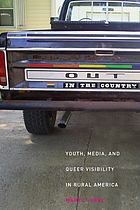
booknotes: out in the country

Last week I reviewed Sarah Schulman's Ties That Bind which explored from a very personal perspective the ravages of familial homobigotry. This week I picked up and read Mary L. Gray's Out in the Country: Youth, Media, and Queer Visibility in Rural America (New York University Press, 2009). Gray's ethnographic study of queer teen lives in rural Kentucky took place in the early 2000s and she published her book in the same year as Schulman. Both authors write thoughtfully about the importance of family in the lives of their queer subjects -- though from very different perspectives. Ironically -- given our usual narrative of urban tolerance vs. rural bigotry -- Gray's consideration of the place of family within queer lives is much more nuanced than Schulman's.

As a researcher, Gray came from a rural California childhood followed by an urban California adulthood working with queer youth organizations. Her exploration of teen lives in rural Kentucky was prompted by national attention on the ways in which the Internet and other media connectivity and queer visibility might work differently in the lives of rural young people rather than urban young people. As she (and others before her) have pointed out, much of our understanding of queer coming-of-age posits a rural-to-urban migration in which our queer selves are incapable of being fully discovered and/or nourished until we "escape" our hometown settings and find the LGBT community in physical locales -- gay bars, lesbian bookstores, gay ghettos, queer action groups. Pushing back against this assumption, Gray sought out youth who were either unable or uninterested in making such a migratory journey of self-discovery. How would young queer people without the resources or desire to leave rural life for the city construct a queer identity?

In Ties That Bind, urban-based adult writer Schulman struggles with familial rejection in the face of her queer activism and chosen family of fellow lesbian, gay, and other non-straight friends. Ties is firmly situation in the milieu of Gay New York, a landscape we all (at least think we) know well, and situates its lesbian protagonist (Schulman) as an adult who struggles to connect with her parents and siblings, but as an adult dragging them to therapy appointments or participating (or not) in rituals like the weddings of relatives. Schulman's pain is that of an adult attempting to reconcile with the failures of her parents' parenting.

In contrast, Gray explores the dense interconnectivity necessary for survival in isolated rural settings. Families of origin, she argues, make or break the experience of rural queer folk in communities where the familiar is often the key to acceptance. Straight family members can act as brokers for their queer youths -- turning the queer into the familiar, making one of "them" into one of "us". The most resilient teens whom Gray encountered were typically youths whose parents supported their identity explorations and attempts to build broader support networks: paying for internet or access to health services, driving them long distances to regional meet-ups, participating in protest actions, or other acts which communicated to fellow townsfolk that their child was not to be disavowed. The more vulnerable children were those whose families either could not or would not provide such support -- in part because, unlike urban queer adults, these youths could not take the city bus to the "gay" district or surreptitiously visit the "women's" bookstore.

In some ways Gray's work underscores the central point that Schulman makes: that queer family members can't just disown their families of origin -- no matter how anti-gay those families are -- and replace them with chosen families without consequence. For Schulman, those consequences are mostly emotional and psychological: the pain of rejection, the loss of future relationship. For Gray's teens, in addition to the emotional support (or pain) a family can provide (or cause) for their queer members in a hostile culture, families are also the gateway to material resources and community belonging. The visibility of queer culture in the media, and access to information -- plus the ability to connect to far-flung networks -- that the Internet provides cannot replace, for queer youth, the insulation that local relationships provide. Nor does an urban-oriented narrative of queerness reliably serve these young people as they work to create usable identities for themselves and their communities.

This was a useful read, one which I might pair with Pray the Gay Away (also about queer folk in the Bible Belt around Louisville, Kentucky) and Not in This Family (challenging the narrative of universal familial rejection of queer family members in postwar America).

2014-07-07

on being "brought out" [anniversary reflections]

It's been roughly five years since Hanna and I started snogging one another.

And, well, other things. It all happened in a bit of a rush; I never was a very patient person once I'd finally determined it was time to do something new. And for us, apparently, the time for sexytimes was late June 2009. 

So yay anniversary!

(via)
This weekend I was reading The Tolerance Trap: How God, Genes, and Good Intentions are Sabotaging Gay Equality by Susanna Danuta Walters (New York Univ. Press, 2014) and was reminded of the now anachronistic corollary to "coming out," that of being "brought out" into the queer community by one's first same-sex partner. Walters writes:
Being "brought out" has within it that dual sense of sexuality and community. One is "brought out" by another queer person and simultaneously brought into the queer community ... coming out in these earlier and sometimes explicitly political iterations was understood as both a process personal and social, both confessional and performative, narrating a "shared fate" but also an "imagined community" (70).
This got me thinking about my own experience of coming out / being brought out into self-awareness and visible queer sexuality. My attitudes toward coming out as a helpful narrative (for myself; for others) have fluctuated a lot over the years. On the one hand, I definitely experienced the silencing pressure of presumptive heterosexuality, experienced the feeling of being closeted. People assumed I was straight and I mostly didn't correct them.

For twenty-eight years.

On the other hand, I remember having casual conversations with my mother, or reflecting in my diary, as early as age eleven or twelve, that I might possibly could maybe be a Lesbian.

I didn't know Bisexuality was an option, really, back then.

That was part of the problem.

I mean, I knew technically that there was this category of sexual identity "Bisexuality" and that it meant people who were sexually attracted to both men and women, but no one I encountered treated it very seriously. It was an elusive, moving target. Something frivolous, a subject of scorn. Men were liars if they claimed bisexuality and women (mostly college girls) were probably just using it as attention-seeking behavior.

We all know the stereotypes. I internalized many of them. I kept my mouth shut when lesbian women -- women I desperately wanted to like and mentor me -- dismissed bisexuality as tantamount to betraying the sisterhood. I judged my own desires along the gay/straight binary and determined that I didn't have enough Gay Thoughts to be properly Gay. And therefore was, by default, Straight.

So: closeted. Definitely.

Except that I had a floating question mark above myself internally as to my sexual desires, and was open about that speculation, so can I say I was ever in the closet, properly speaking?

I remained Straight for twenty-eight ... well, scratch that, more like twenty-six years. Because meeting Hanna in September 2007 began the long slow process of bringing me out.

It took eighteen months.

Though I started telling people I "wasn't entirely straight" almost immediately. Well, within the first six months. I emailed my mother -- reminding her of those conversations we'd had back in when I was twelve -- and wrote letters to friends, angsting about my crush. I started with the gay buddy whose hand I'd held through the winding path he'd taken out of the Mormon faith and into the imagined (and actual) community of queers.

Now I was joining him there, and I know for a fact he wasn't all that surprised.

Most people weren't. At least not to my face.

I was kind of insulted, actually, at the time. Especially by a few second-hand reports I received from my mother back home of family acquaintances who'd claimed they'd practically known before I did what my sexual preferences were. Who did they think they were?!

But I think their larger point was true: straight or otherwise I'd been choosing the queer path for years. I just hadn't found the right person to share it with until that moment.

Which is part of Walters point -- that for some of us same-sex desires are just one part of what it means to be queer. That for us, "coming out" isn't just about leaving the closet -- but also about being "brought out" into a larger community of people who are non-straight, non-normative in their sexuality and gender, their family formation or way of life.

I was a feminist before I was queer, and queerness suited my feminism just fine.

We've always held hands in public.

Yet I made it a promise to Hanna, even before she knew I'd made it (because she didn't know I wanted her), that I would never ask her to cover, never ask her to elide -- no matter how passively -- the nature of our relationship.

I kiss her goodbye outside work every morning, and hello again when I pick her up every evening.

I like to grab her ass while we're standing in the grocery aisle, or waiting for the subway.

These are acts both quotidian and queer. Quotidian in the sense that, as I tried to tell my mother back in the 90s, girls have definitely been possible for me for a long, long time. Quotidian in that this life of ours fits like a well-worn pair of Birkenstocks (yup, I own two pairs). That falling into bed with a woman with Hanna and building a life with her felt like my kind of normal. Like the kind of life I'd been angling for since I'd first read Anne of Green Gables or maybe ElfQuest (probably both).

Oh; this is what I wanted. It came as both a surprise and a homecoming, tangled up together like our limbs as we fell asleep at night.

On some level I must have always known.

Of course, always knowing isn't always synonymous with being known.

On some level, in the first flush of besotted love, I wanted the politics of the personal to be beside the point, but of course politics are never beside the point. Politics are intimately entangled with the possibilities of our lives, the pleasures, the dangers, what can (or must) remain private and what must (or can) become public. In recent weeks we've marked the first anniversary of the downfall of DOMA and then -- whiplash style -- heard two Supreme Court cases that etched bold messages across our legal landscape as to the rights and respect as human subjects we people with uteri have in this country.

As my rights as a lesbian bisexual expand, however modestly, my rights as a woman contract, inexorably.

My embodied self, and the choices I have made with it, are never been far from being the center of others' self-righteous debate.

So even though I framed myself as always the truth of the matter was that in needing to articulate the "always" I made clear that I had, in fact, been raised in a world that was still, itself, the closet. Entangled in a conservative political climate that framed the issues as "gay vs. straight," silenced by explicit biphobia and implicit bi erasure. I needed the safety of both a community (which I found first, online, through women in the constellations that make up the feminist blogosphere) and a person, Hanna, to "bring me out" into self-knowledge and public visibility.

I needed them to find a home.

Which is why I've circled around to respect the paradigm of coming / bringing out into the open that which has been hidden (from ourselves, from others) and celebrating its existence (our existence) in the world as something tangible and joyful -- something achieved rather than something we've always had.

Because we might always have "known" but we haven't always known.

And its only those around us who make it possible for us to share. Only those around us who make a vibrant, joyful community of sexually-various, gender-flexible people with whom it's possible to imagine a life better than the one you're currently living. Those around us who make it possible to choose queerness with pleasure.

So I say it more often these days: I'm gay. I'm bi. I'm a lesbian. I'm a dyke. I'm queer.

Because people, implicitly, explicitly, told me I couldn't be. Shouldn't be. Wouldn't be.

I tell them, now, with every act of visible queerness: I am, I should, and I will.

I choose my wife over all of them, every day.

2014-04-07

presentation @ boston college


On March 29th I attended the Biennial Boston College Conference on History of Religion and presented a paper that tried, for the first time, to offer up some analysis regarding my current project. A big thanks to the conference coordinators for a great experience!

This project is, broadly, exploring the ways in which the Christian left negotiated sex, sexuality, and gender during the thirty year period between 1960 and 1980. Narrowly, for this paper, I looked at a ten-year period of the Methodist publication motive for clues regarding mainline Protestant conceptions of gender and sexuality. As I've mentioned before in this space, I'm particularly interested in what the magazine had to say about sexuality because after breaking with the church, the publication's final two issues focused on the topics of gay liberation and lesbian/feminism (their terminology). Rather than seeing this break as a natural, inevitable conflict between a traditionalist anti-gay church and more radical youth activists, I am asking why Christian left theology ultimately failed to provide a hospitable atmosphere for meaningful, nuanced discussion about queer sexual morality.

At least, that's what I'm fumbling my way toward asking. I'm not sure how close this one conference paper gets to that goal -- but it is a start. So for those who've been following my research this past year, I offer this work-in-progress as a reward.

Access the PDF online via Google Drive.

I'd also like to give a shout-out to my two excellent and inspiring co-panelists, Trevor Burrows (Purdue University) and Casey Bohlen (Harvard University), both of whom are working on aspects of Christian faith and political action during what we might term the "long Sixties" -- looking back into the 1950s and forward toward the 1980s.  I look forward to watching their progress as scholars and writers in the field.

2014-03-24

michigan monday: stuff & things


I'm not gonna even pretend Hanna and I are fully back in Boston headspace, although we arrived back home mid-afternoon on Saturday. It's been a pretty intense ten days (two weeks if you count from the day my grandmother had her initial stroke). 

So instead of any substantive post, here are a few Michigan-related things for you. Starting with the Detroit symphony orchestra's flash mob performance of "Ode to Joy" at a suburban IKEA. (via)

You may have heard NPR's coverage of the event on March 9th.

On a related note, the city of Detroit is offering free houses to writers looking for a place to live and be creative. I admit that part of me wishes that librarianship & archival science were slightly more mobile professions, since it would be really exciting to be part of a rejuvenation project like that -- and the urban core of Detroit has some amazing, historic spaces.

Within driving distance of Brewed Awakenings, this trip's coffee shop find.

And half a day's drive from Gaia Cafe in Grand Rapids, the visual-sensory display in my head whenever anyone uses the word "granola" as a cultural descriptor. 

Plus, soon enough Hanna and I would actually be married-married there. Instead of Massachusetts-and-federally-married there.

In fact, Hanna and I heard the news about Judge Friedman's ruling overturning the Michigan ban on marriage equality while we were driving through New York (oh, the endless endless miles of I-90) on Friday. Huzzah! 

I read the DeBoer v. Snyder decision yesterday afternoon. Some of my livetweets:


Judge Friedman also turned up the snark to full volume by pointing out, in a quote too long to excerpt on Twitter, that:
Taking the state defendants’ position to its logical conclusion, the empirical evidence at hand should require that only rich, educated, suburban-dwelling, married Asians may marry, to the exclusion of all other heterosexual couples. Obviously the state has not adopted this policy and with good reason. The absurdity of such a requirement is self-evident. Optimal academic outcomes for children cannot logically dictate which groups may marry.
As of this writing, Michigan marriage licenses for same-sex couples are on hold until further review, but it's worth noting that Friedman himself didn't issue the stay -- I think it's pretty clear he's had enough of these anti-gay shenanigans.

And finally, for anyone who missed it on Twitter and Facebook, my father wrote a lovely obituary for my grandmother (his mom) which appeared in the local paper this past Wednesday.

2014-03-03

booknotes: for people, not for profit

A few weeks ago, I was hunting for information on the Fenway Interagency Group (FIG), a coalition of neighborhood organizations that came together during the early 1970s in the Fenway neighborhood of Boston as background for a blog post I'm writing for the MHS. Thanks to full-text searching on Google Books, that search led me to Thomas Martorelli's For People, Not For Profit: A History of Fenway Health's First Forty Years (AuthorHouse, 2012). Hanna and I have been using Fenway Health, originally Fenway Community Health Center, as our "healthcare home" since 2009. We stumbled into it on the recommendation of a friend and, from the inside out, have slowly become more aware of its national and international renown in the fields of community-based, culturally-competent healthcare -- particularly within the fields of lesbian, gay, bisexual, and more recently trans* healthcare.

For People, Not For Profit is an institutional history written from an insider's loving perspective: Martorelli is former chair of the Fenway Board of Directors. Nonetheless, he doesn't paper over the growing pains of an organization that grew from an all-volunteer collective of health activists into the established health and research center it is today. Like many activist groups that formed during the idealism of the late Sixties and early Seventies, Fenway Community Health Center initially relied on volunteer labor, with collective decision-making processes and interminable meetings. It offered walk-in clinics for target populations -- namely women, gay men, and the elderly residents of the neighborhood. As it grew into a non-profit organization with a paid staff, successive directors arrived to find finances on shakey footing and physical space in chronic shortfall.

It was the AIDS/HIV crisis during the 1980s that became the fire that forged modern Fenway Health; already positioned to serve the gay male population of Boston, Fenway staff were on the front lines of the epidemic providing innovative care and conducting ground-breaking research that helped develop treatments to extend and enhance the lives of those with HIV and AIDS. Simultaneously, Fenway was also offering education and resources to single women and women with female partners on the options for getting pregnant (alternative insemination), and working with feminist-minded area women's health organizations to reach women across the sexual orientation spectrum who might benefit from community health education and services. In the past decade, Fenway has also become a leader in providing respectful and effective care for members of the trans* community as well.

Martorelli documents each phase of Fenway's growth in a series of chronologically-arranged chapters, each of which contain a section on care, education, advocacy, and leadership. Lengthy excerpts from interviews with key players provide insights into how people involved in Fenway's various programs and projects view their work in historical and social context.

Future historians of queer experience and the history of medicine will have more work to do telling the story of Fenway Health in wider historical context; thankfully, the historical records of Fenway Community Health Center have been donated to Northeastern University's archives and special collections (where Hanna had a hand in processing them in 2010!) and are available for research. When these historians get to work -- and I hope some of them are already digging in! -- For People, Not for Profit will be a valuable starting point for more in-depth studies that focus on specific aspects of the Fenway Health project, as well as explorations of Fenway's participation in the tumultuous landscape of queer activism, AIDS/HIV politics and care, and the rich story of Boston's neighborhood-based activism.

Meanwhile, Martorelli's book has given me valuable background for my own participation in the Fenway Health project as a volunteer on the consumer/community advisory board. I'm grateful that such a resource is available -- and am developing librarian-ish plans to make it (and other Fenway publications) more visible and available to the patients who utilize Fenway's services.

2014-01-20

booknotes: 'bi' and 'a woman like that'

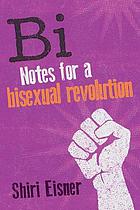
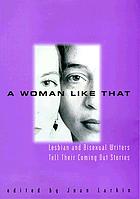
While we were snowbound in Michigan, I had time to do quite a bit of reading. Two of the titles I read were A Woman Like That: Lesbian and Bisexual Women Tell Their Coming Out Stories edited by Joan Larkin (Avon Books, 1999) and Bi: Notes for a Bisexual Revolution by Shiri Eisner (Seal Press, 2013). Separated by nearly fifteen years, and written for very different purposes, yet grappling with similar subject matter, it was interesting to read them back to back.

A Woman Like That is -- at the subtitle implies -- an anthology of personal essays by queer women describing their experiences of coming-to-awareness of their sexual selves. "Coming out" is a term we typically use for the process by which we (non-straight) people make public the shape of our sexual desires. While mainstream narratives generally pin-point a singular event ("When did you come out?") what most of the essays in A Woman Like That make clear -- and what most in the queer community already know -- is that to come out is a verb, a process, and myriad. Reading these pieces challenged me to consider my own narrative of sexual awakening, and asked me to consider how I would organize it biographically. Does one begin with romantic/passionate friendships in childhood? With the acquired vocabulary that allows you to name yourself, or proscribes that ability (more on this below)? With a sexual debut? The first time you employed the word (bisexual lesbian dyke queer) to describe yourself to a (parent friend lover colleague medical professional) or on (on a form the internet) or in (an academic essay a job interview a survey response)?

The women in A Woman Like That, whose essays are arranged roughly chronologically featuring stories from the 1950s to the 1990s, use a variety of these definitions of "coming out," often in combination. They describe childhood passions, first crushes, sexual initiations (good, not-so-good, violently non-consensual). They describe always knowing and coming to their realization later in life. They write a lot about the pain of living queer in an anti-gay world: of "reparative" therapies, of drugs, of physical abuse, of children taken away, of ruptured relationships, of fear and self-loathing. One of the things that startled me, in fact, and bogged me down in the reading, is how grim so many of these women's narratives were. Hanna and I joked, as I kept reading her excerpts, that it should have been titled "The Unhappy Dyke Book."

Still, as I said, the book made me think about the shape of my own story: the intense romantic friendships (same- and other-sexed); the inability to discern erotic from platonic attractions by gender in adolescence (I was told by multiple people "you'll know" ... what it turned out "I knew" was that gender was not a salient factor for me!); the internalized biphobia that caused me to de-legitimize my same-sex longings as invalid data; the sexual debut(s); the transition into a relationship, the describing of that relationship; the (mostly unruffled) reactions of people who found out I was dating a woman; the experience of getting married in a state where same-sex marriage is legally recognized.

Shiri Eisner, author of Bi would probably frown upon my brand of bisexuality. For one thing, I'm an "assimilationist" bisexual, perpetuating my own erasure by playing nice with the mainstream LGBT (or "GGGG") movement, by often using language like "lesbian" to describe myself (even though I am, in fact, bi), and by marrying Hanna ("even if one particular marital arrangement doesn't include any form of direct violence, marriage still constitutes symbolic violence against women in and of itself"). Bi: Notes for a Bisexual Revolution challenges those of us with bisexual desires and identities to push for an end to bisexual invisibility, and to recognize the radical challenge the organization of our sexual desires pose for the sex, gender, and sexual hierarchy of what Eisner refers to as minority-world culture (more commonly known as Western culture).

In eight chapters, Eisner explores what bisexuality is, how monosexism and biphobia work, bisexuality and the concept of "passing" and social privilege, and the intersection of bisexuality and feminism, trans* activism, racialization, and the mainstream gay movement. Overall, despite the fact that I suspect Eisner would take away my bisexuality card if she could, I thoroughly enjoyed this book. It's accessibly written, deeply researched (I'm already mining its bibliography for further reading), and thoughtfully inclusive of many different peoples and communities.

At times I felt like the apparatus of inclusivity was top-heavy and slightly arbitrary. For example, Eisner had a habit of identifying authors' nationalities which didn't always seem any more relevant to the meaning of their work than, say, their marital status, or whether they were parents. Still, I think probably over-articulating subjectivity is probably better than assuming objectivity or universal applicability. The other stylistic challenge of the "big tent" work Eisner is attempting to write is the way the text sometimes got bogged down in enumerations of what could not be discussed, whom the next statements would not be relevant for, and whose voices might be in danger of erasure. As with the identity-markers, these provisos sometimes felt like they were undercutting the relevance of the forthcoming passages and/or assuming a readership that would be unable to discern for itself about whom the text was speaking. While I fully appreciate what Eisner was trying to do, I found myself as a reader getting impatient with too much telling and not enough showing ("I know that already! Get to the damn point!"). This is perhaps a personal limitation rather than an authorial flaw.

At the end of the day, I appreciate Bi as a call to stand up for bisexuality as an actual-factual way of being sexual in the world, and one which is not an attempt to cover one's homosexuality or seek to gain heterosexual privilege. As an adolescent and young twentysomething, I needed someone like Eisner to come along and point out to me that my erotic interest in people with male parts and identities did not trump my erotic interest in people with other parts and identities. For too long, I assumed that as a woman who was capable of sexual attraction to men, my only social recourse was a heterosexual relationship.

(Because statistically speaking, in my hometown, what were the odds of finding a woman interested in me. Because lesbians would all hate and be suspicious of me. Because I was sexually inexperienced and too stupid to tell the difference between platonic and erotic interest; once I had sex with a man I'd suddenly realize what made that different from my same-sex romantic friendships. Because "everyone knows" that bisexuality is just a phase and that bisexual women are flakey, indecisive, and deceptive. Because no one believed me when I said I didn't know what orientation I was. Because the default sexual orientation is always straight and monosexual.)

While A Woman Like That would likely only be of interest to people who like to think about the structure of coming-out narratives and about how the material experience of coming out has (and hasn't) changed since the mid-20th century, I'd argue that Bi is absolutely essential reading for anyone who cares about keeping their fingers on the pulse of queer activism. As we look beyond, around, and through the mainstream gay rights issues that have preoccupied the most visible activists and activist organizations in recent years (i.e. as "gay" people become more accepted to the extent that they look and act like hetero, gender-normative folks), we need to remain committed to gender, sex, and sexual diversity beyond the hetero/mono and male/female binaries that obsess Westerners and others across the globe. Bi offers up a robust toolbox of concepts for doing so.

2013-12-06

big book of orgasms book tour: interview with rachel kramer bussel!


Today the feminist librarian is pleased to be hosting The Big Book of Orgasms (Cleis Press, 2013) book tour, featuring an interview with fabulous erotica anthology editor Rachel Kramer Bussel.

1. The Big Book of Orgasms is an anthology of erotic flash fiction at 1,200 words or fewer. What do you think are some of the biggest challenges and rewards of short-format erotica writing?

For some people, I think trying to tell a fully fleshed out story in 1,200 is difficult, especially if you’re used to having more room to set up the plot and develop your characters, but it’s certainly possible. For others, though, it’s a welcome challenge, and I get many more first-time authors submitting to my 69-story anthologies such as Gotta Have It and The Big Book of Orgasms than I typically do. The rewards are that you learn how to make every single word count; in my own writing, I’ve often had to pare down to get to the heart of what I want to say without giving up the heat and passion of a story. You learn how to write economically and it gives you an opportunity to write about things you may not otherwise devote time to. Flash fiction isn’t every reader’s or writer’s cup of tea, but I think it can be a good way to get yourself writing, especially if you don’t have a lot of time or are stuck agonizing over a given scene. Plus flash fiction can easily be expanded into a longer piece if that’s where the muse takes you; some of my longer stories started out with me trying to write to a shorter word count and getting sucked into the story, which is never a bad thing. As an editor, I appreciate the opportunity to publish three times as many authors’ work as I usually get, and I think it gives readers a wider range of choices.

2. I was impressed with the relative diversity of characters and story types in The Big Book. You have same-sex and different-sex couples, lesbian, gay, bisexual, and trans individuals, partnered and solitary sex scenes, and many flavors of sexual encounters. I often find erotic short-story anthologies to be fairly one-note, or featuring couples of mostly or entirely one variety (lesbian, gay male, straight, etc.), so this was a pleasant surprise. Did you make your selections with diversity in mind? Is the erotica market resistant to such “cross-genre” collections?

I definitely strive for as much diversity as I can get with each book, especially in The Big Book of Orgasms. I didn’t want readers to get bored, and I wanted to represent as broad a cross-section of what orgasms can look like and what they mean to various characters as possible. As an anthology editor I’m at the mercy of what’s in my inbox, so part of my job is making sure my public calls for submissions get spread as widely as possible and encouraging new writers to submit. In this case, there were a few elements I didn’t see as the manuscript neared completion, such a Tantric sex, that I felt were important, so I specifically asked a writer who I knew could write competently about that topic to write a story about it. In general, though, I try to create a whole that’s greater than the sum of its parts, with what I’m given. I wanted this book in particular to appeal to as many potential readers as possible, to be the one book I would recommend to new erotica readers and be the book of mine that is the most accessible, due to both the ultra short format and the breadth of it.

3. In an era when erotica is increasingly available in free or low-cost formats, what do you think readers of a print/ebook edited anthology like The Big Book of Orgasms get that they would be unable to find elsewhere?

From my job as anthology editor to Cleis Press’s ongoing commitment to publishing both highly edited and beautiful books, I think the final product is something that’s clearly been worked on with a lot of care. I love the print edition’s size for its compactness. It feels different than my books with 20 or 25 stories, and I like that it fits easily in purses and some pockets. In terms of quality, I think everyone has different tastes so I don’t necessarily think it’s a matter or choosing between cheaper books and this one, but with The Big Book of Orgasms every single story has been selected and placed with care. What readers will get out of this book is a range of voices, from vanilla to kinky, male to female, solo masturbation stories, which I don’t often get to publish, and very creative ways of looking at the topic of orgasm within an erotic framework. This is the book I’d recommend to new readers of the erotica, and to people looking for erotica to read to or with their partners, because there’s so much to choose from.

There’s room for self-published work about niche topics, as well as flash fiction and full-length works. One thing I personally love about the erotica genre, as a reader, writer and editor, is the abundance of short stories. That’s what I started out reading, in the Herotica and Best American Erotica series, and I always marveled at the authors’ ability to tell such riveting, memorable tales in a short space. The rise of e-publishing means authors can publish at varying lengths and aren’t as tied to the demands of print publishing, but because there is so much erotica out there, readers can be more discerning and demanding in terms of what they are looking for, both content-wise and style-wise. No fetish needs to go untouched or ignored.

4. Recognizing that what’s hot and sexy will always be subjective (and vary wildly among humans!), what is one theme or trope of erotica that you would be happy never to read again?

It’s hard to say because what may appeal to one person may not be my thing. I’m as fascinated as anyone else by the phenomenon of dinosaur erotica, which, if the media interviews this year are to be believed, is more popular than my books. It’s not my thing per se because I’m not usually into science fiction but I think it’s great that so many people are both writing and reading in that genre, and that the marketplace for ebooks exists to support it. I personally find the fetishization of extreme wealth of the billionaire hero, a la Fifty Shades of Grey, a bit overdone. I’m sure there are indeed billionaires out there, but it seems so over-the-top.

5. What is a theme or dynamic you would like to see writers explore more often in erotic writing?

I’d like to see more stories about couples, especially long-term couples, both having adventures and grappling with real-life sexual issues and situations. I see some of this, but I like the idea of couples exploring new things several (or many) years into their relationships. It’s hard to say what I’m looking for—part of what I love about editing anthologies is that every single time, authors manage to surprise and awe me with their creativity. I don’t like to say “I want more of X or Y” and then only get X or Y in my inbox. If I ever dare to think I’ve seen or read it all, putting out a call for writing lets me know I certainly haven’t!

6. What upcoming project(s) are you working on that you’re excited to share with your readers?

I’m teaching my first Portland, Maine erotic writing workshop at sex toy store Nomia, on December 3rd, which I’m looking forward to, then one January 17th at the New York Academy of Sex Education. Then I’m doing something I’ve never done: two three-hour workshops pre-CatalystCon on March 14th, on erotica writing and nonfiction sex writing, respectively (details are on my website). Those are more intensive courses and include individualized feedback. I’m hoping to teach more workshops as well and my upcoming erotica releases are Lust in Latex, about rubber and latex clothing, and Best Bondage Erotica 2014, both out in January from Cleis Press. I’m taking submissions through March 1st for Best Bondage Erotica 2015 and will be announcing a few more calls for submissions soon as well.

Thanks to Rachel for stopping by and taking the time to answer my questions. You can check out The Big Book of Orgasms at Amazon.com, Cleis Press, your local independent bookstore or library (if you're lucky!), or Powell's online.

2013-10-28

comment post: erotic expression and vulnerability

You may have heard about the teaching assistant who recently accidentally sent a nude photograph of herself to her students in lieu of the attachment she meant to send.

I'll let you all cringe in sympathy for a minute, because let's admit we've all been there -- maybe not in the nude photo sense, but in the "impolitic electronic communication" sense.

Done? Okay, good. Now the larger conversation in this instance is what lesson we might take away from these types of mistakes. That's what Claire Potter of the Tenured Radical and I have been discussing in comments over the past few days. My original comment was prompted by this passage in Claire's piece:
Herein lies a lesson for all of us: accidents happen to the best of people, so caution in the matter of nude selfies is advised. Things like this, and revenge porn, wouldn’t happen if people didn’t take nude pictures of themselves, and either give them away to boyfriends who they think are going to love them forever, or keep them on their computers. 
In response, I wrote:
I get where you're coming from on the "don't take nude pictures" line. However, I think a better approach would be to recommend more exacting privacy practices when it comes to erotic images and text you wish to keep between yourself and your intimate partners. Good practice: Not keeping nude photographs of yourself on your workplace computer. (Unless your work involves creating/disseminating nude photographs of yourself, obviously.) Bad practice: Keeping your naked photos in the same "Downloads" folder as the cat pictures you want to send to mom (and not labeling each set clearly, and double-checking all attachments before hitting "send").

Sure, the accidental sending off of the wrong photograph was inappropriate. Probably the TA's supervisor needs to have a conversation with her about working in less haste and keeping her private images private. But the real problems here in my opinion are a) a culture that shames women who leave evidence of their erotic lives that others accidentally or purposefully discover, and b) the students and administrators who see the sexual content of the accidental file transfer as grounds to blow this incident out of proportion.
Claire pushed back, writing in part:
But like the rule on secrets (information is no longer secret when two people know it), it is really unwise to give a photograph of yourself to *any*one that will shame you if it exceeds its intended audience. One person's erotic gift is another person's har-de-har-har or porn/revenge fantasy.
 To which I responded:
Thanks for the response. Again, I take your point in that caution is generally good advice.

I think where we (might?) differ in weighing the tricky balance is that I believe it is misplaced to offer advice like " it is really unwise to give a photograph of yourself to *any*one that will shame you if it exceeds its intended audience." We aren't prescient beings. We can't read the future. Sometimes we date asses who don't overtly advertise themselves as such. Sometimes a breakup is unintentionally messy and in a moment of pique the angry ex posts something they shouldn't.

I would argue that, as a society, we should not then turn around and blame the person who shared the image in a moment of private pleasure in the first place. We should blame the individual who shared that image of their ex without that person's consent.

In the balance, I think pushing individuals to err on the side of super-uber-never-share caution when it comes to erotic expression ends up reinforcing a culture of silence around pleasure. I can see it reinforcing women's sense that their sexual expressions and pleasures are invalid, shameful, and something not to share -- even with those whom they are sexually intimate with! That seems like a recipe for sexual mis-communication, as it fosters a climate of self-censorship rather than self-expression of desire.

Again, I realize you are NOT advocating for women (particularly) to stop speaking, writing, or enacting sex across the board. I think what I am observing is that such advice as you give above might unintentionally contribute to a culture-wide, persistent shaming of individual people daring to claim a sexuality that is personal and authentic to themselves through creating (among other things) images that speak of that desire, and sharing them with the people they wish to communicate that desire to.
Claire was gracious enough to continue the conversation, writing among other points:
I honestly don't think we are helping women by either saying they don't have to think about this, or that they should not distrust the capacity of other people to do them harm. It's not a moral issue from my perspective: it's a question of maintaining control if and when that is important to a person. I'm also a little curious about how it is that sharing a nude selfie is authentic and desiring in a different way than showing up in person and removing one's clothes, but that's another conversation, and this may be a generational distinction more than anything else.
To which I responded:
Thanks again for your thoughts.

I think to the extent we disagree it's a matter of emphasis rather than a more substantial philosophical divide. Like you, I would certainly counsel mindfulness about how, where, when, and with whom we share our most intimate selves. At the same time, none of us are omniscient and none of us are responsible (or can control) the actions of people who mishandle those parts of ourselves. If we withhold those parts of ourselves out of fear that we will get hurt ... chances are we won't get hurt, but we also won't have had that chance to share either.

Re: "I'm also a little curious about how it is that sharing a nude selfie is authentic and desiring in a different way than showing up in person and removing one's clothes, but that's another conversation, and this may be a generational distinction more than anything else."

I hesitate to attribute things too reflexively to a generational divide. There are likely people in your age cohort who have (or will) share erotic images of themselves; there are likely many my age (mid-30s) and younger who would recoil from that impulse.

I didn't mean to make it sound like the "nude selfie" is somehow a sacrosanct category of erotic expression -- but I think historically speaking we could probably find the rough equivalent of "the nude selfie" in virtually any generation. In the 1920s perhaps you and I would have been discussing the advisability of college girls going to dance halls, in the 1890s perhaps the advisability of girls sending erotically-charged letters to their beaus for fear they would fall into the wrong hands. I think that erotic self-expression is often a razor-thin balancing act of (on the one hand) sharing one's self with enough vulnerability with one's lovers for a successful, mutual relationship and (on the other hand) policing the boundaries of that intimacy against unwanted intrusion.

So yeah, I think we could haggle endlessly in this situation (or any other situation X) whether in the balance responsibility for breaching those boundaries falls more heavily with the individual or society (and what the consequences of that breach should be). But I don't think our readings are wholly incommensurate.
Any thoughts, readers?

2013-10-13

on being out day [a belated post]

This Friday, October 11th, was International Coming Out Day.

I thought, in passing, about writing something but I was distracted by trying to get things done at work and by the fact my wife was getting a chest x-ray for pneumonia. And then picking up antibiotics (thank goddess for antibiotics) for her. And remembering to feed the cats. And pick up something for dinner.

Hanna in the redwoods (Sept. 2013)
So this is a belated post on the theme of coming/being out. I don't have anything particularly original to say, except that I am grateful to all of the people throughout history, past and present, who have conspired to make International Coming Out Day an unremarkable occasion in our day lives. Hanna and I live in a time and place where our bisexual inclinations and same-sex relationship are known and largely honored structurally in our workplaces, with our landlord, at our health center, in our city, state (and now, finally, the federal government), by our friends and relations. We hold hands and kiss in public, speak of things sexual while dining out, review queer porn, blog about being dykes.

We don't fear being evicted, fired, blacklisted, jailed, physically attacked, disowned or disinherited, treated as sick because of our sexual selves, or otherwise grossly discriminated against. And if any of these things were top happen to us, we would have advocacy organizations and a network of supporters to turn to for aid.

In many ways, our security is exceptional: many queer folks still live in the toxic closet, or cover aspects of their identities, for fear of social and material marginalization. The young and the old, the gender non-confirming, trans folks, queer people in nations that still actively persecute sexual minorities.

There is obviously still work to be done.

But this week, I'm grateful in my own small domestic way for the work of activists and the kindness of those people in our lives who together made it possible for my Friday to be, in part, a story about leaving work half an hour early so I could get to the pharmacy and pick up Hanna's antibiotics. A story about a boss and colleagues who sent well-wishes for Hanna's quick recovery. A story about a health clinic that knows were a couple and has no problem letting me pick up her medications.

A story about going home to my wife.

2013-06-16

yep, I'm pro-porn. like I'm pro-fiction and pro-food.

Having just submitted my first work of original erotica for consideration for a Cleis Press anthology, I decided it was apropos to work out the writerly shakes by posting a bit of a rant about the recurring moral panic around pornography.

This is what a pornographer looks like.
Last night as I was going through my RSS feeds, I noticed that The Guardian has discovered that some scholars study porn and that others object to the idea that porn can be studied as one studies, say, English poetry, American history, or cellular biology.

That is, the idea that a body of work (sexually-explicit material created with at least a partial intention to arouse the consumer) might be studied using diverse methods of data collection and analysis, a wide range of primary source material within the genre, and theoretical lenses, adding to our body of knowledge about the human condition or the world we inhabit.

And they've discovered that some of those scholars who study porn have decided to start a journal dedicated to the subject (PDF), to be published by Routledge starting in 2014, and that anti-porn activists have accused these journal editors of being "biased" and "pro-porn":
The journal, which announced its call for papers a month ago, and will be published by Routledge next year, marks a turning point in the academic study and treatment of pornography. It is the first peer-reviewed journal dedicated to the subject and its editors – Feona Attwood, professor of cultural studies at Middlesex University, and Clarissa Smith, a reader in sexual cultures at Sunderland University – say it will offer a fresh cross-disciplinary approach and provide a focus for researchers working on porn.

However, a petition accusing journal of bias, and demanding that Routledge either change its editorial board or rename it "Pro-Porn Studies" has attracted 888 signatures, including from senior academics in North America and Europe, people working with the victims of sexual and domestic violence and health professionals.

Gail Dines, a British professor of sociology at Wheelock College, Boston, and the author of Pornland, said that, while it was vital that pornography was studied and research published, she had grave concerns about the editorial direction of the journal.
Some of you may remember Gail Dines from my 2012 series on her Boston University appearance along with Carol Queen at a screening of The Price of Pleasure. It's my personal opinion that she does nothing to enhance the discussion around the ethics of sexually explicit material because her own position has become so dogmatic that she is uninterested in genuine conversation with those who think about pornography in more nuanced ways.

I'm honestly kind of creeped out that she teaches and lives here in the same city I do. But that's life.

I want to offer two inter-related thoughts about the anti-porn faction's framing of Porn Studies as biased because it's "pro porn."

1) Pornography is a genre, nothing more. "Pornography" is the word we use to describe sexually-explicit materials, most often visual materials, created or used at least partially for the purpose of arousal. Pornography is a genre, just like fiction or poetry is a genre. We can talk about porn being unethically or shoddily made, or we can talk about porn that didn't do it for us -- I'm honestly not that into Longfellow's epic poems or anything by Ian McEwan. I think Phillip Pullman let his atheist agenda impede good storytelling toward the end of His Dark Materials and after reading a couple of reviews of Lionel Shriver's latest it sounds to me like she's given in to unacceptable fat hatred.

But that doesn't mean I'm "anti-poetry" or "anti-fiction," and I certainly wouldn't accuse my father-in-law who loves Ian McEwan of "pro-fiction" bias because he loves an author whose characters give me hives.

This is the sort of nuance that Feona Attwood, Clarissa Smith, Tristan Taormino, Violet Blue, and the others involved in Porn Studies, scholarship on pornography, and creating porn are advocating. There's crap porn out there, I don't think anyone is denying that -- though like with fiction we're all going to disagree on what constitutes "crap." (As librarian Nancy Pearl once reminded her readers, one reader's bad sex award-worthy scene is another person's hottest fantasy.) There is also unethical porn, which "pro-porn" feminists have been vigorously discussing and working to advocate for decades -- for the most recent discussions, check out The Feminist Porn Book and associated website.

If I had to sum up what I see as the "pro-porn" feminist stance on bad and exploitative porn, it would be the following: make better porn, and empower workers in the porn industry (including your own, if you're a porn creator) to demand (and achieve) non-exploitative working conditions.

Dines and company, on the other hand -- apparently over eight hundred people! -- don't see porn as a genre. They see porn as a single, monochromatic thing which in its entirety is harmful. They see pornography as a public health harm much like smoking while the Porn Studies folks see it more like pastry or even alcohol. Inhalation of smoke increases your risk of cancer; there's nothing you can really do to make smoking healthy. Eating a brioche, on the other hand, or enjoying a glass of wine at dinner or a cocktail at a party is not per se a self-destructive activity. It's all about how individuals relate to the food or drink. Do you eat compulsively? Do you shop at a bakery that sells stale rolls? Pays its employees under the counter with no benefits? Are you using whiskey to mask your depression? Has the chardonnay you opened last week gone off in the interim? Wine tastings and French pastry-making classes abound in our neighborhood, testament to the fact that people see alcohol and baked goods as two classes of foodstuffs that can be made well or poorly on a number of levels.

Which brings me to point number two...

2) Scholars are nerds, and we're generally passionate about our subjects of study. You say "pro-porn" like it's a bad thing. If pornography is a genre, like poetry or fiction, then it stands to reason that the people who  choose to study it -- to build a scholarly career out of studying it -- and/or are creating it are "pro" the genre. Don't we want them to be? Accusing a pornographer or porn scholar of being "pro-porn" is like complaining Seanan McGuire is "pro-fantasy fiction" or the people on "America's Test Kitchen" are "pro-food."

Uh ... yes? You're point being...?

Back in the 18th century, there was, in fact, a moral panic about the effects of reading fiction -- particularly its effects on girls and women (we're flightly like that). Fiction, of any sort, inflamed the imagination and the imagination turned to sex. Reading fiction, in other words, led straight to masturbation and other lewd behaviors.

When I listen very long to those who protest against the production of porn, any porn, regardless of the context of creation, quality of production, or content, I admit that they sound about as shrill as the eighteenth-century moralizers with their warnings about how reading fiction leads to depravity.

It's disappointing to me that so many people continue to take them seriously, instead of re-framing pornography as a genre like any other ... one which we can choose to shape and reshape as we please. And study endlessly, like we study Shakespeare's corpus or Buffy or the human genome.

2013-04-30

booknotes: hard to get

note: this post was originally written to be cross-posted at the family scholars blog. since I drafted it, the family scholars blog has gone abruptly on hiatus, so this review will only appear here at the feminist librarian.

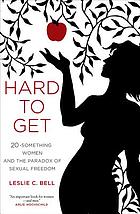
Several weeks ago, when I reviewed Donna Freitas' book, The End of Sex, I linked out to an interview with Leslie C. Bell, author of the newly-released study Hard to Get: Twenty-Something Women and the Paradox of Sexual Freedom (University of California Press, 2013). Like Freitas, Bell studies the sexual habits of humans. A sociologist and psychoanalyst,  Bell became interested in modern relationship dynamics while working with clients in private practice in the Bay Area. Driven by a desire to better serve the women she counseled, Bell set out to explore how today's twenty-something women navigate sexual relationships -- from casual sexual encounters to long-term partnerships. Through extensive and multiple qualitative interviews with a diverse group of women*, Bell sought to understand how and why women made the choices they did about forming, maintaining, and ending sexual relationships.

Hard to Get is, overall, diagnostic rather than prescriptive. It seeks to identify the interviewees common struggles and strategies for addressing those struggles -- both strategies that increase her subjects' well-being and strategies that seem ultimately counterproductive. She sorts her interviewees by three relationship strategy types: the "sexual woman," who has prioritized sexual self-knowledge and pleasure, but resisted forming interpersonal attachments; the "relational woman," who seeks to maintain her intimate relationships, at times even at the expense of her sexual satisfaction; and finally "the desiring woman," who has (sometimes after one of the first two strategies failed) arrived in a place where she feels able to be an independent, sexually-assertive being and capable of intimate relationships without loss of individual identity or desires. 
One of the most interesting aspects of Hard to Get is that Bell's "desiring women" are, for the most part, women with queer sexual histories or identities.  She suggests, in her concluding chapter, that part of the reason queer women in her sample expressed a greater sense of well-being and relationship satisfaction was that their intimate relationships were less freighted with gender-based assumptions about what each partner wanted or needed. She makes a passionate plea for straight couples, as well, to pull away from gender-based assumptions about what "women" and "men" want in a partner, and instead approach one another as individual humans.
I actually noticed another commonality among the "desiring women" that had little to do with their adult sexual identities: many of them came from homes in which parents and/or step-parents modeled a great deal of gender independence -- that is, the ability to draw on human capacities, whether "feminine" or "masculine," which best served them in the situation to hand. Single fathers, for example, who knew their way around the kitchen and nurtured their daughters, and mothers who worked in gender-atypical employment. I suspect that this modeling, perhaps even more than the individuals sexual flexibility, might account for the "desiring" women's resilience and adaptability -- their willingness to meet a relationship partner on individual, rather than rigidly gendered, terms. 
One of my fears about this book was (and remains) that it perpetuates the pervasive and sexist assumption that relationship creation and maintenance is "women's work," that women suffer disproportionately in the absence of relationships, and that we should focus on women when asking questions about relationship success and failure. 
On the one hand, I can't fault Bell for choosing to focus her energies on women; we all have to create boundaries around our research topics in order to say anything meaningful about the data we collect. I think she does an excellent job of centering women without blaming or victimizing them. Bell's subjects actively create and narrate their own lives, even maintaining agency in situations where their choices are severely constrained (such as when they experience sexual assault). This saves the volume from being yet another hand-wringing polemic about "girls these days." Indeed, I really appreciated Hard to Get's feminist sensibility. Bell identifies as a feminist in her introduction, and refuses -- unlike many others who have explores this subject -- to play the "let's blame feminism!" game even when she is looking at the ways changing gender role expectations and sexual opportunities create new challenges. 
On the other hand, time and time again these women seem very much alone in their quest for mutuality. The men (in the lives of those who make connections with men) don't appear to be aware of their partner's struggles, engaged in finding solutions, or even. At the end of Hard to Get we aren't left a whole lot wiser about where these women, at least the hetero-minded among them, might find men with whom they could successfully connect. I find myself wondering, once again, about the emotional and relational lives of men -- and how their experiences fit within this puzzle. As long as straight men remain (by their own volition and/or by neglect) outside of the relationship discussions, it seems doubtful that much progress will be made resolving hetero relationship struggles.
In my last book review, folks at FSB appreciated my question, "Who would I recommend this book to?" So here is my response for Hard to Get: Bell's study should be required reading for anyone who has a scholarly or personal interest in how modern Americans are forming sexually-intimate relationships (and how we might do so more successfully). Bell's urge for us to move forward instead of backward in search of solutions to our relationship struggles is an important counterpoint to more conservative voices. Even if you end up disagreeing with her conclusions, her participants offer us valuable insights into how adult (not college-age) women think and feel about, and how they do, sexual relational intimacy.


*While all from roughly the same age cohort, and largely professional-class women in the Bay Area when they are interviewed by Bell, the participants are about half white and half non-white, half straight and half non-straight, and grew up in a range of different geographical and socioeconomic circumstances. This mix was a deliberate decision on Bell's part and, I think, strengthens her study immeasurably.

2013-04-23

booknotes: does jesus really love me?


cross-posted from the family scholars blog.

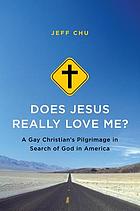
On Friday, while stuck at home due to the "shelter in place" orders here in Boston, I read Jeff Chu's recent book Does Jesus Really Love Me?: A Gay Christian's Pilgrimage in Search of God in America (Harper, 2013).

Part memoir, part ethnography, part journalistic endeavor, Does Jesus...? is more impressionistic than it is polemical or scholarly. Chu offers a series of portraits, featuring both people (pastors, congregants, ex-Christians, agnostics) and institutions (from the Metropolitan Community Church, overwhelmingly queer in membership, to the Westboro Baptist Church). Across sections titled "Doubting," "Struggling," "Reconciling," and "Hoping," Chu offers us a tour around America and the religious and sexual-identity spectrum  as well, introducing us to individuals and congregations wrestling with the relationship between faith and queer sexuality. Chu himself has settled into a life of being gay and Christian, he nevertheless draws empathic (if at times slightly baffled) portraits of LGBT individuals who have forged other paths: queer folks who have been driven from the church or simply drifted away, a gay man who has chosen to remain celibate, a straight woman and gay man in a "mixed orientation" marriage. While he features a few high-profile individuals (Ted Haggard, Fred Phelps, Mary Glasspool), more of the voices in Does Jesus...? are unknowns: the Bible teacher fired from his job for a same-sex affair, the closeted young adult wrestling with if, when, and how to come out to his parents and community, the Christian musician who describes with charming self-deprecation her first gig at a lesbian bar.

I found myself thinking, as I read, a very librarian question: to whom might I recommend this book? One of the pastors Chu interviews offers the following observation: she sees anti-gay Christians and affirming/welcoming Christians trying to have two very different conversations in their discussions around homosexuality. The anti-gay contingent, she maintains, is focused on scriptural authority. The affirming group is focused on stories -- on personal testimony. If this is true (though I'm not ready to buy the theory wholesale), then Chu's book will not have much success in convincing those who believe Christianity demands abstaining from same-sex sexual activity. It is not a work of exegesis, of Biblical interpretation. It is not making a theological argument. Rather, Does Jesus...? is offering us a chance to reconsider our simplistic notions of what "Christian" and "gay," and the assumption that there is but one type of relationship between the two: a repressive or alienated one.

This is an approach that I think might resonate more strongly with the "personal testimony" contingent. With LGBT folks who are, themselves, wondering, "Does Jesus really love me?" Or with queer activists asking how to engage American believers in the LGBT push for equality and acceptance. Or with unchurched/secular-identified queer folks and allies who see the church as bolstering anti-gay sentiment and are baffled why queer Christians seek to remain in the fold.

For example, as a queer woman who grew up in a conservative Christian community (in a region settled by the Reformed Church in America, Chu's present denomination!) and attended a college with deep RCA roots, one of the chapters which spoke most directly to my own experience was the chapter about Harding University.  Or, more specifically, Harding University's student-published Queer Press zine, created and distributed by queer students and alumni primarily to reach out to other (largely closeted) students on the conservative Christian campus. Not only did the creators face a backlash from the administration, they also discovered that their sectarian struggle didn't always translate very well before a secular audience:
[Secular] bloggers would praise the zine but add, "Why would you go to a school that doesn't accept you for who you are?" or "Why not just leave?" These questions reflect a different type of thoughtlessness. For one thing, Harding students are just like millions of others who depend financially on Mom and Dad [to attend college]. Then there's the fact that, again like millions of others everywhere, these students are in a season of fragility and flux. They're still wrestling with their identities, their faith, and their homosexuality, which may not even be acknowledge before college. As one puts it to me, "It's not like someone woke up one morning and said, I'm gay but I'm to go there and make my life suck."
When queer students and allies at my alma mater were making a concerted effort to get the Board of Trustees to revisit their official anti-gay stance, some high-profile queer-friendly blogs got wind of the struggle and there was a lot of puzzlement over why these students had enrolled in, or remained at, such a hostile institution. Setting aside the reality that secular institutions are not always bastions of acceptance themselves, it seems important for non-Christian LGBT activists and allies to remember that "Christian" is often as deeply-held an identity as "lesbian," "bi," or "gay." To ask a queer person raised Christian why they don't just quit their faith is profoundly lacking in compassion or understanding for the complexity of the human soul.*

Overall, I highly recommend Does Jesus..? to anyone interested in reflecting on the human face of the culture war (for lack of a better term) over sexual diversity in American Christianity. It might also, given its episodic nature, make for really good Sunday School or Church reading group material.

Related: For those unable to put their hands on a copy of the book, Chu was a guest on the Diane Rehm Show back in March, and it was an excellent conversation. You can listen to the audio or read a full transcript of the interview (your support for NPR at work!) courtesy of WAMU.


*On a side note, I know many feminists who've encountered similar disbelief that they choose to reconcile their religiosity and their feminism -- often, in fact, grounding their feminist values in their faith. It's fascinating to me that so many people on both sides (the religious side or the queer/feminist side) view these aspects of self as oil-and-water opposites.

2013-04-16

movienotes: footloose and flashdance

This weekend, Hanna and I had a 1980s dance (movie) party with friends A'Llyn, Nathan, and their 1-year-old sprog who -- if his living room moves were any indication -- is going to grow up to be the next generation's Ren McCormack. We watched Footloose (1984), which has stood up surprisingly well, and Flashdance (1983), which has very much not -- although maybe I shouldn't talk since I never saw it in the actual 1980s and this was my first viewing. But those in the audience who had seen it as children confirmed that from an adult perspective it was even creepier than they remembered!

A few observations about first Footloose and then Flashdance. Spoilers below, fairly obviously, if you care.

Footloose I first saw at some point in my pre-adolescent period. The two things I remembered most vividly were John Lithgow's performance as the small-town pastor (whom child-me loved to hate) and the scene where Lori Singer, playing the preacher's daughter, climbs between her friend's car and her boyfriend's truck while they're driving down a two-lane highway. It's a scene meant to impress upon us that Ariel (Singer) is a thrill-seeking teenager, but mostly just terrifies me every time I have to watch it! Still, as I said above Footloose still has charm and, think time around, I was struck by a few things I hadn't noticed, or experienced differently, as a child.

  • John Lithgow's pastor, Rev. Moore is less fire-and-brimstone than he is sad as a character. In fact, we took to referring to him as "sad John Lithgow" every time he showed up in a scene. The film-makers couldn't seem to decide whether they wanted to make him a petty tyrant or a fearful father ... and ended up trying to go for both with only middling success.
  • Kevin Bacon's Ren is, like, the most polite Big City Rebel ever. Seriously. He wears a suit and tie to school on his first day, and when he decides to enlist the high school seniors to defy the town prohibition against dancing he ... wears the suit and tie to a town council meeting and reads a speech in defense of their case. He refuses to smoke pot, even when a local bad boy foists a joint on him, and chills with his little cousins. 
  • Domestic and intimate partner violence get a look-in, although not much of a mention. On the one hand, we have John Lithgow's character smacking his daughter across the cheek for talking back to him (probably part of what cemented him in my childhood head as an Evil Character). On the other, we have Ariel's truck-driving boyfriend who beats her up when she breaks up with him. She takes a pipe out of the back of his truck and smashes his windshield and headlights. He gives her a bloody nose and a black eye. The situation is clearly being set up as the negative contrast to Ariel's eventual relationship with Ren, but it's also treated like a weird side-point that's never substantively addressed.
  • The teenagers get a surprising amount of support from the surrounding adults -- for a town where supposedly dancing is Of The Evil. Ren's mother is fired from her job at one point because her son is causing trouble, and the relatives they're staying with get momentarily judgy. But, like, the mill owner Ren works for after school offers his building for the dance, and Mrs. Moore sticks up for her daughter and the other students at a couple of key points. 
  • Reverand Moore draws the line a burning books from the library, which is sweet but also makes his prohibition against dancing as a sin nonsensical. He's set up at the beginning of the film as the Big Baddie, only to emerge toward the end as one of the primary advocates for the teens. It's disconcerting.
  • And Ren McCormack has more chemistry with his new BFF, Willard, than he ever has with Ariel. The scenes where Ren is teaching Willard to dance have more spark in them than any other scene in the film, frankly, and I'm started to find that there is no fan fiction fleshing this romance out on AO3. Fan writers, you've let me down!

So overall, Footloose is dated and cheesy -- but aged surprisingly well.

The same can most decidedly not be said for Flashdance, which sadly starts out with the promising fact that its female lead, Jennifer Beals plays a welder named Alex Owens who -- in addition to holding down a solid, skilled (and I'd bet unionized) working-class job -- dreams of successfully applying to the Pittsburgh Conservatory of Dance. Even the fact that Alex moonlights as an "exotic dancer" (but OMG not a stripper!!) wouldn't on the face of it be enough to kill the film -- this could have been one of your predictable "triumph over obstacles"-cum-marriage-plot movies, wherein the girl wins the guy and the chance to study ballet at the school of her dreams.

But.

BUT.

  • There's this small problem with the love interest being her boss at the building site where she's working. And, like, a major stalker with the world's creepiest vibe ever. Starting with the fact that he approaches her at work the day after having seen her dance at the dive bar where she works. So, you know, his interest in her as a person has this double creeptastic factor of "I've seen you dance practically naked and I thought that was hot, wanna date?" blended with, "I'm your boss and I've just disclosed to you, on the job where I'm supervising you, that I showed up to watch you dance practically naked and I thought that was hot and want to date you."
  • Ms. Owens (yay feminism!) tells him quite firmly no, she doesn't date the boss. So he follows her home from the site at night in his car, while she's riding her bike, and propositions her again. When she insists she doesn't date the boss he fires her so they can do on a date together the following night.
  • Although she blows him off, she apparently thinks better of it 'cause the following night they're on a date!
  • And on that "first date" there's this truly excitingly horrible you-can't-look-away-from-it scene wherein Alex takes Mr. Manager back to her (loft porn!) apartment for pizza and walks back into the living area in a black negligee and grey warm-up sweater (see DVD cover photo) and proceeds to take her bra off from under her sweatshirt. Our entire audience sort of couldn't believe it was happening. Not that slutting it up for your partner isn't fun sometimes, but this was a first date with a stalker boss and the whole thing felt way too close to a professional strip tease. (Needless to say, they proceed to have sex.)
  • Long story short, she continues to perform sexually for him (and I'm framing it like this deliberately -- all of their private interludes are echoes of her on-stage performances) and lo and behold he has connections at the Conservatory. So he makes a few calls and she gets an audition!
  • Although Alex protests, nominally, over the wheeling and dealing, in the end she goes to the audition anyway and presumably wins a spot in the Conservatory. We never actually get to find out, since the closing shots are of her making out with her sugar daddy.
I think what was so frustratingly, jaw-droppingly bad about Flashdance was that with a few tweaks it could have been a charming, though obviously cliched, romantic comedy. Make the love interest someone other than her boss. Make him someone who didn't proposition her after seeing her perform. Make it clearer what dancing means to her, and dis-entangle the patronage from the romantic relationship. Could her boss at the construction site see her perform and, oh, incidentally, know someone who knows someone ... without sex being used as such overt currency? So it was like two degrees away from being a movie that was meh but not actually cringe-inducing, and ended up just being bad. No cookies, people. No cookies.

Next time around, I think we're gonna go with Alien and Terminator.

2013-03-28

politics, pornography, and combating queer isolation

cross-posted from the family scholars blog.

Conner Habib, an actor who performs in gay male pornographic films, was recently invited by a student group at Corning Community College (Corning, NY) to speak on sex and culture. When the college president found out that Habib, in addition to being a thoughtful and articulate human being, had appeared in erotic film, she took steps to cancel Habib's talk and has apparently moved to further obstruct attempts to host the talk in a non-college-sponsored locale.

Habib has written an excellent piece about his own perspective on these events which can be read in full over at BuzzFeed. In the essay he reflects on the place pornographic materials have in mitigating the isolation sexual minorities can experience, particularly in rural areas. He writes:
Where I grew up, just outside of Allentown, PA, I watched, right through my adolescence into adulthood and early college years, while straight people paired off and experienced sex. They were able to engage with a basic aspect of human life that seemed unavailable and distant to me. Unlike today, there was no discussion about gay marriage, nor were there many gay characters on TV. But even if there had been, neither would have rounded out my experience as a man with homosexual feelings because so many of those feelings were — unsurprisingly for a young man — sexual. Gay sex was a lonely venture. It wasn't easy to find, and was only mentioned in slurs and the butt of jokes. ... Whether I bought it from the adult video store or, later, downloaded it, gay porn helped me encounter positive images of gay men enjoying the act of sex. Gay porn was a window into gay sexuality that was free of shame and guilt, and revealed a different world where sex wasn't a lonely prospect, confined to the shadows or just my imagination.
Habib describes how, being a man of Arab descent, he receives fan mail from gay men in Middle Eastern countries who "[express] gratitude and relief for my having portrayed gay sex in a positive light on camera."

Perhaps most relevant to readers of Family Scholars, Habib articulates the importance of discussion, rather than silence or evasion, in the face of conflicting interests or concerns:
When [Corning Community College Vice President] Don Heins called me and stated that [college President] Katherine Douglass canceled the talk because she had concerns about the controversial subject on campus, I told him that I understood those concerns. They are serious and real concerns - if they weren't, I'd have no need to give talks, after all. I have similar and additional concerns in my own life: How will having done porn intersect with my other interests? How can I pursue porn and speak openly about sex without making other people feel alienated? What have I noticed about the porn industry that I find supportive of or a hindrance to freedom — particularly for LGBT communities? ... the question here isn't whether or not we have concerns, but whether or not we have the courage to address them.
(Emphasis mine. Read the whole piece here.)

As someone who believes in the power of articulate and thoughtful speaking and writing, I believe that the Corning Community College administration has erred in canceling Habib's talk. Particularly without even approaching him first with their concerns (presumably about his acting career) and attempting to find a workable solution short of banning him from campus.

As an undergraduate student, I experienced a similar situation in which a controversial speaker was brought to campus -- in this case, a leader from an ex-gay ministry, Mario Bergner, who was invited by the chapel staff to speak as part of a series on Christian sexual ethics. The group of faculty, staff, and students who objected to the invitation put together a coalition and sponsored, during the same week, the evangelical gay rights activist Mel White.  The power dynamics were different in our case: the administration supported Bergner and the chaplain's office, while White was brought in through grassroots action. At Corning, a student group invited Habib and the administration used institutional authority to veto that action. I also don't claim my college community found a wholly successful method for conflict resolution: participants in the Bergner-White event(s) will likely remember how incredibly difficult it was to navigate the divisions within the community which these dual invitations exposed, divisions which fifteen years later still remain unresolved. 

However, I -- like Habib -- would contended that it is far better to have difficult, even painful, conversations than no conversation at all. Because Habib and the students who wanted to hear him speak have gone public with this story, a conversation is happening anyway: the conversation that the school administration sought to stifle, as well as a conversation about how and why they sought to stifle it.

I hope members of the Corning Community College administration are listening closely, and perhaps learning a thing or two in the aftermath which they might have learned more productively learned by attending Habib's talk as originally scheduled.