~oOo~
Showing posts with label fanfic. Show all posts

2014-07-14

booknotes: jenkins, hellekson and busse on fandom

I've been on a kick lately reading about fanfiction and fandom -- it's what with that addictive habit of footnote mining we're taught to do in academia? -- which has been both inspiring and a little bit wistful in that the muse seems to have deserted me this year. Apparently I find time to write porn really easily when I'm procrastinating on graduate thesis revisions, but less so when I'm coping with family loss, moving house, and some major work responsibilities.

Not that I haven't been thinking about a Miss Fisher's Murder Mysteries Jack/Phryne three-parter, and a couple of Doctor Who Vastra/Jenny one-offs. Not to mention the outstanding sections of my Eureka series "25 Ways to Kiss a Naked Man." I considered returning to that one back in the spring, but all I wanted to write was end-of-life fic involving hospice care ... which I know would have been good but for which people would hate me eternally, and for which my wife would probably have divorced me. So. There's that.

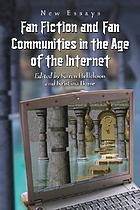
But in the meantime, I've been reading in the fan studies literature (it's a thing! a wonderful, glorious thing!). The two latest books I've read were both anthologies: Fan Fiction and Fan Communities in the Age of the Internet, edited by Karen Hellekson and Kristina Busse (McFarland, 2006) and Henry Jenkins' Fans, Bloggers, and Gamers: Exploring Participatory Culture (New York University Press, 2006). While both assembled by acafen -- fans who are also academics; academics who embrace their identity as fans -- and both well-worth the read, these are two quite different volumes.

Jenkins, whose seminal fan studies work Textual Poachers (1992) I have yet to read, is a skilled writer whose ability to own his expertise without appearing self-important is too rare and to be prized. Despite his renown in the field of popular culture studies, his work is approachable, readable even to those unfamiliar with every theorist or creator whom he cites, not to mention every popular cultural artifact. Fans, Bloggers, Gamers is a collection of essays written after Textual Poachers and before Convergence Culture (2006) and explore topics as diverse as women writing m/m slash ("Normal Female Interest in Men Bonking," with Shoshanna Green and Cynthia Jenkins) the anti-gaming sentiments that flowered after Columbine ("Professor Jenkins Goes to Washington"), and the experience of parenting a teenager who met and courted his first girlfriend online ("Love Online"). Each essay is prefaced by a short introduction/reflection on the context in which Jenkins produced the piece -- and how his thinking has changed (or not) since. I particularly appreciate Jenkins' ease with a mode of thought we would today identify as "intersectional." Perhaps born out of his use of framework that takes fan expression seriously, he is constantly working that tension between dominant-culture narratives and marginalized stories, and how the two interact. Whether he's looking at the queer community response to Star Trek's queer baiting ("Out of the Closet and Into the Universe," with John Campbell) or questioning our cultural obsession with teenage rebellion and dysfunctional teen-parent relationships ("The Monsters Next Door," with Henry G. Jenkins, IV) his perspective invites us to question conventional wisdom about cultural power and the limits of popular narrative.

Fan Fiction and Fan Communities in the Age of the Internet is an anthology of many voices, and one which is perhaps better approached as an opportunity to graze than a volume to be read from end to end. As Busse and Hellekson explain in their introduction ("Work in Progress"), this is an anthology in which one will find work by fans who are using their academic hats to theorize their fan works and experiences. Each reader will no doubt find particular essays which speak most powerfully to their own experience of fandom. In my case, I was particularly moved by Elizabeth Woledge's "Intimatopia: Genre Intersections Between Slash and the Mainstream," and "Keeping Promises to Queer Children: Making Space (for Mary Sue) at Hogwarts," by Ika Willis.

Challenging conventional wisdom that holds fan fiction erotica to be amateur contributions to the pornography or romance genres, Woledge makes a convincing argument for slash fanfic to be understood as part of a new "intimatopic" genre. "Intimatopic" fiction, Woledge argues, focuses on the development of intimacy between characters; it breaks the genre boundaries of romance fiction in going beyond the get-together plot, and breaks pornography convention by insisting that sex is intimacy first and foremost, even in moments of violence, casual connections, or other "plot what plot" narratives. She argues that in foregrounding character intimacy, writers in this genre challenge us to value the work that goes into building and maintaining intimate relationships. I admit that this framing of fanfic resonates strongly with my own experience as both a reader and a writer. When I write fan fiction I have an emotional agenda, at least part of which is making visible the labor that goes into establishing and sustaining sexual intimacy with another being.

Speaking of emotional agendas, Ika Willis, in "Keeping Promises," explores the queering of mainstream texts -- in this case Harry Potter -- and asks us to question the conventional wisdom that views slash as a form of self-insertion or wish fulfillment: inserting queerness into a heterosexual narrative as a form of "resistance." Instead, she argues, those of us who are queer read the narrative as we read the world around us: as a location in which queer beings exist, and are likely in the closet, in denial, or lacking the self- or worldly knowledge to act on their desires. In this reading, slash doesn't insert queerness into the text; instead, it inserts knowledge of queerness into the text, so that characters can act upon that new layer of information. While Willis is writing particularly about Harry Potter, her essay echoed a lot of more recent discussions about canon queerbaiting in television shows such as Supernatural, where one group of viewers brings their knowledge of queerness to their viewing -- and sees the signs of potential queer desire everywhere -- while another group (at times, frustratingly, those officially associated with the show), denies that there is any canonical ambiguity or room for queerness within character behavior or portrayal. "Keeping Promises" points out the way in which queer fans can bring their subcultural knowledge to the characters (in this case through fan fiction) and enable them to explore what, to us, is an authentic and legitimate part of human experience. As a bisexual lesbian fanfic writer I'm most definitely on a mission to do just this: offer up narratives of same-sex intimacy contained within the boundaries of canonical texts that don't otherwise overtly acknowledge its existence.

Take, for example, my Downton Abbey fic that offers up a moment of sexual intimacy between Isobel Crawley and Violet Crawley ("Between the Elements of Air and Earth"). On the one hand, yes, I wrote it as straightforward porn, because I wanted those two characters in all their respect-hate complexity to get naked and work it out. But part of the energy and passion I brought to that writing was my trifold mission to 1) get more women having sex with women into fan fiction, 2) get more elders having sex into fan fiction, and 3) push fan fiction erotica beyond the typical narratives of sexual intimacy -- narratives that rely heavily on normative, youthful bodies doing penis-centric things. Part of why f/f slash tends to be less explicit; as a culture we still have a difficult time answering the question "what do women do together in bed, exactly?" Consider the work linked above, and all of my other f/f slash, a response to that question.

Sure, on way of understanding "Between the Elements" would be that I inserted a lesbian sex scene (between two bisexual women, or at least women with bisexual histories) into the universe of Downton Abbey. But Willis is suggesting -- if I am reading her essay correctly -- that we could also argue that, like in real life, the lesbian and bisexual narratives were already there, in the closet, like they are for so many of us. And all they needed was the "Mary Sue" insertion of outsider knowledge or vocabulary to give it the opportunity to flower. And hopefully, of course (from the perspective of queer adults), the more queer narratives we encourage to flower, the fewer queer children will grow up without the knowledge or vocabulary to construct their own lives -- without the cobwebs of cultural demurral or denial, straightwashing and gaslighting still rampant (don't kid yourself) today.

So. Go forth and read Fans, Fan Fiction, and fan works themselves!

2014-06-30

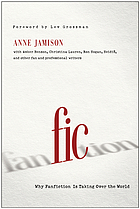
booknotes: fic

Because the Brookline Public Library is awesome (they even have an awesome box ... shaped like a TARDIS!) someone on the staff ordered a copy of acafan Anne Jamison's Fic: Why Fanfiction is Taking Over the World (Smart Pop, 2013). And there I found it, sitting innocently upon the new books shelves (have I mentioned how much I adore public libraries' new books shelves? it's like browsing in a bookstore except you can take everything home for free!). I've found so much eclectic good stuff on the new books wall at Brookline over the past few years, and Fic is no exception. Jamison is a literature professor with a background in English literature and culture, 18th century to the present. As an academic whose scholarly interest is in participatory literary culture, it is no surprise that fanworks captured her interest. This volume is one part narrative history of fanfiction from its "prehistory" in the 1800s to the present, and one part riotous celebration of various fan cultures through both Jamison's own analysis as well as the contributions of fanfic and "profic" writers (at times one and the same!) and other acafen as well. Not quite an anthology, as Jamison's narrative is the "spine" of the text, the contributions by others dodge and weave within the volume providing alternative perspectives, counternarratives, "missing scenes," and many a reading recommendation for the fic-hungry fan.

Jamison uses the lens of several major fandoms to organize her work in roughly chronological order. After a brief sketch of fannish readers of the Romantic period, she begins with the worlds of Sherlock Holmes (19th century to the present), what many believe is the first modern -- and certainly one of the most enduring -- fandoms. She then turns to Star Trek as a way to explore pre-Internet fandom cultures, reaching back into Science Fiction magazines of the mid-twentieth century and forward into the increasing visibility of overtly sexual fanfiction, particularly Kirk/Spock slash as the ground zero couple of queering mainstream narratives through fic. X-Files and Buffy provide fertile ground for exploring how the 1990s expansion of public access to the Internet changed the social dynamics and dissemination of fan creations (as well as their more immediate access to the creators of the original shows around which the fans engaged). Harry Potter and Twilight offer two divergent perspectives on mega fandoms, one much more conscious of its roots in geek/nerd and fandom culture (HP) than the other (Twilight). Finally, sections on the relationship between fanwriting and publishing and current (circa 2012) trends in fanfiction creation bring our rollicking narrative to a close.

As Hanna is fond of pointing out, intellectualizing is an erotic activity for me -- which probably means I'm an acafan even though I don't actually study fandom in academic (would this make me an #altacafan?). If someone can give me a new set of conceptual questions to ponder about a given activity or body of work, I'll be pleased beyond words -- and that's more or less what Jamison provided with Fic. Hers is a thoroughly readable exploration of fandom from the perspective of an insider, yes, but not (I don't think; though I'm an insider myself) accessible only to those familiar with the landscape described therein. She also provides no pat answers to the thorny questions of, to take an example, copyright in the age of "pull to publish," or socioeconomic inequalities shot through our culture that are (unsurprisingly) replicated within fandom even as some fans use their fanworks to create counternarratives and "talk back" to the powers that be, whether the original creators, rape culture, the military in the era of Don't Ask, Don't Tell, or the whitewashed, able-bodied landscape of many mainstream, futuristic worlds (and, yes, sometimes fannish ones as well -- we, too, are hardly free from sin).

If I had any big, new insights while reading Jamison, I think it would be how much the fannish orientation toward one's favorite stories that ends in the production of fanworks is a deeply ingrained one. Most of the contributors to the volume articulated in some fashion having been a fanfic writer before they knew what that was or knew that others, too, did what these individuals felt the impulse to do. I, myself, have a similar "origin story," of responding to narratives in childhood with the instinctive reaction to create more or better or crossover or alternate universe. The altacafan in me is curious whether fan creators could be profiled in certain sociological or psychological ways in relation to the narratives we produce fanworks around. In other words, what is the impetus for us in "talking back" to the stories our culture provides us? What personality characteristics or other factors push us to talk back versus those who don't? There's a project I hope someone in fan studies is already hard at work sorting out. I look forward to reading their book when it's published and available on the new book wall at the Brookline Public Library.

In the meantime, go read Fic. And let it lead you to all the delicious fic that's out there to be discovered. (I have an annotated list.)

2013-03-19

comment post: shipping as ... creativity [survey]

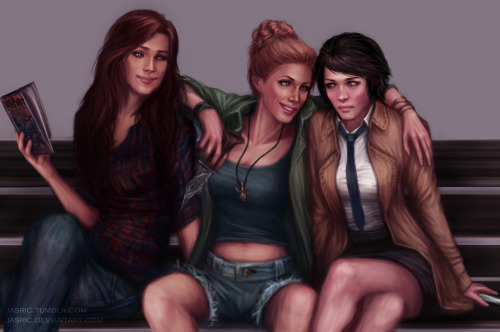
Sam, Dean and Cas ... re-imagined (by jasric)
Our friend tiptoe39 has been authoring a series of posts on "shipping" and fan works over at SpoilerTV, and for the last few posts she's created surveys to help her generate content. Here are my responses to her survey on "shipping as...creativity":

How does shipping enhance your creativity? 

I think shipping kicks my creativity into gear in part because it pushes my political buttons as a bisexual woman and as a feminist: I experience shipping as a direct intervention in mainstream narratives. It is a form of critically interacting with books, movies, television series that depict human sexuality and human relationships in certain ways, challenging the stereotypes, assumptions, or erasures I see there and re-working the source within the fanwork to tell a different version of events.

This is going to sound like a weird comparison, but I once attended a talk by Jane Yolan on faith and writing, in which she talked about how some people viewed writing from a Christian perspective as a negative constraint on creativity -- but instead she saw it as a limitation that fueled creativity because it gave you a framework that you had to work with ... creatively.

I think fan fiction can work in a similar way to writing "Christian fiction" ... in that you have a starting set of assumptions (the canon work) that's sort of there as a de facto set of prompts. And then whatever inspiration you have for your work, you'll have to be clever enough to put those two things together. Fitting form (the original material) with function (your particular vision in this instance). It's a challenge that I think can actually amp up someone's creative juices, because you can't afford to be lazy about it. (If nothing else, your fellow fans will call you on it!)

How does viewing fanworks by others enhance your creativity?

God, I love the creativity of my fellow fan creators. I'm constantly awed by the dedication with which so many of us write/draw/paint/edit/enact/etc. It's wonderful to take in so many visions of the same core material; to see how many ways the same narrative(s) can be improvised upon when humans put their minds to it. I definitely feel that my exposure to fanworks and the people who created them has taught me to look at the world in a more multi-faceted way. I see everything through "slash goggles" now, a perspective that necessarily involves holding more than one understanding of a work in mind (and heart) simultaneously.

Fellow writers have also taught me a LOT about the construction of effective erotica; I do believe I have a strong original voice in that regard, but I'm not going to kid myself into thinking I spontaneously learned how to write smut well. I learned it from my fellow fic-writers (thank you!).

What are you able to do creatively with shipping and fanworks that you cannot do with "original" creative works?

I've always been a person who thinks best "aloud," in dialogue with others. With shipping (and fan fiction writing) that conversation is a built-in feature of the activity from the start: you're in dialogue with the original work that inspired the fan work! I get incredible satisfaction out of participating in that conversation; it generally brings me into a much closer and more positive relationship with the original work (even when I'm highly critical of it) than I would be as a more passive consumer of the original work. I have very little experience with non-transformative fictional work (my non-transformative writing has been in the genres of academic/scholarly papers and creative nonfiction essays / blogging -- also forms of conversation in their own right!). But I have tried my hand, occasionally, at non-transformative fiction and I often run out of steam at some point, I don't have the social accountability to finish the story that the fandom provides. I think I also felt less of a sense of purpose with non-transformative work (it feels less politicized, less like an intervention, which are key kicks-in-the-ass for me as a writer).

What is your response to the idea that those with creative inclinations should work from their own characters and worlds rather than appropriating another's?


I understand the concern of creators who feel threatened by fan works. At first blush, fan works can look like an authorial power-grab, like plagiarism. However, I'd encourage people who are framing fan creations as plagiarism to reconsider that assumption. Instead, I'd argue that fan works are a form of reader/viewer response to the original piece. Like literary or film criticism, they are responsive to the original work, cannot exist (are often meaningless) without that original work with which they are interacting -- usually with a mix of praise and critique.

As long as the pieces are clearly framed as such (transformative works by fans), and the creators are not making money from their creations or passing their work off as actually by the original creator(s), I would argue that original creators can only benefit from the fan community getting excited about their creation enough to generate those responses. That responsive interaction will likely translate into investment in your original creation, which -- if you're a professional of any kind -- is going to translate into a larger audience, higher profile, more income. As a fan creator myself, I'll be honest and say that at least half of the original creations I create for I would not be reading or watching if I were not invested in creating fan works from them. The fan creation IS my investment in the work, my conversation with it.

Finally, as an historian I would point to the fact that fan works have a long history, as does the tradition of artistic inspiration, musical "quotation," fashion trends, and other conventions of one original work informing another very directly. While the Internet and other technologies have made this type of interaction more visible, I would argue it has long been a part of the equation in creative economies. This does not mean that creative rights concerns are invalid -- in fact, they are crucial to continue defining and advocating for -- but it does mean that there is precedent for original works and transformative works living side-by-side in mutual benefit.

Is there anything about shipping, or the shipping community, that limits you as an artist, creator, or consumer?

Well, I don't think this is exactly the kind of "limit" you're looking for, but I have sometimes found myself as frustrated by the tropes of certain fandoms, and the imbalance of having an endless supply of fic along certain themes, for certain fandoms, and then radio silence along other lines, in other fandoms. Obviously people are inspired to write what they're inspired to write. But fan works, like original works, are not created in a vacuum. So I think it's legitimate to note that there are relatively few sexually explicit fan works featuring female couples (compared with the huge pool of m/m slash out there). This can be a self-perpetuating cycle as fan communities reinforce excitement over certain pairings and fans who create in collaboration or through inspiration from one another gather around certain fandoms or pairings and not others.

I will include myself in this indictment: I write both female and male pairings, but in latter days I've been working on male pairings in part because that's where the community reinforcement comes from. My two Supernatural fics have far and away the most views, kudos, and comments on AO3 of all my fic. The next-highest story in terms of exposure and praise is a female pairing for Downton Abbey that's been up for almost two years, and is still only half the views as the Supernatural piece that's been up for five months.

So I think that even though the fan community often pushes back against canon, and the limitations of mainstream media in terms of human sexual diversity and other types of diversity, they are still often constrained by the "givens" of particular fandoms, and by the pressures of "the market" -- even though it's not a financial economy, but more of a social economy.

And, you know, we're human. So to the extent the culture we are steeped in perpetuates racism, sexism, classism, abelism, ageism, etc., etc., etc., as creators/consumers we're going to fall into those limiting traps as well, from time to time.

How would you characterize the community surrounding fanworks? (If you have also created non-fan creative works, can you compare the two communities? Those who read/consume are also welcome to compare the two communities.)


Overall, incredibly positive. These are people who take pleasure in what they do, and who generally engage in the activity as a leisure-time activity, as something fun and joyful. I really appreciate that fan creators are amateurs ("lovers") of their craft.

For myself, the pleasure I get from participation in the fanwork community is enhanced by the fact that my creative expression here is option, is non-professional, is what I do for pleasure rather than for work. I am also creative (even writing-creative!) in my professional life, and that feels more deadline driven and like it has a higher risk level to it than in the fanwork community. I feel more alone and (potentially) judged, like there is a much narrower margin for error in that context.

My fan creations are lower risk because they can be revised and updated as want them to be, and I find my audience to be incredibly supportive and forgiving. Fans are pretty good with the constructive part of constructive criticism -- they WANT your work to succeed, and get better, at what it's trying to do. It's rather like blogging, in that respect, only with no trolls! Which is lovely.

And I don't want it to sound like I haven't had incredibly warm and supportive feedback from my mentors in the professional settings I move in, either -- they've been unbeatable! But the stakes there just feel bigger in terms of being taken seriously as a ______. Fans will pretty much take you seriously as a fan as long as you're enjoying yourself and the object of your fannish love.

I would say particular fandoms strike me (in my early 30s) as "young" by comparison ... but that varies really a lot by fandom, so it's not a generalization.

Fan fiction authors also seem to be majority women, but again that would be a gross a generalization in terms of fan participation in responsive mediums.

What are the major problems you see within and surrounding shipping and fanworks?

I don't know if I'd characterize any of these as "major problems" but I do see them as ... problematic? issues that fans as a community might do well to have conversations about.

1) RPF. Real-person fic is something I have major reservations about, as it feels non-consensual and intrusive to me. There's a difference between someone choosing to portray themselves (or consenting to have themselves portrayed) in a sexual way, publicly, and to have other people create sexually explicit material about them -- even with positive, fannish intent! -- and make that public. It feels stalkery and, like I said, majorly non-consensual. I think it's a kissing cousin of "revenge porn" -- where sexually explicit pictures of videos (real or faked) of a person is released to the public as a form of character defamation.

2) Over-identification and emotional investment. This is something I tred carefully on because obviously fans have a long history of being characterized as hysterical, too passionate, etc. (what is too passionate, even, right??). But I have definitely come across people who use fandoms to validate their own identities (like, a character HAS to be gay or they can't deal, or -- conversely -- the idea that a character could be read as lesbian freaks them out and pushes them into defensiveness). And I've also seen people using fanwork to manage their own trauma or mental health which is totally appropriate alongside getting other forms of help, but I sometimes feel like fanwork is not a replacement for therapy, medication, a social support network, [insert need here].

3) Territorialness. So one of the great things about fans can be our generosity and collaborative spirit. ... and one of the worst things about fans can be our sense of ownership of a particular interpretation of a canon piece. To the extent that people sometimes abuse the folks who support "rival" interpretations, and even abuse original creators whose vision differs from their own. It's one thing to critique a creator's vision (the direction a series is going, something they do to a character, etc.) ... but I also think it's important to remember that just as WE (the fans) have a right to our vision of the story or character, so do other fans and the original creator.

Anything else you would like to add about shipping as creativity?

Whew! I think this form has me beat, so I'm going to leave it at that :) ... looking forward to the post!


2013-01-26

why do I write (and read) fan fiction? [part three]

See part one and part two for the context of this post.

So having explored fan fiction generally (and why I'm drawn to it) and erotic fan fiction as a sub-genre of fic, and why I think it's important, I thought I'd round this little series out with some thoughts on what draws me to the particular fandoms and pairings (relationships) I write ... and what I'm trying to do when I write them. Besides, you know, enjoy the smut. I'm also going to address, below, a couple of questions I've fielded lately about the ethics of fic-writing practice.

Donna Noble (Doctor Who)*
Why write the pairings I write?

Well, so, it's tempting to say that I write the things I write because I find them compelling and I just do, okay? On a certain level, trying to explain why you find the the fiction you like compelling is like trying to explain why you love your partner. It's not really reducible to a bullet point list.

But on the other hand, I'm me. So of course I have some Thoughts on the subject. And it starts with the fact that I consumed a lot of erotic fan fiction at a point where I was beginning to actively think about relational sexuality and how sexual identity and desire worked in peoples' lives (see post two). And I really enjoyed a lot of fan fic I was reading, mostly gay male pairings 'cause those were the fandoms Hanna and I were reading, but I struggled to find sexually-explicit lesbian pairings. And the femslash I did come across was frustratingly in-explicit about sex, or written by people who didn't seem to fully grasp the possibilities of what two female-bodied people might do together, sexual-intimacy wise. Hetero and gay male sex scenes in fic (and, to be fair, in a lot of regular porn) work on a fairly standard narrative arc that culminates in penetrative sex -- penis-in-vagina or anal sex -- as The Most Bestest Form of Sexual Intimacy. It's pretty much always orgasm-producing for both partners and sometimes it's clear the authors (and the characters they're writing) don't consider sex to have happened until there's been a penis inside a vagina or an anus.

Without a penis, what do you do?! Okay, yes, there are dildos and vibrators, but honestly not a lot of fics wade into the territory of sex toys very skillfully, and dildos in a lesbian sex scene too often just cue the author to assume sex with a dildo is about role playing het sex. Which it can be, but certainly doesn't have to be. In my opinion, it's much more fun to start without that penetrative-sex-as-goal model in mind and think about all the ways two bodies might come together (double entendre very much intended).

Idris - the TARDIS personified (Doctor Who)*
So I developed a (Queer, Feminist) Agenda. Which was to inject the world with realistic smut about ladybits. Smut that was tactile, visceral, about real bodies coming together and people making meaning out of the sex they were engaged in. And I'm an historian, so I started out pilfering from Downton Abbey, writing an eight-story arc about Sybil Crawley and Gwen. And I went on from there to other female pairings and eventually stuck my toe into the waters of m/m slash. It was kind of terrifying at first, pushing out into writing about men having sex -- something I don't have hands-on experience with. But I discovered that, at least the way I go about it, the characters take hold of the narrative regardless of gender and help me feel my way through giving them positive (and I hope realistic) sexual experiences! And in part, I was motivated by the same (Queer, Feminist) Agenda as I had been with writing female-bodied sex scenes: the be-all and end-all of sex for guys doesn't have to be penetration.

I'm hardly the first person to observe this, but for people who are queer in some way, writing slash fiction can be a way to revise the heteronormative narratives of mainstream media. And, I'd add as a feminist, it can be a way to revise sexism and other isms as well. Watching a television show with primarily straight relationships and re-writing or filling in those stories to imagine queer relationships injects our experience into the cultural discourse. Characters on television, in film, in books, are assumed straight until explicitly identified as queer; fan fiction more often assumes that everyone is a little bit queer unless they're proven to be straight. It's a re-visioning of the world in which sexual variety is the norm -- one part reflection of our actual experiences in queer subcultures, and one part wishful "what if..." thinking. Looking at my small repertoire of fic pairings, I'd argue I tend to choose characters who have the potential to -- when queered in some way -- disrupt the normative expectations about sex and relationships that we see in a lot of porn, erotica, and mainstream media -- television shows, movies, etc., the original material from which fan fiction is born. Perhaps starting out as a critique of the original material, I often find my acts of fanfic subversion increases my pleasure as a consumer of the original material.

I enjoy writing stories about women unabashedly enjoying sex and knowing their bodies. I enjoy writing stories about elder folk, late-in-life lesbianism, about people having sex when their bodies don't always work the way they want them to. I like writing fic in which it's taken for granted (by me, the author, at least) that men can, and do, enjoy a full range of emotional intimacy, body insecurities, carry baggage from damaging relationships, enjoy sex that isn't always fucking. (In fact, I have yet to write a fic that includes men having anal sex.) I like writing the vulnerability of desire, about what it means to expose to another person just how much you want, and (often even more frightening) what you want. I like writing sex that includes awkward conversations and misunderstandings and bodies that frustrate and fears that overwhelm -- but that all ultimately circle around that moment of knowing and being known that can come when people get naked together, in every sense of the word.

The ethics of slash: a few final thoughts.

Aside from the ethics of porn, which is a topic about which much ink (and internet bile) has been spilled, the ethics of fan fiction (or, more generally, "transformative works") is itself a topic for discussion on the internet and beyond. Hanna and I belong to the Organization of Transformative Works, a non-profit organization that advocates for the practice of fan works and also runs the Archive of Our Own project, which seeks to collect and preserve fan works online. They publish a peer-reviewed journal, Transformative Works and Cultures, that explores fandom in its infinite varieties. So if you're interest is piqued and you'd like to delve into the politics and culture of fan creation -- or poke around and read some fic or whatever variety! -- I really can't recommend them highly enough.

What I wanted to do here is touch on a couple of ethical issues that have come up recently in conversation with friends -- namely the ethics of "m/m erotica" written by women, and the practice of writing RPF or "real person" fic.

Can, or should, women write erotica about gay men?

Periodically, there are internet-based wrangles over whether or not "m/m erotica" -- which in the world of published romance/erotica generally means "gay porn for girls," or (usually) women-authored fiction about gay male relationships marketed to a (presumed straight) female readership -- is ethical (see for example here and here). The question is whether the m/m genre is exploitative, a hetero appropriation of gay male culture. The practice of writing erotic fan fiction is overwhelmingly a female one, and male/male pairings -- as I write above -- generate an incredible amount of enthusiasm, from both writers and readers (who appear to be, again, overwhelmingly female).

As an aside: fan-fiction writing as a feminized activity is something that deserves attention, and I have no doubt someone somewhere is doing incredible work on it. I think there's a lot to explore in that dynamic -- and I'm looking forward to being a part of the conversation, along with people who've done way more research than I into the phenomenon.

But back to the ethics of being a woman writing/reading porn involving men having sex with other men. Which is something I, a cis woman, do on a near-daily basis (see above). I admit that, when the articles about m/m erotica appeared, I did some soul-searching about it. When people suggest an activity might be exploitative it's pretty much always a good idea to take their position seriously and listen to what they have to say. But. Here's my thing about the case against m/m erotica: it basically comes down to an argument that if people of sexual identity A create or consume erotica about (fictional) people of sexual identity B, particularly if there's a dynamic of social privilege in the mix, that's per se a problem.

But sexual identity isn't some sort of siloed, static thing -- or at least I don't experience it that way. Our sexual identities, desires, practices -- they're messy and complicated and shift over time. Preferred sex and/or gender of one's actual partners aside, we can have fantasies and enjoy porn about practices we would never want to actually engage in. And, I would argue, we can find porn about bodies and practices we don't per se find arousing, arousing because so much of sex isn't the geometry of bodies coming together but (see post two) the narrative surrounding that context. Recent research is beginning to support this notion, particularly for female-bodied persons. As J. Jack Halberstam points out in the recent book Gaga Feminism (Beacon Press, 2012):
People are not asking why it is that gay men do not, generally speaking, produce any [sexual] fantasies around femininity, while lesbians produce lots of fantasy environments that include men or masculinity. When, in The Kids Are All Right, the lesbian couple watches gay male pornography to spice up their sex life, the scene was met with incredulity, especially from gay men. Indeed, a gay magazine journalist called me and asked me to comment on this bizarre (to him) scene. I responded that lots of lesbians watch and like gay male porn, straight male porn, and everything in between ... [According to sexual response studies] while men, gay and straight, tend to respond in inflexible ways to erotic images of men and women (straight men want to see female bodies, gay men want to see male bodies), women, gay and straight, tend to respond in flexible ways to images of men, women, and animals. (p. 87-88).
So my point is that what sounds like a fairly reasonable call for non-appropriation ("what do these straight women think they're doing, fantasizing about gay men!") becomes tangled really quickly.

To use my own example: I'm a bisexual woman in a same-sex relationship with another woman. Does that mean I'm only "allowed" to be involved in reading/writing porn featuring two women? Are threesomes okay -- or not, because I'm not in an open or poly relationship? If I write about sex involving male bodies, is it okay because as a bi woman I'm sexually attracted to men? But then it would be okay for straight women to write gay porn also, so maybe I'm only allowed to write porn about hetero pairings? But I've never been in a straight relationship, and identify as part of the queer community -- so maybe that's off-limits as well. But if I'm part of the queer community then we're back where we started: maybe I get to create and consume porn about same-sex couples because I'm part of a same-sex couple?

So you end up on this merry-go-round of factors that could be used to determine who is or isn't "qualified" or ethically able to create certain types of sexual fictions. And I think that that sort of policing ultimately impoverishes us all. If we started saying that straight people could only write or enjoy porn about straight folks, and gay men and lesbians could only write or enjoy porn about gay men and lesbians ... not only would we miss out exploring the sexual diversity of humanity through the imaginative act of writing and reading, but we'd also be ignoring that there are people who don't fit into these neat and tidy categories of the self.

I'm not saying there isn't a place for critique. Hell, in my book, there's nothing in the world so sacrosanct as to be beyond critique. And I absolutely believe that there is porn out there that fetishizes queerness for the straight gaze. I mean, I wouldn't be writing porn in the first place if I hadn't gotten frustrated with the conventions and stereotypes I saw being recapitulated over and over in the porn I was reading. So I think anyone involved in writing erotica should be open to conversation about their work, open to hearing people say, "Hey, that thing you did there in that story rubbed me the wrong way, and here's why." It's not a requirement to engage, but I would hope the resulting conversation could be an opportunity for growth for all involved.

What are my feelings on "real person" erotic fan fiction?

Yup, it's a thing in the world, people writing (often erotic) fan fiction featuring real-life celebrities. Often, though not always, these celebrities are the actors portraying the characters that these same authors write other fan fiction pieces about. But there are also people who write erotic fan fiction about politicians, musicians, and other people in the public eye.

I had a follower on Twitter ask me last week what I think about the practice:
I responded:

And I'm not sure I have a whole lot more to add to this "short answer" response. Characters (whether portrayed by actors or written about in a text) are characters not human beings. We joke about how they take over our brains and insist their own version of events, but at the end of the day they are human creations -- not humans themselves. They have no independent bodily autonomy or agency. They have no legal or social standing as persons. Real people do.

Real people can create erotica or pornography that involves themselves and offer it to others (friends or strangers) to enjoy consuming -- as long as everyone's staying safe and is able to consent without coercion I'm down with that. I even think teenagers technically under the age of consent should have the protected right to create erotica materials involving themselves and share those materials with their peers as part of their own sexual exploration. Obviously this raises questions about how to give them a safe space to explore their sexuality without being exploited, and I agree that's a conversation to be had. But the general principle is: we should all have the creative license to explore our sexuality in textual and visual ways and share it as we desire.

However: consent is key here. I imagine human beings have always developed fantasies around other actual people prior to full and enthusiastic consent being given -- in the case of those we later become sexually intimate with -- or in situations where those relationships will never flower, but we're crushing hard anyway. This isn't about policing personal imagination -- have all the damn fantasies you want about whomever and whatever you find turns you on.

I'd argue, though, that in the case of fantasies about real live actual people who aren't involved in the spinning out of those fantasies? Those stories or images are best left in private spaces: your computer hard-drive, your journal, whatever. I'm not thinking so much of regulation here -- I'm not arguing we pull RPF from the Archive and ban people from publishing more -- but I'm arguing that as a matter of common courtesy it's kinda, well, rude, to put your fantasies about actual people who you have no relationship with and who aren't consenting to have these sexualized stories or images created around them out into the world of the 'net where those same people could presumably come across said stories by Googling their names.

If someone wrote an erotica story -- even a really sweet hot one! -- about me as me and posted it online and I stumbled across it, it would feel really stalkery and invasive to me. Like, my wife is the only one at this point in time who has my permission to spin out stories about my bits that way.

So yes, I do think there are boundaries and ethical considerations where fan-creation is concerned. And I appreciate that there are people within fandom who are willing and interested in engaging in ongoing conversations about those difficult aspects of the genre. What I do hope is that those outside of the genre will think twice before dismissing the practice wholesale as facile or perverted (in the not-cool way). Because I think fan engagement with (mainstream) creative works has a lot of potential to change and complicate the (mainstream) conversation about human sexuality.


*One of the pieces of fan fiction I'm most proud of is a Donna Noble/Idris fic completed for last year's International Day of Femslash.
2013-01-22

movienotes: les miserables

I have some book reviews I need to write for books I've read this month, and a third "why I write fic" post in the queue, but I just got back from a weekend with my sister in the beautiful Austin, Texas, and my brain can't seem to form coherent-yet-complex thoughts. So instead, I'm going to offer up a few observations about the film version of Les Miserables that I saw in the theater the weekend before last.

Javert (Crowe) and Valjean (Jackman)
I saw the musical once before, live, when I was in London in January of 2004. My principle memories at the time involve enjoying the music (I'm a life-long musical theatre fan, so a good musical will always win me over in the end), being distracted by the book I'd picked up that day and brought with me to read during intermission (The Time-Traveler's Wife), and my surprise at the fact that the emotional-relational through-line for the story is not the second act marriage-plot between Marius and Cosette but the connection forged between Jean Valjean and Inspector Javert. It is their dance of power, desperation, obsession, compassion, forgiveness, and despair that drive the plot from start to finish. Hugo's novel is that 19th century classic the Social Problems Novel and, and is -- I'm sure I am far from the first to remark upon this! -- a queer choice for musical theatre.

Fantine (Hathaway) selling her hair.
A few thoughts in no particular order:
  • Women, work and society. The film version of Les Mis had some really interesting (largely visual) observations to make about women and work. There's Fantine, Anne Hathaway's character, who is working in a factory to pay for her daughter's care. Rumored to be a slut, and punished by the foreman for being a single mother, she's cast onto the streets and sells her hair, teeth, and sex before succumbing to consumption. Her daughter, Cosette, has been boarded out as a laborer herself, working for a couple running an inn (the buffoonish and cruel Thenardiers). While Cosette is rescued by Valjean and ascends to the middle class through marriage (one could argue a certain kind of "wage work" in its own right, certainly an economic decision), her age-mate Eponine Thenardier -- abused by her parents and pining after Cosette's lover -- cross-dresses as a boy to join the revolution and ultimately dies on the barricade. On the periphery of the story drift prostitutes, beggars, and female religious who serve as nurses and also offer refuge for Jean Valjean at various points throughout the story. When the student revolutionaries are shot by French soldiers, the uprising put down, it is women who are left to scrub down the blood-filled streets. Overall, Les Mis hammers home in multiple ways the limited options for the vast majority of women in 19th century France. True, there were limited options for most people living in France at that time -- but this film adaptation does a good job of highlighting the way women's sex/gender limited them in particular ways.
  • Futility of revolutionary action? Throughout, the film/musical has a deeply ambivalent relationship to the politics of its student revolutionaries. Marius's boyfriend Enjolras is a charismatic and idealistic young Parisian student who, with a group of peers, orchestrates a violent rebellion (based on a real historical incident) that ultimately fails and leaves everyone -- save Marius, rescued by Jean Valjean for his adopted daughter's sake -- dead. In Hugo's world, the violence of the state (personified by Javert; more below) is responsible for the wretchedness of virtually every character in the story, but political action is depicted as ultimately futile and deadly. Yet the film ends with a triumphant reprise of the rebels call to arms, with Fantine, Valjean, and all of the dead students waving tricolor flags high above the Parisian skyline. Have they ... won? And if so, how? Is the film meant to suggest revolutionary action is ever-needed? If the next generation (Marius and Cosette) have retreated into bourgeois respectability -- Marius' father welcomes them in with open arms and throws a lavish party for their wedding -- should this be considered a win? For whom? I have read some reviews that suggest Hugo's narrative points toward interpersonal love triumphing over political action (again, more below) but if that is the thrust of the plot it is an unsatisfying one: many people, even many "deserving" poor, die or are left in desperate poverty despite benevolence (and occasionally actual care) extended to them by others. If I had to guess, I'd hazard that Hugo might imagine that all attempts to improve the human condition on a large scale are doomed to failure, and that one-to-one interactions are our only -- and ultimately futile -- recourse.
  • Letting go of the next generation. As I wrote above, my first impressions of Les Mis is that it is a story about parents and letting go. Fantine, first, must let go of Cosette in order to provide for her (by going to work and leaving her with the innkeepers), and then ultimately must let her go when she dies and entrusts her to Valjean, a man she barely knows. She cannot know what her daughter's future holds -- for good or ill -- and yet must depart. And then in the second act Valjean must let go of Cosette when she falls in love with Marius. While at first this loss is painful to him, and he tries to leave  the country with Cosette in tow, when he intercepts a letter from Marius to Cosette he regrets his actions and rescues Marius from the barricades. After the two children are engaged to be married, Valjean -- his duty to his daughter complete, now she is in another man's care -- he departs to a monastery to die. We also have, of course, all of the children who die: Eponine and the students, including a young street urchin named Gavroche who is the first casualty of the day. The adults may believe these young peoples' actions are foolish and futile, dangerous even, but the young people ultimately must forge their own paths.
  • The central romance in the story is between Valjean and Javert. So, okay, you don't have to read their relationship as one long exercise in Unresolved Sexual Tension - but I certainly found it much more satisfying than the Marius/Cosette situation, let me tell you. Inspector Javert spends decades in pursuit of Valjean, obsessed with the man and fascinated/repulsed by the notion that the "criminal" Valjean (imprisoned for stealing a loaf of bread) could ever be anything other than a criminal. Valjean, whose religious conversion shortly after he is paroled helps him rebuild his life, tries to model a more nuanced morality for Javert (while, you know, evading re-arrest!) -- and in the penultimate scene he succeeds. Given the opportunity to kill or capture Valjean, whom he has tracked into the Parisian sewers, Javert lets Valjean go. And is so shattered by his decision to let the rule of law go in the interest of human compassion that he commits suicide.
  • Oh, and the acting. I was really impressed with everyone in this cast, all of whom seemed to really be throwing themselves into their work both musically and acting-wise. At times, Hugh Jackman and Russell Crowe really seemed to be struggling with the score which surprised me -- since I know Jackman, at least, is a strong singer. But I think that might have been a function of recording the songs live on-set rather than in a recording studio before or after the shoot. And Helena Bonham Carter and Sacha Baron Cohen as the odious Thenardiers were delightfully campy, offering some of the only comic relief around -- and even then, theirs is a story that has a pretty tragic side if you linger more than a moment or two). 
And that's all I got, folks. If you're musical theater fans or fans of the Victorian "social problem" novel, I'd highly recommend seeing the film -- preferably in the theatre since it truly is a spectacle of a movie musical. I know some people were really frustrated by the filming -- the tendency to frame actors in the corner of the screen, or incompletely, but I actually like that technique for the way it makes you notice the composition of the shot, makes you realize a visual image is being constructed for you, rather than allowing you to feel you're simply immersed in the action. Artifice, in this instance I would argue, works well with the musical genre.

2013-01-17

why do I write (and read) fan fiction? [part two]

(via)
See part one for the background to this post.

I've been letting this sit in my drafts folder for a couple of days and I'm starting to feel the weight of perfection closing in ... so quickly, quickly! I'm going to try and get these ideas out there before I'm crushed by the tyranny of Unfinished Thoughts.

Why write erotic fan fiction?

Why erotic fan fiction indeed.

So a couple of things.

Building on what I wrote in response to the question "why fan fiction," thinking about the lives of characters "off screen" (or after the novel or series is done) can often translate into imagining the playing-out of relationships that were established in canon. Not only do many mainstream novels (not just the ones for children and young adults) fade to black around sexual encounters, they often skirt the whole question entirely by ending the story arc with the get-together moment, or at least the early days of the relationship. Inquiring minds want to know what happens after -- and once you get to beyond a certain age, it seems pretty clear that sexual intimacy is often (though obviously not always) a part of the "after." It's long been a habit of the heart, for me, to extend the existence of fictional characters to give them the relationships and experiences the main narrative only gestures toward.

Too, when I was re-introduced to the concept of fan-created fiction and other fan works, it was as a genre that focused heavily on "slash," or fan work where characters' sexual relationships (whether canon or not) were the central theme. If your only encounter with fan works is through reading about 50 Shades of Gray or the resulting mainstream news coverage of fan fiction as a phenomenon, you can be forgiven in assuming that all fan fiction is erotic. It's not. I'm not sufficiently expert in the field to say what percentage of fan work is, in part or primarily, erotic (I'd guess a substantial proportion, but that's also what I tend to go looking for so my sample is extremely biased), but erotica is not the only direction fan work can take. Yet it was a key factor in what drew me, as an adult, back into the practice of fan writing.

I read it exclusively, for awhile, but eventually I started looking for pairings and stories that I couldn't find anywhere (more on that in part three) ... in other words, I found a gap in the literature! And like any nerdy academic, once I'd found the gap(s) people weren't exploring I determined to explore them. So pretty soon, I started writing, and people started reading, and people by their own account enjoyed what they read, and who doesn't like positive reinforcement?!

You could also ask the question this way: Why write erotic fan fiction?

I find erotica in general a compelling genre, and one -- as I've written before -- that has a great deal of (often underestimated) potential to help us explore meaningful aspects of the human condition. But I often find erotic fiction of the non-fannish variety incredibly hit-or-miss. As a member of my writing group and I were bemoaning the other day, it's often the case that you pick up an anthology of Best Lesbian Erotica or Best Erotic Romance or even the more theme-driven works (steampunk, quickies, food porn, BDSM, etc.) and at the most you find two or three stories out of twenty that dampen the knickers.

I always thought, you know, "different strokes for different folks" (in this case, ahem, quite literally), but then I discovered erotic fan fiction? Maybe it was just that I happened to re-acquaint myself with the genre at a time when I was ready to start thinking about sexual narratives in a more sustained way. Maybe it was because I was exploring my own sexual potential in concrete ways, and thus sexual knowledge, both fictive and non, were suddenly ever more compelling. This is part of the equation, surely. Fan fiction -- the writing and the reading, the community sharing -- has become entangled in my learnings and conversations about sexuality more generally and how we human beings narrate desire.

But as I've been turning this question over in my head the last couple of days, I think there's actually another more ... technical? ... reason why fan fiction erotica has a higher success rate for me (in terms of capturing my interest as a creator and consumer) than erotica in general. And the reason goes something like this: sex gains meaning through context. There are different schools of thought about what makes for effective porn, and some people will argue -- or even just take as read -- that effective porn is effective precisely because it's non-contextual and non-specific. That the characters are effective primarily because they are utterly interchangeable. One of the arguments for why so few male performers emerge as stars in the mainstream porn business is precisely this: that the ideal (male) porn actor fades into the background, is unremarkable enough that the (presumed hetero male) viewer can effectively erase the actor from the scene and insert himself into the action.

But for me, the exact opposite is true: the more particular and real the characters in a given story are, the more heartbreaking and hot the sex. Because I've been convinced I should care. Sex acts are weird and messy and frankly ridiculous ... it's we (participants and witnesses) who imbue the acts with meaning. (You'll say there's a physical component as well, and I'm not disputing that, but consider the difference between someone biting your neck out of the blue and sucking a hickey into your shoulder in the midst of lovemaking ... it's context that makes the physical activity feel good, not the actions in and of themselves.)

Intimacy can be the work of a fleeting moment or happen in the context of a life-long relationship, but without context sex acts themselves are, well, boring (to me, at least).

Fan fiction evokes context. True, the best fan fiction can stand on its own and be enjoyed by readers who know virtually nothing about the canon narratives to which the fic refers. Case in point, when Hanna first started sharing fic with me she was largely sending me stories written for anime and gaming 'verses I had no context for. And they were still compelling and hot. But I think there's a way that even just knowing these stories tie into a larger narrative encourage us to build context and imbue a scene with meaning. We don't have to know every detail of that context, just that there is one. We're encouraged to see the characters not just as conduits for sexual satisfaction, but individuals with full lives and the weight of personal history which they bring to their (fictional) sexual encounters.

As someone who counted fictional characters as intimate friends from a very early age, I guess it's not a big surprise to me that the act of participating (as a voyeur-reader, or as an author-creator) in the intimacy of fictional characters feels real and satisfying in a way that more conventional types of erotic creation/consumption have not, for me.

I also think the energy of the fan community feeds into this: virtually all of the fan writers creating smut in this context are also readers -- we swap work, we are one anothers' editors, we cheer on stories, we're invested in the (fictional) relationships working, so perhaps there's something in the very activity of co-creation that's ... erotic? It's similar to the really good energy you get in a class where everything gels and a critical mass of professor and students are pushing one another toward mutual heightened understanding? The relationship isn't just between the reader and the characters, but also the writer-reader and the reader-writer; even if fan fiction is penned (or typed) by a single author, there's usually a whole network of fellow fans around that author who create context for the work itself. And I think somehow that gives the relationship(s) and sexual intimacies within the work a unique intensity of meaning.

Stay tuned for part three, where I muse more specifically about why I write the particular types of erotic fan-fiction I write...

2013-01-10

why do I write (and read) fan fiction? [part one]

(via)
This topic has been kicking around in the back of my mind for awhile, in nebulous form, and then in the past couple of weeks I've (coincidentally?) found myself engaged in discussing theories of fan fiction and erotica writing with several friends via email, as well as the wonderful women of my #firstthedraft writing group. With encouragement from #ftd, here are my thoughts in blog post form.

I actually think the question why I write erotic fan fiction has several layers, and I'm going to unpack them successively: why fan fiction, why erotic fan fiction, and why the specific fandoms and pairings that I've chosen write. I also want to emphasize, because this is the sort of thing -- both in terms of fandom and in terms of porn/erotica -- about which people have Big and Important Feelings, that I am speaking very much for myself here. This is a post (or, rather, a series of posts) about why I write the erotic fan fiction I write. I am not attempting to synthesize the phenomenon writ large or pass judgement about what are the Correct and Right ways to approach the activity. I'm only trying to respond to the question people have asked me in various ways: Why do you do this thing you do? What do you find enjoyable about it? Is there anything you find troubling about the practice?

For all of you who have asked those questions, I'd love to continue the conversation in comments -- so please do participate if you feel so moved!

Note: It will be unsurprising to most of you that my thoughts are lengthy. So I'm breaking this post into three sections, the first of which is below. Parts two and three will be forthcoming and will be linked from this post as they go live.

Why write fan fiction?

So I've only been consciously participating in online fan spaces and reading/writing fan fiction identified as such for about five years. However, retroactively I would argue that my present practice of fan fictionalizing is only the most recent manifestation of the way I have always, since early childhood, interacted with fictional narratives. Some of my earliest memories are from around the age of five or six spinning out stories about my favorite fictional characters -- at that time stories like Little House in the Big Woods and The Lion, the Witch, and the Wardrobe. My childhood psycho-temporal spaces felt ... porous. My parents never judged us in our childhood practices blurring that line in our imaginative play. (This seems important, because I did know families where the children were schooled early and often on what was and was not "real" and judged harshly for flights of fancy.)

So I had an active imaginative (and often, with friends and siblings, collaboratively imaginative) inner life growing up. I put myself to sleep telling stories about "what happened after..." the end of my favorite books or series; my favorite characters became imaginary playmates; and in adolescence the nearest and dearest of those characters were part of my coming-of-age in intimate ways. They became active participants (as much as fictional characters can be) in my exploration of sexuality and relationships. I not only rehearsed the good and the bad (and the smutty) that actually appeared in the books that I read ... but I spun out elaborate stories incorporating my nearest and dearest (fictional) friends, and myself, building relational networks, families, and developing (hypothetical) sexual intimacies in various ways. In retrospect, I think this alternate universe I inhabited in my head helped me process a lot of the new information I was taking in -- physical changes, emotional upheavals, learnings about what it meant to be an adult in a variety of ways -- without feeling overwhelmed.

Without boring you to tears giving the world-building details, the space I created was one where I could literally move back and forth from childhood and adulthood, exploring the confines and capabilities of each mode of being. Imaginatively living an adult life elsewhere helped me approach my teenage years as if I had the confidence and experience of an adult.

In addition to being useful psychically and emotionally for me, I think the spinning out of private fan-fiction-like scenarios fed my insatiable desire to know more: to know about character motivation, to know what happened next, to know what the characters were thinking and feeling about events that took place, to know what might happen if event X or conversation Y took place. There's a great passage in one of E. Nesbit's Treasure Seekers books where the narrator informs the reader that lots of everyday things have happened (like eating and sleeping and going to the toilet) that he hasn't bothered to write down because those are all the boring bits that everyone does but no one wants to read about. Fiction necessarily revises for a tighter narrative, and things get left out. As a reader, I wanted them back in -- so I put them there, and molded them to my own particular specifications.

In those years, I encountered both professional and amateur fan works (from my mother's little stories about the Pevensie children that she penned for us at Christmastime to fan art to the Star Wars sequel novels to Neil Gaiman's "The Problem of Susan") but I wasn't actively participating in fan communities. I had friends who did (for example, a friend who was active in an online forum for writing stories inspired by Anne McCaffrey's Pern novels) but didn't hear a lot that drew me into active involvement. There was lots of interpersonal drama and litigation fears and, hey, I was already writing/imagining on my own so why bother with the added complication of other fans with their own vision and agenda?

But I got my fan community "reboot" (so to speak) when I met Hanna and she re-introduced me to the activities and pleasures of being a fan -- and this time, being a fan as part of a wider network of fans enjoying the same work(s) of whatever medium. Obviously the Internet had come along in the meantime, and as I was already involved in the feminist blogosphere I had some sense of how online communities work and what their pleasures and pitfalls are. Over time, the language of fandom bled into the language of feminism and became part of my social experience, as feminism had, both on- and offline.

These days, I really enjoy the positive energy of the fan circles in which I run. I enjoy that fans feel license to take joyful pleasure in things and create works inspired by those things. I enjoy the way those creations are shared freely and embraced by the fellow creator-consumer audience. I enjoy the practices of "gifting" works and creating "inspired by" pieces which complement one another or build off another fan's work. I like how the currency of fandom is mutual appreciation and celebration of amateur creation. (And simultaneously I'm much better able than I was as a teenager to ignore or minimize the drama and intensity which can overtake online communities of any kind. I've learned, in other words, when to close the internet browser and walk away!)

So I write fan fiction because I always have, and now know that this practice has a name! I write fan fiction because I'm always hungry to know more, and to make the fictional characters I love known to me in ways that go beyond the bounds of a single novel or series or television show or film. And I enjoy participating in such a positive, creative space that is outside of the economies of wage-work. I purposefully decided not to pursue a career as a writer in part because I wanted writing to be something that I could always come to voluntarily, without worrying whether or not I could pay rent. (I don't think this is a better or purer way to approach writing than writing as a job -- more power to those who do! It just wasn't for me, and I appreciate that I can continue to write and find readers in this playful alternative space.)

Click here for part two: "Why write erotic fan fiction?"

2012-10-18

new fic: we both kinda liked it [dean/cas]

So a while back, Hanna and I watched this Supernatural episode from season five called "The End" (5:04) which some of you may remember. The one in which asshole angel Zachariah tries to give Dean a kick in the pants by sending him into an alternate future wherein the shit has hit the fan due to Dean's unwillingness to follow angelic plans. When present Dean encounters future Dean he has to convince his alternate self he is who he appears to be. And he does it like this:
Future!Dean: Okay. If you're me, then tell me something only I would know.
Dean: Rhonda Hurley. We were, uh, nineteen. She made us try on her panties. They were pink. And satiny. And you know what? We kind of liked it.
Future!Dean: Touché.
In the days that followed, we had several versions of this conversation:
Anna: I really can't believe that scene doesn't turn up in fic more often, I mean it's all right there really.
Hanna: Yup. Right there.
Anna: Like, how it would be something Dean was super secretive and embarrassed about and Cas would totally not understand why it was a source of embarrassment.
Hanna: Yup.
Anna: Someone totally needs to write that fic.
Hanna: It's all yours. Write away.
(via)
So I did. And now it's live over at Archive of Our Own.
Title: We Both Kinda Liked It
Author: ElizaJane
Fandom: Supernatural
Pairings: Dean Winchester/Castiel, Dean Winchester/Rhonda Hurley
Rating: Explicit
Length: 13,514 words (8 chapters)
Tags: Established Relationship, Past Relationship(s), Gender Policing, John Winchester is an asshole, Castiel goes clothes shopping, Dean is all right.
Summary: You’re twenty-nine. He reminds himself. And Dad’s not here to shout or throw things or give you the fucking silent treatment. And the only other people in the hotel room are his boyfriend-the-fallen-angel and his brother the gayest straight boy that ever lived.
"For the people who like this sort of thing, this is the sort of thing they'll like." If this is your sort of thing, hop on over and check it out.

2012-07-20

the headlines through fan goggles

Here's a bit of absolute fluffy fluff for your Friday afternoon ...

In my circle of fannish friends we've been struck lately by the humorous and occasionally horrifying effects of going through your media-consuming life with fan and/or slash goggles welded to your face.

For example:
text: Guardian headline reading, "Branson starts talks with Universal Music on Virgin Records deal"
This is, sadly, not a story about the Downton Abbey chauffeur switching to a career in music.

And this headline ...
text: Guardian headline reading, "Hathaway deserves Catwoman spin-off, says Nolan
... disappointed me mightily last weekend because when I first glanced at it, I thought someone was suggesting there be some sort of Inspector Lewis/Avengers crossover. And then I was like OH ANNE HATHAWAY. RIGHT.

text: email from Fab.com with subject heading, "Vintage Eames Splint, Brownie Box Cameras ..."
Hanna saw this one in her inbox last week and said for a second she was hoping for a bit of Arthur/Eames fanfiction involving Eames' arm or leg in a splint.

Sometimes, the confusion is slightly more awkward and/or embarrassing, such as in these two stories:
text: NPR headline reading, "WHO Says Virus Caused Illnesses in Cambodia"
For a minute I was baffled as to why the latest season of Doctor Who involved Eleven saving the day in Cambodia ... not that I would mind, but it would have been a significant shift from its Euro-centric plotlines!

text: Nerdy Feminist blog post titled "The 'Tosh Sucks' Roundup"
And because I had no idea who Daniel Tosh was before the recent dust-up, I was saddened by the thought that somewhere, a bunch of people cared enough about hating Toshiko Sato that they were writing multiple blog posts about it. Thankfully -- wrong Tosh!

Sometimes, when the real news gets you down, you find yourself wishing the fan-goggle versions were for true! Because of reasons.

Thank goodness it's Friday, everyone, and I hope you have some rest & relaxation time ahead of you.

2012-07-15

trailer for "these are the days we live now" [femslash cont'd]

crumpledquill has posted her beautiful trailer for my Donna/Idris fic at her YouTube channel, so as promised here it is!


My fic has been up at AO3 less than twenty-four hours and already I've gotten some lovely positive feedback -- fanfic folks are by and large such a generous, passionate, enthusiastic people! I love it.

2012-07-14

international day of femslash!

Idris (the TARDIS) in "The Doctor's Wife"
A few months ago, I discovered there is such a thing in the world as an International Day of Femslash.
o_O

So naturally I had to participate, and my piece went live today over at Archive of Our Own:
Title: These Are The Days We Live Now
Author: ElizaJane
Fandom: Doctor Who
Pairing: Donna Noble/Idris (the TARDIS)
Rating: R / Explicit (AO3)
Length: 5,487 words
Summary: Idris stretches herself thin, across time, across space, threads of consciousness. Searching. A Donna Noble fix-it fic inspired by “The Doctor’s Wife.”
Tags: Loss, Memory Loss, Human/Non-Human Relationship, Pining, Dreams, Hurt/Comfort, Fix-It Fic, Homecoming
You can find it on AO3 (linked above) and eventually it will also be posted at Passion & Perfection and Shatterstorm Productions along with all the other entrants.

As part of the IDF challenge, I was paired with crumpledquill who created a fantastic video trailer for my story (squee!) which you will be able to view on her YouTube channel and as part of the IDF collections at Passion and Shatterstorm. I'll embed it here when I can!

2012-06-28

rambling thoughts on identity, relationships, and fan fiction

warning: navel-gazing ahead!
For the past few weeks, I've been thinking a lot about how we, as a culture, conceptualize identity -- particularly sexuality as part of identity -- and how it relates to our real-life experiences in relationships: how our understandings of self shape the possibilities we see for relationships, how relationship experience shapes our notions of identity, and what stories we tell each other about how sexual identity and relationship inform one another.

These aren't new thoughts for me, but being engaged to Hanna -- planning our marriage, talking to other people about the cultural and personal meanings of marriage -- brings me back once again to the twin topics of identity and relationship. Being engaged -- actively defining our relationship to the outside world -- also prompts me to notice more keenly the stories we tell, as a culture, about sexual identity and relationships. In this instance, the way in which sexual identity and relationships are theorized in erotic fan fiction (which, many of you know, I read regularly and passionately).

There's a lot of fic out there in which character X discovers they are attracted to character Y who is of the gender they didn't think they had the hots for and ohmygod identity crisis ensues! This is a plot/relationship narrative that -- just like any other dramatic tension -- can be handled really well or handled really poorly. But I'm less interested in the deftness, in this instance, than I am in the assumption that experiencing desire for someone of an unexpected [insert identity characteristic here] stops the desiring character in their tracks because their feelings of attraction don't match up with their self-understanding.

On the one hand, I completely understand that sometimes, falling in love "against type" so to speak precipitates re-evaluation of who you thought you were or what it is you understand yourself to desire. I won't lie: falling in love with Hanna required (or at least prompted) me to think more seriously than I had before about how my sexuality worked. I've written about this in the past (see here, here, and here). Sexuality is one thing in the singular, another thing in the relational.

So, yeah, there was adjustment.

But here's the thing that I've been thinking about lately: my sexual identity in the abstract was most urgently important before Hanna and I were actually in a relationship. I worried about how to convince her with evidence that no, really, I thought she was hot. I worried about what might count as evidence of same-sex desires in the past (which, in turn, could be brought forth in support of a pattern into which Hanna-desires fit neatly, rather than being the exception to the rule). I worried about whether I was worrying too much about marshaling the evidence and therefore reading back into my personal history sexualized feelings that hadn't been there at the time ("did I like her, or like- like her?").

Basically, I worried a lot.

There was massive angst.

I wrote my own life into an angsty, identity-crisis fic to which, appropriately enough, there was ultimately a solution in the form of sexytimes.*

Here's the "on the other hand" thing, though. The moment -- and I'm talking the moment -- we touched in a way that undeniably conveyed to each other "I want to get in your pants as quickly as possible"?

Worry totally gone.

In that moment, I had absolutely all the evidence I needed that whatever-and-whoever-the-hell-else I might be interested? I was interested in Hanna.

End of story.

Well, okay, not totally end of story. 'Cause within that story I got to think a lot about what sex meant to me, and what I enjoyed, under what circumstances, the space between fantasy and real-world interaction, all of that. It's an ongoing conversation. And a really hot one.

(Have I mentioned intellectual stimulation is a turn-on for me?)

But the question of identity became kinda ... irrelevant. Actually, super-irrelevant. Because no matter what I chose to identify as, whatever I called myself, in whatever contexts I named myself, in practice I was Hanna-sexual. As in, sexually attracted to Hanna. All the other attractions I may or may not have moved into the realm of "theoretically interesting but not that practically relevant."

Because I could have said I was doorsexual and still when I put my hands on Hanna I would have wanted her.

And in my book, experiential evidence trumps theory every time.

So when I read these fics in which character X is enjoying sex with character Y -- and I mean seriously enjoying sex -- yet simultaneously freaking out because this isn't sex they should be enjoying? I think about the issues we've created for ourselves by imagining that sexuality and sexual identity is the quantifiable, identifiable, constant thing.

That we can, that we should, understand what we want prior to actually having it, prior to coming across it in the wild, this beautiful, breath-taking being in our path. Prior to knowing and being known, in that moment of intimacy, of home-coming (or, conversely, that moment of escape-from-the-body, of clarifying distance; sex is, after all, what we make and want of it).

What I'm saying is: Aren't we simply what we are?

And if we stumble into love, into desire, into oh god you feel amazing under my hands and please never stop touching me there does it really matter so frickin' much to our notion of the self whether or not the body, the person, in question is the same shape as the last body, the last person, who felt this way under, within, around us?

At what point in our history did the body of others become so central to the constitution of ourselves? Because that's how the think of sexual identity these days -- it's about the self, yes, but it's about the self in relation to the bodies that one finds desirable. It constitutes the self in some pretty fundamental ways but pre-emptively narrowing who we imagine ourselves capable of getting down and dirty with.

As I type this, my internal antagonists are arguing with the words on the page, pointing out how much all of this is colored by my subjective experience of fluid, person-centered sexual attractions, and my claustrophobic reaction to closing doors of possibility when there's no imminent need to do so. So obviously this is only my own particular reaction and all, but really ... why do we make it so difficult for ourselves?

Wouldn't it just be easier if instead of an existential crisis, falling in love with an unexpected person was more like, "Oh, you mean I like this too? That's cool."


*Someday, maybe I'll write it into an actual smutty fic. Hanna and I keep threatening to do this in turns, but so far neither of us has made the time to follow through and do it.